People analytics and headcount planning on one connected data layer
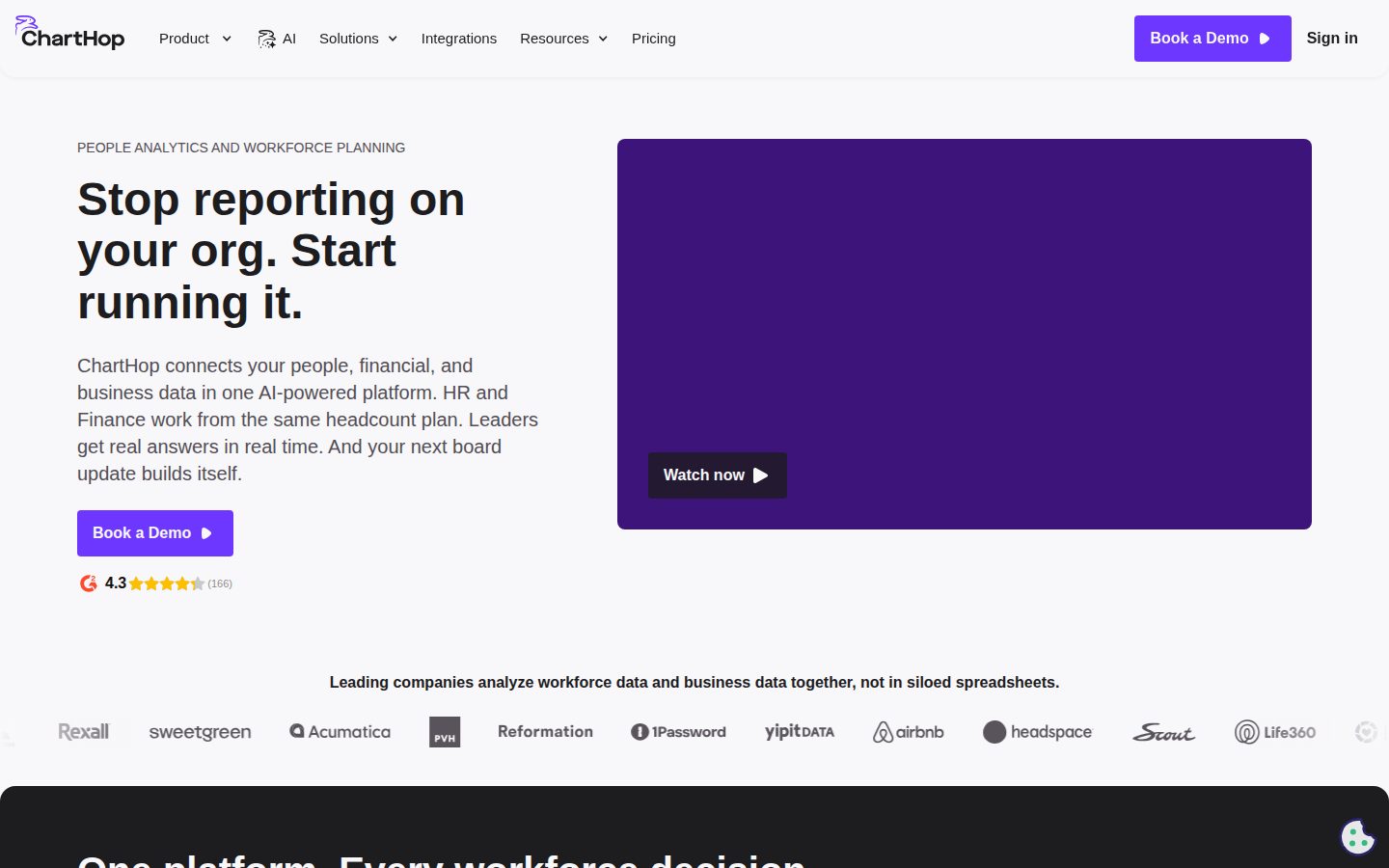
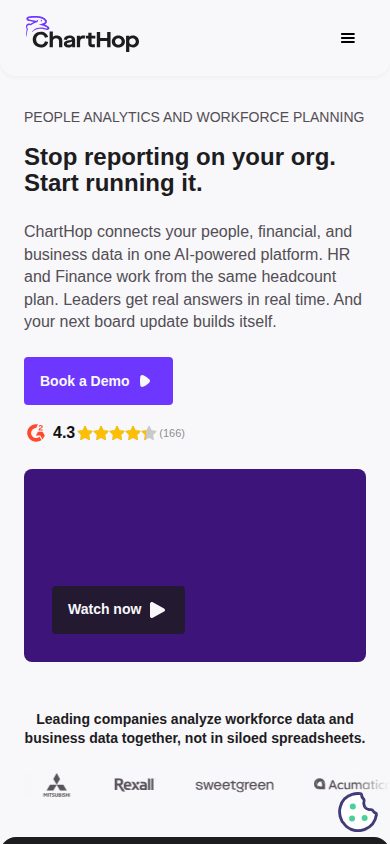
ChartHop is an AI-powered people operations platform for people analytics, headcount planning, and org management.
AI Panel Score
6 AI reviews
Reviewed
AI Editor ApprovedApproved and published by our AI Editor-in-Chief after full panel analysis.ChartHop works as a single data layer that pulls together workforce records, financial data, and business metrics so that people and finance teams see the same numbers at the same time. Users interact with dynamic org charts, dashboards, and headcount planning scenarios, and can ask questions in plain language through Ask ChartHop or trigger actions through AI Pro agents instead of building manual reports. Organizational history is preserved over time, which lets analysts and leaders track trends rather than working from a single point-in-time snapshot.
The platform is organized into modules that customers can adopt incrementally: Core Analytics + AI (org chart, dashboards, and Ask ChartHop) is the starting point for every customer, with add-ons for headcount planning, performance reviews and calibration, compensation, and a full HRIS system of record. Access Guard provides role-based permissions so different teams see only the data relevant to them. ChartHop can run as a standalone HRIS or sit on top of an existing HRIS such as Workday, ADP, or SAP as an added planning and analytics layer, and it integrates with ATS and payroll systems as well.
ChartHop is aimed at people analytics and HR leaders, along with finance leaders and executives, at mid-market and enterprise companies with more complex organizational structures. It competes with other HR platforms such as BambooHR and HiBob, though ChartHop positions itself specifically around analytics depth and headcount planning rather than as a general HR system of record. Pricing is based on a Core Analytics + AI package plus modular add-ons, and detailed pricing requires contacting the company.
ChartHop is delivered as a web application and holds SOC 2 Type 2 certification. Customers referenced on the site, including Plaid, Airbnb, Wistia, and Starburst, use it for headcount decisions and workforce planning as part of connecting people data to broader business and financial data.

Multi-agent AI with custom agents that take agentic actions directly on org data, going beyond answering questions to executing tasks.
Conversational AI available across all modules that reasons across the full org to answer questions and surface insights in plain language.
Foundational module providing org chart, people analytics, and dashboards combined with Ask ChartHop for self-serve reporting.
Enables leaders and analysts to get answers about org structure, cost, and headcount in minutes without waiting on IT or a data team.
An intelligent system of record that feeds people data into every other ChartHop module.
AI-powered headcount planning that connects live workforce, business, and financial data to model hiring and reorg scenarios and support confident hiring decisions.
Visual organization charts that preserve organizational history so structure and headcount trends stay analyzable over time.
Performance reviews, feedback, and calibration tools connected to goals, compensation, and org context so reviews drive real decisions.
Unifies workforce, business, and financial data on one data layer so People and Finance teams work from the same source of truth.
Connections across HRIS, ATS, payroll, and other business systems (including Workday, ADP, SAP) so ChartHop can serve as a standalone platform or an intelligence layer on top of an existing HRIS.
Role-based access control that governs who can see and act on specific people, financial, and business data within the platform.
Security posture and certification (SOC 2 Type 2) that supports enterprise trust and compliance requirements.
Standalone product or foundation for any add-on module; for orgs wanting to understand, visualize, and act on people data. Volume pricing available.
Add-on module to bring all people data into one place with analytics and AI insights.
Add-on module to plan, approve, and track headcount with real-time budget impact.
Add-on module to configure merit, promotion, and equity cycles and track budget impact.
Add-on module to connect reviews, goals, and development conversations.
Add-on module to understand sentiment and connect engagement data to people analytics.
Add-on module to set company, team, and individual goals tracked against live people data.
Pay as you go module empowering Ask ChartHop to automate workflows and act on people data.
For teams managing thousands of employees across multiple entities, geographies, or business units; includes dedicated support and flexible pricing. Contact us for pricing.
Real data model, real customers, but you're paying per module before you know your total bill.
“ChartHop unifies people and finance data with modular pricing starting at $5/employee/month. Plaid and Airbnb are proof points, but the a la carte structure means costs stack fast.”
Core Analytics runs $5/employee/month. Add HRIS, Headcount Planning, Compensation, Performance — each $4 more. That adds up quick for a mid-market buyer, and 'contact us' pricing for Enterprise tells me the real number lives in a sales call, not the pricing page.
Two things work in their favor. Plaid, Airbnb, Wistia, and Starburst are named customers, not logos pulled off a partner page. SOC 2 Type 2 is real, and the ADP two-way sync plus 100+ integrations means this slots on top of Workday or SAP without a rip-and-replace fight.
Competes with BambooHR and HiBob but plays a different game — analytics and planning depth, not system-of-record simplicity. AI Pro agents taking action on org data is the interesting bet. Whether it's reliable enough to trust with headcount decisions, I can't tell yet.
Differentiates from BambooHR and HiBob on analytics depth, a real gap in the HR platform category.
Named enterprise customers and SOC 2 Type 2 make this a safe, defensible pick to bring to a board.
Core Analytics is self-serve reporting from day one, but full value needs HRIS or Headcount Planning add-ons layered in.
Single data layer across people and finance advances planning maturity beyond spreadsheets, not just cost-cutting.
Established enough to land Airbnb and Plaid as customers, though no public funding or headcount data given.
Mid-market or enterprise people and finance teams tired of stitching spreadsheets together for headcount planning.
You need one flat price and can't stomach a module-by-module procurement conversation.
A modular data layer over your HRIS stack, not a replacement for it — that's the right architecture bet.
“ChartHop's single connected data model and optional deployment on top of Workday, ADP, or SAP is a sound integration posture. The module pricing at $4-5/employee/month rewards incremental adoption but the agentic AI Pro layer is where the 3-year risk concentrates.”
ChartHop's core architectural decision — sit on top of Workday, ADP, or SAP as an intelligence layer, or run standalone HRIS — is the right call. It means you're not forced into a rip-and-replace to get analytics depth, which is where competitors like BambooHR and HiBob feel more monolithic. Access Guard's role-based permissions on top of a unified people/finance/business data model is table-stakes done correctly, not an afterthought.
The real question is AI Pro Agents. Letting an agent take actions across comp, headcount, and HRIS modules is a powerful capability, but agentic write-access to compensation and org data is a governance surface, not just a feature. SOC 2 Type 2 covers the data at rest; it says nothing about the blast radius of an agent executing the wrong headcount change at scale.
Modular pricing ($4/employee/month per add-on, Core at $5) means you can pilot Core Analytics without committing to their HRIS. That's low lock-in for evaluation, high lock-in once org history and workflows live inside their data model for three years.
Positions against BambooHR and HiBob on analytics depth rather than system-of-record breadth, a defensible but narrower lane.
Modular adoption (Core, HRIS, Headcount, Comp, Performance as separate add-ons) matches how mid-market people/finance teams actually roll out tooling.
Two-way sync with ADP Workforce Now plus 100+ HRIS/ATS/FP&A integrations lets it layer over Workday or SAP without displacing them.
Agentic write-access via AI Pro Agents raises governance questions SOC 2 Type 2 alone doesn't resolve.
Single connected data model plus historical org tracking is deeper than typical org-chart tools, per the module breakdown.
Mid-market or enterprise people and finance teams that want an analytics and planning layer without abandoning their existing HRIS.
Avoid if your team needs a single system of record with minimal vendor surface rather than an additional connected data layer.
Modular pricing looks cheap per module. Stack five modules and it isn't.
“Core at $5/employee/month is a real number, rare in this category. Everything past Core is a la carte, and the total adds up fast.”
$5/employee/month for Core. HRIS, Headcount Planning, Compensation, Performance — each $4 more. Engagement and Goals at $3 each. Stack all seven and you're near $27/employee/month before AI Pro usage fees, which are pay-as-you-go with no published rate.
50 employees × $27 × 12 = $16.2K/year, Core-plus-everything. Add AI Pro overage, unknown. Add Enterprise tier for multi-entity orgs — pricing hidden behind a sales call. Year 3 total depends entirely on how many modules you adopt, and that's the real risk here, not the sticker.
Compare to BambooHR and HiBob, both bundled products with fewer moving line items. ChartHop's à la carte model is honest about per-module cost but makes total TCO a moving target. SOC 2 Type 2 helps procurement. Volume pricing exists but isn't published — back to the sales call.
Volume pricing and Enterprise tier both require sales contact, adding procurement friction.
No published term length or auto-renewal terms; annual billing implied but not detailed.
Per-module prices are published, but Enterprise and AI Pro usage rates are not.
Headcount Planning's real-time budget impact tracking gives a measurable link to hiring cost.
Seven add-on modules at $3-5 each mean full-stack cost can triple the Core sticker.
Mid-market people and finance teams who need headcount planning tied to live financial data.
You want one flat number for budgeting without stacking five separate module invoices.
Modular pricing is honest about what people analytics actually costs, module by module.
“ChartHop's Core-plus-add-on structure at $5/employee/month means you can start with analytics and org charts before touching HRIS or comp. That's the right sequencing for a mid-market people team, but it also means the full platform bill stacks up fast once you're on five modules.”
Org chart with preserved history is the thing that sells this in a demo, and it's a real daily-use feature — being able to trend headcount instead of screenshotting a point-in-time chart matters when finance asks 'what changed since Q2.' Ask ChartHop across modules is the differentiator versus BambooHR, which doesn't pretend to do cross-functional querying.
Day-3 reality depends heavily on which modules you've bought. Core at $5/employee/month is genuinely standalone, per their own FAQ, but Headcount Planning, Compensation, and Performance are each separate $4 add-ons — so a full rollout means juggling five billing lines and five sets of permissions via Access Guard. That's not a dealbreaker, it's a procurement conversation you'll have every renewal.
AI Pro agents taking action rather than just answering questions is the real power-user layer, but it's pay-as-you-go and under-documented in what's public — no changelog, no visible API docs. For analysts who live in the weeds of comp cycles, that's a gap worth probing before signing.
Org chart history and self-serve reporting solve real recurring headcount questions, per the feature list.
Docs and blog exist per capability scan, but no changelog or API docs listed, thin for a data-layer product.
Five separately priced add-ons ($3-5/month each) mean fragmented billing and permission setup across modules via Access Guard.
AI Pro agents executing actions across modules go beyond Ask ChartHop's Q&A, a real ceiling for advanced users.
Two-way ADP Workforce Now sync plus Workday/SAP layering lets it sit on existing HRIS rather than forcing migration.
Mid-market people analytics or finance teams who want one data layer over an existing HRIS like Workday or ADP.
Avoid if you need a single system of record with predictable flat pricing rather than a modular per-employee stack.
Solid org-chart brain for finance and HR, but you won't know the daily feel until you're in it
“ChartHop stacks a lot of real capability into a modular price sheet, starting at $5 a head for Core. The public evidence answers what it does well; it's quiet on what using it actually feels like week to week.”
ChartHop's pitch makes sense on paper: one data layer for people and finance, org charts that remember history instead of freezing a moment in time, and Ask ChartHop for questions you'd normally wait on an analyst for. Compared to BambooHR, it's clearly aimed higher up the complexity ladder — mid-market and enterprise orgs with real headcount planning needs, not a 40-person shop that just wants PTO tracking.
What I can't tell from the site is the day-to-day texture. No mobile info listed at all, which for an org chart tool people might want to glance at from their phone during a reorg meeting is a real gap, not a nitpick. No free trial either, so you're committing to a demo and a sales call before you get a feel for whether Ask ChartHop actually understands your org or just paraphrases your dashboard back at you.
SOC 2 Type 2 and ADP two-way sync are the kind of specifics that build trust on paper. The module pricing (HRIS at $4, Headcount Planning at $4, Engagement at $3) is refreshingly transparent for enterprise HR software. Whether it feels like a partner three months in is still an open question from the outside.
Feature list is dense and specific, but no evidence of empty-state or micro-copy craft either way.
Modular adoption (Core plus add-ons like Headcount Planning, Compensation) lets teams grow into it rather than face it all at once.
Platforms listed as unknown and no mobile mention anywhere I could find, for a tool people may want on the go.
No free trial and sales-contact-only pricing means first ten minutes is a demo call, not hands-on discovery.
SOC 2 Type 2 certification and org history retention suggest a system built to be trusted with real data over time.
Mid-market or enterprise people and finance teams who need headcount planning tied to real financial data.
You're a small team wanting a simple HR system of record like BambooHR without a sales call first.
Modular pricing that adds up fast, on a category that's eaten its own before.
“ChartHop bundles seven add-on modules at $3-5/employee/month each — do the math before you sign. The tech looks real, the moat looks thin.”
"The HR Platform Built for AI" is the kind of superlative that ages poorly if the agents underdeliver. Ask ChartHop and AI Pro sound like real features, not vaporware — but so did a dozen 'AI copilot' pitches from HR tech that quietly pivoted or sold for parts.
Seven modules, each priced separately. Core at $5, HRIS at $4, Headcount Planning at $4, Compensation at $4 — stack four and you're past $17/employee/month before Enterprise pricing kicks in. That's not disclosed upfront; you contact sales.
Exit story is fine if you run it as a layer over Workday or ADP — you keep your system of record. Worse if you adopt ChartHop HRIS itself as the record. SOC 2 Type 2 is real signal. BambooHR and HiBob are named rivals, but ChartHop's analytics-first angle is genuinely distinct, not copycat.
Analytics-and-planning-first positioning vs. BambooHR/HiBob's system-of-record focus is a real, named gap.
Clean if used as a Workday/ADP overlay; messier if ChartHop HRIS becomes the system of record.
Named customers (Plaid, Airbnb, Wistia, Starburst) and SOC 2 Type 2 are solid signals; no funding or headcount data disclosed.
"Built for AI" is aspirational framing; features listed are concrete enough to check against, which helps.
Modular add-on pricing mirrors platforms that bloat and lose customers to consolidation later — pattern worth watching.
Mid-market or enterprise people/finance teams already juggling Workday or ADP who want an analytics layer on top.
Avoid if you want one flat price or plan to replace your HRIS outright with a single vendor.
Common questions answered by our AI research team
ChartHop Core costs $5 per employee per month, billed annually. It includes people analytics, AI insights (including Ask ChartHop), org chart, employee profiles, map view, and company calendar. Volume pricing is available for larger teams.
Yes. ChartHop Core is a complete standalone product offering people analytics, org visualization, and AI insights across your workforce. You can add workflow modules like HRIS, Headcount Planning, or Compensation at any time as your needs grow.
Yes. ChartHop has a deep, two-way sync with ADP Workforce Now and also integrates with Greenhouse, Ashby, Workday, and over 100 other HRIS, ATS, and FP&A tools as an intelligence layer on top of your existing systems.
ChartHop AI Pro empowers Ask ChartHop to automate workflows and take action on your people data, going beyond answering questions in plain language to actually executing tasks across modules like org charts, HRIS, performance, compensation, and headcount planning. It's priced pay-as-you-go.
Yes. ChartHop, Inc. has successfully completed a SOC 2 Type 2 examination by Schellman & Company.