GPU cloud infrastructure purpose-built for AI training and inference at scale
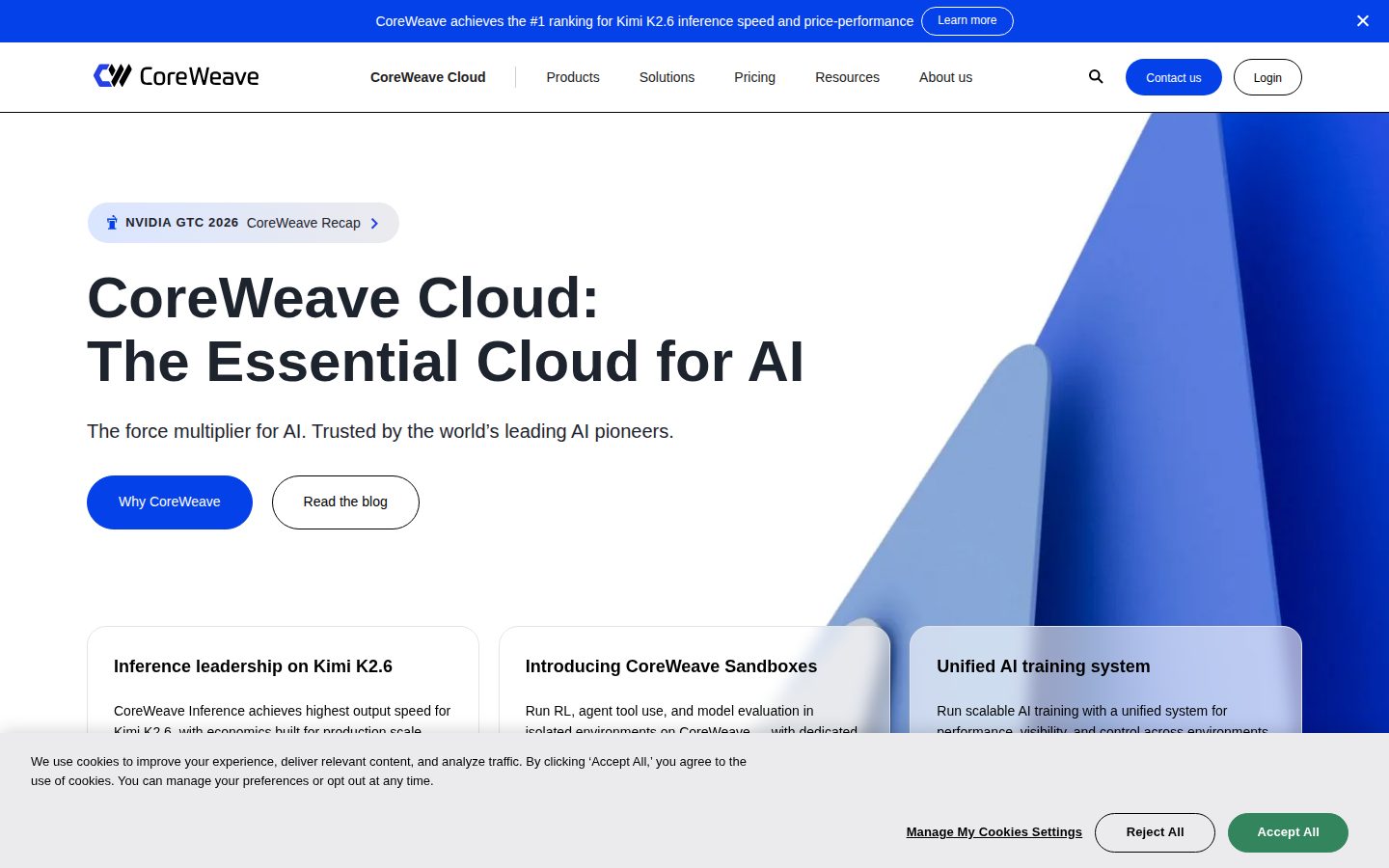
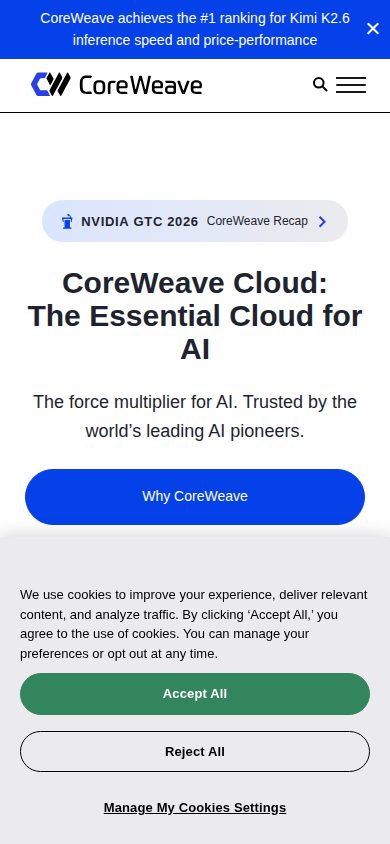
CoreWeave is a specialized AI cloud computing platform for organizations running large-scale GPU workloads.
AI Panel Score
6 AI reviews
Reviewed
Users access CoreWeave through a Kubernetes-native interface that provisions bare-metal GPU infrastructure for AI workloads including model training, inference, reinforcement learning, and agent evaluation. The platform handles automated provisioning, node lifecycle management, and workload orchestration, allowing teams to run jobs in hours rather than weeks. CoreWeave Sandboxes, launched in 2026, provides isolated environments for RL, agent tool use, and model evaluation via dedicated Kubernetes or fully managed serverless runtimes.
Distinguishing capabilities highlighted on the platform include the SUNK (Self-service and Anywhere) feature for deploying AI workloads across cloud environments, integrated cluster health management with deep observability, and a managed software services layer that offloads infrastructure management. CoreWeave has benchmarked as the fastest inference provider for models including Moonshot AI's Kimi K2.6, citing full-stack optimization across memory architecture, runtime, and interconnect. The platform also provides early access to NVIDIA GPUs.
CoreWeave targets AI labs, enterprises, and platform companies running production-scale GPU workloads — customers cited include OpenAI, Mistral AI, IBM, Jane Street, and NovelAI. It competes with hyperscale GPU cloud offerings from AWS, Google Cloud, and Microsoft Azure, as well as specialized GPU cloud providers like Lambda Labs and Voltage Park. Pricing is usage-based and is not publicly listed; prospective customers are directed to contact sales for enterprise agreements.
The platform is accessed via web and integrates with standard Kubernetes tooling and leading workload orchestration frameworks. Infrastructure is bare-metal, and the platform exposes APIs consistent with Kubernetes-native workflows, making it compatible with existing MLOps and orchestration stacks.
Delivers high-speed model inference with 10x faster spin-up times compared to general cloud providers, optimized across memory architecture, runtime, and interconnect.
Runs reinforcement learning, agent tool use, and model evaluation in secure, isolated environments using dedicated CKS or fully managed serverless runtime.
Provides a unified system for running scalable AI training with integrated performance visibility and control across environments.
Provides an integrated suite of services for cluster health management and performance monitoring, including rigorous node lifecycle management and deep observability.
Offers a robust platform layer covering observability, security, and ML tools to support diverse AI development challenges.
Automates provisioning and node lifecycle management so AI workloads can be brought online in hours rather than weeks with minimal manual intervention.
Enables self-service setup and management of AI workloads across cloud environments, including SUNK Self-Service and SUNK Anywhere for flexible deployment.
Provides GPU compute resources through a Kubernetes-native environment with bare-metal infrastructure and automated provisioning for AI training and inference workloads.
Delivers high-performance networking infrastructure optimized for cluster scale-out and interconnect connectivity across large AI workloads.
Lifts the management burden from teams by providing a suite of managed software services for running AI infrastructure.
Offers flexible, purpose-built storage solutions specifically tailored for AI workloads to support training and inference data needs.
Provides around-the-clock support from dedicated engineering teams to resolve cluster issues in near real-time and keep AI workloads running continuously.
Usage-based GPU cloud compute for AI labs, platforms, and enterprises. No fixed tiers — pricing based on actual resource consumption.
OpenAI runs on it. That's the endorsement no analyst can manufacture.
“CoreWeave is the purpose-built GPU cloud that hyperscalers can't match on inference speed or cluster reliability. If you're running serious AI workloads, it's the honest default.”
96% cluster goodput and 10x faster inference spin-up than AWS or GCP isn't a feature bullet — it's a productivity argument your eng team will feel immediately. OpenAI, Mistral, and Jane Street are named customers. That's not a logos slide, that's validation from buyers who could afford any alternative. Series C or later, recently IPO'd — they'll exist in 3 years.
The tradeoff is real. No public pricing means every conversation starts with a sales call, and enterprise agreements can lock you in before you understand the renewal math. Lambda Labs and Voltage Park offer simpler entry points if you're not running production-scale workloads yet.
CoreWeave Sandboxes launching in 2026 for RL and agent evaluation signals a roadmap that's chasing where AI work is actually heading. Pilot with a single training cluster. If your team ships faster in 90 days, standardize.
Benchmarked fastest inference for Kimi K2.6 ahead of hyperscalers; peers running production AI are already here or evaluating it.
A board will recognize the customer list; adopting CoreWeave reads as serious, not experimental.
Automated lifecycle management gets clusters live in hours, not weeks — the productivity payback is near-term and measurable.
If AI training or inference is core to your product, this advances you — it isn't just cost reduction, it's throughput at scale.
OpenAI as a named anchor customer and a recent IPO filing puts them in a stable category — they're not disappearing.
AI labs or platform companies running production-scale GPU training and inference who need reliability guarantees a hyperscaler won't commit to.
You're running occasional GPU jobs and don't want to negotiate an enterprise contract before knowing your actual usage.
Bare-metal Kubernetes GPU infrastructure that hyperscalers can't match on AI-specific throughput.
“CoreWeave is purpose-built from the interconnect up for AI training and inference at scale. The 96% cluster goodput and 10x faster inference spin-up aren't marketing numbers — they're architectural outcomes of stripping out the general-purpose abstraction layers AWS and GCP can't remove.”
Kubernetes-native on bare-metal with automated node lifecycle management. That's the right foundation for serious AI infrastructure. The Sandboxes feature — launched 2026 for RL, agent tool use, and model evaluation — signals they're tracking the frontier workload roadmap, not just selling H100 hours. Customers like OpenAI and Jane Street don't run production workloads on infrastructure they don't trust.
The SUNK Anywhere capability is strategically important: it lets teams deploy across environments without rebuilding orchestration. That keeps CoreWeave from becoming a pure lock-in play, which matters when you're signing enterprise agreements with no public pricing. The tradeoff is real — no free trial, no pricing page, contact-sales only. Smaller AI teams will hit a procurement wall that Lambda Labs won't put in front of them.
If we adopt this and build MLOps pipelines against their Kubernetes APIs, in 3 years we have infrastructure that moves with NVIDIA's roadmap — CoreWeave's early GPU access is a structural advantage. The ceiling here is genuinely high. The risk isn't the stack; it's the contract dependency when you're at scale with no published exit ramp.
Benchmarked fastest inference provider for Kimi K2 and counted OpenAI as a customer — CoreWeave is the default specialist alternative to hyperscale GPU clouds, well ahead of Lambda Labs.
Kubernetes-native bare-metal with 24/7 dedicated engineering support matches exactly how ML platform teams structure serious training and inference operations.
Kubernetes-native APIs and compatibility with standard MLOps and orchestration frameworks mean minimal re-plumbing against existing stacks.
Early NVIDIA GPU access and API-compatible Kubernetes surface are durable advantages, but no public pricing and contact-sales contracting create opaque renewal leverage at scale.
Full-stack optimization across memory architecture, runtime, and interconnect — plus 2026 Sandboxes for RL and agent eval — shows genuine infrastructure depth, not resold capacity.
AI labs and enterprise ML platform teams running production-scale GPU training and inference who need infrastructure that keeps pace with frontier model development.
Your team needs transparent pricing and self-serve onboarding before committing infrastructure budget.
96% goodput claim is credible; zero public pricing is the real risk.
“CoreWeave is a serious GPU cloud with named customers like OpenAI and Mistral AI. No public rates means every TCO model starts with a phone call.”
Usage-based with no published rates. That's the first number that matters — or rather, the absence of one. Lambda Labs publishes per-hour GPU pricing. CoreWeave doesn't. Procurement teams will spend cycles just getting to a quote. Budget owners can't self-model year 1, let alone year 3.
The performance claims are specific enough to take seriously: 96% cluster goodput, 10x faster inference spin-up, 50% fewer daily interruptions. CoreWeave Sandboxes adds RL and agent eval environments — launched 2026, so contract terms around that feature set are immature. Overage rates, egress costs, storage tiers: none publicly listed. That's the invoice you can't predict.
For a 50-person AI lab burning serious GPU hours, the operational savings from 24/7 engineering support and automated lifecycle management could offset a pricing premium vs. AWS. But you won't know the premium until you negotiate. No termination-for-convenience language is public. Caveat emptor.
Usage-based model is conceptually clean, but zero self-serve pricing forces procurement into a full sales cycle before any budget approval.
No public auto-renewal windows, cancellation terms, or termination-for-convenience clauses; enterprise agreements are bespoke and opaque.
No public per-hour or per-GPU rates; pricing page exists but directs to sales — Lambda Labs and Voltage Park both publish rates.
10x faster inference spin-up and named customers like OpenAI provide credible anchors, but the dollar value of those gains can't be modeled without actual rate cards.
96% goodput and automated lifecycle management reduce ops overhead, but no public storage or egress pricing makes 3-year TCO modeling impossible without a sales engagement.
AI labs and platform companies running production-scale GPU workloads who can negotiate enterprise agreements and absorb procurement friction.
Your finance team needs self-serve pricing to model budget before engaging a vendor.
Kubernetes-native bare-metal GPU cloud that actually ships production clusters fast
“CoreWeave is purpose-built GPU infrastructure for teams running real AI workloads at scale. 96% cluster goodput and 10x inference spin-up claims are specific enough to hold them to.”
The Kubernetes-native interface is the right call. Your existing kubectl workflows, Helm charts, and MLOps tooling port over without rewriting your stack. That's not a given — Lambda Labs still leans on SSH-and-pray for cluster management. Automated lifecycle management means you're not babysitting node failures at 2am, which is the actual daily fight on AWS when a GPU instance goes sideways mid-training run.
CoreWeave Sandboxes for RL and agent evaluation is genuinely interesting. Isolated environments with dedicated CKS or serverless runtime — that's the kind of feature that shows up when the product team runs workloads themselves. SUNK Anywhere for multi-cloud deployment is either a lifesaver or unnecessary complexity depending on your architecture. No public pricing is the honest friction: you're negotiating enterprise agreements blind, and that slows procurement.
Docs exist, changelog doesn't appear public. For an infra product at this level, a public changelog matters — you need to know what changed before your next training run breaks. 24/7 engineering support is a real differentiator versus hyperscalers where L1 support can't read a CUDA error.
Kubernetes-native interface means existing tooling works; 96% goodput claim suggests fewer mid-run cluster failures than AWS, but no public changelog makes version drift a blind spot.
Docs exist per evidence, but no public changelog signals the docs may lag the actual product — a real problem when you're debugging a broken training job after a platform update.
No public pricing creates procurement friction; no free trial means you're committing before you've stress-tested the cluster under real workloads.
SUNK Anywhere, CoreWeave Sandboxes, and deep observability tools suggest genuine depth for teams running multi-environment GPU workloads at production scale.
Bare-metal Kubernetes with standard orchestration compatibility means MLOps stacks port cleanly without rebuilding pipelines.
AI labs and platform engineering teams running production-scale GPU training or inference who need Kubernetes-native infra without managing bare-metal themselves.
Your team needs self-serve pricing transparency or a trial environment before committing to an enterprise agreement.
If you're running serious GPU workloads, CoreWeave is hard to argue with.
“Purpose-built AI cloud that actually delivers on the infrastructure promises general clouds keep fumbling. Not for small teams, not for experimenting — for organizations where GPU uptime is the job.”
That 96% cluster goodput claim isn't marketing fluff for this category — on AWS or Google Cloud, fighting for GPU availability and watching jobs fail mid-run is a genuine tax on engineering time. CoreWeave's whole pitch is that bare-metal, Kubernetes-native infrastructure plus automated node lifecycle management means workloads that used to take weeks to spin up are live in hours. Customers like OpenAI and Mistral AI aren't logos slapped on a landing page. They're stress tests.
The 10x inference spin-up figure versus general cloud providers is the number that would get my attention day-to-day. CoreWeave Sandboxes — launched in 2026 for RL and agent evaluation — shows they're tracking where the workloads are actually going, not where they were two years ago. That's a good sign.
The tradeoff is real though: no public pricing, no free trial, contact-sales-only. Lambda Labs at least shows you a number. CoreWeave is enterprise infrastructure with enterprise buying friction. If you're a team still figuring out your GPU strategy, this isn't your first call.
Kubernetes-native interface with deep observability and cluster health dashboards suggests care, but no changelog is visible and mobile evidence is thin.
Kubernetes-native access means teams with existing MLOps workflows plug in fast, but teams without that foundation face a steep ramp with no self-serve trial to practice on.
Platform is listed as web-only with no mobile app evidence — reasonable for GPU cluster management, but you're definitely not checking job status from your phone.
No free trial, no public pricing, and a sales-contact model means onboarding starts with a call, not a sandbox — high friction before you touch anything.
96% cluster goodput, 50% fewer interruptions per day, and 24/7 dedicated engineering support are specific, verifiable claims that signal serious infrastructure discipline.
AI labs and enterprises running production-scale GPU workloads who need reliability that general clouds can't match.
Your team is early-stage, still evaluating GPU needs, or can't start without seeing pricing upfront.
Real customers, real benchmarks — but 'Essential Cloud for AI' is the kind of superlative that ages poorly
“CoreWeave has the receipts most GPU cloud vendors lack: OpenAI, Mistral, Jane Street as named customers, 96% cluster goodput, 10x inference spin-up claim. The marketing is louder than it needs to be, but the underlying product appears legit.”
Three tells I clock immediately. One: '#1 AI Cloud' in the meta description. Two: no public pricing. Three: no changelog. That combination usually signals a company selling story over substance. But then the customer list lands — OpenAI, IBM, Jane Street — and I hedge. These aren't vanity logos. That's evidence.
The 10x inference spin-up and 96% cluster goodput numbers are specific enough to be falsifiable, which I respect. CoreWeave Sandboxes for RL and agent eval, launched in 2026, suggests active shipping cadence. Lambda Labs competes here and wins on accessibility; AWS wins on breadth. CoreWeave's moat is bare-metal NVIDIA access plus deep orchestration — narrower, but real.
The exit story is the concern. Kubernetes-native helps portability, but no public pricing and no self-serve trial means you're locked into a sales relationship from day one. If you outgrow them or pricing shifts, migration friction is real.
Early NVIDIA GPU access, bare-metal Kubernetes, and CoreWeave Sandboxes for agent/RL eval carve a real gap vs. Lambda Labs on depth and vs. AWS on AI-specific optimization.
Kubernetes-native architecture and standard API compatibility reduce lock-in, but no self-serve trial and opaque pricing means you're deep in a vendor relationship before you can test exit friction.
Named enterprise customers, 24/7 dedicated engineering support, and a 2026 product launch (Sandboxes) suggest an active, funded team — no public funding data visible but customer roster implies institutional backing.
'The Essential Cloud for AI' and '#1 AI Cloud' are superlatives with no citation — but specific claims like 10x spin-up and 96% goodput are anchored and testable.
OpenAI, Mistral AI, and Jane Street as named customers, plus Kimi K2.6 inference benchmark, match the pattern of legitimate infrastructure vendors with real production traction.
AI labs and enterprises running production-scale GPU workloads who need NVIDIA hardware access faster than hyperscalers can provision it.
You need transparent pricing, self-serve access, or a low-commitment trial before locking into an enterprise agreement.
Common questions answered by our AI research team
CoreWeave delivers 10x faster inference spin-up times compared to general cloud providers.
CoreWeave achieves 96% cluster goodput, designed for maximum reliability and optimal TCO.
Yes, CoreWeave offers Managed Software Services to lift the management burden, plus Cluster Health Management for performance monitoring.
AI workloads can run in hours instead of weeks, with clusters ready for production workloads on Day 1.


CoreWeave is a Roseland, NJ-based cloud provider specializing in GPU-accelerated infrastructure for AI training, inference, and high-performance computing workloads.