People analytics software for HR teams
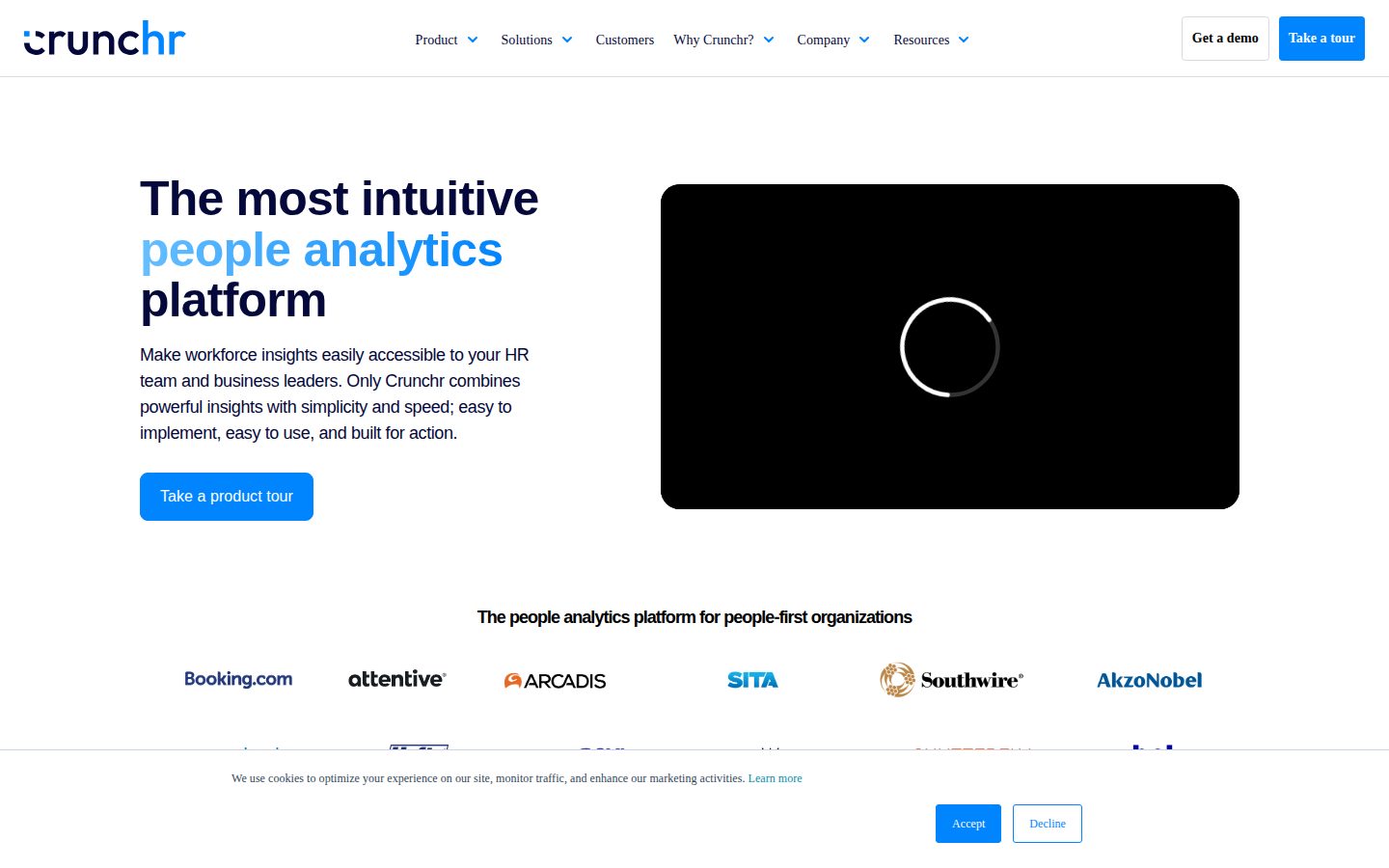
Crunchr is a people analytics platform for HR teams to report on and analyze workforce data.
AI Panel Score
6 AI reviews
Reviewed
AI Editor ApprovedApproved and published by our AI Editor-in-Chief after full panel analysis.Crunchr is used by HR teams to turn raw workforce data into reports, dashboards, and metrics. Users connect their HR systems as data sources, and Crunchr organizes that data into pre-built and customizable reports covering areas such as headcount, turnover, span of control, and diversity metrics. The typical workflow involves pulling data into the platform, exploring it through dashboards, and using those insights to support HR decisions such as succession planning or workforce restructuring.
The platform includes the Crunchr Assistant, an AI-powered feature described as a co-pilot for HR and people leaders, intended to let users ask questions of their workforce data rather than manually building every report. Crunchr also offers a dedicated workforce planning product for translating business strategy into workforce strategy, along with tools for span of control assessment at scale. The company has formed partnerships, including one with TechWolf to support skill-based people decisions and one with AspireHR aimed at deploying AI-powered people analytics within a few weeks of implementation.
Crunchr is built for HR departments and people analytics teams within mid-size to large organizations that need to consolidate and report on workforce data. It competes in the people analytics and HR reporting category alongside products such as Visier, One Model, and ChartHop. Pricing is not publicly listed on the website; prospective customers need to contact Crunchr directly for pricing details.

Users can ask workforce questions in natural language and get immediate, clear answers from a personal AI assistant built into the platform.
Crunchr uses HR data to forecast headcount and costs, predict workforce demand, and perform skills gap analysis to help organizations plan ahead.
Crunchr allows organizations to benchmark their people metrics against industry standards to identify competitive strengths and gaps.
The platform includes driver analysis to uncover the underlying reasons behind key workforce metrics, helping teams create informed, impactful strategies.
Crunchr's Strategic Workforce Planning tool forecasts headcount, costs, and related metrics such as diversity and tenure, and predicts the financial impact of major workforce decisions.
Crunchr's Strategic Workforce Planning tool allows HR, Finance, and other departments to share projects with each other, supporting collaborative planning.
Crunchr offers hundreds of out-of-the-box metrics and analytics spanning HR domains such as recruitment, retention, diversity and inclusion, performance, rewards, and internal mobility.
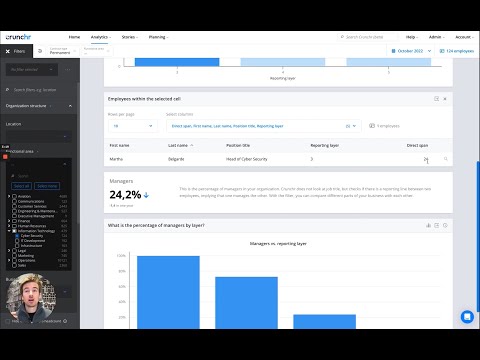
HRBPs, managers, and leaders can independently explore workforce data and conduct multidimensional ad-hoc analyses, forecasts, and correlations in seconds.
Crunchr Stories lets users build fully customized dashboards within minutes using drag-and-drop widgets to adjust, resize, and rearrange hundreds of pre-built metrics and visualizations.
Crunchr automatically pulls, cleans, and consolidates data from various HR and business systems into a single source of truth, including automatic connections to systems like Workday.
Crunchr facilitates extraction of consolidated and cleaned workforce data via the Crunchr API, enabling integration of HR insights with other business data and BI tools.
Crunchr's authorization features ensure that dashboards and data are securely shared so the right people see only what they're authorized to view.
Crunchr is an enterprise people analytics platform priced via custom quotes based on company size (employee headcount), number of modules/dashboards selected, and data integrations required. No public list pricing is available on crunchr.com; prospective buyers must contact the vendor's sales team for a tailored quote.
Solid HR analytics platform, but no pricing page and no named customers to defend it.
“Crunchr does the workforce reporting job well, with a Workday integration and a real AI assistant layer. What's missing is anything to help a CFO believe the vendor bet.”
Hundreds of pre-built metrics, a Workday connector, span of control and CSRD reporting. That's a real product, not a slideware pitch. The Crunchr Assistant lets HRBPs query data without building reports manually, which is the actual pain point in this category.
Here's what's thin: no pricing page, no funding data, no team size. "Contact us" pricing is category norm for Visier and ChartHop too, but I can't tell if Crunchr is 50 people or 500. TechWolf and AspireHR partnerships suggest momentum, not scale.
This isn't a hard sell to the board — HR analytics is expected now, and Visier's the incumbent everyone already knows. Crunchr's pitch is faster time-to-value, but I've got no proof point, no case study, nothing to point to in 18 months.
Competes directly with Visier and One Model but lacks visible market share signals.
Neutral choice next to Visier and ChartHop, but lack of named customers makes it hard to defend.
AspireHR partnership claims deployment within a few weeks; pre-built metrics library shortens setup.
Consolidates HR data and adds AI querying — advances reporting speed, not just cost savings.
No public funding data, team size, or time-in-market info on the site.
Mid-size to large HR teams that need Workday-native reporting and can tolerate a sales-led pricing process.
Skip it if you need board-ready proof of vendor scale before signing a multi-year HR data contract.
Solid HRIS-consolidation layer with a real AI assistant, but the API and no-docs stance worry me long-term.
“Crunchr is a competent workforce analytics consolidation layer with a genuinely useful natural-language assistant. The integration story is thinner than the feature list suggests.”
Automated data consolidation from Workday and other HR systems, plus an API for extraction — that's the right architecture. You want a single source of truth sitting below the reporting layer, not reports scattered across five tools. If we adopt this, in three years we have a clean workforce data spine feeding BI tools downstream, assuming the API is actually mature.
No public docs page, no changelog, no pricing page. For a platform I'm plugging into Workday and expecting to extract data from via API, that's a real gap — I can't assess integration depth or API stability without a sales call. Compare that to Visier, which at least signals more analytics maturity publicly.
The Crunchr Assistant is the interesting bet: natural language queries instead of manual report-building. If it works as described, that's a genuine reduction in report-request tickets for HRIS teams. The tradeoff: hundreds of pre-built metrics is good breadth, but breadth without visible API docs means I'm trusting a vendor relationship, not evaluating an architecture.
Sits credibly alongside Visier, One Model, and ChartHop, with the TechWolf and AspireHR partnerships as a differentiator.
Span of control, CSRD reporting, and strategic workforce planning map directly to how mid-size/large HR teams actually operate.
API exists per feature list, but zero public docs or changelog that I could find makes engineering evaluation impossible pre-sales-call.
Workday integration and API extraction create a viable data spine, but contact-only pricing and no visible SLAs are a 3-year unknown.
Hundreds of pre-built metrics plus driver analysis and benchmarking show real analytical depth, not just dashboards.
Mid-size to large HR teams that already run Workday and want a consolidated reporting layer above it.
Avoid if your team needs to technically vet API and integration depth before signing, since none of that is public.
Zero published pricing. Zero free trial. Every dollar figure is a black box.
“No pricing page, no tiers, no free plan. You're negotiating blind against Visier and One Model, also blind.”
No pricing page. No tiers listed. Contact-sales only, which means every deal is custom and every buyer starts from zero leverage.
Mid-size to enterprise HR platforms in this category typically run $30K-$150K/year depending on headcount and modules. Add Workday integration setup, the Strategic Workforce Planning add-on, and CSRD reporting — each likely a separate line item. Year 3 TCO could easily run 40% above year 1 quote once modules stack. No public number to sanity-check that against.
Feature list is deep: hundreds of pre-built metrics, driver analysis, benchmarking, the Crunchr Assistant for natural language queries. Competes against Visier, One Model, ChartHop — all of whom also hide pricing. Category norm, not a Crunchr-specific flaw. But opacity plus no free trial means procurement eats the full evaluation cost before seeing a contract.
No free trial and no self-serve path means full sales-cycle friction before first invoice.
No terms published; category norm is annual contracts with limited negotiation room pre-quote.
No pricing page, no tiers, contact-sales only — nothing to verify against.
Concrete metrics like span of control and turnover are measurable, but no benchmark or case-study numbers provided.
Multiple add-ons (Workforce Planning, CSRD, TechWolf/AspireHR partnerships) suggest modular pricing with stacking risk.
Mid-size to large HR teams with budget authority and patience for a sales cycle.
You need a quote before your first meeting.
Solid metric library, but the day-3 test is whether the Assistant actually replaces report-building
“Crunchr's pre-built HR metrics library and Workday connector look practitioner-ready on paper. Whether the Assistant holds up outside curated demos is the open question — the site gives no docs to check.”
Hundreds of pre-built metrics, span of control, CSRD reporting, Workday integration out of the box. That's a real HR reporting stack, not a marketing slide. Crunchr Stories with drag-and-drop widgets is the kind of thing HRBPs actually use once they stop needing the analytics team to build every dashboard.
The open question is the Assistant. Natural-language querying over workforce data sounds great in a demo, then on day three someone asks it a nuanced headcount-by-cost-center question and you find out fast whether it's Visier-grade or a chatbot wrapper. No docs page, no changelog, no API reference published — that's a red flag for anyone who wants to self-serve integration work before buying.
No pricing page, no free trial. For mid-size HR teams comparing against ChartHop or One Model, that means a sales call before you can even bench the metrics library against your own data model. Fine for a category where six-figure contracts are normal, less fine if you just want to poke around first.
Pre-built metrics and Stories dashboards suggest fast time-to-value, but Assistant reliability is unverified in public evidence.
Capabilities scan shows no docs page and no API reference publicly available, only a blog.
No trial or pricing transparency adds sales-cycle friction before a practitioner ever touches the product.
Driver analysis, benchmarking, and API extraction indicate depth beyond dashboards, though discoverability is untested.
Automatic Workday connection and cross-department planning sharing fit existing HR/Finance workflows without much retraining.
Mid-size to large HR teams with a Workday-centric stack who want pre-built metrics over building from scratch.
Avoid if you need to self-serve pricing or technical docs before looping in procurement.
Deep HR reporting tool, but you'll never see what it costs until you call someone.
“Crunchr packs hundreds of pre-built metrics and a natural language assistant into one dashboard. Solid bones for HR teams, but there's no pricing page, no trial, and no way to poke at it yourself before buying.”
Crunchr's pitch is the classic people analytics play: connect Workday and other HR systems, get hundreds of pre-built metrics on turnover, span of control, diversity, all wrapped in drag-and-drop dashboards called Crunchr Stories. That's a real, mature feature set going up against Visier and ChartHop, and the workforce planning module with cross-department sharing between HR and Finance is a genuinely useful addition, not just a bolt-on chart.
The Crunchr Assistant is the interesting bit — ask questions in plain language instead of building a report from scratch. Sounds great in a demo. Whether it holds up on messy, three-years-of-legacy-systems data is the actual test, and there's nothing in the public evidence showing how it handles ambiguity or wrong answers.
No pricing page, no free trial, no docs listed. For a tool HR leaders are supposed to trust with sensitive workforce data, that's a lot of blind faith required before you even see a screen.
Crunchr Stories drag-and-drop dashboards suggest real design attention, but no public demo means it's unverified.
Hundreds of pre-built metrics plus an AI assistant meant to skip manual report-building should flatten the ramp for non-technical HRBPs.
Platform is listed as web-only, with nothing suggesting a mobile experience exists at all.
No free trial and no pricing page means the first ten minutes is a sales call, not a product.
Automated data consolidation from systems like Workday implies a mature pipeline, but no changelog or status page to confirm uptime track record.
Mid-size to large HR teams already on Workday who need deep reporting without building it themselves.
You want to try before you buy or need mobile access for people managers on the floor.
"Most intuitive" is a claim, not a citation. No pricing page confirms nothing else.
“Crunchr looks like a competent Visier alternative with a real Workday integration and a genuine metrics library. But no pricing, no docs, no changelog leaves a lot to trust on faith.”
"The most intuitive people analytics platform" is the H1. That's the kind of superlative every vendor in this category uses right before you find the learning curve. No pricing page, no docs, no changelog listed. For a platform selling into mid-size and large HR departments, that's thin public surface.
The feature list is solid on paper — span of control, driver analysis, CSRD reporting, a Workday connector, an actual API for data extraction. That API matters. It's the difference between lock-in and a real exit path, assuming it covers full data extraction and not just summary metrics.
Competes with Visier, One Model, ChartHop — an established graveyard-adjacent category, not empty space. TechWolf and AspireHR partnerships suggest real integration work, not vaporware. Contact-only pricing is category norm here, but it still means no comparison shopping before a sales call.
Span of control and CSRD reporting are notable, but core metrics library overlaps heavily with Visier and ChartHop.
A named API for data extraction is a genuine plus, assuming it covers full historical data, not just dashboards.
No funding, team, or headcount data visible; partnerships are the only concrete signal of momentum.
"Most intuitive" is unverifiable superlative with zero docs or demo evidence backing it.
Feature set mirrors Visier's playbook closely; partnerships with TechWolf and AspireHR suggest real traction, not just PR.
Mid-size to large HR teams already running Workday who need span-of-control and CSRD reporting without building it themselves.
You want to compare pricing or see a shipping cadence before committing to a sales call.
Common questions answered by our AI research team
The Crunchr Assistant is an AI-powered tool that helps HR and people leaders query workforce data and surface insights without manually building reports.
Yes, Crunchr offers a dedicated Workday integration as part of its solutions.
Yes, span of control is one of the core workforce metrics covered in Crunchr's reports and dashboards.
Yes, Crunchr offers a dedicated solution for CSRD workforce reporting.
Yes, Crunchr has a dedicated Security & Privacy section covering this topic.


Crunchr is an Amsterdam-based provider of people analytics software that helps HR teams build reports and track workforce metrics.