Datarails logo

Datarails Review

Visit

FP&A software for finance teams built around Excel and AI

Datarails is a financial planning and analysis (FP&A) platform for finance teams and CFOs.

Datarails·Founded 2015·Contact for pricingAI FinanceAI AccountingAI Analytics

AI Panel Score

7.6/10

6 AI reviews

Reviewed

AI Editor Approved

What is Datarails?

Datarails is a financial planning and analysis (FP&A) platform for finance teams and CFOs. It connects to more than 400 ERP, CRM, HRIS, billing, and operational systems to consolidate financial data into a single source of truth, while preserving Excel as the working interface so finance teams keep their existing workflow. On top of that unified data layer, the FinanceOS product adds budgeting, forecasting, financial reporting, month-end close, cash management, and Genius AI, which generates audit-ready narrative insights. Pricing is quote-based, with no free trial. TopReviewed's six-seat AI review panel scored it 7.6/10, praising the breadth of integrations paired with no-code setup that removes IT dependency, while noting that the absence of public pricing forces a sales conversation before internal budgeting can begin. It best fits mid-market CFOs managing multi-entity FP&A in Excel who need consolidation and AI-ready reporting without replacing their spreadsheet workflow.

About Datarails

Datarails works by pulling data from a company's existing financial and operational systems into a centralized platform, then surfacing that data through familiar Excel-based workflows. Finance teams use it to build budgets, run forecasts, close the month, produce reports, and monitor cash positions without leaving their existing spreadsheet environment. The platform handles data consolidation and version control in the background, so analysts work with a single clean dataset rather than reconciling multiple exports.

The platform's headline offering is called FinanceOS, which the company positions as an operating system for the office of the CFO. Key capabilities include planning, budgeting, and forecasting tools; financial consolidation across multiple entities; AI-powered narrative summaries and variance analysis (branded as Genius); real-time cash management with support for global bank integrations; a month-end close module with task tracking; spend control for managing vendor contracts and subscriptions; and pre-built financial dashboards. The platform claims integrations with over 400 systems including QuickBooks, Xero, NetSuite, and Sage 50.

Datarails targets mid-market finance teams, particularly those managing FP&A with spreadsheets who need more structure and automation without replacing Excel entirely. It competes directly with Vena, Cube, Planful, Prophix, Adaptive Insights, Anaplan, Abacum, and Jirav. Pricing is not publicly listed on the website; prospective customers are directed to request a demo, indicating a sales-led, contact-for-pricing model.

The platform is web-based and requires no IT involvement for setup, with its Connect module described as no-code configuration built for finance teams. Bank integrations for cash management are described as supporting all banks globally through a multi-method approach.

Features

AI

  • AI-Generated Insights (Genius AI)

    Delivers tailored AI-powered summaries, insights, and analyses built on the consolidated financial data layer, producing audit-ready outputs finance teams can act on.

  • FinanceOS AI-Ready Data Layer

    Structures and standardizes consolidated financial data so it can be passed to any AI tool or agent, making the finance data stack AI-ready across the office of the CFO.

Analytics

  • Data Visualization and Analysis

    Provides dashboards and visual analysis tools that surface financial and operational data for review and decision-making.

  • Financial Reporting

    Generates financial reports by pulling consolidated data across connected systems, enabling finance teams to produce and distribute reports without manual data assembly.

Automation

  • Month-End Close

    Visualizes, streamlines, and manages the entire month-end close process, automating task tracking and status visibility to reduce close cycle time.

Core

  • Cash Management

    Provides real-time cash visibility by integrating with 100% of banks globally through a multi-faceted approach, enabling cash position monitoring and forecasting.

  • Financial Consolidation

    Consolidates financial data across multiple entities or systems into a unified view, eliminating manual spreadsheet aggregation at period end.

  • Planning, Budgeting, and Forecasting

    Automatically pulls in financial and operational data to support budgeting cycles, rolling forecasts, and scenario planning within a familiar Excel interface.

  • Spend Control

    Allows finance teams to manage recurring and one-time vendor contracts and subscriptions within the platform to track and control spend commitments.

Customization

  • Industry-Specific Solutions

    Offers tailored configurations for specific verticals including Healthcare, Manufacturing, Real Estate, Retail, Non-Profit, Financial Services, and Transportation & Logistics.

Integration

  • Data Consolidation (Connect)

    Connects to 400+ ERP, CRM, HRIS, billing, and operational systems to consolidate financial data into a single source of truth with no-code configuration built for finance teams.

  • Excel Integration

    Preserves Excel as the working interface for finance teams, allowing users to operate within their existing spreadsheet workflows while Datarails manages data synchronization behind the scenes.

Preview

Datarails desktop previewDatarails mobile preview

Pricing Plans

Contact Sales

Contact sales

Datarails does not publicly list pricing tiers or prices. All plans require contacting sales for a custom quote. The platform (FinanceOS) is aimed at finance and FP&A teams seeking budgeting, forecasting, reporting, consolidation, and AI-powered financial insights.

  • FP&A planning, budgeting, and forecasting
  • Financial reporting and data visualization
  • 400+ ERP, CRM, HRIS, and billing integrations
  • AI-powered financial insights and analysis
  • Month-end close automation
  • Cash management

AI Panel Reviews

The Decision Maker

The Decision Maker

Strategic bet, vendor viability, timing, adoption approval
7.8/10

Solid FP&A platform that wins by not forcing Excel out of the room.

Datarails solves the real problem: mid-market finance teams won't abandon Excel, so fighting that battle loses. Six-hundred-plus integrations and a no-code setup make the consolidation case easy to defend.

600+ integrations including NetSuite, QuickBooks, and Xero. No-code setup. Excel stays intact. That's a credible pitch to any CFO running FP&A on a tangle of spreadsheets. The Genius AI narrative layer and month-end close automation are the features that move close cycles from weeks to days — that's where the ROI shows up fast.

The tradeoff: no public pricing means you're walking into a sales process blind. Adaptive Insights and Anaplan will quote against them hard, and without knowing the number, it's hard to pre-frame the board conversation. That's a friction point, not a dealbreaker.

Vendor viability is the open question. No funding data is public. They're established enough to claim 600 integrations and vertical-specific configs across healthcare and manufacturing, which suggests real market tenure. Pilot it with one entity. If consolidation and close time improve in 90 days, the renewal math defends itself.

Competitive Positioning7.8

Excel-native positioning is a real differentiator against cloud-first competitors like Anaplan, especially for mid-market teams not ready to rip and replace.

Reputation Risk7.5

Competes credibly against Vena, Planful, and Adaptive Insights — a defensible pick that won't raise board eyebrows.

Speed to Value8.0

No-code Connect module and pre-built dashboards point to fast time-to-consolidation; month-end close automation is the earliest visible win.

Strategic Fit8.5

Excel preservation plus AI-generated variance analysis via Genius directly advances FP&A maturity without forcing a workflow overhaul.

Vendor Viability7.2

No public funding data, but 600+ integrations and seven named verticals suggest meaningful market tenure and product investment.

Pros

  • 600+ integrations cover virtually every mid-market ERP and HRIS stack
  • Excel stays the working interface — zero retraining cost for finance teams
  • Genius AI delivers audit-ready narrative summaries, not just raw data
  • No-code setup means finance owns the rollout, not IT

Cons

  • No public pricing forces a sales conversation before you can run internal math
  • No changelog or API docs visible, which limits how technical teams can evaluate depth
  • No free trial means the pilot is gated behind a sales cycle

Right for

Mid-market CFOs managing multi-entity FP&A in Excel who need consolidation and AI-ready reporting without replacing their spreadsheet workflow.

Avoid if

You need transparent pricing upfront or your finance team is ready to go fully cloud-native and leave Excel behind.

The Domain Strategist

The Domain Strategist

Craft and strategy in the product's domain — adapts identity per category, same lens
8.1/10

Excel-native FP&A with 600+ integrations — the mid-market CFO's serious upgrade path.

Datarails solves the spreadsheet chaos problem without forcing a behavioral change on finance teams. For mid-market CFOs managing FP&A across multiple entities, this is a credible platform bet.

The 600+ system integrations and no-code Connect module tell me this was built by people who understand that mid-market finance teams don't have IT partners on speed dial. Financial consolidation, cash management with global bank connectivity, and month-end close automation in one governed data layer — that's real coverage for a CFO running a 3-5 person FP&A function. The Genius AI layer producing audit-ready variance narratives is the right application of AI in this context: explainable outputs, not black-box forecasts.

The Excel preservation strategy is both the strongest selling point and the ceiling. If we're still running Excel workflows in year three, we haven't compounded the investment — we've just added a cleaner data pipe. Adaptive Insights and Anaplan both push teams toward platform-native models eventually; Datarails bets you won't need to make that leap.

No public pricing is the friction point for any CFO doing a legitimate build-vs-buy analysis. Sales-led cycles add 6-8 weeks to procurement. That's a process cost, not a dealbreaker — but it's real.

Category Positioning7.8

Sits clearly above Cube and Jirav in breadth, below Anaplan in enterprise ceiling — the right position for its stated mid-market target.

Domain Fit8.5

Excel-native interface with governed data sync matches exactly how mid-market FP&A teams actually operate — analysts won't resist adoption.

Integration Surface8.3

600+ integrations including QuickBooks, NetSuite, Xero, Sage 50, plus global bank connectivity covers the realistic mid-market stack completely.

Long-term Implications7.5

If Excel remains the interface ceiling, the platform doesn't compound analytically over time the way a model-native tool like Anaplan would.

Strategic Depth8.0

FinanceOS architecture covering planning, consolidation, cash, close, and spend control is genuine platform depth, not a feature list bolted together.

Pros

  • 600+ system integrations with no-code setup removes the IT dependency entirely
  • Genius AI delivers audit-ready narrative outputs — not just charts, but boardroom-ready variance analysis
  • Multi-entity cash management with global bank connectivity is rare at this market tier
  • Industry-specific configurations for Healthcare, Manufacturing, and Real Estate reduce implementation time

Cons

  • No public pricing means every evaluation starts with a sales cycle — adds procurement friction
  • Excel-native design limits how far the platform can push teams toward forward-looking, model-driven planning
  • No changelog or API docs visible publicly — hard to assess platform velocity or extensibility

Right for

Mid-market CFOs managing FP&A across multiple entities who need governed consolidation without displacing Excel-dependent finance teams.

Avoid if

You're running a finance org that's ready to move beyond Excel entirely into model-native forecasting at Anaplan or Adaptive Insights scale.

The Finance Lead

The Finance Lead

Money, total cost of ownership, contracts, procurement math
6.8/10

600+ integrations, zero public pricing — TCO is anyone's guess

Datarails is a feature-complete FP&A platform with Excel preservation and 600+ integrations. No public pricing means every TCO model starts with a blank cell.

No pricing page, no tiers, no starting number. Sales-led, contact-for-quote. Category norm for enterprise FP&A — Anaplan and Adaptive Insights do the same — but it still means procurement adds 4-6 weeks before you see a number. Year 3 TCO is unmodelable until after the demo.

The integration breadth is real: 600+ systems including NetSuite, QuickBooks, Xero, and global bank connections. That's a meaningful consolidation surface. Excel preservation via FinanceOS means no retraining budget — a line item competitors like Vena or Planful can't always eliminate. Month-end close automation and Genius AI variance analysis are named, shippable features, not roadmap promises.

The tradeoff: opaque pricing plus no free trial means you're 3 sales calls deep before a number surfaces. No changelog visible, so version velocity is unverifiable. Auto-renewal terms and termination clauses aren't public. Negotiate hard on term length and exit rights before signing.

Billing & Procurement5.0

No self-serve, no trial, no invoice transparency; procurement friction is high relative to competitors with published tiers like Cube.

Contract Flexibility5.5

No public auto-renewal terms or cancellation policy; standard risk for a sales-led mid-market SaaS vendor.

Pricing Transparency2.5

No tiers, no starting price, no public rate card — contact-only model per pricing page.

ROI Clarity7.0

Month-end close automation and Genius AI variance analysis are concrete, measurable outputs — close cycle reduction is a real CFO metric.

Total Cost of Ownership5.0

600+ integrations reduce consolidation labor cost, but no published rates make 3-year modeling impossible without a sales engagement.

Pros

  • 600+ ERP, CRM, HRIS, and bank integrations — broadest consolidation surface in the mid-market segment
  • Excel preservation means zero retraining cost for existing finance teams
  • Genius AI variance analysis and month-end close are named, shipped features — not vaporware
  • No-code Connect module cuts IT dependency and implementation labor

Cons

  • Zero public pricing — TCO model requires a sales cycle before first number appears
  • No free trial means commitment before validation
  • No public changelog — feature velocity unverifiable from outside
  • Contract terms, auto-renewal windows, and exit clauses are not disclosed publicly

Right for

Mid-market finance teams running FP&A on Excel who need multi-entity consolidation and can absorb a sales-led procurement process.

Avoid if

Your CFO needs a signed contract number before the board meeting — you won't get one fast enough.

The Domain Practitioner

The Domain Practitioner

Daily hands-on reality in the product's domain — adapts identity per category, same lens
7.8/10

Excel stays, chaos leaves — Datarails is serious FP&A infrastructure for mid-market CFOs

Datarails preserves the Excel workflows finance teams won't abandon while adding real consolidation, AI-generated variance analysis, and 600+ system integrations underneath. No public pricing is the main friction before you even get to day three.

The Excel-native bet is the right one. Finance teams don't want to relearn Anaplan or Adaptive Insights. They want their pivot tables to stop lying to them. Datarails threads that needle — the FinanceOS data layer handles consolidation and version control invisibly while analysts stay in spreadsheets. Month-end close with task tracking and entity-level cash management in one platform is genuinely useful at the mid-market level.

The Genius AI variance analysis is the feature I'd stress-test hardest. AI-generated narrative summaries on financial data sound compelling, but the docs indicate no changelog is public, so it's hard to know how mature the model outputs are. Audit-ready is a high bar. Vena and Cube make similar claims; the real question is whether the outputs hold up under CFO scrutiny without heavy editing.

No free trial, no public pricing, no API docs visible — that's three speed bumps before a single cell gets populated. For a tool claiming no-IT-required setup, the sales-gated entry feels inconsistent. Strong fit for mid-market FP&A teams consolidating multi-entity books across QuickBooks or NetSuite. Overkill for anything under 50 employees with a single-entity P&L.

Day-3 Reality7.5

Excel-native interface reduces relearning friction, but no trial access means day-three feels are entirely self-reported by Datarails — can't verify close cycle or consolidation speed independently.

Documentation Practitioner-Fit6.5

Docs flag shows Y for blog but N for changelog and API — marketing-heavy evidence without the technical depth a hands-on analyst needs to evaluate edge cases.

Friction Surface6.8

No changelog, no API docs, no free trial, and contact-only pricing create compounding procurement and onboarding friction before the tool even opens.

Power-User Depth7.8

Industry-specific configurations across 7 verticals plus multi-entity cash management and spend control suggest real depth beyond basic budgeting, though discoverability isn't verifiable from public materials.

Workflow Integration8.5

600+ integrations including QuickBooks, NetSuite, Xero, and Sage 50 plus Excel preservation is the strongest workflow argument in the mid-market FP&A category.

Pros

  • Excel-native interface removes the single biggest adoption blocker for mid-market finance teams
  • 600+ ERP, CRM, HRIS, and bank integrations is a genuinely large consolidation surface
  • Multi-entity cash management with real-time balances covers a gap most FP&A tools ignore
  • Month-end close task tracking inside the same platform reduces tool-switching during crunch periods

Cons

  • No public pricing makes budget conversations with your CFO a second sales call
  • No free trial — you're buying on demo trust alone, which is a lot to ask for core financial infrastructure
  • No public changelog or API docs makes it hard to assess how mature Genius AI outputs actually are
  • Contact-gated entry feels inconsistent with the 'no IT required' self-serve positioning

Right for

Mid-market finance teams managing multi-entity consolidation and FP&A in Excel who need governed data without a full platform migration.

Avoid if

You're a single-entity SMB or solo finance operator who doesn't need multi-system consolidation — the overhead won't pay off.

The Power User

The Power User

Daily human experience, onboarding, polish, learning curve, reliability
7.8/10

Excel stays, chaos leaves — solid FP&A for mid-market finance teams

Datarails does the heavy lifting of connecting 600+ systems while letting finance teams stay in Excel. No public pricing is a friction point, but the feature depth is real.

The pitch is honest: your team lives in Excel, so Datarails works around that instead of fighting it. Financial Consolidation, Planning and Budgeting, Cash Management, month-end close — all of it runs through a familiar spreadsheet interface with the messy data wrangling handled in the background. That's not a small thing. The number of FP&A teams that have rebuilt the same budget file seventeen times because someone emailed the wrong version is basically all of them.

The 600+ integrations claim is impressive on paper. QuickBooks, NetSuite, Xero, banks globally — if that holds up in practice, the connect-and-go setup genuinely reduces the IT dependency that kills mid-market rollouts. Compared to Adaptive Insights or Anaplan, Datarails is clearly positioned as the less-scary option.

The tradeoff: no public pricing, no free trial, no changelog visible. Sales-led all the way. Day three, you're still waiting for a demo callback, not poking around yourself. That matters. And web-only with no mobile parity means your CFO can't pull cash positions from an airport.

Daily Polish7.5

Pre-built dashboards and AI narrative summaries via Genius suggest care for daily use, but no changelog means it's hard to know how consistently the team iterates.

Learning Curve8.0

Excel-native interface lowers the day-one learning curve dramatically for finance teams who already live in spreadsheets.

Mobile Parity4.5

Web-only platform with no mentioned mobile app means cash management and reporting aren't accessible on the go.

Onboarding Experience6.5

No free trial and a mandatory demo request means onboarding starts with a sales call, not the product itself.

Reliability Feel7.8

No-code Connect module and background data sync suggest a stable architecture, though no public reliability data or changelog to verify cadence.

Pros

  • Excel stays intact — no ripping and replacing the workflow finance teams actually know
  • 600+ integrations including QuickBooks, NetSuite, and global bank connections
  • Genius AI delivers audit-ready narrative summaries, not just raw data dumps
  • Industry-specific configurations for Healthcare, Manufacturing, Real Estate, and more

Cons

  • No public pricing — every evaluation starts with a sales conversation
  • No free trial means you can't self-serve your way to confidence
  • Web-only, no mobile — cash positions aren't in your pocket
  • No visible changelog makes it hard to know how fast the product is actually moving

Right for

Mid-market finance teams running FP&A on spreadsheets who need consolidation and automation without abandoning Excel.

Avoid if

You need mobile access to financial data or want to evaluate the product without talking to sales first.

The Skeptic

The Skeptic

Contrarian. Watch-outs, deal-breakers, broken promises, category patterns
7.2/10

Excel-native FP&A with real integration depth — but opacity is doing heavy lifting here

Datarails has a coherent identity: Excel stays, chaos goes. The 400+ integrations claim and multi-entity cash management are substantive differentiators vs. Vena or Jirav.

Three flags before I dig in. One: no changelog visible. Two: pricing page exists but lists zero prices. Three: integration count is 400+ in the description, 600+ in the FAQ — those aren't the same number. Someone isn't keeping the story clean.

The Excel-native angle is genuinely smart positioning. Finance teams don't want to leave Excel — Adaptive Insights learned that expensively. Datarails doesn't fight the behavior; it wraps it. Genius AI delivering audit-ready variance narratives on top of consolidated data is a real workflow unlock, not just a badge. The no-code Connect module for 400+ (or 600+) integrations is the actual moat, if it holds.

The exit story worries me. No API documented publicly. Data lives in their consolidation layer. If they fold or pivot — and mid-market FP&A has a real graveyard, see Tidemark, Host Analytics — extraction gets complicated. Contact-only pricing plus no free trial means zero low-risk evaluation. That's friction that protects them, not you.

Competitive Differentiation7.5

Combining Excel preservation with 400+ no-code integrations plus real-time bank connectivity is a tighter bundle than Cube or Jirav offer at the same segment.

Exit Portability5.0

No public API documentation means your consolidated data layer is inside their walls; if direction shifts, extraction path is unclear.

Long-term Viability6.5

No changelog, no public funding data visible, no SLA page — mid-market FP&A vendors have failed quietly before; I'd want more shipping signals to call this a safe 3-year bet.

Marketing Honesty5.5

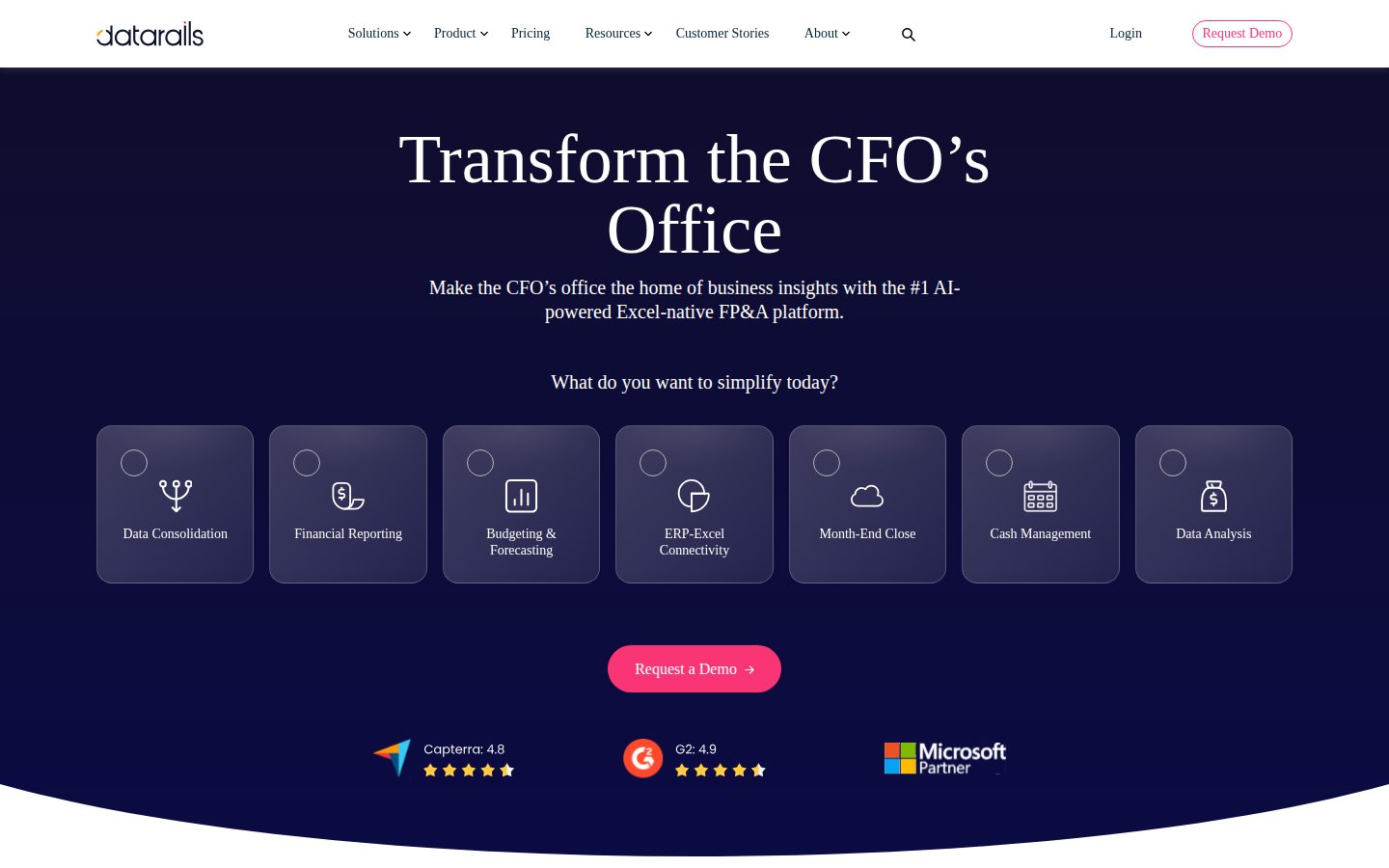
Integration count discrepancy (400+ vs 600+) across their own pages, plus 'Transform the CFO's Office' is the kind of superlative that ages poorly — marketing voice is running ahead of the verifiable claims.

Track Record Match7.0

Excel-native FP&A is a pattern that's worked — Vena has survived and scaled on similar positioning — so the thesis isn't novel, but it isn't a known failure mode either.

Pros

  • Excel interface is preserved, not replaced — genuine workflow continuity
  • Genius AI variance narratives built on consolidated data, not raw exports
  • Multi-entity cash management with claimed 100% global bank coverage
  • Industry-specific configurations for Healthcare, Manufacturing, Real Estate, and others

Cons

  • No API documented publicly — exit portability is a real risk
  • Integration count inconsistency (400+ vs 600+) is a trust signal worth watching
  • No free trial, no transparent pricing — evaluation friction is entirely on the buyer
  • No changelog visible; shipping cadence is unverifiable

Right for

Mid-market finance teams running FP&A in Excel who need multi-system consolidation without an IT project.

Avoid if

You need API access, transparent pricing before a sales call, or a clean documented exit path.

Buyer Questions

Common questions answered by our AI research team

Integration

How many systems does Datarails integrate with?

Datarails integrates with 600+ accounting software, ERP, CRM, Bank, and HRIS systems.

Features

Can I still work inside Excel with Datarails?

Yes, FinanceOS preserves 100% Excel functionality, letting finance teams continue working in their Excel environment while adding automated consolidation and reporting.

Features

Does Datarails support multi-entity cash management?

Yes, Datarails Cash Management supports entity-level management and multi-entity operations, providing up-to-date balances across entities.

Features

What does Datarails FinanceOS include?

FinanceOS consolidates all financial data sources into a single governed layer and includes AI-generated insights, budgeting, forecasting, reporting, cash management, data visualization, and collaborative workflows.

Integration

Can Datarails connect to bank accounts directly?

Yes, Datarails connects directly to bank accounts, automatically categorizing transactions and providing real-time cash balances across multiple bank accounts.

Also in AI Finance