Production-grade voice API for agentic AI and multilingual media
Deepdub is a voice AI platform for building multilingual speech into AI agents, dubbing, and media content.
AI Panel Score
6 AI reviews
Reviewed
Deepdub is a voice AI platform that converts text into expressive, emotionally tagged speech across multiple languages, serving AI agent conversations, video dubbing, and voice cloning. Built for long-form stability, its Phantom X model tied for first place in a blind expressivity benchmark referenced on the site. The platform targets media companies, broadcast studios, and AI product teams needing multilingual dubbing at broadcast quality. A free plan and free trial are available, while paid pricing is quote-based. Key capabilities include the eTTS engine with 26 emotional variations controlled through inline script tagging, real-time live broadcast dubbing, hybrid speech-to-speech dubbing, accent control, and a licensed voice bank backed by an artist royalty program. TopReviewed's six-seat AI review panel scored it 7.6/10, praising the performance-level emotional control for directors while noting the absence of public pricing forces every deal through a sales conversation.
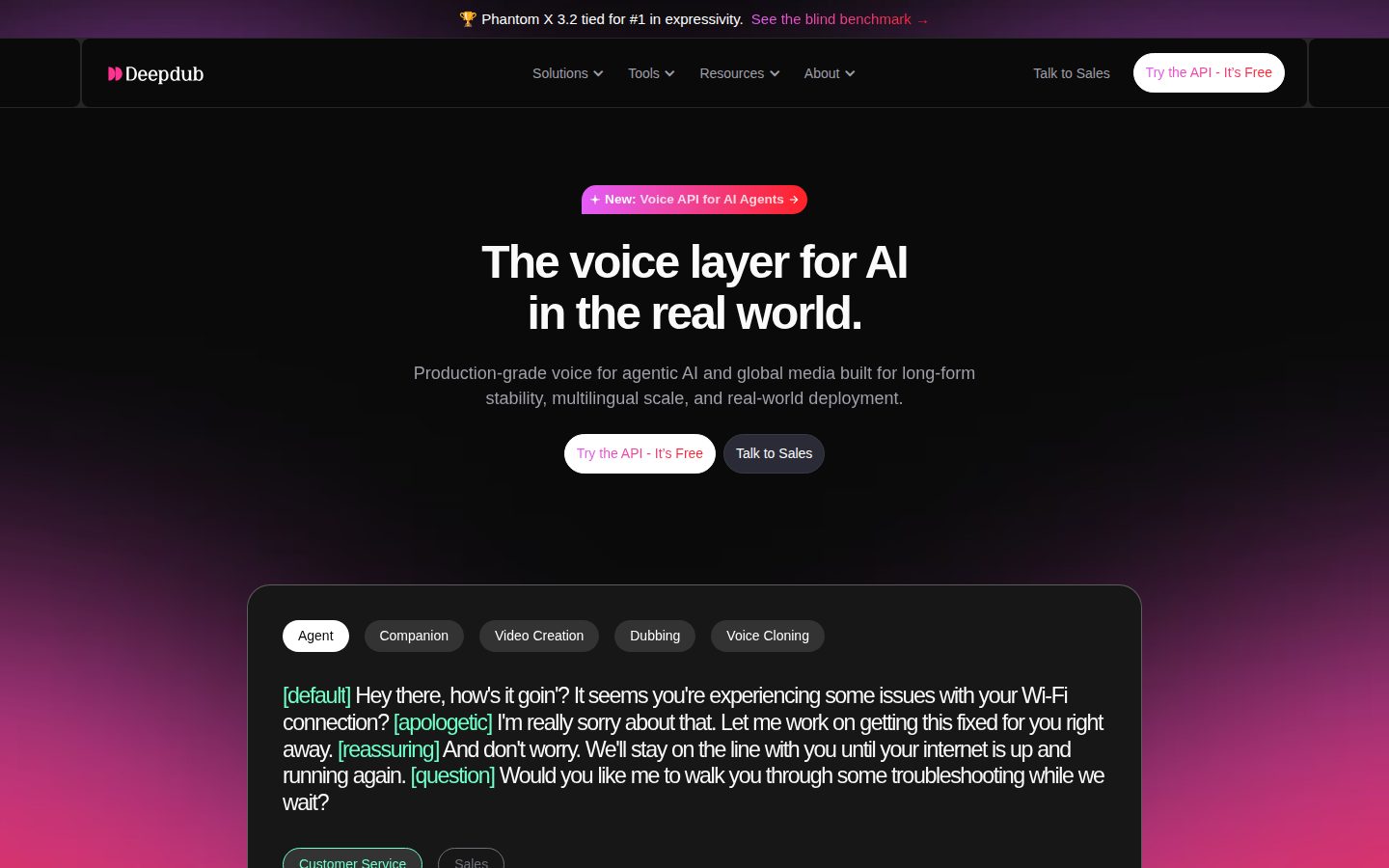
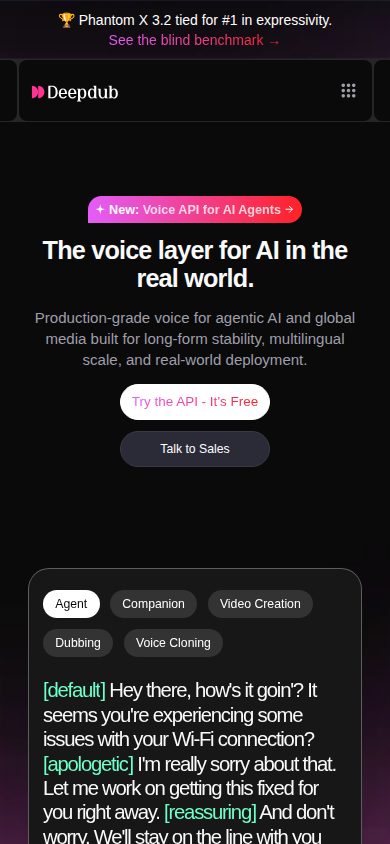
Users interact with Deepdub primarily through its API, which accepts text with inline emotional cues — such as [apologetic], [reassuring], or [excited] — and returns speech that reflects those tones. The platform supports a range of output styles including customer service dialogue, sales scripts, dramatic narration, sports commentary, and news reading. Voices can be rendered in languages including English, French, Portuguese, German, Italian, Spanish, Hindi, and Hebrew.
Deepdub highlights several specific capabilities on its homepage: voice cloning, dubbing for video, a companion voice mode for AI agents, and a dedicated voice creation tool. The system is designed for long-form content stability, which addresses a common failure mode in AI voice systems where quality degrades over extended audio. Emotional tagging within the script gives users fine-grained control over how each passage is delivered without post-processing.
The platform appears aimed at two primary audiences: AI product teams building voice into agent workflows and media companies needing scalable multilingual dubbing. Competitors in the space include ElevenLabs, Resemble AI, PlayHT, and Murf. Pricing details are not disclosed on the homepage, though the site advertises free API access as a starting point.
Deepdub is accessible via a web interface and an API. The API is positioned as the primary integration path for developers building agentic AI products. A free tier for API access is promoted directly on the homepage.
A generative AI feature that lets creators retain or modify character accents when dubbing content into another language, with granular control over accent intensity and regional variation.
Automatic speech recognition that converts speech to text and generates transcripts with natural language segmentation and speaker identification across 130+ languages.
A proprietary multimodal LLM-powered speech synthesis engine that dynamically adjusts tone, pacing, pitch, and intensity to generate emotionally expressive, human-like voices across 130+ languages and dialects.
An AI agent embedded directly into the dubbing and localization workflow that autonomously handles segment-level content modification, dialogue generation with cultural sensitivity, timeline management, and structured QC validations across dozens of languages simultaneously.
Integrated tools that allow post-production teams, linguists, translators, dubbing directors, and sound engineers to work together within a unified platform regardless of location, with dedicated success managers and onboarding support for each client.
An all-in-one SaaS virtual AI dubbing studio for post-production editors that manages the entire localization workflow—from audio splitting and transcription through translation, eTTS synthesis, and script adaptation—in a single platform.
An enterprise-grade, real-time AI dubbing solution that delivers emotionally rich, synchronized voice localization for live sports, esports, and breaking news across 100+ languages with no perceptible lag.
A human-led, AI-powered dubbing method where voice actors record guide performances in a studio that are then used to inspire AI-generated dialogue, achieving theatrical-quality dubbed output.
A curated library of diverse AI-generated voices with full commercial rights cleared for broadcast and downstream distribution, enabling clients to select voices by emotion, style, and characteristics without traditional licensing constraints.
A program within the Enterprise GO plan that enables studios to create custom voicebanks while ensuring voice artists are compensated and retain rights each time their voices are selected for a project.
A dedicated API that allows enterprise customers to seamlessly embed Deepdub's AI dubbing and voice synthesis capabilities directly into their existing post-production and content workflows.
The platform holds Trusted Partner Network (TPN) Gold Shield certification and is GDPR compliant, with customer data fully isolated and never used to train models, ensuring broadcast-grade content security.
Deepdub is a fully enterprise- and studio-focused platform with no publicly listed pricing tiers. All pricing is custom and requires contacting the Deepdub sales team directly. Multiple third-party sources confirm Deepdub uses a 'custom quote' model targeting large media, broadcast, and entertainment companies. Prospect customers should reach out via deepdub.ai or support@deepdub.ai for a tailored contract.
Deepdub is the serious enterprise dubbing bet ElevenLabs won't take on.
“TPN Gold Shield, 130+ languages, real-time live dubbing — this is built for studios and broadcasters, not hobbyists. No public pricing means you're negotiating blind, but the feature depth is real.”
Paramount and Mattel are on the client list. Deepdub Live launched April 2025 for live sports dubbing with no perceptible lag. That's not vaporware — that's a shipping team with enterprise accounts.
The eTTS engine with 26 emotional variations and accent control across 130+ languages puts this ahead of ElevenLabs for production workflows. TPN Gold Shield and GDPR compliance means legal won't block the deal. The royalty program for voice artists reduces long-term rights liability.
Two concerns. One: no public pricing means every deal is a negotiation, which slows procurement. Two: the free API tier exists, but this platform is clearly designed around enterprise contracts — solo devs and startups will hit a ceiling fast.
Phantom X tied for first in expressivity benchmarks against peers like ElevenLabs — that's a credible differentiation in a crowded market.
TPN Gold Shield and SOC 2 certification plus recognizable client logos makes this defensible to any board.
Free API access is immediate, but enterprise onboarding with dedicated success managers and custom contracts will extend time-to-production.
If you're building multilingual agent voice or need broadcast-grade dubbing at scale, this advances the product — it's not just cost reduction.
Named clients include Paramount and Mattel, and Deepdub Live shipped April 2025 — signs of a team executing, though no public funding data to confirm runway.
Media companies and AI product teams that need multilingual dubbing at broadcast quality and can handle enterprise procurement.
You need transparent, self-serve pricing and fast deployment without a sales cycle.
Broadcast-grade dubbing architecture with craft depth ElevenLabs hasn't matched yet.
“Deepdub is built for media production at scale — 130+ languages, TPN Gold Shield certification, royalty-cleared voice banks. This isn't a developer toy; it's a localization pipeline disguised as an API.”
The eTTS™ engine with 26 documented emotional variations is the creative control layer that matters here. Inline emotional tagging — [apologetic], [reassuring], [excited] — means directors can shape a performance at the script level without post-production passes. That's craft-aware design. ElevenLabs offers emotion controls, but Deepdub's Hybrid Dubbing method, where human guide performances inspire the AI output, shows someone understands what dubbing directors actually need.
The Licensed Voice Bank with cleared commercial rights and the Voice Artist Royalty Program solve two brand safety problems most platforms ignore entirely. If we're building a multilingual content system for broadcast, those clearances aren't nice-to-have — they're the difference between shipping and legal hold.
The constraint is real: fully custom pricing with no published tiers means budget planning requires a sales conversation before proof-of-concept. For smaller production teams, that friction stalls adoption. If the free API access genuinely opens without a contract, that changes the calculus — but the homepage promise and the enterprise-only pricing reality create a gap worth pressure-testing.
Phantom X tying for first in expressivity benchmarks, plus Deepdub Live for real-time broadcast, puts this ahead of Murf and PlayHT in the professional media segment.
Collaborative post-production workflow with linguists, dubbing directors, and sound engineers mapped to actual studio org charts.
Enterprise API plus AWS Marketplace listing gives clean integration paths, though no changelog visibility makes versioning trust harder to establish.
TPN Gold Shield and GDPR compliance create durable enterprise fit, but full custom-quote dependency is a procurement constraint at scale.
26 emotional variations plus Hybrid Dubbing methodology signals genuine craft depth, not surface-level TTS.
Media companies and broadcast studios needing scalable, rights-cleared multilingual dubbing with emotional fidelity.
Your team needs self-serve pricing and fast proof-of-concept without a procurement cycle.
130 languages, zero published prices — enterprise-only math with no sticker.
“Deepdub is a serious enterprise dubbing platform. No public pricing means TCO is a black box until you're already in a sales cycle.”
No pricing page. Custom quotes only, confirmed across third-party sources. That's the whole story for procurement. You can't model year 1 without a sales call, let alone year 3. AWS Marketplace availability helps — at least there's a procurement vehicle — but contract terms, overages, and seat counts aren't visible anywhere public.
The feature set is genuinely deep: 130+ languages, 26 emotional variations via eTTS™, TPN Gold Shield certification, real-time live dubbing launched April 2025. Phantom X tied for first in expressivity benchmarks. For media companies dubbing at scale, this is a credible stack. ElevenLabs publishes tiers at $5–$330/month; Deepdub doesn't publish anything. That gap costs Deepdub procurement cycles.
TCO risk is high. No overage rates, no per-minute published costs, no term length disclosed. Auto-renewal window unknown. Finance teams will spend weeks on legal review before a number lands. Free API trial exists, but it's a lead capture, not a pricing signal.
AWS Marketplace availability reduces some friction, but custom contracts mean legal review adds weeks to any purchase cycle.
Auto-renewal terms, cancellation clauses, and term lengths are undisclosed; AWS Marketplace helps but doesn't solve it.
Zero public pricing; custom-quote-only model confirmed, no tier structure visible without a sales call.
Dubbing cost displacement vs. human voice actors is measurable, but without unit pricing the math can't close before contract.
No per-minute, per-seat, or overage rates published — year-3 TCO modeling is impossible from public materials.
Large media studios and broadcast companies with legal bandwidth to negotiate custom contracts at scale.
Your finance team needs a pricing page to approve a vendor evaluation.
TPN Gold, 130 languages, live dubbing — this is built for post-production, not prototypers
“Deepdub is a broadcast-grade dubbing platform with serious infrastructure: TPN Gold Shield, 26 emotional variations in eTTS, and a Hybrid Dubbing workflow that pairs guide recordings with AI synthesis. It's not a solo producer tool — this is for localization pipelines at scale.”
The eTTS engine with inline emotional tags like [apologetic] or [excited] is the kind of control that actually matters in post-production. You're not riding a fader after the fact — you're directing tone at the script level. The Agentic Dubbing Co-Worker handling segment-level QC and timeline management across 130+ languages simultaneously is genuinely differentiated from what ElevenLabs or PlayHT offer out of the box. Phantom X tied for first in expressivity benchmarks according to their own blind test citation — promising, though independent verification isn't public.
DeepDub Live launching April 2025 for real-time broadcast dubbing with no perceptible lag is the headline nobody's shipping yet. Sports commentary and breaking news are brutal latency tests. The Collaborative Virtual Studio with dedicated success managers suggests this isn't self-serve — expect a sales cycle, not a sign-up.
No public pricing is the daily friction point for anyone scoping a project. ElevenLabs and Resemble AI both show seat costs upfront. Here, every estimate requires a conversation. For budget-constrained indie productions, that friction is disqualifying. For studio-level pipelines, it's just procurement.
Enterprise onboarding with dedicated success managers smooths early friction, but no public pricing means budget conversations happen before you've validated the workflow.
Docs exist and API is accessible, but evidence of practitioner-authored depth is thin — no changelog, and emotional tag syntax documentation quality is unverifiable from public materials.
No changelog listed on the site means producers can't track model updates affecting existing sessions — a real concern when eTTS output consistency matters across a long project.
Accent Control Technology with granular intensity settings, 26 emotional variations, and Speech-to-Speech Hybrid Dubbing give power users genuine levers that most competitors don't expose.
Deepdub GO covers audio splitting through eTTS synthesis in a single platform, and AWS Marketplace availability means it fits existing enterprise procurement flows.
Studio and broadcast localization teams running multilingual dubbing pipelines at volume who need TPN compliance and collaborative post-production tooling.
You're an indie producer or small team needing transparent per-minute or per-seat pricing without a procurement cycle.
Enterprise dubbing that actually sounds like someone cared about the performance
“Deepdub is built for studios and media teams who need emotionally expressive multilingual dubbing at scale. It's not for solo creators — it's for post-production pipelines where ElevenLabs isn't enough.”
The eTTS engine with 26 emotional variations is the thing that separates this from generic TTS tools. Tagging a line [apologetic] or [excited] inline and getting back a voice that actually sounds that way — without a separate post-processing pass — is the kind of detail that adds up over a 10-hour dubbing project. The Phantom X model tying for first in expressivity benchmarks backs that up. 130+ languages with accent control is a serious number.
The tradeoff is real though: there's no public pricing, no self-serve tier beyond a free API trial, and the whole platform is pointed squarely at enterprise. Smaller studios or indie teams will hit a 'contact sales' wall fast. That's a deliberate choice, not an oversight.
DeepLive for real-time broadcast dubbing launched April 2025 and is genuinely ambitious. TPN Gold Shield and GDPR compliance means this is built for clients who have content security requirements. This isn't a hobbyist tool. If you need it, you'll know.
Inline emotional tagging and the Deepdub GO Virtual Studio suggest a team that's thought about the daily editor experience, though no changelog is public to verify iteration pace.
Docs and API exist, plus dedicated success managers and onboarding support per client, but the collaborative workflow complexity means month-three fluency takes real ramp time.
Web-only platform — mobile parity isn't the point here, but post-production review on a phone is simply not a use case they've designed for.
Free API access exists but pricing is fully gated behind sales, which means most new users hit friction before they understand what they're buying into.
TPN Gold Shield certification, SOC 2 compliance, and isolated customer data suggest infrastructure built for broadcast-grade workloads, not demo-grade.
Media companies, broadcasters, and enterprise AI teams building multilingual voice pipelines at production scale.
You're a solo creator or small studio that needs a self-serve tool with transparent pricing.
Real differentiation buried under enterprise opacity — no pricing, no changelog
“Deepdub has genuine product depth: eTTS with 26 emotional variations, TPN Gold Shield cert, Deepdub Live for broadcast. But zero public pricing and no changelog make this a trust-me enterprise sale.”
Three tells upfront. One: homepage says 'free API' but pricing page doesn't exist — classic bait. Two: no changelog visible. Three: 'production-grade' is the kind of superlative that invites scrutiny. That said, the named clients — Paramount, Mattel, Mercado Libre — aren't decorative. Those logos suggest real contracts, not pilot programs.
The differentiation is plausible. ElevenLabs owns the indie developer market. Deepdub isn't chasing that. Deepdub Live for real-time sports dubbing across 100+ languages with no perceptible lag, hybrid speech-to-speech for theatrical output, a Voice Artist Royalty Program — these are enterprise-specific bets ElevenLabs and Murf haven't made as explicitly. The Phantom X blind test result is self-reported, so weight it accordingly.
Exit portability is the real concern. Custom contracts, no published tiers, proprietary eTTS format. If they redirect or get acquired, migration gets expensive fast. TPN Gold Shield and GDPR compliance matter for broadcast buyers — but lock-in risk is real.
Real-time live broadcast dubbing and Voice Artist Royalty Program are concrete bets ElevenLabs and PlayHT haven't made at this depth.
Proprietary eTTS format, custom contracts, no self-serve tier — switching costs are high if strategy shifts.
No public funding data, but AWS Marketplace listing, TPN Gold Shield cert, and enterprise client roster suggest institutional footing.
Promotes free API access but hides all pricing behind sales contact — that gap is a yellow flag.
Named broadcast clients like Paramount and launch of Deepdub Live in April 2025 suggest active shipping, not vaporware.
Enterprise media and broadcast teams needing scalable multilingual dubbing with studio-grade compliance.
You need self-serve pricing, fast API prototyping, or a clean exit path without contract negotiation.
Common questions answered by our AI research team
Yes, Deepdub supports voice cloning, allowing you to create a digital replica of any voice.
Deepdub supports accent control in 130+ languages.
Yes, the Deepdub API is free to try — the site explicitly offers "Try the API - It's Free."
Yes, Deepdub has a Live Dubbing solution designed to bring live content to global audiences.
Deepdub's Phantom X model tied for first place in expressivity benchmarks according to a blind test referenced on the site.
Company
DeepdubFounded
2019Pricing
FreemiumFree Trial
AvailableFree Plan
AvailableDeepdub is a voice AI company founded in 2019 that provides enterprise dubbing, localization, and AI-agent voice infrastructure across 130+ languages.