Build and deploy custom LLM agents on the open-source Haystack framework
Deepset is an AI development platform for building, testing, and deploying production-grade LLM agents and applications.
AI Panel Score
6 AI reviews
Reviewed
In practice, users work within the deepset AI Platform to design, test, and deploy AI pipelines without rebuilding infrastructure from scratch. Workflows typically involve connecting data sources, configuring retrieval or processing logic, and deploying agents that handle tasks such as document analysis, enterprise search, or natural language querying of databases. The platform is built on top of Haystack, deepset's open-source Python framework, which provides the composable pipeline architecture that underlies every application.
The platform includes specific solution templates for common enterprise use cases: RAG systems for building chatbots and knowledge applications, intelligent document processing (IDP) for extracting structured data from large document volumes, text-to-SQL for converting plain-language queries into database queries, and AI enterprise search for cross-organizational information retrieval. These are offered as configurable starting points rather than fixed products, allowing teams to adapt pipelines to their own data and requirements.
Deepset targets enterprise teams in finance, legal, media, manufacturing, government, and life sciences, with an emphasis on regulated or high-trust environments. Pricing details are not publicly listed on the website, suggesting a primarily contact-based sales model for enterprise contracts. Competing platforms in the LLM application development space include LangChain, LlamaIndex, and Microsoft Azure AI Studio.
Haystack is available as a standalone open-source Python framework under an Apache 2.0 license, which provides a no-cost entry point for developers. The deepset AI Platform adds managed infrastructure, deployment tooling, and enterprise support on top of Haystack. Integrations span major LLM providers and vector databases, with deployment options oriented toward cloud and on-premises enterprise environments.

Enables construction of intelligent agents and virtual assistants that streamline workflows and solve business challenges.
Uses knowledge graphs to process complex datasets, enabling richer context retrieval for LLM-generated responses.
Provides flexible RAG systems and architecture for building extraction tools, chatbots, and knowledge apps for AI agents.
Converts plain-language queries into SQL using LLMs to simplify data analysis and boost business intelligence insights.
A pioneering Groundedness score metric that evaluates LLM answer quality to improve RAG application security, trust, and observability.
Provides tools for evaluating document retrieval and other RAG pipeline components to measure and improve system accuracy.
Processes documents at scale using AI to accelerate insight extraction and boost workflow efficiency.
Delivers fast, accurate search results across organizational data sources to improve information access enterprise-wide.
An open-source framework that serves as the backbone engine for building custom, production-grade AI agents and LLM applications at enterprise scale.
Enables semantic search over large document collections using text embeddings and vectorization to find relevant information beyond keyword matching.
A platform for building, testing, and deploying custom GenAI agents and applications, powered by the Haystack framework.
Supports building and deploying fully customizable AI solutions tailored to specific industries, brands, and business requirements with full production control.
Free, open-source Python framework for developers and teams who want to self-host and build production-grade LLM applications, RAG pipelines, and AI agents with full control and no licensing fees.
Free trial tier of the Haystack Enterprise Platform for individuals or small teams prototyping AI applications. Includes 1 workspace, 1 user, and 100 pipeline hours per month.
Support and services layer for teams building production AI on Haystack open source. Pricing is custom/quote-based and requires contacting sales. Sized based on organization scale.
Full-stack managed enterprise AI platform (formerly deepset Cloud/deepset AI Platform) for organizations building and scaling mission-critical AI agents and applications. Pricing is custom and requires contacting sales; structured around platform licensing, agent/application runtime, and expert services. Available as managed cloud, VPC, hybrid, or on-premise.
Open-source moat plus SOC 2 and air-gap support makes this a serious enterprise bet.
“Deepset owns Haystack, an Apache 2.0 framework with 100+ LLM integrations, and wraps it in a managed platform with real compliance credentials. The contact-only pricing is a friction point, but the open-source escape hatch neutralizes lock-in risk.”
SOC 2 Type II, ISO 27001, HIPAA, and air-gapped deployment. That's a compliance stack that beats most of LangChain's orbit and puts this in rooms that Azure AI Studio can't always enter. The Groundedness evaluation metric is a named, specific differentiator — not vague 'observability,' but a scored trust layer baked into RAG pipelines.
Two things concern me. One: no public pricing, which slows procurement and signals enterprise-only appetite. Two: the Studio trial caps at 100 pipeline hours and one user, so small teams hit the ceiling fast and face a sales call before they've proven value internally.
The pipeline export to Python or YAML is the detail I'd lead with in a board conversation. No vendor lock-in is a defensible answer when someone asks why we didn't just build on Azure.
Air-gapped deployment and the Haystack open-source moat differentiate this clearly from LangChain and LlamaIndex in regulated environments.
SOC 2 Type II, HIPAA, and ISO 27001 certifications make this an easy board answer in finance, legal, or life sciences.
Pre-built expert templates and the visual pipeline editor accelerate time-to-prototype, but contact-only pricing adds procurement lag before production.
GraphRAG, Text-to-SQL, and IDP templates directly advance AI capability, not just cost reduction on existing workflows.
Haystack's open-source adoption and enterprise client list in defense and regulated industries suggest durable demand, though no public funding data is available.
Enterprise teams in regulated industries who need air-gapped RAG or document processing with defensible compliance credentials.
You need a fast self-serve pilot with transparent per-seat pricing before committing to a sales process.
Haystack's Apache 2.0 foundation is the moat — the platform just makes it enterprise-deployable.
“Deepset's strategic bet is correct: own the open-source layer, monetize the managed runtime. The SOC 2 Type II plus air-gapped deployment support makes this a serious conversation for regulated industries.”
100+ LLM integrations, 30+ vector DB connectors, multimodal pipeline support, GraphRAG, and a Groundedness evaluation metric that most competitors haven't shipped yet. That's a mature integration surface. LangChain and LlamaIndex compete on the framework layer, but neither offers a managed platform with on-prem, VPC, and air-gapped deployment options in one product tier.
The architecture here is what matters most. Pipelines export as Python or YAML — that's the right anti-lock-in move. If deepset disappears in 2027, you're holding portable Haystack code, not a proprietary DSL you can't run anywhere. The 100 pipeline hours on the Studio trial is thin for team evaluation, but the open-source tier buys you real exploration time before any contract conversation.
The opaque pricing is the real friction. No public numbers means every serious evaluation runs through a sales cycle, which slows platform adoption in engineering teams who want to self-qualify first. For regulated enterprise buyers with air-gap requirements, that's acceptable. For product teams benchmarking against Azure AI Studio, it's a drag.
Deepset occupies a defensible position between raw frameworks like LangChain and full-stack cloud AI platforms like Azure AI Studio — regulated-industry demand makes that middle lane valuable.
Visual pipeline editor plus YAML/Python export hits the right balance for engineering teams who want GUI for iteration and code for production handoff.
100+ LLM providers and 30+ vector databases is library-grade breadth; Kubernetes-ready cloud-agnostic runtime means it drops into existing infrastructure without forcing a migration.
Apache 2.0 Haystack as the foundation means adopting deepset doesn't create dependency on their commercial layer — the escape hatch is real and portable.
Groundedness metrics, GraphRAG, and multimodal IDP signal a team that's building ahead of current enterprise demand, not just catching up to it.
Regulated enterprise engineering teams that need on-prem or air-gapped LLM deployment with production-grade RAG pipelines.
Your team wants self-serve pricing transparency and a free trial that supports more than one engineer.
No public pricing, but the open-source entry point at $0 is real.
“Haystack is Apache 2.0 and genuinely free. Everything above that requires a sales call and patience.”
The open-source tier is honest: $0, Apache 2.0, 100+ LLM integrations, self-hosted. Studio trial adds 100 pipeline hours/month and a visual editor for 1 user. Real on-ramp, no credit card theater. That's better than LangChain's commercial licensing ambiguity.
Enterprise pricing is fully opaque. No published per-seat rate, no platform fee range, no overage schedule. The pricing page doesn't exist — confirmed by capabilities scan. For a 50-person team, year-3 TCO is genuinely unknowable before a contract. SOC 2 Type II, HIPAA, and air-gapped deployment are real compliance checkboxes, but they price accordingly.
The export-as-Python-or-YAML clause matters. No vendor lock-in is a contractual protection, not just marketing. Auto-renewal terms and termination windows aren't published — standard enterprise hostage contract risk. Negotiate those clauses on day one.
No self-serve purchase path above the 1-user Studio trial; procurement friction is high for enterprise buyers.
Export-as-Python/YAML reduces lock-in risk, but auto-renewal and termination terms aren't publicly disclosed.
No public pricing page; enterprise tiers require sales contact and custom quotes across all paid plans.
Groundedness evaluation metric and RAG component scoring provide measurable quality signals — better than most competitors.
Year-3 TCO at 50 seats is unknowable — no published platform fee, no overage rate, no per-agent pricing.
Regulated enterprise teams in finance, legal, or defense who need air-gapped deployment and can navigate opaque procurement.
Your team needs transparent per-seat pricing and self-serve procurement without a sales cycle.
Haystack's open-source roots give engineers real escape hatches from vendor lock-in
“Deepset's Apache 2.0 Haystack framework is the actual product — the enterprise platform wraps it in managed infra, observability, and SOC 2 compliance. Engineers who already know Python pipelines will move fast here.”
Haystack's composable pipeline architecture is the right abstraction for RAG work. Export pipelines as Python or YAML means you're not writing migration scripts when the contract lapses — that's a real differentiator against LangChain's tighter ecosystem coupling. The 100+ LLM integrations and 30+ vector DB connectors suggest someone's actually maintaining these, not just listing logos. Studio tier gives 100 pipeline hours/month free, which is enough to prototype before touching sales.
Day three looks like: visual pipeline editor for fast iteration, REST API endpoints for actual integration, Groundedness evaluation metrics for trust-but-verify in production. The absence of a public changelog is a yellow flag — knowing what shipped last week matters when you're debugging a retrieval regression in production.
No public pricing is the friction point. Every serious infra decision needs a number before it reaches a budget conversation. Azure AI Studio publishes pricing; deepset makes you call. That slows procurement without adding value.
Visual pipeline editor and pre-built RAG/IDP templates reduce cold-start friction, but no public changelog means debugging what changed is guesswork.
Docs confirmed present and the Haystack open-source community (Discord, GitHub) signals real practitioner contribution, not marketing copy — though depth is unverifiable from public evidence.
Contact-only pricing and no free trial on the full enterprise platform adds procurement lag; Studio's 100-hour/month cap will hit fast on any real document workload.
GraphRAG, multimodal IDP pipelines, text-to-SQL, and the Groundedness evaluation metric suggest genuine depth beyond basic RAG; air-gapped deployment support is a power-user signal.
Python-native Haystack framework fits cleanly into existing CI/CD; REST API endpoints and YAML pipeline export mean engineers aren't locked into a GUI-only workflow.
Enterprise engineering teams building RAG or document processing pipelines in regulated industries who need on-prem or VPC deployment with real compliance certs.
You need transparent, self-serve pricing before starting an evaluation — the contact-only model will stall solo engineers and small teams.
Serious enterprise RAG platform, but you'll need a sales call to get started
“Deepset's Haystack framework gives regulated-industry teams a real production path for LLM agents without starting from scratch. The open-source on-ramp is genuine, but the full platform is priced behind a contact form.”
The free Haystack tier isn't a trick — Apache 2.0, 100+ LLM integrations, 30+ vector databases, Kubernetes-ready, actually open. That's a real starting point, not a bait-and-switch. The Studio trial adds a drag-and-drop pipeline editor and 100 pipeline hours a month for solo builders. Compare that to LangChain, which is pure DIY, and you feel the difference fast.
The Groundedness evaluation metric is the kind of detail that signals someone actually ships these things to production. Knowing whether your RAG answers are hallucinating isn't a nice-to-have at month three, it's the thing you're losing sleep over. SOC 2, HIPAA, ISO 27001, air-gapped deployment — for finance or defense teams, that list clears real procurement hurdles.
The tradeoff is real though: no public pricing, no free trial on the full platform, web-only. If you're a solo developer prototyping, the open-source path is fine. If you need the managed platform, you're in sales-call territory immediately. Mobile is irrelevant here, which is honest — nobody's building enterprise pipelines from their phone.
Visual pipeline editor with drag-and-drop and pre-built templates suggests care, but no changelog is public and the pricing page absence is a gap that everyday users will bump into.
Expert templates and 4 hours monthly of direct consultation with Haystack core maintainers on the Starter tier is genuinely useful, but the Python-first architecture assumes real developer fluency from day one.
Web-only platform — no mobile story at all, which is fine for the actual use case but worth noting for any team that expects dashboard access on the go.
Haystack open-source plus the Studio free tier (1 user, 100 pipeline hours) gives developers a genuine on-ramp, but no free trial on the full platform means most teams hit a wall before they see the real product.
SOC 2 Type II, auto-scaling managed infrastructure, and built-in Groundedness observability metrics signal a team that's thought about what breaks in production.
Enterprise dev teams in regulated industries who need RAG or document processing pipelines with real compliance credentials.
You want transparent pricing upfront or you're a solo builder who needs the full managed platform without a procurement process.
100+ LLM integrations, open-source escape hatch, no public pricing — classic enterprise play
“Haystack's Apache 2.0 license is the real differentiator here. If deepset the company disappears, the framework doesn't.”
Three tells on arrival. One: 'Sovereign AI Platform' in the meta — sovereignty is this year's buzzword, could age poorly. Two: no changelog visible. Three: pricing page is fully gated. That's a contact-sales moat, not a product moat.
The exit story is actually the strongest card. Export pipelines as Python or YAML is listed explicitly. Haystack runs on Kubernetes, cloud-agnostic, Apache 2.0. Compare that to LangChain's hosted products or Azure AI Studio — neither gives you a clean YAML export. The 100 pipeline hours/month Studio tier gives developers a real starting point without a sales call.
What's missing: no changelog means I can't verify shipping cadence. SOC 2, ISO 27001, HIPAA certifications are listed — that's real for regulated buyers. GraphRAG and Groundedness scoring suggest genuine product depth, not a feature list padded with synonyms. Cautiously solid.
Air-gapped deployment, Groundedness evaluation metrics, and IDP templates give real distance from LangChain and LlamaIndex, which don't offer managed on-prem at this layer.
Python/YAML pipeline export plus Apache 2.0 Haystack license means migration is unusually clean — closest thing to no lock-in I've seen in this category.
No public funding data visible, no changelog cadence to verify — SOC 2 Type II and ISO 27001 certs suggest organizational maturity, but funding runway is unverifiable.
'Sovereign AI Platform' is aspirational framing; Groundedness metric and specific compliance certs (SOC 2, HIPAA) ground it partially, but no changelog and gated pricing reduce trust.
Haystack has real GitHub presence and enterprise adoption signals; open-source-first then enterprise-layer is a pattern that worked for dbt Labs, Airbyte — not just a pitch.
Enterprise teams in regulated industries who need on-prem AI pipelines with a clean open-source escape hatch.
You need transparent pricing upfront or a self-serve trial that scales past one user without a sales call.
Common questions answered by our AI research team
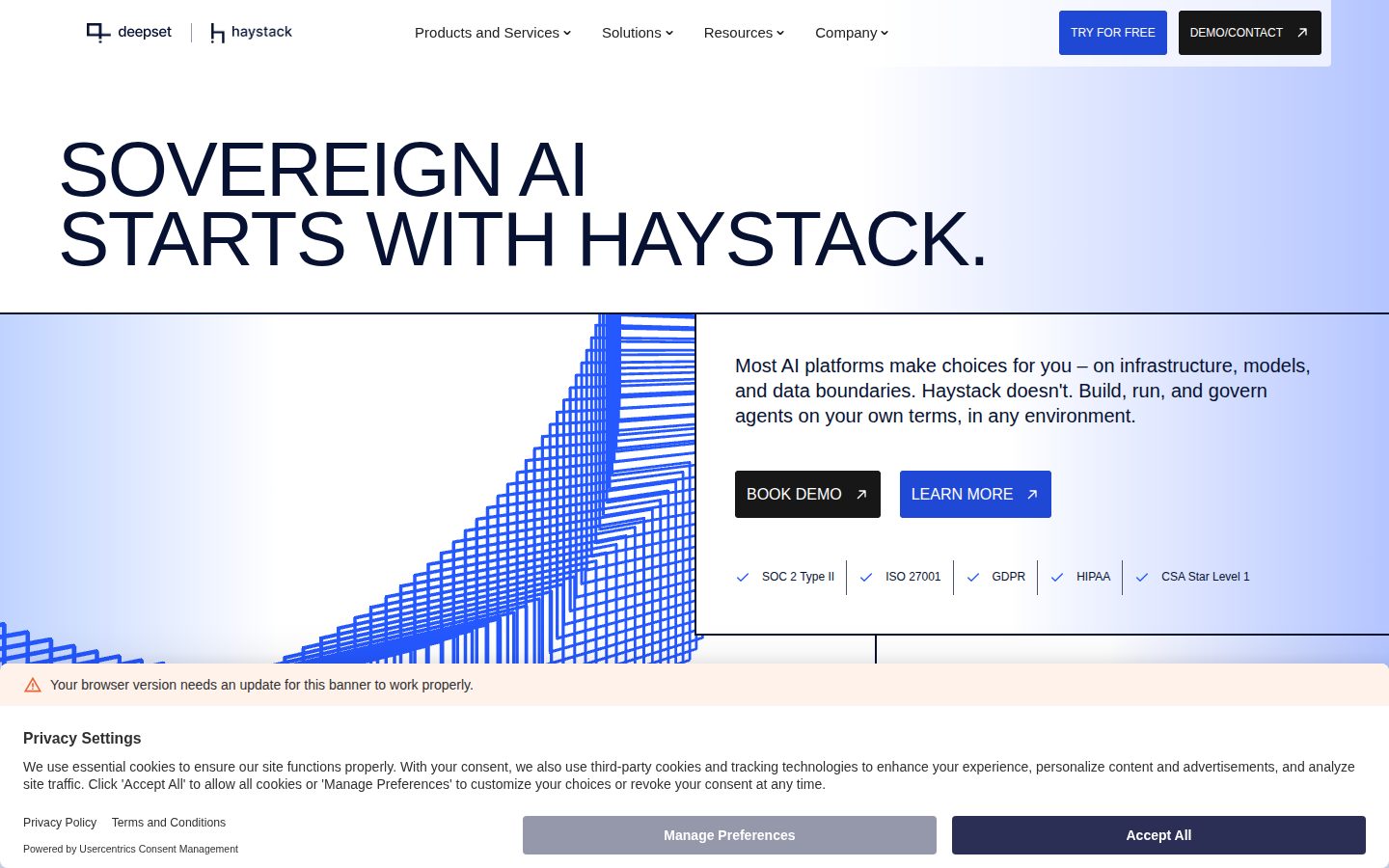
Deepset holds SOC 2 Type II, ISO 27001, GDPR, HIPAA, and CSA Star Level 1 certifications.
Yes, Haystack supports deployment across cloud, VPC, on-premise, and fully air-gapped environments, giving organizations full control over where AI runs and where data stays.
Deepset offers four tiers: Haystack (open-source framework), Haystack Enterprise Starter (support, templates, consulting), Haystack Enterprise Platform (full tooling and infrastructure), and Expert AI Services (hands-on implementation and upskilling).
Yes, Haystack supports multimodal document processing pipelines combining OCR, layout understanding, and LLM-based reasoning for text, tables, images, and scanned documents.
Yes, Haystack is an open-source AI framework built on transparent, extensible code, allowing teams to swap models, tools, and infrastructure as needs change.