Vellum logo

Vellum Review

Visit

A personal AI assistant that runs locally, learns your habits, and acts on your behalf

Vellum is a personal AI assistant for macOS and iPhone that automates email, calendar, Slack, GitHub, and task management on your behalf.

AI Panel Score

7.4/10

6 AI reviews

Reviewed

AI Editor Approved

What is Vellum?

Vellum is a personal AI assistant for macOS and iPhone that automates email, calendar, Slack, GitHub, and task management on the user's behalf. Running locally, it connects to tools like Gmail, Slack, GitHub, and Linear to take real actions such as drafting emails, triaging issues, and updating project boards without the user initiating each task, and its 72-hour time-to-intuition model is designed to learn preferences well enough to act proactively. Pricing is usage-based through prepaid credits, with no free plan or trial and no published per-action rates. Key capabilities include automated email management, GitHub issue auto-triage, Linear board auto-updates, computer use with screen control, a granular permission system, and 60+ built-in skills. TopReviewed's six-seat AI review panel scored it 7.4/10, praising local credential storage via macOS Keychain while noting that missing funding and team data leaves vendor viability unknown. It fits Mac-first knowledge workers wanting proactive agentic automation.

About Vellum

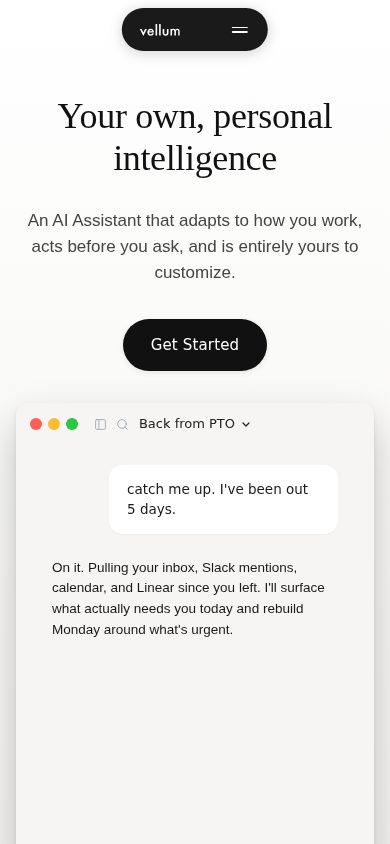
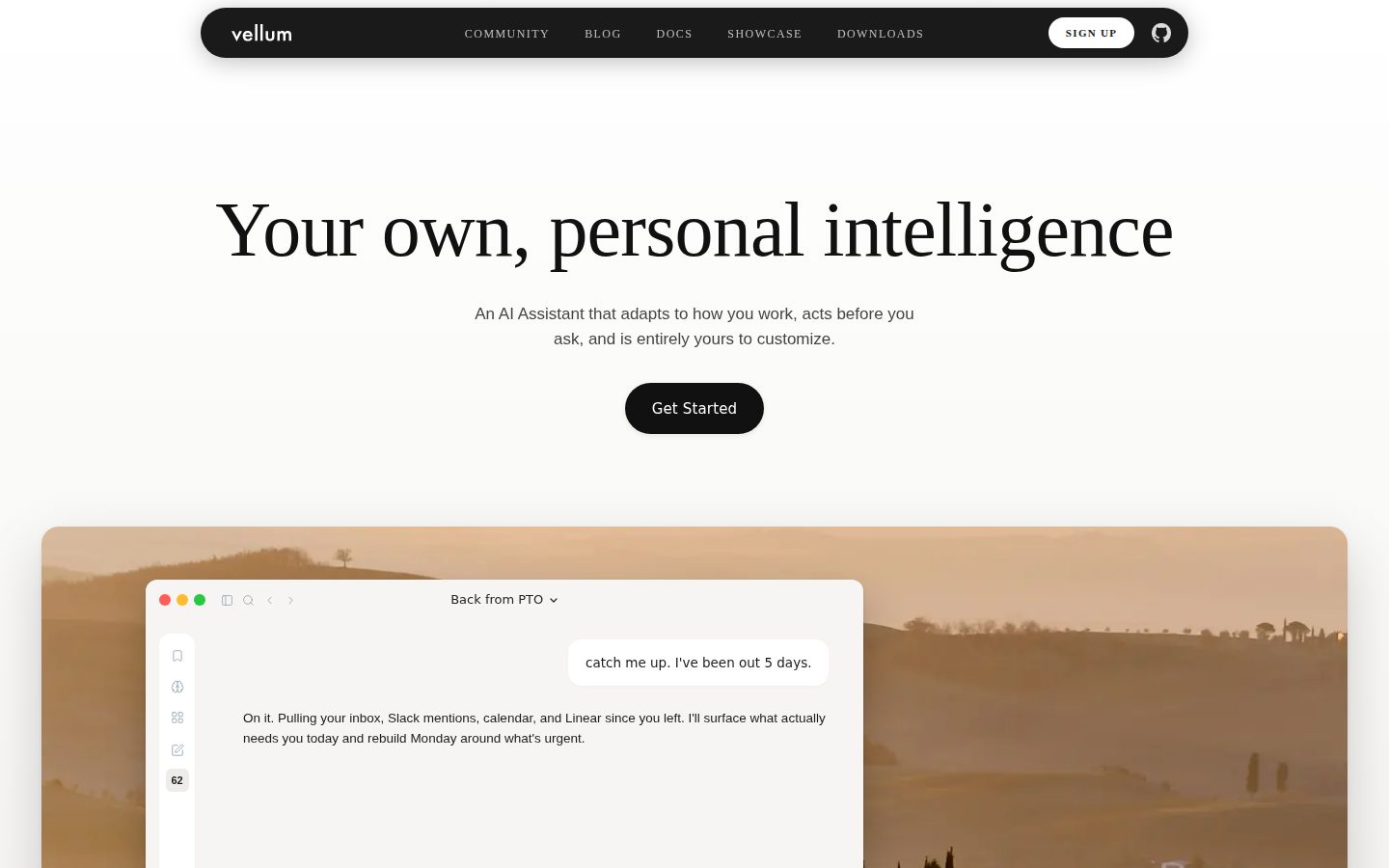
In practice, users interact with Vellum through a macOS app (and optionally a browser extension or iPhone app). On first use, you provide context about your role, communication style, and tool preferences. The assistant then monitors connected services in the background—processing incoming emails overnight, commenting on GitHub issues before you check in, surfacing Slack blockers each morning—and asks for approval before executing any action it hasn't been explicitly cleared for.

Vellum ships with over 60 built-in skills covering email management, calendar, web browsing, Slack monitoring, GitHub triage, Linear board updates, document writing, image generation, food delivery, and phone calls. Users can also build custom skills to extend the assistant further. Computer use—letting the assistant see your screen and interact with UI elements via macOS accessibility and screen recording—is opt-in and requires explicit system-level permission. A granular permissions system lets you approve actions once, for a time window, per thread, or permanently.

Vellum is positioned for general knowledge workers and individuals who want an always-on assistant rather than a chat tool. It explicitly differentiates itself from ChatGPT and Claude (cloud conversation tools with no persistent memory) and from OpenClaw (an open-source developer-focused agent with fewer guardrails). Pricing uses a prepaid credit model where usage is deducted as the assistant acts; no flat monthly subscription tier is published on the homepage.

Credentials are stored in macOS Keychain and never passed to the AI model. Conversations are sent to cloud AI providers (such as Anthropic or OpenAI) for inference but are not stored on Vellum's servers and are not used for training. Supported platforms are macOS, iPhone, and web; Android and Windows are listed as roadmap items. The assistant currently supports models including Claude Opus 4.7 and GPT-5.5.

Features

AI

  • 72-Hour Time-to-Intuition

    Measures and optimizes how fast the assistant learns your preferences, reaching proactive colleague-level behavior within 72 hours of use.

  • Multi-Model Support

    Supports multiple AI models including Claude Opus 4.7, GPT-5.5, and Gemini 3, with GPT-5.5 set as the default OpenAI model as of v0.7.0.

Automation

  • Automated Email Management

    Reads, drafts, and prioritizes emails in Gmail while you sleep, archiving newsletters, drafting replies, and surfacing only the emails worth your attention.

  • GitHub Issue Auto-Triage

    Automatically labels, assigns, and responds to GitHub issues based on team rules, including tagging priority levels and routing to the appropriate engineer.

  • Linear Board Auto-Updates

    Creates, updates, and reprioritizes Linear board tickets automatically from Slack threads and other signals so the backlog reflects current reality.

Collaboration

  • Slack Channel Monitoring

    Joins Slack channels, surfaces blockers, decisions needed, and shipped items overnight, and keeps conversations moving by filing issues and responding in threads.

Core

  • 60+ Built-in Skills

    Ships with over 60 out-of-the-box skills covering email, calendar, Slack, web browsing, food delivery, image generation, coding, app building, document writing, task management, and phone calls.

  • Computer Use (Screen Control)

    Can see your screen and interact with UI elements via macOS accessibility and screen recording permissions, with explicit opt-in approval required before each action.

Customization

  • Custom Skills Builder

    Allows users to build and add their own custom skills to extend the assistant's capabilities beyond the default set.

Integration

  • Browser Extension Integration

    Provides a one-click installable Chrome Web Store browser extension with a reworked experience for interacting with the assistant from any browser.

Security

  • Granular Permission System

    Enforces action approval through traditional software, letting users choose permission scope: once, per thread, within a time-frame, always, or never.

  • Local Data Storage

    Stores workspace data, memories, and credentials entirely on the user's machine using macOS Keychain, with no data stored on Vellum's servers and telemetry off by default.

Preview

Vellum desktop previewVellum mobile preview

Pricing Plans

Prepaid Credits

Contact sales

Pay-as-you-go prepaid credit balance; usage is deducted as you use the assistant. Add credits from Billing as needed.

  • Prepaid credit balance model
  • Credits deducted per usage
  • Add credits anytime from Billing
  • Access to all Vellum assistant features
  • Local data storage on your machine

AI Panel Reviews

The Decision Maker

The Decision Maker

Strategic bet, vendor viability, timing, adoption approval
7.2/10

Vellum's 72-hour intuition model is a serious differentiator — if the vendor survives to prove it.

Local-first, 60+ skills, and a real agentic loop across Gmail, Slack, GitHub, and Linear. Company transparency is thin, and no public funding data is a real flag.

No published funding data. No team size. No flat monthly price — just prepaid credits with no public rate card. Compare that to OpenClaw, which at least has a community and GitHub stars you can count. That opacity is the core risk here, not the product.

The product itself is legitimately interesting. Local credential storage via macOS Keychain, conversations routed to Anthropic or OpenAI but not retained, telemetry off by default — that's a security story you can actually tell a board. The granular permission system, where you approve once, per thread, or always, is the right answer to the obvious 'what if it does something stupid' question.

The tradeoff is real: no free trial, credit-only pricing, and macOS-only right now. Android and Windows are roadmap. If your team isn't majority Mac, this doesn't land yet. Pilot it with three or four knowledge workers for 90 days before you say another word about it.

Competitive Positioning7.0

macOS-only limits org-wide rollout today, but 60+ built-in skills and multi-model support including GPT-5.5 and Claude Opus 4.7 is a stronger out-of-box stack than most competitors.

Reputation Risk6.5

Local-first storage and no training on data is a defensible story, but an unknown vendor with screen recording permissions will raise eyebrows at the board level.

Speed to Value8.0

The 72-hour time-to-intuition model, if it delivers, is faster payback than any comparable agentic tool including ChatGPT or Claude, which have no persistent memory.

Strategic Fit7.8

Automated GitHub triage, Linear board updates from Slack signals, and overnight email management are genuine workflow advances, not just cost swaps.

Vendor Viability5.5

No public funding data, unknown team size, and a credit model with no published rates makes a 36-month survivability bet hard to justify.

Pros

  • Local credential storage via macOS Keychain with no server-side retention is a credible enterprise security posture
  • 60+ built-in skills across email, GitHub, Linear, and Slack means real workflow coverage on day one
  • Granular permission scoping — once, per thread, always — is the right design for agentic risk management
  • Multi-model support with GPT-5.5 and Claude Opus 4.7 avoids single-provider lock-in

Cons

  • No public funding data or team size makes vendor viability a genuine unknown
  • No free trial and opaque credit pricing makes budget forecasting impossible before you commit
  • macOS and iOS only right now — Android and Windows are roadmap, not product

Right for

Mac-first knowledge worker teams who want proactive agentic automation across their existing dev and comms stack.

Avoid if

Your org runs Windows or Android, or your security team won't approve screen recording access on production machines.

The Domain Strategist

The Domain Strategist

Craft and strategy in the product's domain — adapts identity per category, same lens
7.8/10

Local-first agentic architecture with real integration depth, but credit pricing creates unpredictable TCO.

Vellum's macOS Keychain credential isolation and 60+ built-in skills represent genuine architectural discipline for a personal agent. The usage-based pricing with no published floor makes budget forecasting difficult at team scale.

The security architecture here is the first thing I'd scrutinize — and it holds up. Credentials stay in macOS Keychain, inference goes to cloud providers but isn't stored server-side, telemetry is off by default. That's a defensible posture for a tool with screen recording and email write access. Most competitors in this category (looking at you, OpenClaw) skip the granular permission layer entirely. The five-scope approval model — once, per thread, time-frame, always, never — is the right primitive.

Sixty-plus built-in skills plus a custom skills builder means the integration surface is library-grade, not prototype-grade. GitHub auto-triage plus Linear board sync from Slack signals is exactly the loop that costs engineering teams 20-30 minutes per standup. The 72-hour intuition model is a bold claim, and the docs indicate it's behavioral, not just keyword-matching.

The constraint I'd flag: prepaid credits with no published per-action pricing means you can't model monthly cost before committing. If the assistant is running overnight email and GitHub triage simultaneously, cost variance is real. macOS-only in 2025 also constrains team rollouts — Windows engineers are excluded until roadmap ships.

Category Positioning7.5

Sits meaningfully above chat-only tools like Claude or ChatGPT and above developer-focused open-source agents like OpenClaw, but the prepaid-only pricing model limits its enterprise credibility.

Domain Fit8.0

GitHub triage plus Linear sync from Slack signals is the exact async coordination overhead that burns senior engineers — this maps to real workflow friction, not invented use cases.

Integration Surface7.8

Gmail, Slack, GitHub, Linear, and computer use via macOS accessibility covers the core dev-adjacent stack, though Android and Windows gaps mean cross-platform teams can't standardize yet.

Long-term Implications7.2

If Vellum's custom skills layer matures, the switching cost compounds; if it doesn't, you've built muscle memory around a tool with a shallow ceiling.

Strategic Depth8.2

Local credential storage, five-scope permissions, and multi-model support (Claude Opus 4.7, GPT-5.5, Gemini 3) show someone who's thought through the threat model, not just the demo.

Pros

  • macOS Keychain isolation — credentials never touch Vellum's servers
  • Five-scope permission model is the right security primitive for agentic actions
  • 60+ built-in skills with a custom skills builder means genuine extensibility
  • Multi-model support including Claude Opus 4.7 and GPT-5.5 avoids single-provider lock-in

Cons

  • No published per-action credit pricing makes TCO modeling impossible before you commit
  • macOS and iOS only — Windows and Android engineers are blocked until roadmap ships
  • No free trial means you're buying before validating the 72-hour intuition claim on your own workflows

Right for

A macOS-centric engineering team that wants always-on GitHub and Linear automation without standing up their own agent infrastructure.

Avoid if

Your team is cross-platform or you need predictable per-seat SaaS pricing for budget approval.

The Finance Lead

The Finance Lead

Money, total cost of ownership, contracts, procurement math
6.5/10

60+ skills, zero published price points — credit model hides the real number

Vellum runs on prepaid credits with no flat tier and no sticker price. You can't model year-3 cost without burning credits first.

No starting price. No per-action rate. No free trial. The pricing page exists, but the actual number doesn't. That's the core procurement problem. Usage-based is fine — AWS runs on it. But AWS publishes a price list. Vellum doesn't, based on their pricing page.

Compare to Claude.ai Pro at $20/seat/month: predictable, invoiceable, budget-able in a spreadsheet. Vellum's credit model means finance can't pre-approve a line item. For a 10-person team, that's 10 separate credit balances or one shared account — neither maps cleanly to standard procurement.

The 60+ skills and local Keychain storage are real differentiators. No server-side credential exposure is a genuine security win. But no published overage rate, no trial, and no contract terms are visible — that's three unknowns stacked. Procurement will push back. The math can't close until Vellum publishes it.

Billing & Procurement4.5

No invoicing model, no free trial, and no flat tier means standard procurement workflows will stall at the quote stage.

Contract Flexibility5.5

Prepaid credits imply no auto-renewal trap, but no cancellation or term terms are publicly documented.

Pricing Transparency3.5

Prepaid credit model is confirmed but no per-action or per-credit rate is published on their pricing page.

ROI Clarity6.0

72-hour intuition model and 60+ automation skills suggest measurable time savings, but no benchmarks or saved-hours data are published.

Total Cost of Ownership4.0

Year-3 TCO is unmodelable without published credit rates; seat creep and usage growth can't be projected.

Pros

  • Local Keychain storage — credentials never leave your machine
  • 60+ built-in skills with custom skill builder, no extra add-on fee indicated
  • Granular permission system reduces runaway-agent billing risk
  • Multi-model support including Claude Opus 4.7 and GPT-5.5

Cons

  • No published credit price — can't build a TCO model
  • No free trial to validate cost-per-action before committing
  • macOS and iOS only; Windows and Android are roadmap items
  • No flat subscription tier means finance can't approve a predictable line item

Right for

Individual knowledge workers comfortable with pay-as-you-go and no upfront cost modeling.

Avoid if

Your procurement team requires a published price list or predictable monthly invoice before approval.

The Domain Practitioner

The Domain Practitioner

Daily hands-on reality in the product's domain — adapts identity per category, same lens
7.8/10

60+ skills, local storage, GitHub triage — but credit pricing hides your monthly burn

Vellum is a genuinely ambitious local-first AI agent with real integrations into the GitHub/Linear/Slack stack engineers actually live in. The prepaid credit model with no published rates is the one thing that'll send you to a spreadsheet before you trust it.

The GitHub Issue Auto-Triage feature is the first thing that catches an engineer's eye — automatic labeling, assignment, and routing based on team rules runs overnight without a cron job or custom webhook. That's real friction removed. The granular permission system (once, per thread, time-windowed, always) is architecturally sound; someone thought about the blast radius of an agent gone wrong. Credentials stay in macOS Keychain, never passed to the model. Good sign.

Day three is where the 72-hour intuition claim gets stress-tested. If the assistant mis-triages a GitHub issue or files a wrong Linear ticket before you've calibrated it, you're auditing agent output instead of writing code. No API exposed in the current evidence means no way to script corrections or pipe Vellum actions into your own observability stack — unlike OpenClaw, which at least lets you inspect the agent loop.

The credit model is the daily friction I'd fight most. No flat tier, no published per-action rate, no free trial. You won't know your burn rate until you're already in. Multi-model support across Claude Opus 4.7 and GPT-5.5 is useful, but model cost per action isn't surfaced. For engineers who want to trust a tool with write access to their repos, opaque pricing is a real blocker.

Day-3 Reality7.2

72-hour intuition is a bold claim; no API or observability hook means agent mistakes require manual audit, not programmatic correction.

Documentation Practitioner-Fit7.5

Changelog exists and v0.7.0 model updates are named specifically — suggests docs are maintained by people tracking real releases, not just marketing copy.

Friction Surface7.0

Granular permissions reduce runaway-agent fear, but opaque credit pricing and no free trial add onboarding friction before the first useful action.

Power-User Depth8.0

Custom Skills Builder plus 60+ built-in skills plus computer-use opt-in gives a real power ceiling, with multi-model switching (Opus 4.7, GPT-5.5, Gemini 3) for cost-performance tuning.

Workflow Integration8.1

GitHub, Linear, and Slack are the actual engineer stack — overnight triage and board updates fit the async workflow without forcing new habits.

Pros

  • GitHub issue triage and Linear board updates run autonomously overnight — no custom webhook needed
  • Credentials in macOS Keychain, never passed to the model, telemetry off by default
  • Custom Skills Builder extends beyond the 60 built-ins for team-specific workflows
  • Multi-model support lets you swap Claude, GPT, or Gemini per task or cost requirement

Cons

  • No published per-action credit rate — burn visibility is zero until you're already spending
  • No API exposed, so you can't script corrections or integrate agent actions into your own observability pipeline
  • No free trial makes it hard to validate the 72-hour intuition claim before committing credits
  • macOS and iOS only — Windows and Android are roadmap, not shipping

Right for

Engineers who live in GitHub, Linear, and Slack and want overnight async triage without building their own agent infrastructure.

Avoid if

You need Windows support, transparent per-action pricing, or programmatic access to inspect and correct agent behavior.

The Power User

The Power User

Daily human experience, onboarding, polish, learning curve, reliability
8.1/10

Finally an assistant that does the work, not just the chat

Vellum runs locally, learns fast, and actually takes actions across Gmail, Slack, and GitHub so you don't have to babysit it. The credit-based pricing is the one thing that'll make you squint before committing.

Sixty-plus built-in skills covering everything from email triage to food delivery — that's not a feature list, that's a statement of intent. The 72-hour intuition model is a genuine differentiator. Where ChatGPT and Claude hand you a chat box and wish you luck, Vellum is supposed to be commenting on GitHub issues before you've had your coffee. That's the pitch, and the architecture — local storage, macOS Keychain, no training on your data — makes it easier to actually trust.

The granular permission system is the kind of thing you don't appreciate until day three, when an agent does something you didn't expect. Approve once, approve per thread, approve always. That's a real design decision by someone who thought about what trust actually feels like at 9am on a Tuesday.

Biggest real tradeoff: no flat monthly price published anywhere. Prepaid credits on a personal AI assistant means every action costs something invisible, and that math gets uncomfortable fast. No free trial either. That's a lot of faith to ask before you've seen it work.

Daily Polish8.2

Changelog exists and ships named version milestones like v0.7.0 with model defaults updated — suggests a team that's iterating on real daily feel, not just features.

Learning Curve8.0

The 72-hour intuition model gives you a real mental timeline; custom skills builder extends it naturally for power users who want more than the 60 defaults.

Mobile Parity6.8

iPhone app exists which is better than most local-first tools, but Android and Windows are roadmap items — half the working world isn't invited yet.

Onboarding Experience7.8

Role and style setup on first launch is sensible structure, but no free trial means you're paying before you feel the 72-hour promise actually land.

Reliability Feel7.5

Local-first storage and opt-in computer use with explicit permissions suggests careful engineering, but no public uptime data or error-state documentation to anchor confidence.

Pros

  • Local storage with macOS Keychain means your credentials never touch Vellum's servers
  • 60+ skills out of the box across email, Slack, GitHub, Linear — actually broad coverage
  • Granular permission system lets you calibrate trust action by action, not all-or-nothing
  • Multi-model support including Claude Opus 4.7 and GPT-5.5 gives you flexibility as models improve

Cons

  • No published flat pricing — prepaid credits on an always-on assistant is anxiety-inducing math
  • No free trial means you're buying before the 72-hour intuition even kicks in
  • Android and Windows users are fully excluded right now
  • Cloud inference still happens even with local storage, so full privacy is more nuanced than the headline suggests

Right for

Mac-based knowledge workers who are drowning in GitHub, Slack, and email and want something that actually acts, not just answers.

Avoid if

You need predictable flat-rate monthly costs or you're on Windows or Android.

The Skeptic

The Skeptic

Contrarian. Watch-outs, deal-breakers, broken promises, category patterns
6.8/10

60+ skills and a 72-hour promise — category graveyard is full of both

Genuinely interesting local-first architecture. No public funding, no free trial, and a credit model with no listed floor price — three flags I can't ignore.

Three tells upfront. One: 'personal intelligence' in the meta copy — superlative that's doing heavy lifting. Two: no free trial, no flat pricing visible, credits-only with no starting number published. Three: 72 hours to 'proactive colleague-level behavior' is a claim that ages poorly fast if it doesn't hold. I've seen this pitch from Rabbit R1's software layer, from Humane's Ai Pin companion app, from Inflection Pi before Microsoft absorbed them. Doesn't mean Vellum fails. Means the bar is higher than the landing page suggests.

The local storage angle is actually real differentiation. Credentials in macOS Keychain, telemetry off by default, no server-side retention — that's not marketing fluff, the docs back it. Versus ChatGPT or Claude, which store conversation history by default, that's a genuine gap. Computer-use with opt-in screen permissions is honest gating. Changelog exists, multi-model support including GPT-5.5 shows active shipping.

The exit story is weak. No API listed, custom skills are Vellum-native, and memories live locally but in a proprietary format presumably. If they shut down in 18 months — which credit-model consumer AI tools do — you lose the learned behavior entirely. macOS and iPhone only; Android roadmap means half your users are theoretical.

Competitive Differentiation7.2

Local storage plus 60+ out-of-box skills plus GitHub/Linear auto-triage is a real gap versus ChatGPT and Claude; the computer-use opt-in framing is more honest than OpenClaw's fewer-guardrails approach.

Exit Portability4.5

No API, proprietary skill format, and learned memory stored locally in presumably non-portable format — switching costs compound every week you use it.

Long-term Viability5.2

No funding listed, no team page visible, no flat pricing floor, changelog exists but company is unknown — credit-model consumer AI is a difficult business to sustain.

Marketing Honesty5.5

'Powered by memory that remembers the way you do' and the 72-hour intuition claim are aspirational enough that any gap between promise and reality will sting fast.

Track Record Match5.8

Local-first personal agents (Rabbit, Humane, Inflection) have a poor survival record; the GitHub/Linear integration depth is a better signal, but company credentials are unknown.

Pros

  • Local-first storage with macOS Keychain is genuine, not marketing — no server retention, telemetry off by default
  • 60+ built-in skills with active changelog and multi-model support (GPT-5.5, Claude Opus 4.7) suggests real shipping cadence
  • Granular permission system — once, per thread, time-window, always — is more honest than most agent products
  • GitHub auto-triage and Linear board updates fill a real workflow gap vs. pure chat tools

Cons

  • No published starting price, no free trial — credit model with no floor is a trust barrier
  • 72-hour proactive behavior claim is extraordinary and unverifiable from public evidence
  • No API means no exit path; proprietary memory format locks you in hard
  • No funding or team signals visible — unknown company asking for deep system permissions is a real risk

Right for

macOS-native knowledge workers who want agent-level automation across GitHub, Linear, and Slack and prioritize local data privacy over SLA guarantees.

Avoid if

You need Android, Windows, or any portable migration path if the product shuts down.

Buyer Questions

Common questions answered by our AI research team

Security

Does Vellum train on my data?

Messages go to the AI for responses but are never used for training. Telemetry is off by default.

Integration

Can Vellum connect to Linear and GitHub?

Yes, Vellum connects to both Linear and GitHub. It auto-triages GitHub issues and updates Linear boards based on team rules.

Features

How does the 72-hour intuition period work?

Day 1 the assistant learns your style and preferences. By Day 2 it picks up patterns. By Day 3 (72h) it acts proactively—finishing your thoughts and taking action before you ask.

Product Information

  • Company

    Vellum
  • Founded

    2023
  • Pricing

    Usage-based

Platforms

maciosweb

About Vellum

Vellum (Vocify Inc.) is a New York-based AI company founded in 2023 that builds personal AI assistants with persistent memory systems, backed by Y Combinator.

Resources

Documentation
Blog
Changelog

Also in AI Agents & Assistants