API access to GPT Image 2 for text-heavy image generation and editing
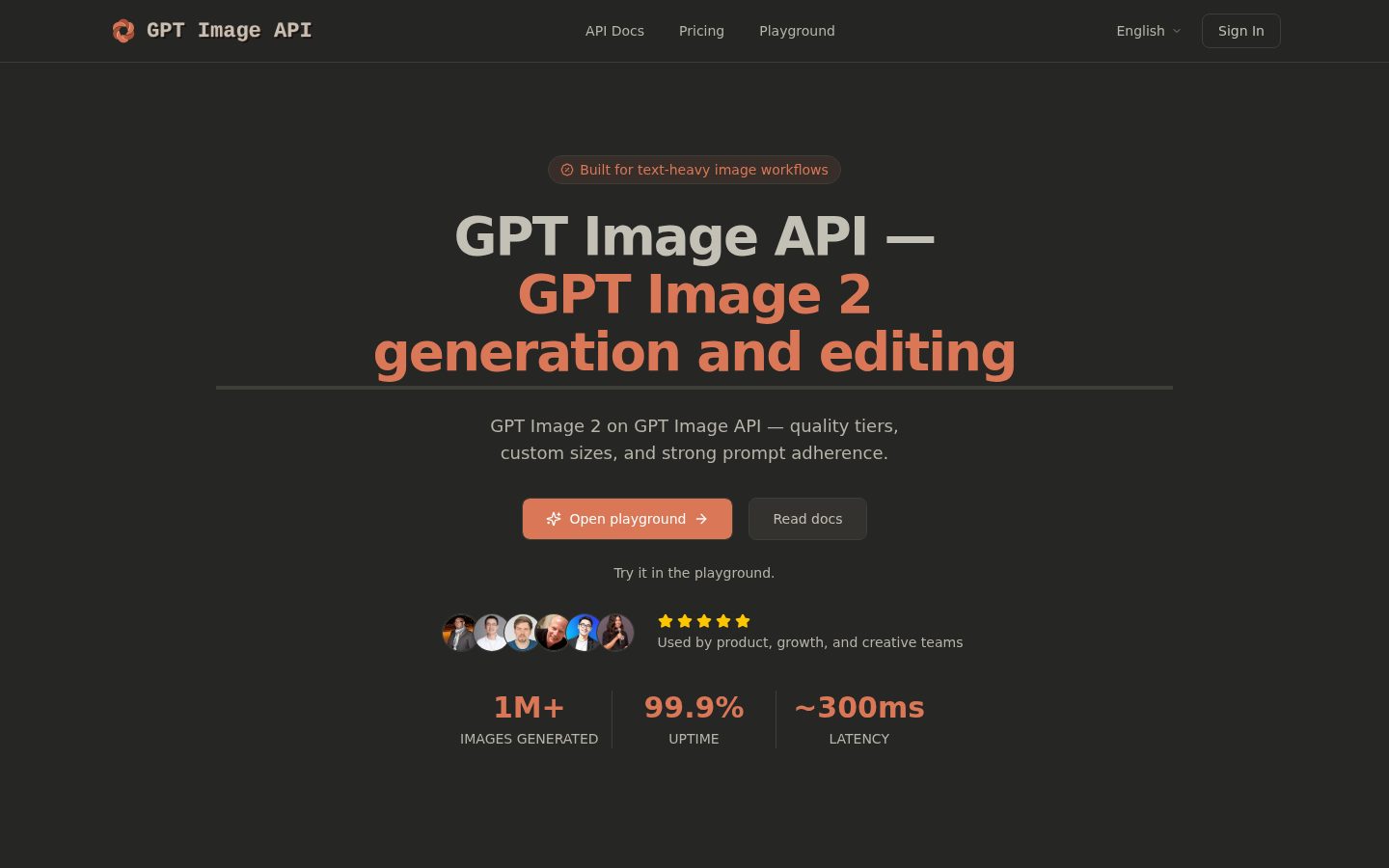
GPT Image API is a developer API for generating and editing images with GPT Image 2, targeted at text-heavy visuals.
AI Panel Score
6 AI reviews
Reviewed
AI Editor ApprovedApproved and published by our AI Editor-in-Chief after full panel analysis.GPT Image API is used by sending requests to endpoints such as POST /v1/images/generations with model set to "gpt-image-2", retrieving the resulting image URL from the response. For tasks that take longer to process, the API offers an async route (POST /v1/async/images/generations) that returns a task ID to poll via GET /v1/tasks/{id} until the status reaches "completed", at which point the asset URL is available in the result. For editing existing brand-approved assets, such as updating copy, packaging details, or scene elements, the documentation recommends using the image edit route (POST /v1/images/edits) rather than regenerating an image from scratch.
The product's documented prompting guidance is built around getting literal text to render correctly inside generated images: wrapping exact copy in quotes, keeping each text region short, separating must-have text from styling instructions, and specifying layout context explicitly. It also documents seeded reruns so teams can reproduce consistent outputs for review, and recommends storing prompts and seeds alongside each request. Separate guidance covers CJK (Chinese, Japanese, Korean) text, advising concise literal copy and validation of spelling, placement, and legibility against representative inputs before publishing.
The API is aimed at teams and developers building applications that require accurate in-image text, such as marketing collateral, packaging mockups, or social media graphics. Pricing details, plan tiers, and trial availability are not specified in the available documentation; access and usage rules are described in the full product reference rather than the public marketing pages.

Provides documented prompting techniques such as wrapping literal copy in quotes, keeping text regions short, and separating must-have text from styling instructions.
Produces GPT Image 2 outputs designed to render literal in-image text accurately for posters, menus, app mockups, packaging comps, and social cards.
Submits long-running image generation jobs via POST /v1/async/images/generations and lets clients poll GET /v1/tasks/{id} until completion to retrieve the result URL.
Supports using seeded reruns so teams can consistently reproduce and review generated images by storing prompts and seeds alongside each request.
Edits existing brand-approved images via POST /v1/images/edits to update copy, packaging, or scenes without regenerating from scratch.
Generates images synchronously via POST /v1/images/generations using the gpt-image-2 model, returning an image URL in response.data[0].url.
Provides configurable output options for image generation and editing requests, as referenced in the API request fields.
Offers specific guidance for Chinese, Japanese, and Korean text to keep literal copy concise and validate spelling, placement, and legibility before publishing.
Offers a one-page developer guide covering quick start, authentication, endpoints, request fields, responses, errors, and code examples.
Publishes official notices about model availability, service changes, and promotions on a dedicated announcements page.
For first prompts, benchmark runs, and internal proof-of-concept work.
For recurring social assets, experiments, and editorial visuals.
For teams shipping launch pages, UI mockups, and client-visible assets every week.
For batch generation, campaign operations, and multi-seat creative teams.
For agencies and in-house studios running frequent high-resolution assets.
For the heaviest branded content pipelines and multi-client delivery flows.
For platform-scale integrations and dedicated production pipelines.
For the largest content operations and enterprise AI workloads.
A repackaged GPT Image 2 wrapper priced against OpenAI, not differentiated from it.
“Solid docs and a real feature set for text-heavy image work. But it's a credit-based reseller of someone else's model, not its own moat.”
$10 gets you 1,000 credits, roughly 1,000 low-quality images, valid one year. Every tier claims savings versus OpenAI directly — 10% at Starter, up to 25% at the $5,000 Ultra tier. That's the whole pitch: same model, markup arbitrage on volume.
The product itself is competent. Async task handling via POST /v1/async/images/generations, seeded reruns for review consistency, and dedicated CJK guidance for literal text placement are real, documented features, not vague promises. The image edit endpoint for updating brand-approved assets without full regeneration is a genuinely useful primitive for production teams.
Tradeoff: you're dependent on OpenAI's model roadmap and pricing, with this vendor as a pass-through layer. An announcements page exists, no pricing-page trial, no visible security or compliance detail for teams handling client assets. Fine for prompt iteration and batch social content. Riskier if you need contractual guarantees on uptime or data handling.
CJK text guidance and seeded reruns for review are concrete differentiators versus raw model access.
No security or compliance detail I could find, and credits expire after 1 year with no refund terms shown.
Single API key, synchronous endpoint, and $10 entry tier let a team test text-in-image quality same day.
Saves cost on an existing capability (GPT Image 2 access) rather than unlocking new ones.
Docs are complete with code examples and error handling, and there's a blog, though no changelog surfaced.
Teams needing accurate in-image text for marketing or packaging who want lower per-image cost than going direct.
Skip if you need contractual SLAs or compliance guarantees beyond what a thin API wrapper documents.
A clean wrapper around GPT Image 2's text-rendering strength, but you're renting someone else's model with no visible SLA.
“This is a thin, well-documented API layer over GPT Image 2, priced as prepaid credit packs rather than usage-based billing despite the category tag. Solid for teams that need in-image text accuracy now, but the architecture is entirely dependent on upstream model access.”
The endpoint design is unremarkable in a good way: POST /v1/images/generations, an async task/poll route for batch jobs, and an edits endpoint that lets you patch a brand-approved asset instead of regenerating it. That's the right shape for production pipelines — edit-in-place saves both cost and review cycles. The documented prompt patterns (quoted literal copy, CJK validation guidance, seeded reruns for reproducibility) show someone has actually shipped text-heavy generation work before, not just wrapped an OpenAI call.
What's missing is any SLA or rate-limit documentation — I found docs, a pricing page, an announcements page and a blog. Credits expire at 1 year, sold in one-time packs from $10 to $5,000, which is a strange billing model for something calling itself usage-based.
If you adopt this, in three years you have a dependency on a third party's access to GPT Image 2, with your own reliability capped by theirs. Fine for prototyping or a bounded campaign pipeline; risky as the only path to a model you can't call directly.
Positioned squarely against calling OpenAI directly, undercutting on price (10-25% savings claimed) while adding CJK and edit-focused tooling.
Async task/poll pattern and an edits endpoint for brand-approved assets match how production teams actually batch and iterate.
Single API key, REST endpoints, and webhook-based async completion integrate cleanly, but there's no SDK or client library mentioned.
One-year credit expiry and no SLA I could find mean you're locked to a reseller layer, though an announcements page does track updates.
Prompt-pattern docs and CJK guidance show real craft, but the core value is entirely inherited from GPT Image 2, not built here.
Teams needing accurate in-image text for marketing or packaging assets who want a cheaper, better-documented wrapper than calling the model directly.
Avoid if you need contractual SLAs, a changelog for audit trails, or want to own the model relationship directly.
Credits never expire faster than a year. Everything else is prepaid guesswork.
“Eight tiers, all priced, all visible. No subscription — just credit packs that expire in 12 months.”
$10 buys 1,000 credits. At low-quality 1K resolution, that's ~1,000 images — $0.01 each. Scale to Business at $100 for 10,500 images, same math, better bonus credits. No monthly fee, no seat pricing. That's rare in this category.
TCO math gets fuzzy fast. Quality tiers multiply credit cost 4x from low to high. A team running high-fidelity packaging comps burns through Growth's 20,000 credits quicker than the marketing math implies. Credits expire in 1 year — use them or lose them. No published overage rate beyond buying the next tier up.
Each tier claims savings "vs OpenAI" — 10% at Starter, 25% at Ultra. No named competitor pricing shown to verify that math myself. Billing is one-time purchase, not invoiced — fine for a dev card, friction for procurement wanting POs and terms.
One-time card purchase, no invoicing terms mentioned — light for solo devs, friction for finance teams needing POs.
No auto-renewal risk since it's one-time credit purchase, but 1-year expiry forces re-buying.
All 8 tiers and credit counts published with no sales call required.
Cost-per-image is calculable; text-accuracy value (fewer redo cycles) isn't quantified anywhere.
Quality tier multiplies cost 4x per image; no overage rate published beyond upgrading packs.
Developers who want prepaid, calculable per-image cost without a subscription.
You need invoiced procurement terms or usage that won't burn credits within a year.
Solid REST surface for text-heavy image gen, but pricing model is one-time credits, not usage billing
“POST /v1/images/generations and the async /v1/async route cover the two real-world shapes of this job. Docs read like they were written by someone who's actually polled a task ID before.”
Endpoint shape is sane: sync POST /v1/images/generations for quick calls, async with GET /v1/tasks/{id} polling for batch work. That's the correct split — I've been burned by APIs that only offer sync and time out on real workloads. Edit route (POST /v1/images/edits) instead of full regen for brand-approved assets is a good call; saves credits and keeps layout stable.
Seeded reruns plus 'store prompts and seeds alongside each request' is the kind of advice that only shows up when someone got burned in a review cycle. CJK guidance is oddly specific — validating spelling/placement/legibility before publish reads like a postmortem, not marketing copy.
Friction: pricing is credit packs valid for 1 year, not metered usage despite being labeled usage-based — $10 gets 1,000 credits, that's a budgeting exercise, not a bill. No webhook confirmation in the docs excerpt beyond a buyer-question mention, so I'd want to see the actual payload before trusting production batch runs. No pricing tier for pay-as-you-go if you're prototyping small.
Async polling and edit-vs-regenerate guidance suggest real production use, not just a demo endpoint.
Prompt-quoting rules, CJK validation steps, and seed-storage advice read like practitioner notes, not landing-page copy.
Credit packs expiring after 1 year add a bookkeeping task usage-based billing normally avoids.
Low/medium/high quality tiers and seeded reruns scale reasonably, and an announcements page tracks updates, though version drift still takes watching.
Standard REST verbs and a single API key fit existing pipelines; webhook details for batch jobs are thin from what I could find.
Teams shipping text-heavy visuals like packaging comps or social cards who can plan credit purchases ahead.
You need transparent per-call metered billing without buying credit packs upfront.
A REST API for text-in-images, sold like phone minutes you buy in bulk
“Solid, focused endpoint for a real problem — legible text inside generated images. But there's no free trial, no dashboard tour to speak of, and you're buying credits upfront like a prepaid card.”
This is a dev tool, so 'daily polish' means: does the doc read like someone actually shipped with it. It mostly does — POST /v1/images/generations, async polling via GET /v1/tasks/{id}, an edit route so you're not regenerating a whole poster to fix one typo. That's the right shape for real production work, not just demo prompts.
Onboarding is a scoped API key and a curl command, which is homework, but familiar homework if you've used any image API before. No free trial though — you're in at $10 for 1,000 credits before you know if CJK text guidance actually holds up on your fonts. That's a real cost of finding out.
The pricing ladder (up to $5,000 for 500K credits) tells me this is built for teams who already know they need volume, not folks kicking tires. Seeded reruns for reproducibility is a nice touch — most teams forget review workflows until month three, and here it's documented on day one. Mobile isn't really the point; this lives in your build pipeline, not your pocket.
Edit endpoint, seeded reruns, and quality tiers (low/medium/high) show real workflow thinking, not just a generate button.
Documented prompt patterns for literal text and separate CJK guidance give a real path from first request to production quality.
Web-only platform listed; evidence is silent on mobile SDKs, which is normal but unremarkable for an API product.
One-page doc and a curl-first quickstart, but no free trial means the first ten minutes cost $10 minimum.
Async task polling with status states is the right pattern for long jobs; updates land on an announcements page, though I couldn't find a status page.
Teams building packaging, menus, or social assets who need literal text to render correctly and are ready to commit budget upfront.
You want to test the water with a free trial before committing any money.
A wrapper on OpenAI's own model, priced as 'savings' off OpenAI.
“Every tier brags about saving vs OpenAI directly — which tells you exactly what this is. Solid docs, real endpoints, but the moat is thin.”
"Save 10% vs OpenAI" is on every single tier. That's not a differentiator, that's an admission — this is GPT Image 2 behind a markup arbitrage, not a distinct model or capability. Fine if the convenience is worth it. Not fine if you think you're buying something OpenAI doesn't already offer directly.
The docs are genuinely specific: POST /v1/images/generations, async polling via /v1/tasks/{id}, seeded reruns, CJK guidance. That's real engineering, not vapor. Credits expire after 1 year, which is a fair constraint most vendors bury.
Exit portability is the real question. If this shuts down, you're rewriting to hit OpenAI's endpoint directly — probably a day of work, not a migration project. An announcements page and a blog exist, no pricing-page tiers beyond credits. Fine for a thin layer. Just know what you're paying the markup for.
Every pricing tier's selling point is a percentage saved vs OpenAI — that's arbitrage, not a distinct capability.
Standard REST shape means switching to the underlying model's own API directly is plausible, per the documented request format.
One-page docs, an announcements page and a blog exist, though maintenance cadence is still hard to verify.
Claims are grounded in real endpoints, but "Save X% vs OpenAI" framing undersells that it's reselling the same underlying model.
Specific endpoints, request fields, and CJK prompting guidance back the text-accuracy claim with real detail.
Teams that want a discount layer on GPT Image 2 without dealing with OpenAI's account setup directly.
You need a durable architectural reason to pick this over calling the underlying model yourself.
Common questions answered by our AI research team
Yes. GPT Image API supports Chinese, Japanese, and Korean text — keep copy concise, quote literal text in the prompt, and validate spelling, placement, and legibility with representative inputs before publishing.
Low quality is best for prompt iteration and testing, medium is the default for most product work, and high quality is reserved for public-facing assets where text fidelity and final polish matter.
Yes. Edit routes let you update copy, packaging, or layout on brand-approved assets instead of regenerating from scratch, making them ideal when you already have an approved base image.
Queue jobs asynchronously with webhook-based completion so batch runs don't tie up synchronous workers or browser sessions. Store prompts and seeds alongside each request and validate outputs automatically where possible.
Create a scoped API key from the developer console, then send a POST request to https://api.gptimageapi.dev/v1/images/generations with the model set to "gpt-image-2" and a prompt and size — the same endpoint works across all supported models.
GPT Image API provides a hosted API for generating and editing images with GPT Image 2, including a browser-based playground for testing prompts.