Pixapi logo

Pixapi Review

Visit

Unified API access to image and video generation model routes

Pixapi is an API platform for developers building image and video generation workflows.

AI Panel Score

7.4/10

6 AI reviews

Reviewed

About Pixapi

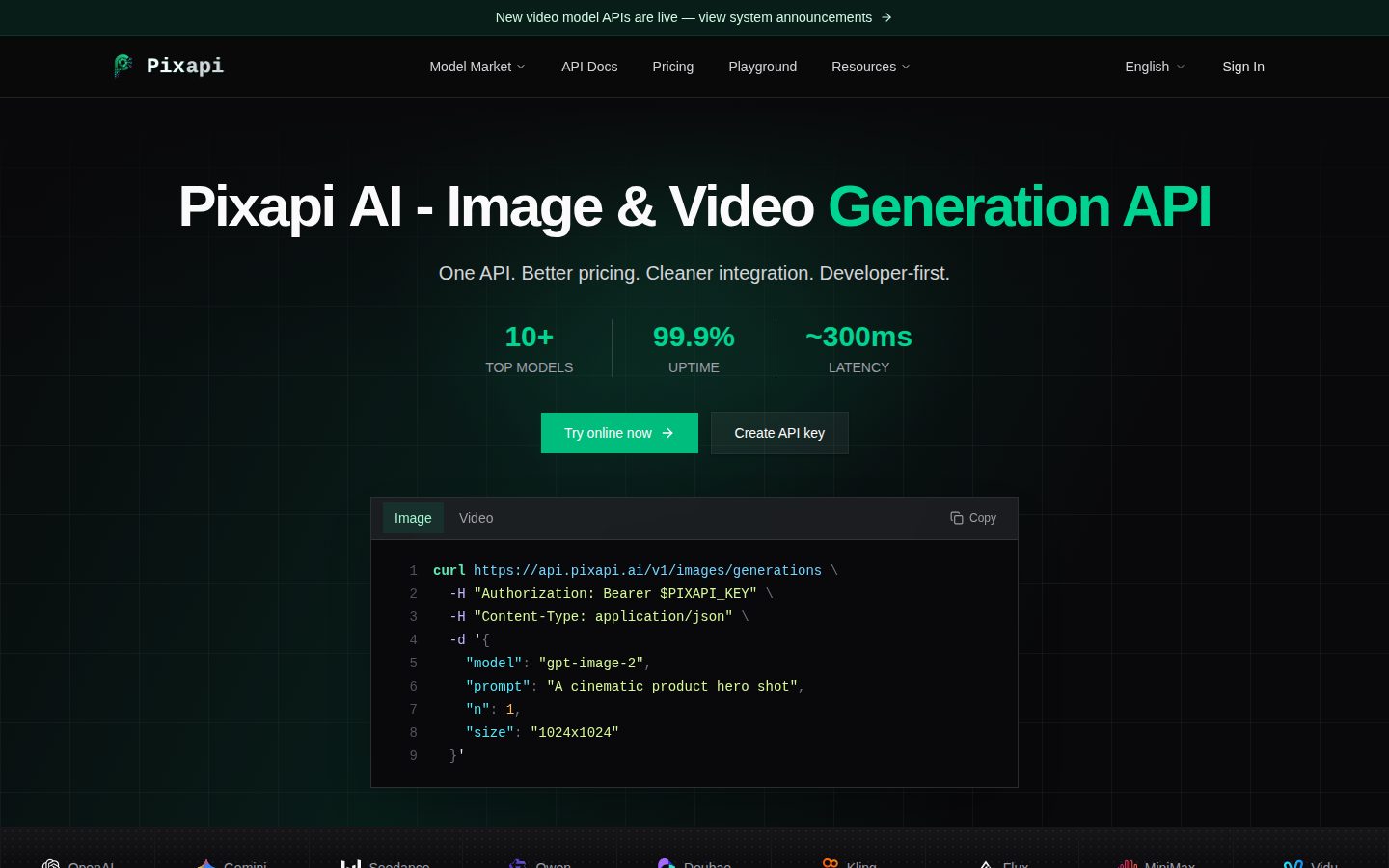
Pixapi gives developers a single API to call for image and video generation rather than integrating separately with each model provider. For images, a request to /v1/images/generations with a model id such as gemini-3.1-flash-lite-image returns a result with the image URL in response.data[0].url. Video generation works differently: requests go to the async endpoint /v1/async/videos/generations, and the client polls GET /v1/tasks/{id} until the task status is completed, then reads the media URL from result.data[0].url. For image-to-video workflows, a generated image URL is passed as input along with parameters for duration (seconds) and resolution (480p, 720p, 1080p, or 4k, depending on model support).

The platform's model catalog includes named video model ids such as seedance-2, seedance-2-fast, seedance-2-mini, kling-3.0-turbo, kling-v3, kling-v3-omni, wan2.6, wan2.6-flash, grok-video-3, grok-video-1.5-preview, and happyhorse-1.1, each with dedicated documentation pages. Pixapi also offers a Nano Banana API specifically for accessing Google Gemini image models, with a published price comparison against Google AI, fal.ai, and Replicate list prices. Beyond the core API, Pixapi provides a Remote MCP server with OAuth so AI agents can connect for pricing lookups, Gemini image generation, and task result retrieval, plus a prompt library of source-verified commercial image and video prompts that can be opened directly in a Playground.

Pixapi is aimed at developers building applications that need image or video generation, and it publishes a comparison page against other AI API platforms including Replicate, fal, Runware, and PiAPI. Pricing is based on one-time credit packs covering image, editing, and video API usage, tracked through account usage and API keys rather than a recurring subscription.

Access to the API requires an API key, and account usage is tracked through credits. The documentation covers authentication, model-specific parameter pages, code examples in cURL, JavaScript, and Python, billing, and error handling. Pixapi explicitly deprecates older integration patterns, instructing developers not to use the /v1/videos/generations endpoint, the async=true parameter, or the image_url field for new integrations, in favor of the async task and image parameter patterns described above.

Features

AI

  • AI Image and Video Prompt Library

    Provides source-verified commercial image and video prompts that can be opened directly in the Pixapi Playground.

  • Image Editing API

    Enables editing of reference images and building product image workflows using supported image models.

  • Nano Banana API Access

    Offers access to Google Gemini image models (Nano Banana) through a simple REST integration at lower price points.

  • Video Generation Workflows

    Supports text-to-video and image-to-video generation, allowing users to set video length via seconds and resolution options like 480p, 720p, 1080p, or 4k.

Analytics

  • AI API Platform Comparison

    Compares Pixapi against other AI API platforms such as Replicate, fal, Runware, and PiAPI.

  • Nano Banana Price Comparison

    Compares Pixapi's Nano Banana API pricing against Google AI, fal.ai, and Replicate list prices.

Core

  • AI Model Catalog

    Lets developers browse available Pixapi image and video generation models, their ids, categories, and endpoint mappings in one place.

  • Asynchronous Video Generation with Task Polling

    Submits video generation jobs via POST /v1/async/videos/generations and lets developers poll GET /v1/tasks/{id} for status, progress, and final media URLs.

  • Credit-Based Pricing and Usage Tracking

    Uses API keys, prepaid one-time credit packs, and per-request usage tracking to manage account access to image, editing, and video API usage — no subscriptions, seat fees, or monthly minimums.

  • Synchronous Image Generation Endpoint

    Generates images synchronously via POST /v1/images/generations, returning an image URL in response.data[0].url.

  • Unified Image and Video Generation API

    Provides a single REST API that routes requests to multiple image and video generation models, including Nano Banana, Seedance, Kling, Wan, Grok Video, and HappyHorse.

Integration

  • Pixapi MCP (Model Context Protocol)

    Connects AI agents to Pixapi through Remote MCP and OAuth for pricing lookups, Gemini image generation, and retrieving task results.

Preview

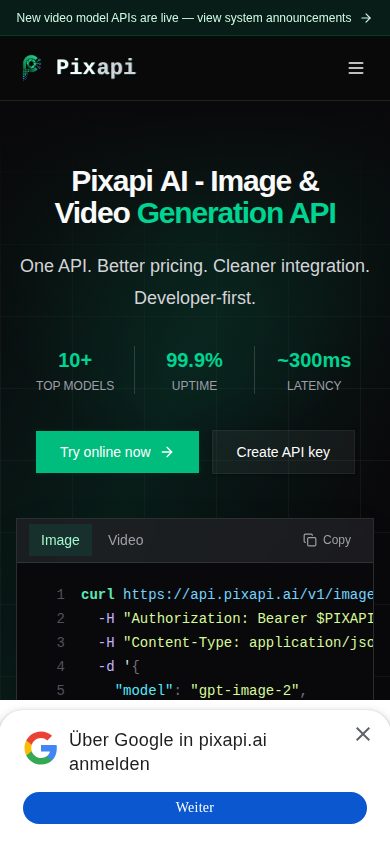
Pixapi desktop previewPixapi mobile preview

Pricing Plans

Pay as you go

Contact sales

No subscriptions or seat fees; prepaid credit system for calling 10+ production image and video models through one API. Top up from $10, 1 credit ≈ $0.01, credits valid for 1 year.

  • No monthly fee, prepaid credits
  • Create API key without a credit card
  • Failed generations are not charged
  • Usage metered per request, real-time console tracking
  • Pay via card, Alipay/WeChat, or bank transfer with auto top-up
  • Access to GPT Image 2, GPT Image 1.5, Gemini 3.1/2.5 Flash and Gemini 3 Pro Image models

AI Panel Reviews

The Decision Maker

The Decision Maker

Strategic bet, vendor viability, timing, adoption approval
7.2/10

One API for ten-plus image and video models, priced by the credit, no subscription required.

Pixapi routes requests to Nano Banana, Seedance, Kling, Wan, Grok Video, and HappyHorse behind one REST interface. Solid plumbing, unproven company.

Ten-plus models, one API key, credits starting at $10. That's the pitch, and the docs back it up with real endpoints: synchronous /v1/images/generations, async /v1/async/videos/generations with task polling. They've even deprecated old patterns like async=true, which tells me someone's actively maintaining this, not just running a wrapper and walking away.

Two questions matter here. One: does aggregation add value or just save a few integration hours? For teams juggling five model providers, routing plus a Nano Banana price comparison against Google AI, fal.ai, and Replicate is real leverage. Two: what happens when Gemini or Kling changes their API and Pixapi lags?

Credits valid one year, failed generations not charged, no card required for a key. Fair terms. The release log only goes back to July 2026, there's no funding data, and there's lock-in risk if your prompts and workflows live entirely inside their task polling model.

Competitive Positioning7.0

Published comparison against Replicate, fal, Runware, and PiAPI shows a clear price and routing angle versus going direct to providers.

Reputation Risk6.5

Credit-based billing is transparent, but no security/compliance detail is given for an API handling generated media at scale.

Speed to Value7.8

No card needed to create a key, $10 top-up, cURL/Python/JS examples suggest a first request in minutes.

Strategic Fit7.5

Consolidating multi-model calls into one API advances build speed, not just cost, for teams shipping gen-AI features.

Vendor Viability7.0

Deep docs, model-specific pages, and active deprecation of old endpoints signal ongoing development.

Pros

  • Single API for Nano Banana, Seedance, Kling, Wan, Grok Video, HappyHorse
  • No subscription, credits valid 1 year, failed generations free
  • MCP server with OAuth for agent-based workflows

Cons

  • A release log that only starts in July 2026 and no funding signal to gauge long-term durability
  • No security/compliance detail for production media pipelines
  • Adds a routing dependency between you and the underlying model providers

Right for

Developers building multi-model image or video features who don't want to integrate each provider separately.

Avoid if

Skip it if you need one specific model long-term and want to negotiate pricing directly with that provider.

The Domain Strategist

The Domain Strategist

Craft and strategy in the product's domain — adapts identity per category, same lens
7.2/10

A REST aggregator over 10+ image and video model routes, priced and versioned like infrastructure meant to last.

Pixapi is a routing layer, not a model — the value is in normalizing sync image and async video calls across vendors. That's a real engineering problem, but it also means you're trusting their uptime as much as Google's or Kling's.

The core bet here is normalization: one Bearer-auth REST API in front of Nano Banana, Seedance, Kling, Wan, Grok Video, and HappyHorse, with sync /v1/images/generations and async /v1/async/videos/generations plus task polling. That's the correct shape for the job — video generation is inherently async, and treating it as sync would be the amateur mistake. They've also already deprecated their own old endpoint (/v1/videos/generations, async=true, image_url) in favor of cleaner patterns, which tells me someone is maintaining this, not just shipping and abandoning.

The risk is architectural dependency, not code quality. If we adopt Pixapi, in three years we've outsourced our multi-model routing and failover logic to a layer we don't control, priced on credits (1 credit ≈ $0.01, packs from $10, valid 1 year). If a provider they route to changes pricing or deprecates a model, we're waiting on Pixapi's docs team, not our own.

The MCP server with OAuth is the interesting long-term signal — agent-native access matters more than the REST wrapper alone.

Category Positioning7.3

Publishes direct pricing comparisons against Google AI, fal.ai, Replicate, Runware, and PiAPI — positioning itself explicitly as the cost-arbitrage layer over those platforms.

Domain Fit7.8

Async task polling for video matches how production image/video pipelines actually have to be built.

Integration Surface7.5

cURL, Python, and JS examples plus a Remote MCP server with OAuth cover both classic REST and agent-based integration paths.

Long-term Implications6.5

Credits expire in 1 year and routing logic lives outside our stack, creating a renewal and dependency decision point every 12 months.

Strategic Depth7.0

Sync/async split and endpoint deprecation notices show real API design maturity, and a dated announcements log — starting July 2026 — shows ongoing iteration.

Pros

  • Unified endpoint for 10+ image/video models cuts per-provider integration work
  • Async task polling pattern is correctly modeled for video generation
  • No-credit-card key creation and failed generations not charged lowers evaluation cost
  • Remote MCP server with OAuth positions it for agent-driven, not just app-driven, workflows

Cons

  • A blog and release log that only begin in mid-2026 make release discipline hard to judge over time
  • Credits expire after 1 year, forcing a recurring cost decision unrelated to usage
  • Routing dependency means provider-side pricing or deprecation changes hit us indirectly

Right for

Teams building multi-model image or video features who don't want to maintain five separate provider SDKs.

Avoid if

Avoid if you need direct SLA guarantees from the underlying model vendor rather than an intermediary.

The Finance Lead

The Finance Lead

Money, total cost of ownership, contracts, procurement math
7.7/10

A 1080p second of Seedance 2 costs 38 credits — 38 cents, published before you spend it.

Prepaid credits at a cent each, no subscription, no card required to start. Every model publishes its own credit cost — images per output, video per second at each resolution — so the bill is computable before the first call.

You can build the spend model before you write the integration. Seedance 2 posts 8 credits per second at 480p, 16 at 720p, 38 at 1080p, 78 at 4K. Images price the same way — Gemini 3.1 Flash Lite Image at 2 credits. A credit is a cent.

Ten thousand image calls a month at 2 credits each is $200. Every video model page carries the same resolution-by-second grid, so the video line is a spreadsheet, not a guess. Failed generations aren't billed. No seat fees, no monthly minimums, no SSO tax.

No auto-renewal to diary. You exit by not topping up. Pixapi publishes its own rate comparisons against fal, Replicate, Runware and PiAPI — rare candour on a pricing page. The catch is procurement: credits are prepaid, no invoicing or net terms are disclosed, and unused credits expire at 12 months.

Billing & Procurement7.0

No credit card required and card, Alipay/WeChat or bank transfer accepted, but no invoicing terms disclosed.

Contract Flexibility8.5

Prepaid credits, no subscription, credits valid 1 year — no auto-renewal trap to negotiate.

Pricing Transparency8.2

Every model publishes its credit cost upfront — images per output, video per second at each resolution — with no sales call.

ROI Clarity7.0

Per-call billing with unbilled failed generations makes cost-per-output easy to track.

Total Cost of Ownership7.8

One credit is one cent with no monthly fee, and the per-second video grid makes spend at scale computable.

Pros

  • Prepaid credits, no subscription, seat fees, or monthly minimums
  • Failed generations are not charged
  • Credit cost published for every model in the 30-model catalog
  • Comparison pages against fal, Replicate, Runware, PiAPI
  • Video billed per second at each resolution — 8 credits at 480p, 78 at 4K on Seedance 2

Cons

  • Credits expire 1 year after purchase
  • No invoicing or net payment terms published for procurement

Right for

Developers who price image and video generation per call before they build.

Avoid if

Finance teams who need monthly invoicing and net terms rather than prepaid credits.

The Domain Practitioner

The Domain Practitioner

Daily hands-on reality in the product's domain — adapts identity per category, same lens
7.6/10

One REST API for ten-plus image/video models, but sync images vs async video means two mental models

Pixapi routes to Nano Banana, Seedance, Kling, Wan, Grok Video and HappyHorse behind one key. The split between synchronous image calls and polled async video jobs is the daily friction point worth knowing about upfront.

Unified routing across 10+ models is the real pitch, and it's grounded in actual endpoint docs: POST /v1/images/generations returns response.data[0].url synchronously, while video goes through /v1/async/videos/generations plus GET /v1/tasks/{id} polling. That's two different client patterns to maintain in the same SDK wrapper. Fine once you've built the polling loop, mildly annoying every time you onboard a new model that ships as one or the other.

They've explicitly deprecated /v1/videos/generations, async=true, and image_url in favor of the current patterns — good sign they're maintaining docs against real usage, not letting stale pages rot. Credit pricing is transparent per-model (Gemini 3.1 Flash Lite Image at 2 credits, GPT Image 2 from 1 credit), failed generations aren't charged, and no card is needed to get an API key.

MCP server with OAuth is a nice touch for agent workflows, though it's unclear how deep that surface goes beyond pricing lookups and Gemini calls.

Day-3 Reality7.5

Sync image calls are simple; async video polling adds real state-management work once you're past the first request.

Documentation Practitioner-Fit8.0

Model-specific parameter pages plus cURL/JS/Python examples for each endpoint reads like docs written against real integration, not marketing copy.

Friction Surface7.5

Deprecated endpoints (image_url, async=true) are called out explicitly, reducing the chance of building against dead patterns.

Power-User Depth7.5

MCP server, prompt library, and per-model resolution/duration params give room to grow, though depth beyond Gemini access is unverified.

Workflow Integration7.0

One API key and REST calls fit standard backend patterns, but two request/response shapes (sync vs async) means two code paths.

Pros

  • Single API key covers Nano Banana, Seedance, Kling, Wan, Grok Video, HappyHorse
  • Credit pricing is per-model and transparent; failed generations aren't billed
  • No credit card required to create an API key and start testing

Cons

  • Sync image endpoint and async video-with-polling endpoint require separate client logic
  • No free trial or free tier beyond pay-as-you-go credits
  • MCP server scope (pricing, Gemini, task retrieval) looks narrow compared to full API surface

Right for

Backend developers who need one billing relationship and one auth pattern across multiple image and video generation models.

Avoid if

Avoid if you need a single unified request/response shape across both image and video without maintaining separate sync and async code paths.

The Power User

The Power User

Daily human experience, onboarding, polish, learning curve, reliability
7.2/10

A sane API wrapper for image and video models, if you like reading docs first

Pixapi puts Nano Banana, Seedance, Kling, Wan, Grok Video and HappyHorse behind one REST API with credit pricing. It's clearly built by developers for developers, not for anyone who wants a UI to poke at.

There's no app here, this is a product you live inside your codebase, so 'daily polish' means: are the docs clean and do the endpoints behave. On that front it looks decent — cURL, Python, JS examples, model-specific pages, and they've actually gone back and deprecated old patterns like /v1/videos/generations and async=true instead of just letting cruft pile up. That's the kind of housekeeping most API platforms skip.

Onboarding is API-key-and-go: no credit card required, $10 minimum top-up, 1 credit ≈ $0.01, credits valid a year. That's homework you can finish in ten minutes, not a sales call. The async video flow (submit, then poll /v1/tasks/{id}) is standard for this category but adds a state machine you have to build yourself — no webhooks mentioned.

Learning curve is gentle at first, since image gen is synchronous and simple, but scales up once you're juggling video resolutions, durations, and model-specific quirks across 10+ models. Mobile and reliability are non-questions for a backend API — the real tradeoff is you're trusting Pixapi's routing layer over going direct to each provider like fal or Replicate, which they compare themselves against on pricing.

Daily Polish7.5

Deprecating old endpoints and maintaining model-specific docs pages shows active upkeep.

Learning Curve7.0

Sync image vs async video patterns differ, adding real complexity once video and multiple models enter the picture.

Mobile Parity6.5

Evidence is silent on any client apps; this is a server-side API product so the dimension is largely moot.

Onboarding Experience7.8

No credit card needed, $10 minimum top-up, and code examples in three languages make first requests fast.

Reliability Feel7.0

Failed generations aren't charged and task polling is documented, but no webhook or uptime info is given.

Pros

  • Single API for 10+ image/video models including Nano Banana, Seedance, Kling, Wan, Grok Video, HappyHorse
  • No credit card required, credits from $10, valid one year
  • Failed generations aren't billed
  • Active deprecation of legacy endpoints shows real maintenance

Cons

  • Async video requires building your own polling logic, no webhook mentioned
  • No free trial or free plan beyond pay-as-you-go credits
  • Pricing model is credits, not a clean subscription, which some teams may find harder to budget

Right for

Developers who want one API key instead of five provider integrations for image and video generation.

Avoid if

You want a subscription with predictable monthly billing rather than a prepaid credit system.

The Skeptic

The Skeptic

Contrarian. Watch-outs, deal-breakers, broken promises, category patterns
7.3/10

The public track record is real and dated — it just starts in July 2026.

Pixapi routes image and video models through one REST API, with per-resolution credit pricing published model by model. The release log and blog are both real and both start mid-2026, so the maintenance record is short rather than missing.

July 2, 2026. That's the oldest dated entry on the announcements page, and the newest is September 6. Three blog posts, all from early September. So there is a public record here — it's just three months deep.

The specifics hold up. Video is priced per resolution per second — seedance-2 is 8 credits at 480p, 38 at 1080p — and the Nano Banana Price Comparison puts the image rates next to Google AI, fal.ai and Replicate instead of a contact form.

But the deprecation list is already three items long — /v1/videos/generations, async=true, image_url — on a platform this young. Exit is cheap either way: it's a routing layer, so you re-point at the provider. $10 to start, credits good for a year, no subscriptions or seat fees. Fine bet for prototyping. Watch the cadence before production.

Competitive Differentiation7.0

Unified routing plus a published per-model price matrix is a real angle in a field that already holds Replicate, fal, Runware and PiAPI.

Exit Portability7.0

Thin routing layer over named third-party models means reverting to a direct provider integration is straightforward.

Long-term Viability6.5

A dated release log runs July to September 2026 alongside three blog posts — active, but only about three months of public cadence.

Marketing Honesty8.0

Comparison pages name Replicate, fal, Runware and PiAPI, and video rates are published per resolution rather than on request.

Track Record Match7.3

Endpoint behaviour, credit costs and per-model video rates all check out against the published model pages.

Pros

  • Detailed docs with cURL, Python and JS examples for every endpoint
  • No monthly fee, credits from $10, failed generations not charged
  • Broad model catalog: Nano Banana, Seedance, Kling, Wan, Grok Video, HappyHorse

Cons

  • Dated release notes only run back to July 2026, so the cadence is short
  • Already deprecating three older endpoint patterns
  • Prepaid credits expire after one year, so unused balance is a real cost

Right for

Developers who want one API key across several image and video model providers.

Avoid if

Teams who need years of published release history before committing production traffic.

Buyer Questions

Common questions answered by our AI research team

Pricing

How is usage billed on Pixapi?

Pixapi uses transparent, usage-based credits. Each model has a credit cost shown upfront (e.g., Gemini 3.1 Flash Lite Image costs 2 credits, GPT Image 2 starts from 1 credit), and you pay only for successful outputs while tracking usage from your developer console.

Features

How does video generation differ from image generation?

Image generation runs synchronously through the /v1/images/generations endpoint, returning results directly. Video generation is asynchronous via /v1/async/videos/generations, requiring you to poll the GET /v1/tasks/{id} endpoint until the task completes and the final output is available.

Integration

Which image and video models does Pixapi support?

Pixapi routes requests to 10+ models including Nano Banana (Google Gemini image models like Gemini 3.1 Flash Lite Image, Gemini 3.1 Flash Image Preview, Gemini 3 Pro Image Preview), GPT Image 2, GPT Image 1.5, Seedance, Kling, Wan, Grok Video, and HappyHorse.

Setup

How do I get started with the Pixapi API?

Create an API key in the developer console, choose a model (image or video), and send your first request using the REST endpoint—Pixapi's example shows a first request completing in minutes with familiar cURL, Python, or JavaScript patterns.

Security

How are API keys managed and secured?

API keys are created, rotated, and revoked from the developer console, with secret credentials kept server-side. Scoped keys should be stored safely in your server environment, such as reading them from an environment variable like PIXAPI_KEY.

Product Information

  • Company

    Pixapi
  • Pricing

    Usage-based

Platforms

web

About Pixapi

Pixapi provides APIs for image and video generation models, allowing developers to integrate visual AI capabilities into their applications.

Resources

Documentation
API
Blog
Changelog

Also in AI APIs