AI-powered chat assistant built for HubSpot CRM
ChatSpot is an AI chat assistant that connects to HubSpot CRM to help with sales, marketing, and data tasks.
AI Panel Score
6 AI reviews
Reviewed
ChatSpot is an AI-powered assistant built by HubSpot and integrated directly with the HubSpot CRM platform. It allows users to perform CRM-related tasks through a conversational chat interface, using natural language instead of navigating menus or building reports manually. Users can ask questions, request summaries, create records, and pull data from their HubSpot account by typing plain-language prompts.
The tool is primarily aimed at sales representatives, marketing professionals, and business operations teams who already use HubSpot as their CRM. It lowers the barrier to accessing CRM data by eliminating the need to know where specific features are located within HubSpot's interface. This makes it useful for both experienced HubSpot users looking to work faster and newer users still learning the platform.
Key capabilities include prospecting assistance, contact and company record creation, deal pipeline summaries, drafting follow-up emails, and generating analytics reports. ChatSpot also includes templates for common prompts, allowing users to quickly perform recurring tasks without writing new queries each time. It leverages large language model technology combined with real-time access to a connected HubSpot account.
ChatSpot fits into a broader category of AI copilots for business software, similar to tools like Salesforce Einstein GPT or Microsoft Copilot for Dynamics. Its primary differentiator is its tight, native integration with HubSpot's existing data structures, meaning responses and actions reflect live CRM data rather than generic outputs. It operates as a web-based interface accessible separately from or alongside the main HubSpot platform.
As of its public availability, ChatSpot is offered at no additional cost to HubSpot users, though the depth of functionality may depend on the user's existing HubSpot subscription tier. It represents HubSpot's approach to embedding generative AI into its CRM workflow rather than offering AI as a standalone product.

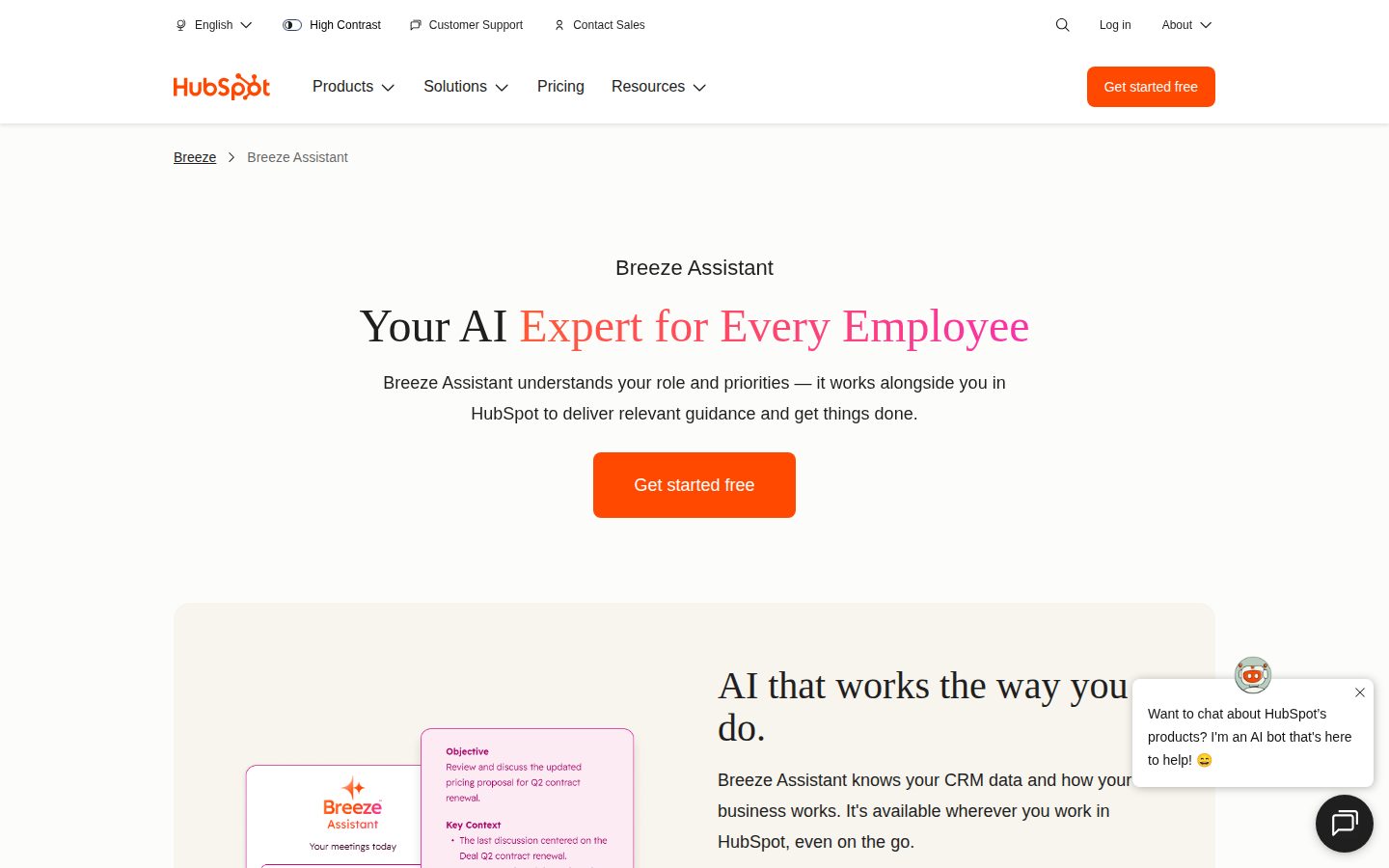
Breeze Assistant understands what the user is working on and where they are in HubSpot, delivering answers and guidance that are always relevant to the current context.
Built-in Loop Marketing expertise lets users define audiences, analyze performance, get content strategy guidance, and pressure-test campaign ideas with personalized distribution channel recommendations.
Pulls instant insights from customer records to help users get ready for meetings without manually reviewing CRM data.
Delivers instant expertise tailored to the user's specific role — such as a marketer planning campaigns or a sales rep managing deals — rather than one-size-fits-all responses.
Gives users access to 60+ HubSpot-created prompts for marketing, sales, and service, with the ability to save their own prompts and share them across the team.
Breeze Assistant requires no configuration, training, or code to get started, allowing immediate use within HubSpot subscriptions at no additional cost.
A centralized marketplace where users can discover, browse, build, and install AI agents and custom assistants for their specific business needs.
Allows users to create custom assistants trained on their company's specific knowledge via Breeze Studio, in addition to pre-built marketing, sales, and service assistants available out of the box.
Connects to emails, calendars, shared documents, and team conversations from Google Workspace, Microsoft 365, and Slack, making them accessible alongside CRM data in a single interface.
Breeze Assistant is available on the HubSpot mobile app for iOS and Android, enabling AI-assisted work from anywhere.
Breeze Assistant operates under HubSpot's strict enterprise-grade security and privacy standards, giving users control over how their CRM and workspace data is used.
Provides how-to guidance and accurate answers by pulling from HubSpot Academy, the HubSpot knowledge base, and the user's own business data rather than returning generic advice.
Breeze Copilot (formerly ChatSpot) is bundled with every HubSpot subscription at no additional cost. Not sold standalone.
A free CRM copilot from a public vendor that only pays off if you already run HubSpot.
“HubSpot is public since 2014 and closed 2025 near $3.1B in revenue with roughly 289,000 customers. The catch is that ChatSpot only delivers value inside an existing HubSpot subscription.”
HubSpot has been public since 2014 and closed 2025 near $3.1B in revenue with roughly 289,000 customers. No board asks whether this vendor survives three years.
The real call is whether ChatSpot advances you or just rebrands work you already do in HubSpot. It is now Breeze Assistant, bundled free across Marketing, Sales, and Service Hub, with a Prompt Library of 60+ ready prompts and Breeze Studio for custom assistants. Salesforce Einstein bundles similar copiloting, but ChatSpot acts on live CRM records, not generic text.
However, the value depends entirely on your HubSpot tier. Free seats cannot touch HubSpot Credits, and as of November 10, 2025 metered actions are required for the Prospecting Agent. Speed to value is real since setup is zero. If you already run HubSpot, switch it on.
Native live-CRM action differentiates it, though Salesforce Einstein offers comparable copiloting.
A NYSE-listed CRM leader is an easy choice to defend to any board.
No-Code Setup means it works immediately within a HubSpot subscription at no extra cost.
Advances existing HubSpot workflows but adds nothing for non-HubSpot stacks.
HubSpot is public since 2014 with roughly $3.1B in 2025 revenue and 289,000 customers.
HubSpot customers who want faster CRM workflows at no extra cost.
Teams not on HubSpot who would have to migrate to use it.
ChatSpot is now a native layer of HubSpot, so the strategic bet is the platform, not the assistant.
“ChatSpot has been folded into Breeze Assistant, a native AI layer across every HubSpot Hub. The craft is strong, but the architecture commits you fully to one CRM platform.”
A RevOps leader scoping a CRM platform through 2029 should read the rebrand history first. HubSpot, founded in 2006, shipped ChatSpot in 2023, renamed it Breeze Copilot at INBOUND 2024, then Breeze Assistant at INBOUND 2025. The assistant is no longer a product — it is a layer of the platform.
The craft ceiling is real. CRM-Aware Contextual Assistance reads where you are inside HubSpot and answers against live records, while Breeze Studio lets teams build custom assistants trained on company knowledge. Against Salesforce Einstein, the integration carries far less configuration ceremony because there is nothing to wire — it ships inside the seat.
The catch is the metering. Breeze is bundled at no extra cost, however the HubSpot Credits model gates real AI actions, credits expire monthly, and free seats are locked out entirely. The three-year bet is HubSpot itself, not the chat box.
A credible native-CRM-copilot answer to Salesforce Einstein and Microsoft Copilot for Dynamics.
Native to how HubSpot RevOps teams already work, eliminating menu-hunting across Marketing, Sales, and Service Hubs.
Connects Google Workspace, Microsoft 365, and Slack alongside live CRM data in one interface.
Adoption deepens commitment to the HubSpot platform with no portable path off it.
CRM-aware context plus Breeze Studio custom assistants give real depth beyond a generic chat wrapper.
RevOps teams already standardized on HubSpot as their CRM platform.
Teams that want a CRM-agnostic AI assistant they can carry across vendors.
ChatSpot is free, but HubSpot Credits at $0.010 each are the line item that grows.
“The assistant itself costs nothing on any paid HubSpot seat. The real budget is HubSpot Credits, which expire monthly and reprice your account when you run over.”
Sticker price on Breeze Copilot, formerly ChatSpot, is zero. It bundles into every paid HubSpot seat at no charge. Free and View-only seats are excluded, so the real cost is whatever Hub subscription you already carry.
The meter is HubSpot Credits. They expire monthly, no rollover. Overage runs $0.010 per credit, roughly $9 per 1,000 on an annual commitment. The catch is the default: hit your limit and the account auto-upgrades to the next capacity pack for the rest of the term. You must opt into pay-as-you-go to avoid the sticky upgrade.
ROI is legible if you watch the credit ledger. Compare to Salesforce Einstein, which prices AI as a paid add-on. HubSpot bundles the assistant; the credits are where the invoice moves.
No separate contract or vendor onboarding; it rides on the existing HubSpot invoice.
Credits expire monthly and the default auto-upgrade locks a higher capacity pack for the full term.
The assistant is openly free on paid seats, and the $0.010 credit overage rate is published.
Credit usage is metered per action, so AI spend is auditable against output.
True cost is the underlying Hub subscription plus monthly credit consumption, which scales with AI use.
HubSpot customers on paid seats who want AI without a separate contract.
Free-tier HubSpot users who cannot access HubSpot Credits at all.
Breeze Assistant turns CRM lookups into plain English, but real AI work now meters against HubSpot Credits.
“A sales rep can summarize a deal pipeline or draft a follow-up without leaving the chat. But credit metering and a paid-seat requirement gate the features that actually save time.”
A sales rep judges a CRM copilot by the Tuesday standup where they need a deal pipeline summary, not the demo reel. Breeze Assistant — the tool formerly shipped as ChatSpot — answers in plain English instead of making you build a custom report. CRM-Aware Contextual Assistance reads where you are in HubSpot, so a record lookup skips the menu hunt.
The daily-workflow win is the Prompt Library: 60+ HubSpot-written prompts plus your own saved and shared across the team, so recurring tasks stop being rewritten. Salesforce Einstein still feels like a separate console; this lives inside the records you already work. No-code setup means it works the day your seat goes live.
The catch is metering. Since November 10, 2025 every account burns HubSpot Credits for Prospecting Agent and workflow AI actions, and free or view-only seats can't touch credits at all. Credits expire monthly with no rollover.
Plain-language lookups and pipeline summaries hold up past the demo, but credit limits surface fast on heavy days.
The knowledge base spells out credit packs, overage rates, and the November 2025 policy clearly.
Monthly credit resets with no rollover and the paid-seat gate add recurring friction for mixed teams.
Breeze Studio custom assistants and the Breeze Marketplace extend depth, though Studio is still Beta.
CRM-Aware Contextual Assistance reads your in-app location, so it fits HubSpot work without new habits.
HubSpot users on paid seats who run daily sales or marketing tasks inside the CRM.
Teams on free HubSpot seats who expect full AI features without paying.
ChatSpot is now Breeze Assistant, and it works best when you forget the name changes
“The assistant lives inside HubSpot now, so you ask questions where you already work. The catch is the new HubSpot Credits meter behind the "free" label.”
ChatSpot barely exists as ChatSpot anymore. It became Breeze Copilot, then Breeze Assistant at INBOUND 2025 — two rebrands in about two years. If you bookmarked chatspot.ai you land somewhere else now. The upside: the assistant moved inside HubSpot, so you ask questions where you already work instead of tab-switching to a separate site.
Day three, the part that earns its keep is Meeting Preparation Insights — it pulls a customer record into a quick brief so you skip the manual scroll before a call. The Prompt Library, 60-plus HubSpot-written prompts, saves you from staring at a blank box. Salesforce Einstein feels heavier and slower to stand up. Breeze needs no setup at all.
The catch is HubSpot Credits. Free and view-only seats can't use them, and overage runs about $10 per 1,000 credits unless you opt into pay-as-you-go. "No additional cost" has a meter behind it now.
CRM-aware context and Meeting Preparation Insights surface useful detail where you already work.
The 60-plus prompt library shortens the climb, but two rebrands muddy what to search for.
Breeze Assistant ships on the HubSpot iOS and Android app, not just web.
No-Code Setup means it runs immediately inside an existing HubSpot subscription.
Native HubSpot integration means responses reflect live CRM data, not generic output.
HubSpot users who want CRM answers without hunting through menus
Free-seat users who expect AI features at no real cost
Renamed twice in two years, but backed by a public company that is not going anywhere.
“ChatSpot became Breeze Copilot in 2024, then Breeze Assistant in 2025, all under a NYSE-listed parent. The product is safe; the catch is HubSpot Credits and total lock-in.”
The product I'm asked to review no longer exists under that name. ChatSpot became Breeze Copilot at INBOUND 2024, then Breeze Assistant in 2025. Two renames in two years is its own tell.
The parent is the opposite of a graveyard risk. HubSpot has traded on the NYSE since 2014, founded 2006, and posted roughly $3.1B in revenue last year. The assistant ships fast — Breeze Studio for custom assistants, a 60+ Prompt Library, Google Workspace and Slack connections. It's bundled free with any paid HubSpot seat.
But "free" has a catch. AI actions now run on HubSpot Credits, which expire monthly and don't roll over, and overages auto-upgrade your pack. Exit portability is the real yellow flag — this only works inside HubSpot. Salesforce Einstein has the same lock-in, but at least it's a feature, not a moat.
Native HubSpot CRM access is a real edge over Salesforce Einstein for HubSpot-committed teams.
Breeze Assistant runs only inside HubSpot, so prompts and custom assistants do not port anywhere.
Founded 2006, NYSE-listed since 2014, with roughly $3.1B revenue and a fast shipping cadence.
The "free AI companion" pitch is mostly true but skips the HubSpot Credits metering behind AI actions.
HubSpot is a durable public company, but the assistant itself has been renamed twice since 2024.
HubSpot CRM customers who want AI help without paying for a separate tool.
Teams who want a portable AI assistant they can keep after leaving HubSpot.
Common questions answered by our AI research team
Unused HubSpot Credits expire at the end of each usage period and do not roll over to the next month. Credits reset every month, aligned with the start date of your usage period.
Free users and View-only Seat users cannot use HubSpot Credits. Only users with paid seats (Core Seats, Sales Seats, Service Seats, and Commerce Seats) and Partner Seats can use HubSpot Credits.
By default, when you reach your monthly credit limit, your account will automatically be upgraded to the next HubSpot Credits capacity pack for the remainder of your commitment term. You can switch to pay-as-you-go overages instead, where you are charged HubSpot's current overage rates for each credit used beyond your monthly limit, and on your reset date your account returns to your original monthly credit limit rather than staying at the higher tier.
HubSpot Credits are available with Marketing Hub Starter, Professional, and Enterprise; Sales Hub Starter, Professional, and Enterprise; Service Hub Starter, Professional, and Enterprise; Data Hub Starter, Professional, and Enterprise; and Content Hub Starter, Professional, and Enterprise. As of November 10, 2025, all accounts are required to use HubSpot Credits for Prospecting Agent, AI actions in workflows, and Data Studio syncs.


HubSpot is a Cambridge, Massachusetts-based company offering an all-in-one CRM platform with marketing, sales, service, and CMS products.