Agentic AI built for banking compliance and customer engagement
Kasisto is an agentic AI platform for banks and credit unions to automate customer and employee interactions.
AI Panel Score
6 AI reviews
Reviewed
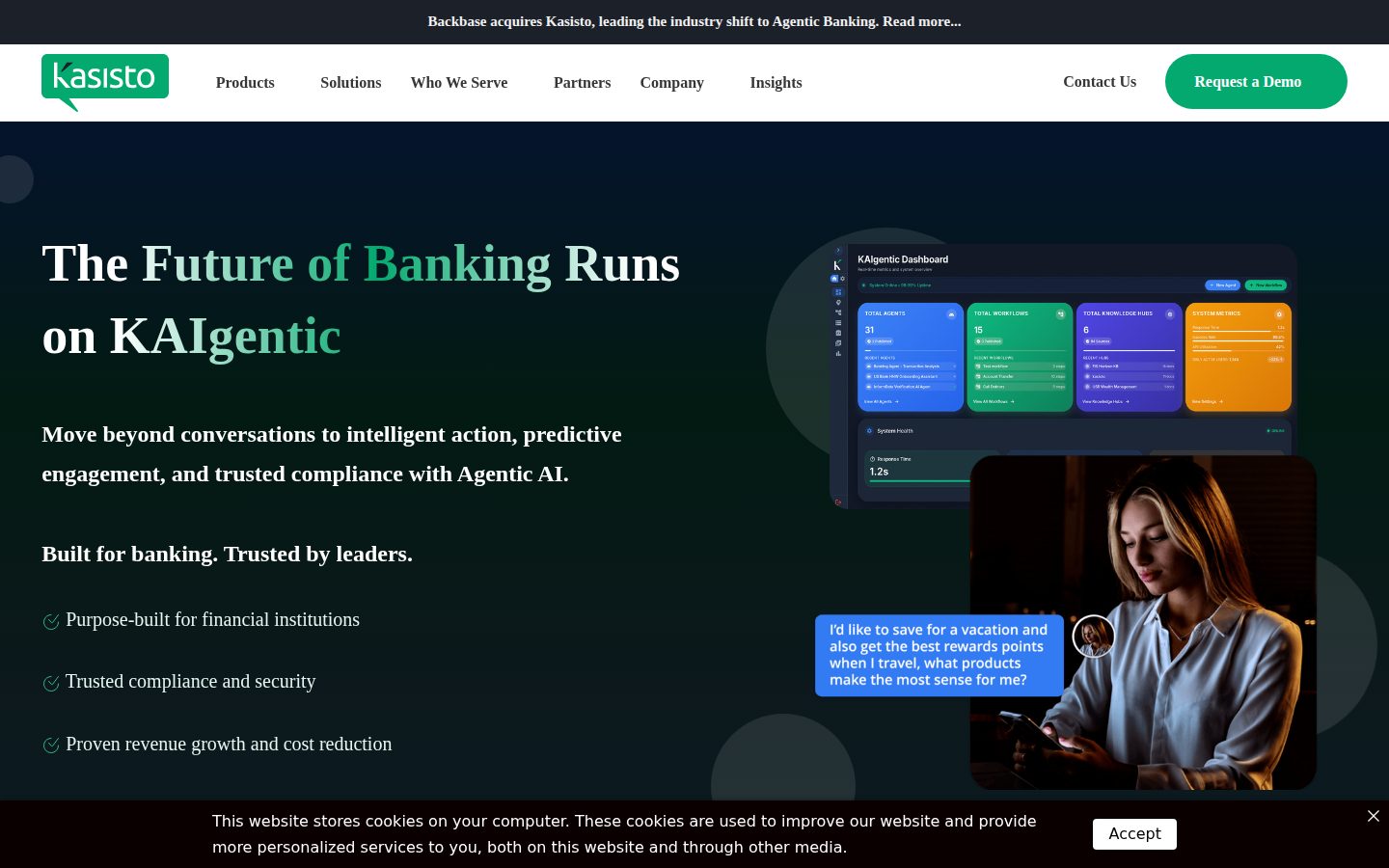
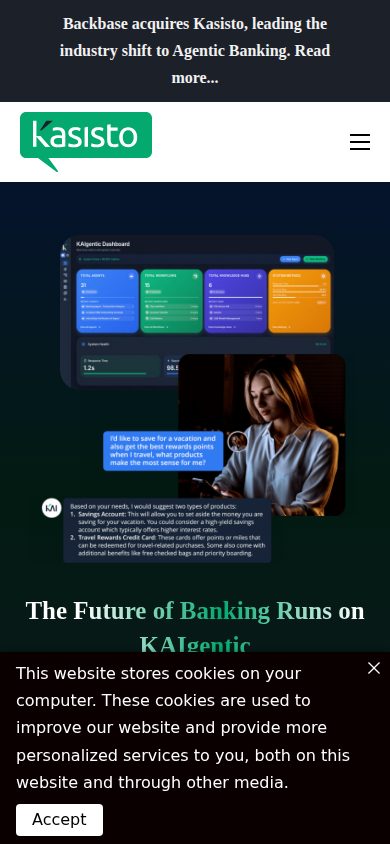
AI Editor ApprovedApproved and published by our AI Editor-in-Chief after full panel analysis.Kasisto's KAI platform is deployed by financial institutions to manage customer support conversations, answer employee questions, and proactively reach out to customers based on predicted needs. The system is designed to fit into existing banking workflows, handling inbound inquiries during high-volume periods such as mergers or system conversions, while also giving customer service agents and employees direct access to institutional knowledge bases for faster, more accurate responses.
The platform's core differentiator is its multi-agent architecture, where specialized AI agents coordinate to execute tasks in parallel rather than relying on a single model, which Kasisto says reduces hallucinations and handles multi-step workflows autonomously. KAIgentics, the company's behavioral personalization engine, adjusts engagement based on individual customer financial behavior patterns and evolving customer profiles. KAI-GPT layers Kasisto's proprietary banking-trained large language model on top of GPT technology to produce generative AI responses grounded in financial industry context. The platform also includes KAI Answers, a tool that connects to an institution's knowledge repositories to give employees and agents referenceable answers and relevant documents.
Kasisto is built specifically for banks, credit unions, and other regulated financial institutions, targeting use cases like customer assist, agent assist, and employee assist. It also partners with fintech vendors who integrate KAI into their own products. Pricing is not published and is handled through direct sales contact, placing Kasisto in the same general space as other conversational and agentic AI vendors serving banking, such as Kore.ai and Interface.ai.
The platform is delivered as a web-based service that integrates with a financial institution's existing systems and knowledge bases, with an emphasis on regulatory compliance and security given the sensitivity of banking data and transactions.

Combines Kasisto's proprietary financial large language model with GPT technology to deliver generative AI tailored for banking providers.
A proprietary behavioral engine that refines personalization in real time based on years of real banking behavior patterns and evolving customer profiles.
Orchestrates multiple specialized AI agents working collaboratively in parallel to execute complex, multi-step banking workflows faster and more accurately while avoiding hallucinations.
Tailors every customer interaction based on user behavior, history, and preferences to boost CSAT and NPS.
Anticipates customer needs before they reach out in order to increase containment rates and decrease abandonment.
Handles spikes in customer support requests during events like mergers, upgrades, or conversions using prescriptive and generative AI agents for consistent support.
Engages customers proactively to turn service interactions into growth opportunities and new revenue streams.
Fulfills customer needs through conversational experiences powered by prescriptive and generative AI.
Integrates with a financial institution's knowledge repositories to give employees direct, referenceable answers and quick access to relevant documents and policies.
Enables FinTech partners to integrate with KAI to access combined generative AI, conversational capabilities, and financial knowledge to enhance their own offerings.
Provides customer service agents instant access to needed information to reduce response times, onboarding time, and improve resolution confidence.
Gives employees instant, accurate answers by drawing on the institution's knowledge base and generative AI.
Kasisto is an enterprise conversational AI platform (KAI) sold to banks, credit unions, and financial institutions. It does not publish list pricing; costs are customized based on institution size, deployment scope, and integration needs, so pricing requires contacting Kasisto's sales team directly.
Kasisto earned its blue-chip banking roster; the bet now rides on Backbase's integration roadmap.
“Kasisto's KAI platform runs at 55 financial institutions in 16 countries, with JP Morgan and Standard Chartered on the roster. Backbase acquired the company in June 2026, so the decision now includes the acquirer's roadmap.”
Due diligence on Kasisto is now due diligence on Backbase. The Amsterdam banking-platform vendor closed its acquisition of Kasisto in June 2026, price undisclosed. The three-year viability question didn't go away — it became whether KAI stays a product or dissolves into Backbase's Banking OS.
The customer roster is why this stays shortlisted. Kasisto spun out of SRI International — the lab behind Siri — in 2013, and KAI now runs at 55 financial institutions across 16 countries, including JP Morgan, Standard Chartered, and TD Bank. Logos like that do your reference calls for you.
The catch: no published pricing, no trial, and a roadmap that now answers to Backbase's priorities, not yours. Boost.ai will quote a standalone deal without the M&A variables. If you're already a Backbase shop, escalate; otherwise pilot small with change-of-control terms in writing.
55 institutions across 16 countries shows peer adoption, but Boost.ai and Glia keep the category crowded.
JP Morgan, Standard Chartered, and TD Bank on the roster make this an easy vendor to defend.
Contact-sales pricing and bespoke core-banking integration mean payback is measured in quarters, not weeks.
Agentic customer and employee workflows advance a digital banking strategy rather than just trimming call-center cost.
Thirteen years in market plus the June 2026 Backbase acquisition put real backing behind the three-year question.
Banks and credit unions that want field-proven agentic AI for customer and employee support.
Institutions that need transparent pricing before the first sales conversation.
Backbase's acquisition turns Kasisto from a vendor bet into a platform bet — underwrite it accordingly.
“Kasisto brings thirteen years of banking-only conversational AI — KAIgentics, KAI-GPT, deployments at 55 institutions — and Backbase acquired it all in June 2026. The craft moat is real, but the three-year roadmap now runs through Backbase's Banking OS.”
Evaluate the acquirer now, not just the product. Backbase bought Kasisto in June 2026, price undisclosed, folding its agentic AI team into the Banking OS — so a KAI deployment is now a position on Backbase's roadmap, not a standalone vendor call.
The craft floor is deep. KAIgentics tunes engagement on behavior patterns from banking-only deployments running since DBS's 2016 digibank launch, and KAI-GPT shipped in May 2023 as the first banking-specific LLM. That data moat is the real differentiator against Personetics in the predictive-engagement lane, with 55 institutions across 16 countries validating the shape.
But alignment is the strategic question: if your engagement layer isn't Backbase, you're adopting a capability whose roadmap now serves someone else's platform, and contact-only pricing means you can't model that divergence. If you're consolidating onto Backbase anyway, this acquisition is the argument for the whole stack.
A conversational-banking original now sitting inside the engagement-platform consolidation wave alongside Personetics and Glia.
Built exclusively for banks and credit unions, with 55 institutions across 16 countries including DBS and Standard Chartered.
KAI Answers connects to institutional knowledge repositories and core systems, but no public API docs are listed.
The June 2026 Backbase acquisition ties the three-year path to Banking OS priorities while core integrations raise switching costs.
Banking-only conversational data since 2016 plus KAI-GPT, the first banking-specific LLM, set a high craft ceiling.
Financial institutions that want banking-trained agentic AI backed by a platform vendor.
Institutions that need a conversational AI roadmap independent of Backbase's platform.
Kasisto publishes an 82% containment number but no price — and Backbase now owns the company.
“Kasisto's KAI platform is quote-only, with outcome numbers — 82% containment at DBS — doing the selling. Backbase acquired the company in June 2026 at an undisclosed price, so quotes now come from a new owner.”
There's no number on Kasisto's site to start a model with. KAI Consumer Banking is quote-only — institution size and integrations move the figure. Glia doesn't publish either; that's how this category sells. What Kasisto does publish is outcomes: DBS reports KAI handling 82% of digibank inquiries without a human.
The deflection math is the model. 500,000 contacts a year × $5 a contact — category norm — is $2.5M. Contain 80% of them and roughly $2M shifts onto software. If the quote lands under seven figures, the math clears; over it, negotiate.
Ownership just changed. Founded 2013 out of SRI International; Series C reached $31M after FIS and Westpac added $15.5M in 2022. Backbase bought the company in June 2026 — price undisclosed. The catch: you'd be negotiating with a new owner mid-integration, and packaging can move before the ink dries.
Standard enterprise banking sales motion, but vendor onboarding now runs through new owner Backbase.
No published terms, and the June 2026 Backbase acquisition adds packaging-change risk at renewal.
No pricing page and no list price; every figure requires a sales cycle.
DBS's published 82% containment gives finance a hard deflection number to price against cost per contact.
Custom quotes scale with institution size and integrations, so a 3-year figure can't be built from public data.
Financial institutions that want measurable call-deflection ROI from banking-specific AI.
Buyers who need published pricing before opening a vendor evaluation.
Compliance-first banking AI with zero pricing transparency and no visible audit trail
“Kasisto pitches multi-agent orchestration and a proprietary financial LLM layered on GPT, which reads well for regulated deployments. But the underwriting details a bank compliance officer needs — model risk documentation, SOC reports, explainability logs — aren't on the public site.”
No pricing page, no docs, no API reference. For a vendor selling into risk committees and model risk management teams, that's a gap I'd flag before this ever reaches procurement. 'Contact sales' works for enterprise deals, but banks need to model total cost of ownership against Kore.ai or Interface.ai before a pilot even starts, and Kasisto gives analysts nothing to underwrite against.
The multi-agent architecture and KAIgentics behavioral engine are the real differentiators — parallel agent execution to cut hallucination risk is exactly what a model risk framework wants to hear. KAI Answers grounding employee responses in the institution's own knowledge base also maps well to audit requirements.
But 'always regulatory-compliant' is a marketing claim, not a SOC 2 report or a model validation package. Until there's a documented compliance artifact trail, this stays a strong shortlist candidate, not a signed contract.
Enterprise banking AI with real bones, but you'll never see it work until sales lets you
“Kasisto is a walled-garden enterprise product, not a tool you get a feel for in ten minutes. Strong feature list, zero self-serve, which is normal for this category but still a real cost.”
No docs page, no API page listed, no pricing page, no free trial. For a product I'd normally judge by how it feels on day one, there is no day one — you talk to sales, then a team builds something bespoke for your institution. That's category norm for enterprise banking AI (Kore.ai and Interface.ai play the same game), but it means my usual questions about empty states and onboarding friction just don't apply the way they would for a self-serve tool.
What I can judge: the feature list is dense and specific. Multi-agent coordination to cut hallucinations, KAI-GPT layering a proprietary financial model on top of GPT, KAIgentics adjusting to behavior patterns built from years of banking data, KAI Answers pulling from internal knowledge bases for employees. That's not vaporware phrasing, that's a real architecture with a reason behind each piece.
The tradeoff is you're trusting a vendor pitch deck instead of a demo. Three months in, this either integrates cleanly with core banking systems or it becomes another IT ticket queue nightmare. No public evidence either way yet.
No blog/docs evidence of UI-level craft; feature list reads well but is unverifiable without a demo.
KAI Answers and Agent Assist are built to reduce onboarding time for employees, per the feature list.
Delivered as web service integrated into institution systems; no mobile app or parity claims in evidence.
No free trial, no self-serve path — onboarding is a sales cycle, not a first-session experience.
Multi-agent design explicitly built to reduce hallucinations and handle compliance-sensitive banking workflows.
Banks and credit unions handling high-volume events like mergers who need compliant customer and employee assist tools.
Avoid if you want to self-serve, test a trial, or see pricing before talking to a sales rep.
Old company, new coat of agentic paint. Founded pre-LLM, rebranded for the moment.
“Kasisto's been doing conversational banking AI since before 'agentic' was a word. That's either deep domain moat or a legacy platform relabeled for 2024.”
Three tells before I trust the H1. One: 'The Future of Banking Runs on KAIgentic' — the kind of superlative every vendor's using this year. Two: no pricing page, no docs, no API listed. Three: 'always regulatory-compliant' is a legal promise marketing shouldn't be making.
What's real: KAI-GPT, KAIgentics, KAI Answers — named products, not vaporware, and the multi-agent pitch to reduce hallucinations is the same one Kore.ai and Interface.ai are running. Banking-specific LLM training since before GPT-4 existed is a genuine differentiator if true.
Exit portability is the real question nobody answers. Deep integration into core banking systems and institutional knowledge bases means switching costs are high by design — good for Kasisto, bad for you in 18 months. No SLA, no docs page, no changelog visible. For an enterprise banking vendor, that's thin public accountability.
Multi-agent architecture and proprietary financial LLM claim differentiation vs Interface.ai, but the pitch is now category-standard.
Deep core-banking and knowledge-base integration plus no docs/API listed implies high switching friction.
Active blog and fintech partner integrations suggest ongoing operation, but no funding data, changelog, or team signals visible.
H1 leans aspirational ('Future of Banking'); 'always regulatory-compliant' is a strong claim with no cited audit.
Long-tenured banking AI vendor, not a 2023 GPT-wrapper — matches survivor patterns like Kore.ai more than failed chatbot startups.
Banks and credit unions wanting an established vendor for compliance-heavy customer and employee AI assist.
You need transparent pricing or a low-commitment pilot before an 18-month contract.
Common questions answered by our AI research team
KAI-GPT combines Kasisto's proprietary financial language model (KAI) with GPT technology, creating a large language model tailored specifically for generative AI in banking.
KAIgentics is Kasisto's proprietary behavioral engine that refines personalization in real time, using years of real banking behavior patterns to enhance engagement and adapt to evolving customer profiles.
Yes. Kasisto orchestrates multiple specialized AI agents working collaboratively, enabling parallel processing, avoiding hallucinations through collaborative output, and handling complex multi-step workflows autonomously.
Yes. KAI Answers integrates seamlessly with a financial institution's knowledge repositories, giving employees direct, referenceable answers and quick access to relevant documents and policies.
Yes. Kasisto's KAIgentics engine is described as always regulatory-compliant and secure, blending the predictability of compliance systems with intelligent, proactive AI banking experiences.