Latent AI logo

Latent AI Review

Visit

Edge AI deployment and MLOps tooling for disconnected, mission-critical environments

Latent AI is an edge AI software platform for teams that need to deploy, optimize, and update machine learning models on local hardware without cloud dependency.

AI Panel Score

7.6/10

6 AI reviews

Reviewed

AI Editor Approved

What is Latent AI?

Latent AI is an edge AI software platform for teams that need to deploy, optimize, and update machine learning models on local hardware without cloud dependency. Its core product, LEIP, the Latent AI Edge Inference Platform, takes existing models and data and prepares them for deployment across diverse edge device fleets. The defining capability is field-updatable AI: models can be retrained and redeployed rapidly in the field without returning to central cloud infrastructure. Additional capabilities include a Python API, model optimization for edge hardware, reusable ML pipelines, and support for disconnected, offline environments. Pricing is quote-based, with no free plan. TopReviewed's six-seat AI review panel scored it 7.6/10, praising 18x faster model redeployment documented in a Navy production deployment while noting the absence of public pricing means every procurement cycle starts from zero. It best fits defense, government, and industrial teams running ML on air-gapped or disconnected hardware fleets.

About Latent AI

Users interact with LEIP through a Python API that spans the full ML pipeline: model ingestion, optimization, retraining, and deployment. The workflow is designed so that engineers without deep AI expertise can manage model updates using reusable pipelines, reducing reliance on specialized data scientists. Hardware compatibility is broad, allowing the same software factory to target diverse edge devices across a fleet.

LEIP includes tools for model compression and optimization that reduce compute requirements at the edge — the website cites one manufacturer cutting required GPUs by 92%. The platform also supports automated model retraining when real-world conditions drift, such as changing lighting in a factory or new defect types emerging on a production line. Field update speed is a named capability: in a documented Navy deployment, LEIP enabled 18x faster model update and redeployment cycles.

Latent AI targets enterprise teams in industrial, defense, and sports/venue verticals, as evidenced by its Navy task force deployment and a bowling venue analytics use case. The platform also integrates with existing enterprise AI platforms rather than replacing them. Pricing is not publicly listed; procurement appears to be contract- or demo-based, positioning it toward mid-to-large enterprise and government buyers. Competitors in the edge AI deployment category include Edge Impulse, Deeplite, and OctoML (now part of TVM ecosystem).

LEIP exposes a Python API for pipeline management and is designed to run on existing customer hardware without requiring a new hardware investment. It supports disconnected and air-gapped environments, which is a specific requirement in defense and remote industrial contexts. The platform's interoperability across heterogeneous hardware fleets is a stated design goal.

Features

AI

  • Latent Assisted Label

    A capability for accelerating data discovery and annotation, reducing the human effort required to prepare training data for edge AI models.

  • Model Optimization for Edge

    Prepares and optimizes existing ML models for efficient inference on edge hardware, reducing compute requirements such as cutting GPU needs by up to 92%.

Automation

  • Edge MLOps Tooling

    Provides an AI development toolchain that accelerates the journey from model development to edge deployment, enabling teams to scale ML projects rapidly without specialized AI data scientists.

  • Reusable ML Pipelines

    Provides reusable pipelines that allow users to quickly modify, retrain, and redeploy edge AI models as real-world conditions change.

Core

  • Cloud-to-Edge Migration

    Shifts data processing away from remote cloud data centers to the edge, reducing bandwidth consumption and slashing upfront and ongoing compute costs of AI systems.

  • Disconnected / Offline Environment Support

    Deploys and validates AI models in real-world disconnected environments where cloud connectivity is unavailable or impractical.

  • Field-Updatable AI Deployment

    Enables models to be retrained, modified, and redeployed in the field without returning to central cloud infrastructure, achieving up to 18x faster model update and redeployment cycles.

  • LEIP Python API

    Allows users to interact with the entire ML pipeline via a Python API, enabling both beginners and experts to design, optimize, and deploy machine learning models programmatically.

  • Multi-Hardware Fleet Support

    Runs ML models seamlessly across diverse hardware types and device fleets, enabling interoperable edge AI deployments without being locked to specific hardware.

Integration

  • Enterprise AI Platform Integration

    Integrates with existing enterprise AI platforms to simplify complex ML development workflows and improve business processes within current tooling ecosystems.

Preview

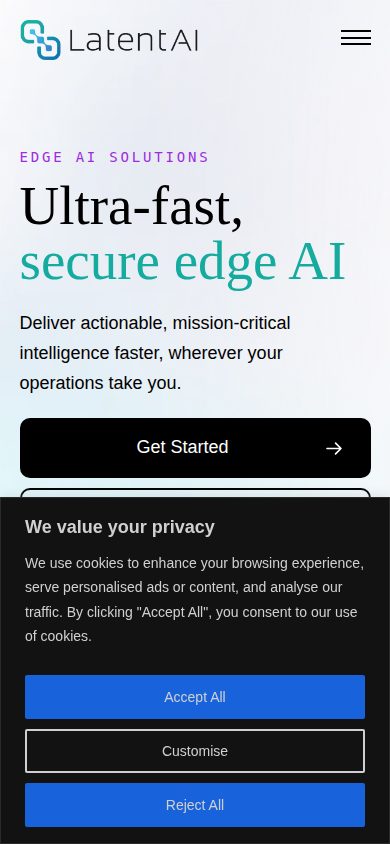
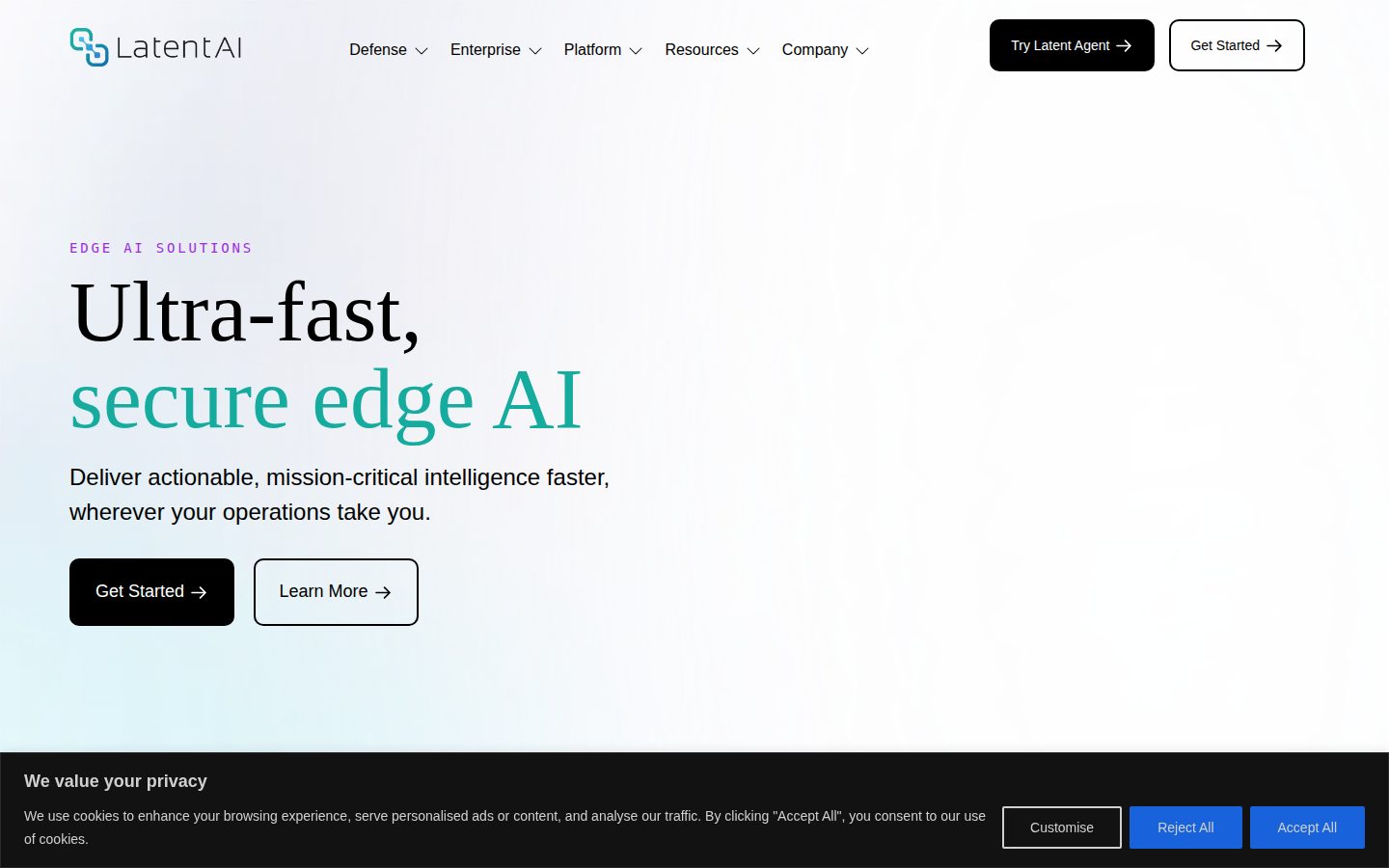
Latent AI desktop previewLatent AI mobile preview

Pricing Plans

Contact Sales

Contact sales

Latent AI (latentai.com) is a sales-led, enterprise-focused edge AI platform. No public list pricing is published on their website or any third-party pricing aggregator. All pricing for the LEIP (Latent AI Efficient Inference Platform) and related products — including LEIP Optimize, LEIP Deploy, Latent Field Tactical Suite, Latent Assisted Label, and Latent Linguist — requires contacting the vendor directly. A free one-year trial license is available via accounts.latentai.io. Gartner notes pricing is subscription-based and tiered by usage, device quantity, and support level, but no specific figures are publicly disclosed. Contact Latent AI at info@latentai.com or via the demo request form on latentai.com.

  • LEIP SDK: all-in-one edge AI development platform (train, optimize, deploy)
  • LEIP Optimize: automated hardware and software model optimization
  • LEIP Deploy: secure, standardized Latent Runtime Engine (LRE)
  • 50,000+ pre-configured model-hardware recipes
  • Python API access across the full ML pipeline
  • Model watermarking, encryption, and version tracking
  • Real-time model diagnostics and lifecycle monitoring
  • Field-updatable AI (retrain and redeploy without internet connectivity)
  • Support tiers: first-, second-, and third-line assistance via Slack/Teams, email, and phone
  • Integrations with TensorFlow, PyTorch, ONNX, ArcGIS, and Amazon SageMaker
  • Free one-year trial license available on sign-up

AI Panel Reviews

The Decision Maker

The Decision Maker

Strategic bet, vendor viability, timing, adoption approval
7.8/10

Serious edge AI MLOps for defense and industrial teams that can't touch the cloud.

Latent AI's LEIP platform solves a real, underserved problem: deploying and updating ML models in disconnected environments. The Navy's 18x faster redeployment result is the kind of number that wins procurement reviews.

No public pricing, no changelog, no funding data. That's the honest starting point. But the evidence underneath is more compelling than the website suggests — 50,000+ pre-configured model-hardware recipes, a documented Navy deployment, and a free one-year trial license that most enterprise vendors won't offer. Against Edge Impulse or Deeplite, this is a materially more complete MLOps story for fleet-scale, air-gapped environments.

The 92% GPU reduction claim and field-updatable AI via reusable pipelines aren't marketing fluff — they're direct answers to what defense and industrial procurement teams actually ask. The LEIP Python API designed for non-data-scientists is the right call for operational teams who don't have ML specialists on the floor.

The tradeoff: this is a contact-sales, contract-procurement product. Startups and teams that need transparent pricing and fast onboarding won't get that here. This is enterprise and government, full stop.

Competitive Positioning8.2

Edge Impulse targets smaller deployments; Latent AI's multi-hardware fleet support and air-gap capability occupy a narrower but less contested segment.

Reputation Risk8.0

A Navy task force deployment and integration with SageMaker and ArcGIS make this a defensible board conversation, not an experiment.

Speed to Value7.5

The one-year free trial and reusable ML pipelines suggest a faster ramp than typical enterprise AI tooling, though no public onboarding benchmarks exist.

Strategic Fit8.5

Field-updatable AI and disconnected environment support aren't cost-savers — they're capability unlocks for mission-critical teams that can't rely on cloud infrastructure.

Vendor Viability6.5

No public funding data and no changelog make the 3-year bet harder to defend — the free trial license and documented government contracts are the only positive signals.

Pros

  • 18x faster model redeployment documented in a real Navy deployment
  • 50,000+ pre-configured model-hardware recipes reduce integration lift
  • Free one-year trial license — rare for enterprise AI platforms
  • Works across heterogeneous hardware fleets without new hardware investment

Cons

  • No public pricing — every procurement cycle starts from zero
  • No changelog published, making vendor momentum opaque
  • No funding data; impossible to assess 3-year runway with confidence
  • Contact-sales model slows evaluation for teams without procurement bandwidth

Right for

Industrial or defense teams deploying ML models on disconnected hardware fleets where field update speed is mission-critical.

Avoid if

Your team needs transparent pricing, fast self-serve onboarding, or cloud-connected MLOps.

The Domain Strategist

The Domain Strategist

Craft and strategy in the product's domain — adapts identity per category, same lens
8.2/10

LEIP solves the hardest edge MLOps problem — field-updatable models in air-gapped environments — convincingly.

Latent AI's LEIP platform is purpose-built for disconnected, mission-critical deployments where cloud MLOps pipelines simply don't apply. The 18x faster redeployment figure from the Navy deployment and 92% GPU reduction claim suggest real production depth, not demo-ware.

50,000+ pre-configured model-hardware recipes is a serious library. That's not a startup's weekend project — that's the kind of compatibility surface that only comes from sustained hardware partnership work. Edge Impulse competes here but targets smaller-scale IoT; LEIP is clearly positioned for enterprise fleet management across heterogeneous hardware, which is a materially harder problem.

The field-updatable AI architecture is the real differentiator for my team's calculus. If we're operating in defense or remote industrial contexts, the alternative to LEIP is building custom update pipelines that our MLEs maintain forever. The reusable ML pipelines feature plus the Python API means a data engineer — not a senior ML practitioner — can own retraining cycles in the field. That changes headcount math.

The lock-in question lives in the Latent Runtime Engine. If we standardize fleet deployment on LRE, migrating away in year three means re-validating every device. No public pricing and no changelog visibility make procurement and roadmap trust harder. For the right vertical, that's an acceptable tradeoff. For a general-purpose ML team, it isn't.

Category Positioning8.2

Edge Impulse owns the embedded/IoT low end; LEIP owns disconnected enterprise fleet deployment — that's a defensible and underserved niche with defense and industrial tailwinds.

Domain Fit8.8

Field-updatable retraining triggered by distributional drift — changing factory lighting, new defect types — maps directly to how production ML teams actually manage model decay.

Integration Surface8.0

TensorFlow, PyTorch, ONNX, ArcGIS, and Amazon SageMaker integrations cover the realistic enterprise ML stack without requiring a rip-and-replace.

Long-term Implications7.5

LRE runtime standardization creates meaningful switching costs; no changelog visibility makes roadmap trust a leap of faith over a 3-year horizon.

Strategic Depth8.5

Model watermarking, encryption, version tracking, and real-time diagnostics in a single platform suggests genuine MLOps depth, not feature-list padding.

Pros

  • 18x faster model redeployment in documented Navy production deployment — not a synthetic benchmark
  • 92% GPU reduction claim indicates optimization pipeline is production-grade
  • 50,000+ model-hardware recipes means real heterogeneous fleet coverage
  • Field-updatable AI without cloud dependency solves a problem most MLOps platforms ignore entirely

Cons

  • No public pricing or changelog makes vendor trust and budget forecasting harder than it should be
  • LRE runtime lock-in is real — fleet-wide migration cost grows with device count
  • No free trial visibility on the main site; trial license requires account creation at a separate subdomain
  • Positioned too narrowly for general-purpose ML teams without edge or disconnected requirements

Right for

Enterprise ML teams in defense, remote industrial, or venue analytics verticals where air-gapped or disconnected deployment is a hard requirement.

Avoid if

Your models run in cloud or hybrid environments where standard MLOps platforms like SageMaker already cover your deployment lifecycle.

The Finance Lead

The Finance Lead

Money, total cost of ownership, contracts, procurement math
6.2/10

18x faster field updates, zero public pricing — classic defense-sector opacity.

LEIP is purpose-built for air-gapped, mission-critical edge deployments. Pricing is fully opaque — Gartner confirms subscription tiers exist, but no numbers are public.

No pricing page. No trial cost. Gartner indicates tiered subscription pricing by device count and support level — zero figures disclosed. A free one-year trial license exists via accounts.latentai.io, which softens early evaluation friction, but procurement still requires a sales engagement. For a 50-device fleet, you're negotiating blind.

The Navy deployment citing 18x faster model redeployment is the strongest ROI anchor in the evidence. That's a measurable operational metric. The 92% GPU reduction claim is also concrete. Against Edge Impulse or Deeplite, those numbers are differentiated. But without invoice data, year-3 TCO is genuinely unknowable — device-count tiers plus support tiers plus potential add-ons like Latent Linguist create real cost surface risk.

Tradeoff: the platform is clearly built for defense and industrial buyers who tolerate opaque procurement. Commercial teams that need budget approval before a demo will stall here.

Billing & Procurement3.5

Fully sales-led with no self-serve pricing; procurement teams will face maximum friction before any budget number appears.

Contract Flexibility4.0

No public auto-renewal terms, cancellation clauses, or term lengths disclosed — standard enterprise contract risk with no counterevidence.

Pricing Transparency2.5

No public list pricing anywhere — Gartner confirms tiers exist but all figures require a sales call.

ROI Clarity7.5

18x faster redeployment (Navy) and 92% GPU reduction are specific, documented operational metrics — rare in this category.

Total Cost of Ownership4.5

Device-count tiers, support tiers, and add-ons like Latent Linguist create unpredictable year-3 cost surface with no public anchors.

Pros

  • 18x faster model redeployment documented in a real Navy deployment — not a benchmark lab number.
  • 92% GPU reduction claim is specific and attributable to a named manufacturer use case.
  • Free one-year trial license available — reduces evaluation risk before contract negotiation.
  • 50,000+ pre-configured model-hardware recipes reduces integration engineering cost at deployment.

Cons

  • Zero public pricing — device-count and support tiers confirmed by Gartner but all figures withheld.
  • No changelog published — impossible to assess cadence or platform maturity from public evidence.
  • No termination or auto-renewal terms disclosed; contract risk is entirely unquantifiable pre-engagement.
  • Year-3 TCO is genuinely unknowable without an invoice — add-on products like Latent Linguist expand cost surface.

Right for

Defense, government, or industrial buyers deploying ML on air-gapped or disconnected hardware who can tolerate fully negotiated procurement.

Avoid if

Your team needs a budget number before a demo or is evaluating against Edge Impulse on a commercial timeline.

The Domain Practitioner

The Domain Practitioner

Daily hands-on reality in the product's domain — adapts identity per category, same lens
8.1/10

Edge MLOps for disconnected fleets: serious infrastructure, not a hobbyist toy

LEIP solves a real problem that cloud-first platforms like Edge Impulse simply can't touch — air-gapped, field-updateable model deployment at scale. The 18x redeployment speed claim from the Navy deployment is the kind of number that actually matters to an ML engineer managing a heterogeneous device fleet.

The Python API spanning the full pipeline — ingestion, optimization, retraining, deployment — is the right architectural choice. Engineers stay in their tooling. The 50,000+ pre-configured model-hardware recipes suggest someone actually thought about the device-targeting problem rather than leaving it as an exercise for the integrator. TensorFlow, PyTorch, and ONNX support means existing model artifacts don't need surgery before ingestion.

The friction question is: what does day-3 look like when your first model-hardware recipe doesn't match your specific device variant? No public changelog visible, no API reference scraped — the docs page exists but practitioner depth is unverified. That's a real unknown. Contrast with Edge Impulse, where SDK behavior is exhaustively documented and community-searchable. LEIP's support via Slack/Teams suggests responsiveness, but that's not a substitute for self-serve debugging at 11pm.

No free trial without a sales conversation is the sharpest tradeoff. A one-year trial license exists at accounts.latentai.io, but procurement friction before a proof-of-concept is a meaningful barrier. For defense and industrial buyers, that's normal. For a mid-market team evaluating options against Deeplite, it slows the decision cycle significantly.

Day-3 Reality7.5

Reusable pipelines and Python API reduce daily friction for retrain-redeploy cycles, but no public changelog means debugging version behavior is opaque.

Documentation Practitioner-Fit6.8

Docs exist and a Python API is exposed, but no scraped API reference or changelog suggests documentation depth hasn't been independently verified — a gap for self-serve debugging.

Friction Surface7.2

50,000+ model-hardware recipes reduce targeting friction, but no public API reference and contact-only pricing add process overhead before first deployment.

Power-User Depth8.0

Model watermarking, encryption, version tracking, and real-time lifecycle diagnostics are genuine power-user features, not just marketing-layer additions.

Workflow Integration8.3

Native ONNX/PyTorch/TensorFlow ingestion and SageMaker integration mean engineers don't rewire their upstream workflow to use LEIP.

Pros

  • Field-updatable AI in air-gapped environments — 18x faster redeployment is a documented Navy result, not a benchmark lab claim
  • Python API covers the full pipeline without forcing a context switch out of standard ML tooling
  • 92% GPU reduction for one manufacturer signals real optimization depth, not just quantization wrappers
  • Multi-hardware fleet support with 50,000+ recipes reduces the device-targeting problem significantly

Cons

  • No public changelog or API reference makes self-serve debugging harder than Edge Impulse or OctoML ecosystem equivalents
  • Sales-led procurement slows proof-of-concept cycles for teams that want to evaluate before committing
  • No visibility into how model diagnostics surface drift alerts — whether it's actionable signal or noise isn't clear from public evidence

Right for

ML engineering teams deploying and maintaining model fleets in disconnected industrial or defense environments where cloud dependency is a hard constraint.

Avoid if

Your deployment target is cloud-connected and your team needs self-serve documentation and trial access before a procurement conversation.

The Power User

The Power User

Daily human experience, onboarding, polish, learning curve, reliability
8.2/10

18x faster field deployments is a real number, not a brochure number

LEIP solves a specific, hard problem — AI in places without internet — and solves it well. Not for everyone, but if you're in defense or industrial edge, this is the shortlist.

That 18x faster model update cycle from the Navy deployment isn't marketing copy. That's a documented outcome in an environment where slow updates get people hurt or missions failed. The 92% GPU reduction claim for one manufacturer is similarly concrete. When a product leads with numbers that specific, someone on the team actually ran those deployments. That's not common.

The free one-year trial license changes the calculus a little — no pricing page, but at least you can kick the tires before the sales conversation. Edge Impulse competes here and has better public documentation and community. LEIP's 50,000+ pre-configured model-hardware recipes suggests serious engineering depth, but the changelog is absent and docs coverage is unclear from public evidence.

The daily-use experience is genuinely hard to read from the outside. It's a Python API targeting engineers, not a SaaS dashboard for everyone. Mobile parity is basically irrelevant for the use case. The real tradeoff: this is enterprise procurement territory — no self-serve, no transparent pricing. Smaller teams will bounce off that wall fast.

Daily Polish6.5

No changelog visible and docs depth is unclear; the Python API workflow is functional but polish signals are thin from public evidence.

Learning Curve7.5

Reusable ML pipelines and a Python API designed for non-data-scientists is a genuine accessibility play, though category complexity sets a real floor.

Mobile Parity4.0

Web and Linux only — mobile parity is irrelevant here, but that's by design for the industrial and defense deployment context, not negligence.

Onboarding Experience7.0

A free one-year trial license exists via accounts.latentai.io, which is better than pure contact-sales, but no self-serve walkthrough is evident.

Reliability Feel8.5

Documented Navy deployment and real-world disconnected environment validation give strong reliability signals for mission-critical use.

Pros

  • Field-updatable AI with 18x faster redeployment — documented, not theoretical
  • 50,000+ pre-configured model-hardware recipes means broad fleet compatibility out of the box
  • Works in air-gapped and disconnected environments — genuinely rare capability
  • Free one-year trial license available without immediate sales commitment

Cons

  • No public pricing; procurement is entirely contract-based, which slows evaluation
  • No changelog and limited public documentation signals compared to Edge Impulse
  • Pure enterprise motion — smaller teams or solo builders will hit a wall quickly

Right for

Industrial or defense engineering teams deploying ML on disconnected hardware fleets where update speed and offline reliability are non-negotiable.

Avoid if

You need self-serve onboarding, transparent pricing, or a tool that works without a procurement cycle.

The Skeptic

The Skeptic

Contrarian. Watch-outs, deal-breakers, broken promises, category patterns
7.2/10

Real Navy deployment at 18x speed-up. No changelog, no public price. Jury's out.

Latent AI's LEIP has documented defense deployments and a specific 92% GPU reduction claim — that's not nothing. But no pricing page, no changelog, and no visible funding round means I'm watching carefully.

Three tells up front. One: no changelog listed — can't assess shipping cadence. Two: no public pricing — pure sales-led, which limits buyer leverage. Three: 'ultra-fast, secure' in the H1 is exactly the kind of superlative that ages poorly. That said, the 18x faster redeployment for the Navy and the bowling-venue use case are oddly specific. Marketing people don't invent those. I'm partially hedged.

The differentiation against Edge Impulse is real. Air-gapped, field-updatable AI is a genuine category gap — Edge Impulse doesn't go deep on disconnected DoD-class environments. The 50,000+ pre-configured model-hardware recipes and ONNX/PyTorch/SageMaker integrations suggest actual engineering, not vaporware. Free one-year trial license is a green flag.

Exit portability is the soft spot. Python API is good. But if LEIP's runtime engine is tightly coupled to their proprietary stack, migration off is messy. No public API docs visible. Pricing is contract-only — which means no self-serve exit either.

Competitive Differentiation8.2

Air-gapped, field-updatable AI in defense and industrial settings is a genuine gap that Edge Impulse and OctoML don't fill nearly as specifically.

Exit Portability5.5

Python API exists but the proprietary Latent Runtime Engine and no visible public API docs suggest migration off would be painful.

Long-term Viability6.0

No changelog, no public funding data, and sales-only procurement makes long-term continuity signals thin — can't assess shipping cadence at all.

Marketing Honesty6.5

'Ultra-fast, secure' headline is vague, but the 18x redeployment and 92% GPU reduction claims are specific and defensible.

Track Record Match7.8

Navy task force deployment and documented industrial use cases match the successful pattern of specialized edge MLOps vendors that found defensible verticals.

Pros

  • 18x faster model redeployment in a documented Navy deployment — specific, not marketing fluff
  • 92% GPU reduction claim is verifiable in named manufacturer context
  • Genuine air-gapped / disconnected environment support that named competitors don't prioritize
  • Free one-year trial license exists despite enterprise-only positioning

Cons

  • No changelog visible — shipping cadence is a black box
  • No public pricing; contract-only procurement adds friction and leverage risk
  • Proprietary Latent Runtime Engine creates potential lock-in on exit
  • No visible public funding round or team size signals

Right for

Defense and industrial teams deploying ML on air-gapped or remote hardware who need field-updatable models without cloud infrastructure.

Avoid if

You need transparent pricing, self-serve evaluation, or a clear migration path before committing to a vendor.

Buyer Questions

Common questions answered by our AI research team

Features

How fast can LEIP update and redeploy edge AI models?

LEIP delivered 18x faster model update and redeployment for the Navy. Reusable pipelines allow users to modify, retrain, and deploy edge AI quickly, achieving 97% faster time to update.

Features

Does LEIP work across different hardware types and device fleets?

Yes, LEIP runs seamlessly across diverse hardware and device fleets. It is designed as a software factory that starts with your data and models, not a specific hardware investment.

Setup

Can non-AI engineers use LEIP without specialized data scientists?

Yes, LEIP's Python API lets beginners and experts alike design, optimize, and deploy ML models without specialized AI data scientists, enabling engineers of all skill levels to innovate and scale projects.

Integration

Does LEIP integrate with existing enterprise AI platforms?

Yes, Latent AI tools integrate with existing enterprise AI platforms, simplifying complex ML development and enabling teams to improve business processes across their current tooling.

Features

Can LEIP operate in disconnected or offline environments?

Yes, LEIP is proven deployed and validated in real-world, disconnected environments, enabling mission-critical AI decisions without reliance on cloud connectivity.

Product Information

  • Company

    Latent AI
  • Founded

    2018
  • Pricing

    Contact for pricing

Platforms

weblinux

About Latent AI

Latent AI is a San Jose-based company that provides a software platform for compressing, optimizing, and deploying AI models on edge devices.

Resources

Documentation
Blog

Also in Machine Learning Platforms