AI design agent that turns a conversation into logos, packaging, and campaigns
Lovart is an AI design agent for creating visual content, from logos to full marketing campaigns.
AI Panel Score
6 AI reviews
Reviewed
Lovart works through a conversational interface: a user describes a brand or design need in natural language, and the system generates corresponding visual assets. Rather than requiring separate tools for different formats, the workflow is structured to move from a single input, such as a brand description, to a set of outputs that can include logos, packaging designs, social media content, and video advertisements within the same session.
The product's distinguishing feature is its aggregation of multiple third-party generative models under one interface. It integrates more than 16 image generation models (including Midjourney, GPT Image, Nano Banana, Seedream, and Flux) and more than 13 video generation models (including Kling, Seedance, Veo, and Hailuo), alongside 3D and audio generation capabilities. This model breadth is presented as a way to route different design tasks to whichever underlying model suits them, rather than relying on a single generative engine.
Lovart is aimed at individuals and teams who need visual design output, such as logos, packaging, social content, and marketing campaigns, without operating separate specialized design software for each asset type. The company states more than 100,000 creators use the product. It follows a freemium pricing model with a free tier providing 500 daily credits and no credit card requirement; paid plans are listed on the company's pricing page. Competing products in the AI design and creative generation category include tools such as Canva's AI features, Adobe Firefly, and other AI-assisted design platforms.
Lovart is delivered as a web-based application, accessible through a browser without a required local install. The platform's documentation and tools pages describe a large catalog of specific tools and features (the site references hundreds of individual tool and feature pages), reflecting granular support for particular design tasks alongside the general conversational workflow.

Lovart's core AI Design Agent autonomously researches, plans, designs, and executes complete branding and creative projects from a single brief with minimal human intervention.
Lovart uses a proprietary Multi-Chain-of-Thought (MCoT) engine that breaks down complex creative briefs into logical steps and selects the best underlying model for each task.
Lovart's AI Video Background Remover extracts subjects and swaps in custom backgrounds instantly without requiring a green screen.
The platform supports batch-generating up to 40 images at once, speeding up production for teams that need multiple design variants quickly.
Lovart's Seedance model creates cinematic AI videos with native audio generation, character consistency across shots, and up to 2K resolution for ads, social media, and film.
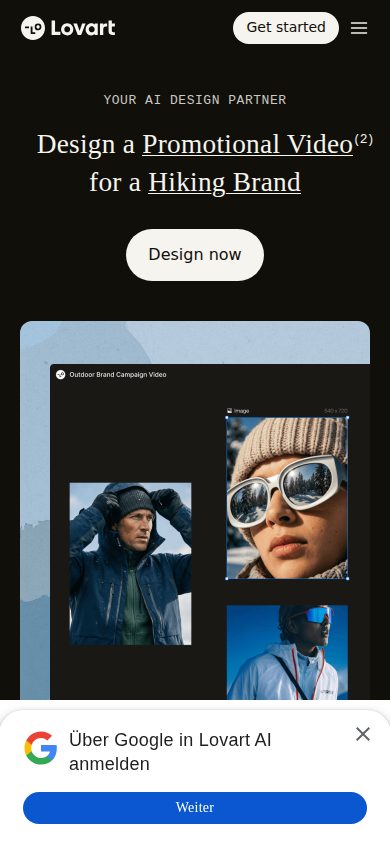
Users work on an infinite canvas combined with a conversational chat interface, allowing sketches, text prompts, and image annotations to be interpreted directly into designs.
Designs can be exported in production-ready formats including PNG, JPG, SVG, PDF, and PSD, with print-ready specs like bleeds and spine calculations for items such as book covers.
Touch Edit lets users click any element and describe a change to make targeted, precise edits without disturbing the rest of the composition or needing to re-prompt the whole design.
Lovart provides specialized generators for structured business assets such as price lists, restaurant menus, product catalogs, book covers, magazine layouts, diplomas, and student ID cards.
Brand Kit locks in colors, fonts, voice, and style guidelines at the system level so every generated asset maintains consistent branding across a project or campaign.
Users can upload existing brand assets or reference images and Lovart's Style Infusion and style-matching tools apply that visual style consistently across new designs.
Lovart connects to a range of leading AI and design models/tools—including GPT-4o, Flux, Stable Diffusion, Kling, Veo 3, Sora, and Nano Banana Pro—choosing the right one for each creative task.
Individuals and casual users exploring the platform with basic AI design generation before committing to a paid plan.
Solo creators and freelancers who need professional, unique designs beyond free-tier limits.
Freelance creatives and small teams needing AI video generation and multi-brand management.
Small agencies (2-5 people) needing multi-seat, multi-brand, white-label capable design workflows.
Enterprise marketing teams and agencies requiring IP indemnification, custom brand AI training, and dedicated support.
Studios, creative agencies, and businesses requiring high-volume generation with custom contracts; pricing requires contacting sales.
A model aggregator, not a moat — 16 image models isn't a product, it's a routing layer.
“Lovart bundles Midjourney, Flux, Kling and a dozen others behind one chat interface. Clever positioning, thin defensibility.”
100,000 creators and a $19 starter tier. No public funding data, no team size, no named backers — I can't tell if this is a five-person wrapper or a funded platform play.
Two things matter here. One: their whole pitch depends on continued API access to Midjourney, Kling, Veo, and a dozen others staying cheap and available. Two: none of those vendors owe Lovart anything long-term.
Credits don't roll over, which is a Canva-style trap dressed as freemium. Against Adobe Firefly and Canva's AI suite, Lovart wins on breadth, loses on backing. Fine for a solo freelancer at $19/month. I wouldn't put a brand system on it.
Positioned against Canva and Adobe Firefly on breadth of 16+ image and 13+ video models, but neither has adopted this approach at scale.
Aggregating third-party models like Midjourney and Kling under one brand raises questions about originality and IP if scrutinized.
Free tier with 50 designs/month and no card required lets teams test output within a day.
Speeds up asset production but doesn't advance a differentiated design capability, mostly repackages existing models.
No funding data, no team size disclosed — 100K users is the only durability signal we have.
Solo freelancers and small teams who want fast multi-format output without juggling five tools.
Avoid if you need a design vendor with visible funding and a defensible model of its own.
A genuinely useful model-router for brand output, but it's an aggregator's ceiling, not a craft ceiling.
“Lovart stitches 16+ image models and 13+ video models into one conversational workflow, which is genuinely useful for fast concepting. But the Brand Kit and Touch Edit tooling suggest a production layer that's still thinner than what a working studio needs long-term.”
16 image models, 13 video models, one chat interface. That's not a design system, it's a routing layer — MCoT picks the best underlying model per task, which is clever engineering but means your output quality ceiling is whatever Midjourney or Seedream ships this quarter, not something Lovart owns. Brand Kit locks colors, fonts, and voice at the system level, which is the right instinct, but it's competing against Adobe Firefly's asset-level integration with an actual production suite behind it.
Touch Edit and the infinite ChatCanvas are the parts built by people who've actually shipped campaigns — targeted edits without re-prompting the whole composition is real workflow empathy.
Three years in, you've built brand assets inside someone else's model marketplace. If Midjourney or Kling change licensing terms, your pipeline shifts under you. Fine for freelancers at $19/month Starter; riskier as an agency's system of record at $99 Advanced tier.
A useful aggregator lane between raw model subscriptions and Adobe Firefly's production suite.
Touch Edit and the infinite ChatCanvas were built by people who've shipped campaigns — targeted edits without re-prompting is real workflow empathy.
Brand Kit locks colors, fonts, and voice at the system level — the right instinct for consistent output.
Three years in, your brand assets live inside someone else's model marketplace; a Midjourney or Kling licensing change shifts your pipeline.
MCoT model routing is clever engineering, but the quality ceiling belongs to Midjourney or Seedream, not Lovart.
Freelancers and small teams fast-concepting brand work across many models at $19/month.
Avoid if you're making it an agency's system of record — the $99 tier still sits on other vendors' models.
Six tiers, $19 to $149. Solo creator math is fine. Agency math gets messy.
“Starter at $19/month covers one freelancer with print exports. Team collaboration doesn't show up until $49, and multi-seat access waits until $99.”
$19/month gets Starter: commercial rights, print-ready exports, brand kit. Fine for one freelancer. Team collaboration for 3 users doesn't appear until Pro, $49/month. Multi-seat and white-label wait for Advanced, $99/month.
Run the math for a 5-person agency. Advanced tier × 12 = $1,188/year. Add credit packs, since unused credits don't roll over and reset every cycle. Year 3, closer to $4K-$5K once seat creep and overage packs stack. Competing against Canva's AI tools and Adobe Firefly, both cheaper at the entry tier.
No credit card on the free plan — 50 designs/month, honest limit. Six tiers, all visible on the pricing page, no sales call needed until Enterprise. That's rare and worth noting. Contract terms aren't published here; no stated renewal window, no stated term length. IP indemnification only shows up at $149. Procurement will want that in writing before signing anything above Starter.
Self-serve monthly billing through Ultimate tier; Enterprise requires sales contact for custom contracts.
No published renewal terms or cancellation process in the evidence provided.
Six tiers with specifics, priced from $19 to $149, visible without a sales call.
100,000 claimed users but no measurable output-per-dollar metric beyond credit counts.
Credits reset monthly with no rollover, pushing real cost above sticker via credit packs.
A solo freelancer or small team needing multi-model design output without separate software licenses.
Avoid if you're a 5-person agency comparing against Canva or Adobe Firefly on pure seat cost.
An infinite canvas that routes to 16 image models, but the layer discipline isn't there yet
“Lovart's ChatCanvas plus Touch Edit is a real answer to the 'redo the whole prompt for one tweak' problem. But credits resetting monthly and a 2-session device cap make it feel built for solo sprints, not studio pipelines.”
Touch Edit is the feature that matters day-to-day: click an element, describe a change, don't nuke the rest of the comp. That's the actual daily fight in AI generation tools — one edit forces a full regeneration and you lose what worked. Lovart's MCoT engine routing tasks across Midjourney, Flux, Seedream, Nano Banana is clever on paper, but as a working designer I want to pick my model sometimes, not always trust auto-routing.
Brand Kit locking colors and fonts at system level is the right instinct — Canva's brand kit does this too, just with less model variety underneath.
Real friction: credits don't roll over, batch caps at 40 images, and only 2 desktop sessions run per account. That last one kills true studio handoff. Export to PSD is there, which matters for finishing touches in Photoshop, but $19/month Starter still gates print-ready CMYK exports behind a paywall most freelancers hit fast.
Touch Edit solves re-prompting fatigue, but credit resets punish exploratory iteration mid-project.
Hundreds of individual tool pages suggest granular docs, though marketing framing ('World's First AI Design Agent') dominates the surface.
Batch capped at 40 images and no credit rollover forces constant plan-tier math over a work week.
16+ image models, 13+ video models, Style Infusion, and vertical templates give real range from logo to book-cover spine calc.
PSD/SVG export bridges to Photoshop, but 2-desktop-session cap fights team handoff workflows.
Solo freelancers and small studios who want one conversational workflow instead of juggling Midjourney, Kling, and Photoshop separately.
You need true multi-seat studio collaboration with unrestricted concurrent sessions.
Sixteen image models under one chat box, but nobody's promising a smooth mobile day.
“Lovart throws a huge model buffet at you — Midjourney, Kling, Veo, Flux, all in one conversation. Whether that adds up to a calm daily tool is the open question.”
Sixteen-plus image models and thirteen video models sitting behind one chat interface is genuinely wild for a $19 starter plan. Touch Edit and Brand Kit sound like the parts that actually matter three months in — clicking one element and fixing it without re-rolling the whole design is the difference between a tool you keep and one you abandon by week two. Batch generation up to 40 images is a real time-saver for teams, not just a demo trick.
But the mobile story worries me: one mobile web session per account, and tasks capped at two desktop sessions total. That's not 'always with you,' that's a tool you sit down for.
Credits reset monthly with no rollover, which is a normal SaaS move but still stings if you have a slow week. Against Canva or Adobe Firefly, Lovart's pitch is breadth of models, not polish of workflow — and breadth alone doesn't mean it feels calm by day three.
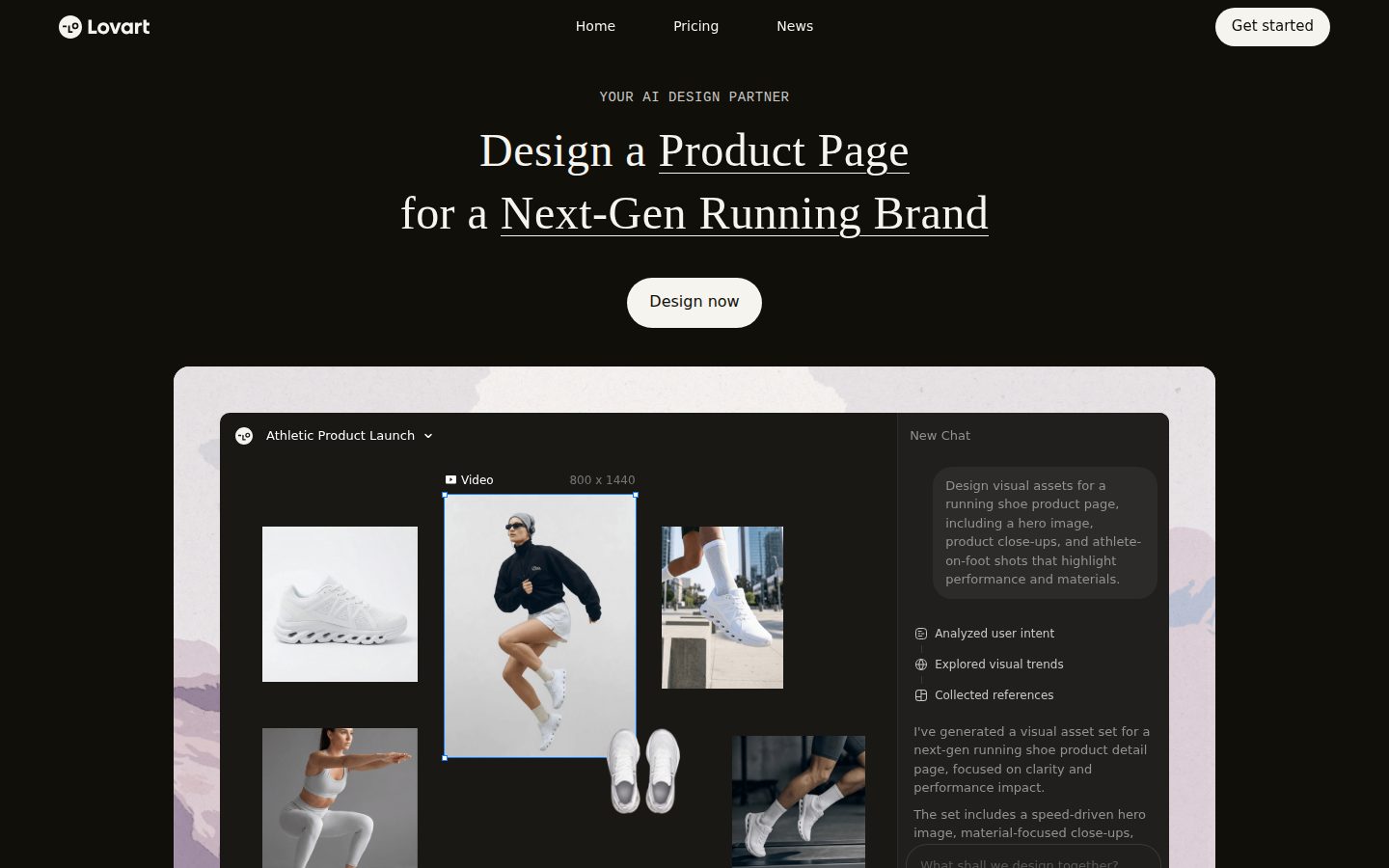
Touch Edit and Brand Kit suggest real craft, but the site's own H1 reading 'Design a Product Page(1)' hints at rough edges.
Hundreds of individual tool pages plus vertical templates for menus, book covers, and catalogs suggest depth, but that same sprawl takes time to map.
Only one mobile web session per account allowed, which reads as an afterthought, not a real mobile product.
No credit card required and 500 daily free credits lower the barrier, though a single-input-to-many-outputs flow can feel like homework fast.
Routing across 16+ third-party models via an MCoT engine is ambitious, but juggling that many providers is a lot of places for something to break.
Solo creators and small teams who want logo-to-video output without juggling Midjourney, Kling, and Canva separately.
Avoid if your work happens mostly on a phone or you need guaranteed multi-device team access.
16 image models, one wrapper. The moat question doesn't go away.
“Lovart aggregates Midjourney, Flux, Kling, Veo and a dozen others behind a chat interface, which is impressive plumbing but not a defensible product on its own. The pricing ladder is real and detailed. The dependency risk is real too.”
Three tells before I dug in. 'World's First AI Design Agent' — the kind of superlative every wrapper claims. 100K+ creators, no retention or churn number next to it. And an H1 that reads 'Design a Product Page(1)' — looks like a templated page, not proofread.
What's actually here: 16+ image models, 13+ video models, Touch Edit, Brand Kit, batch generation up to 40 images. That's real breadth. But breadth isn't moat. If Midjourney or Kling change API terms, Lovart's core pitch changes with it. I've seen this exact aggregator play before — some survive by adding proprietary layers (MCoT reasoning claims to be one), some don't.
Exit is fine — export to PSD, SVG, PDF means your files leave clean. Competitive gap versus Canva and Adobe Firefly is real for now: nobody else routes across 29+ models in one chat. Whether that gap survives three years is the open question.
Routing across 16+ image and 13+ video models (Midjourney, Kling, Veo) in one chat is a real gap versus Canva AI and Adobe Firefly today.
Multi-format export (PNG, SVG, PDF, PSD) with print-ready specs means assets leave cleanly if you churn.
No funding data, no named team, no API in evidence — docs and changelog exist but that's thin for a 6-tier pricing structure up to $149/mo.
'World's First AI Design Agent' is unverifiable superlative; feature list (Touch Edit, Brand Kit) is concrete and matches docs.
Aggregator-of-models pattern has both survivors and casualties; too early to place Lovart confidently in either bucket.
Solo creators or small agencies who want one chat interface instead of juggling Midjourney, Kling, and Canva separately.
Avoid if you need guaranteed long-term platform stability over a specific proprietary design engine.
Common questions answered by our AI research team
No. For both monthly and annual plans, unused credits do not roll over and reset automatically at the start of the next billing cycle.
Yes. You can purchase credit packs to get more generation capacity without changing your current subscription, and these credits are added instantly and never expire.
Lovart draws on 16+ image models, including Midjourney, GPT Image, Nano Banana, Seedream, and Flux.
Touch Edit lets you make targeted changes exactly where you need them, preserving what's already working so every edit is precise and intentional without disrupting the rest of the design.
Tasks can run simultaneously on up to 2 desktop Web sessions and 1 mobile Web session per account. Teams needing multi-user access should use the Team Plan.


Lovart is an AI design agent that generates logos, marketing visuals, and campaign assets from conversational prompts.