Manus AI logo

Manus AI Review

Visit

Hands-on AI agent for slides, websites, apps, design, and research

Manus is an AI agent platform for individuals and teams that automates tasks like building websites, creating slides, and conducting research.

AI Panel Score

6.9/10

6 AI reviews

Reviewed

What is Manus AI?

Manus is an AI agent platform for individuals and teams that automates tasks like building websites, creating slides, and conducting research. Rather than only generating text responses, it executes multi-step tasks autonomously across design, development, research, and communication, letting users describe goals in natural language while the platform handles execution. A free plan is offered, including a Team Plan with SSO and API access, though pricing beyond that tier is not publicly detailed. Key capabilities include AI Slides, website building, an AI image generator, a browser operator, wide research, and Slack integration, available across web, iOS, Android, Mac, and Windows. TopReviewed's six-seat AI review panel scored it 6.9/10, praising the breadth of slides, websites, design, research, and email in one interface while noting undefined post-acquisition product direction following its acquisition by Meta. It suits teams wanting one agent for mixed autonomous tasks.

About Manus AI

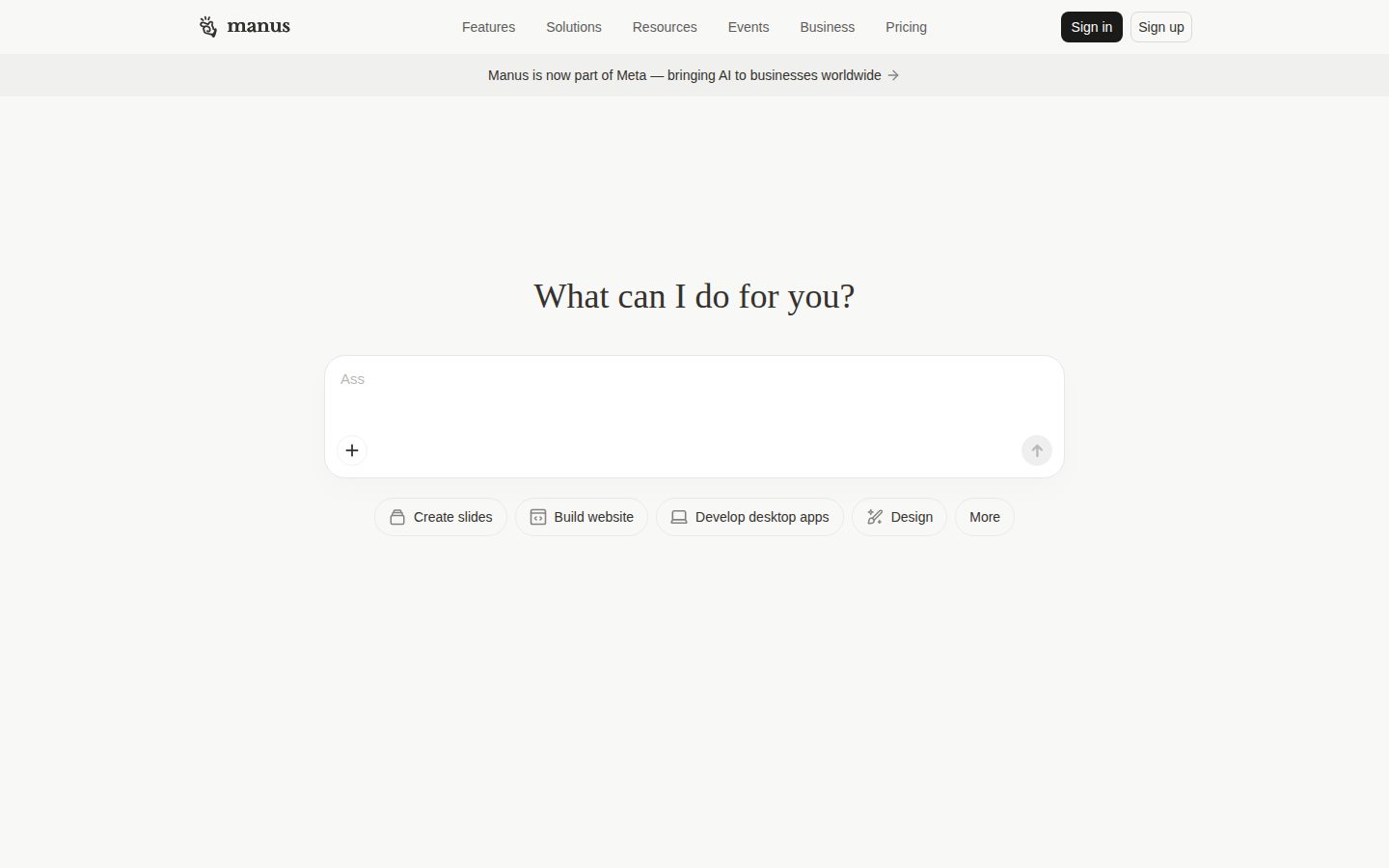
Users interact with Manus by describing what they want — a slide deck, a desktop app, a designed asset, or a research brief — and the agent carries out the work end-to-end. The interface supports open-ended prompts and routes tasks through specialized capabilities depending on the job type. Results can be iterated on within the same session.

Manus surfaces several distinct product modules: AI slides, AI design, AI image generation, a browser operator that can navigate the web autonomously, a Wide Research mode for deep information gathering, and Mail Manus for email-related tasks. It also integrates with Slack, supports a custom browser (Manus Browser), and exposes an API for programmatic access.

Manus is positioned for both individual users and business teams, with a dedicated Team Plan, SSO support, and startup-focused pricing. It competes directly with ChatGPT, Lovable, and Replit, as noted on its own comparison pages. A mobile app, desktop app, and web app are all available. Pricing details are available on the product's pricing page; the freemium model includes a free tier alongside paid plans.

The platform is now part of Meta, which the homepage describes as expanding AI access to businesses worldwide. An API is available for developers, and the product supports deployment across web, iOS, Android, Mac, and Windows.

Features

AI

  • AI Design

    Produces design assets and outputs using AI-driven generation.

  • AI Image Generator

    Generates images using artificial intelligence based on user prompts.

  • AI Slides

    Generates presentation slides autonomously from user input.

  • Build Website

    Creates websites based on user-described goals without manual coding.

  • Desktop App Development

    Develops desktop applications autonomously as a task execution capability.

  • Wide Research

    Conducts broad research tasks autonomously across multiple sources.

Automation

  • Mail Manus

    Handles email-related tasks and communication workflows autonomously.

  • Manus Browser Operator

    Operates a browser autonomously to execute web-based tasks on behalf of the user.

Collaboration

  • Team Plan

    Provides a shared plan for teams to access and use Manus collaboratively.

Integration

  • API

    Exposes an API allowing external systems to programmatically access Manus capabilities.

  • Slack Integration

    Connects Manus to Slack to enable task execution within Slack workflows.

Security

  • SSO

    Supports Single Sign-On for centralized and secure authentication.

Preview

Manus AI desktop previewManus AI mobile preview

Pricing Plans

Team Plan

Contact sales

Business team collaboration plan for organizations using Manus AI

  • Team collaboration features
  • SSO support
  • API access
  • Business-grade tools

AI Panel Reviews

The Decision Maker

The Decision Maker

Strategic bet, vendor viability, timing, adoption approval
7.2/10

Meta's December 2025 acquisition gives Manus real runway, but the use case is still taking shape.

Manus bundles autonomous agents for slides, websites, design, and research into one platform. The Meta acquisition changes the viability math entirely.

Acquired by Meta in December 2025. That's the single fact that moves this from 'interesting startup' to 'defensible bet.' Butterfly Effect built something attractive enough to buy, and now it has distribution. The 36-month survival question is answered.

The feature breadth is real — AI Slides, Wide Research, Manus Browser Operator, Mail Manus, desktop app, API, SSO, Slack integration. That's not a demo reel. The Team Plan with SSO and API access at free pricing is aggressive. The tradeoff: this is a wide platform with shallow roots in any single category. Lovable owns website building. ChatGPT owns the generalist prompt. Manus is competing everywhere at once.

Two things to watch. One: post-acquisition product direction is unclear — Meta integrations could make this stronger or turn it into an internal tool. Two: no changelog surfaced, which makes it hard to know if they're shipping. Pilot with a small team on one concrete use case before committing workflows.

Competitive Positioning6.8

Competes directly with ChatGPT, Lovable, and Replit across three different categories simultaneously, which dilutes the clear positioning.

Reputation Risk7.5

Meta-backed product is boardroom-safe; the China founding origin may draw scrutiny in regulated industries.

Speed to Value7.5

AI Slides and Build Website are zero-to-output tasks — a motivated team could see results in a first session, no integration required.

Strategic Fit7.0

Wide Research and Manus Browser Operator could genuinely expand what teams accomplish, not just automate existing steps — but use case definition is still on the buyer.

Vendor Viability8.5

Meta acquisition in December 2025 eliminates short-term survival risk; parent has the balance sheet and distribution.

Pros

  • Meta acquisition removes the runway question entirely
  • Free Team Plan with SSO and API access is an aggressive entry point
  • Covers slides, websites, design, research, and email in one interface — reduces tool sprawl
  • Available across web, iOS, Android, Mac, and Windows

Cons

  • No changelog surfaced — hard to confirm shipping velocity
  • Competing in too many categories against focused leaders like Lovable and ChatGPT
  • Post-acquisition product direction is undefined — roadmap could shift toward Meta priorities
  • Pricing details beyond the Team Plan aren't publicly clear

Right for

Teams that want one agent to handle mixed autonomous tasks without stitching together five separate tools.

Avoid if

Your org needs a category-leading specialist in website building or research — focused tools still win those head-to-heads.

The Domain Strategist

The Domain Strategist

Craft and strategy in the product's domain — adapts identity per category, same lens
7.2/10

Meta's autonomous agent plays wide but the architecture story needs scrutiny.

Manus covers an unusually broad execution surface — slides, websites, desktop apps, browser automation, research — for a single agent platform. The December 2025 Meta acquisition changes the governance calculus for any enterprise CTO evaluating a 3-year bet.

The capability breadth here is real: browser operator, Wide Research, Mail Manus, API access, SSO, Slack integration — that's not a demo feature list, that's a multi-surface execution layer. Someone built an orchestration architecture that routes heterogeneous task types through specialized sub-agents. That's non-trivial. The question is whether the orchestration layer is stable enough to build workflows on, or whether it's still shifting under active post-acquisition restructuring.

The Meta acquisition in December 2025 is the dominant architectural risk. Butterfly Effect built this independently; Meta now owns the roadmap. If/then: if Meta folds Manus capabilities into Meta AI broadly, the standalone API surface you're depending on gets deprecated or repriced without warning. That's the constraint I'd stress-test before committing team workflows.

Against Lovable and Replit, Manus plays wider but likely shallower on pure dev tooling. No changelog visibility in the evidence means I can't assess iteration velocity — for an agent platform, that's a gap. SSO and Team Plan suggest enterprise readiness, but pricing is opaque, which complicates budget approval cycles.

Category Positioning7.5

Positioned directly against ChatGPT, Lovable, and Replit but differentiates on execution breadth rather than depth in any single vertical.

Domain Fit7.0

Browser operator and API access fit how CTOs think about workflow automation, but desktop app development via agent is still a fragile primitive for production use.

Integration Surface7.8

Slack integration, SSO, cross-platform clients (web, iOS, Android, Mac, Windows), and API access compose a solid enterprise integration surface.

Long-term Implications6.5

Post-Meta acquisition, roadmap independence is uncertain — a 3-year dependency on this API surface carries higher deprecation risk than pre-acquisition.

Strategic Depth7.5

Multi-modal task orchestration across design, code, research, and communication suggests real architectural investment, but no changelog makes depth hard to verify.

Pros

  • Browser operator plus API plus SSO is a legitimate enterprise-ready integration stack
  • Multi-surface task routing — design, code, research, email — in one orchestration layer is architecturally ambitious
  • Cross-platform availability across all five major surfaces reduces deployment friction for teams

Cons

  • Meta acquisition creates roadmap uncertainty for any 3-year infrastructure dependency
  • No changelog visibility makes it impossible to assess iteration velocity or stability
  • Pricing is opaque — 'Team Plan Free' with no paid tier details blocks serious budget planning
  • Execution breadth likely trades off against depth vs. specialists like Replit for dev or Perplexity for research

Right for

Teams that need a single agent layer spanning multiple task types without stitching together five point solutions.

Avoid if

You're building core workflow infrastructure that needs a stable, independently-governed API over a multi-year horizon.

The Finance Lead

The Finance Lead

Money, total cost of ownership, contracts, procurement math
5.8/10

Meta-acquired, 12 features listed, zero public individual pricing — that's the problem.

Manus has SSO, API, Slack, and a broad autonomous agent feature set. But no published per-seat price makes TCO modeling impossible.

The pricing page exists but only surfaces a free Team Plan. No individual tier price. No per-seat number. No overage rate. Comparing to ChatGPT Team at $25/seat or Lovable's published credit model, Manus gives procurement nothing to work with. That's not a minor gap — it's a blocker.

Feature breadth is real: Wide Research, Mail Manus, Browser Operator, AI Slides, website builder, desktop app dev — 12 named capabilities. SSO included in the Team Plan, which is rare without a tax. But Meta acquired Butterfly Effect in December 2025. Ownership transitions reset contract terms. Any multi-year commitment before that stabilizes is a risk.

ROI math requires an output rate — tasks completed, hours displaced. Manus doesn't publish benchmarks. The autonomous agent pitch is defensible. The billing model isn't ready for enterprise procurement.

Billing & Procurement4.5

SSO is included per the Team Plan listing, but invoicing model and payment terms aren't publicly documented.

Contract Flexibility4.5

No public auto-renewal terms or cancellation policy; Meta acquisition adds contract continuity risk.

Pricing Transparency3.5

Only a free Team Plan is published; no per-seat or usage pricing visible without a sales call.

ROI Clarity5.5

Autonomous agent capabilities are broad but no published output benchmarks to anchor a displacement calculation.

Total Cost of Ownership4.0

No published overage rates or individual tier pricing makes 3-year TCO modeling purely speculative.

Pros

  • SSO included in Team Plan — no separate tax based on published tier
  • 12 distinct capabilities covering research, design, slides, browser automation, and dev
  • API exposed for programmatic access, reducing manual workflow overhead
  • Slack integration reduces adoption friction for team rollout

Cons

  • No published per-seat price — procurement can't build a baseline model
  • Meta acquisition in December 2025 creates contract and roadmap uncertainty
  • No free trial; freemium entry only — harder to scope value before committing
  • Zero published overage or usage-cap data — invoice unpredictability is real

Right for

Teams willing to negotiate pricing directly and absorb the uncertainty of a recently-acquired AI platform.

Avoid if

Your procurement team requires published per-seat pricing and contractual stability before signing.

The Domain Practitioner

The Domain Practitioner

Daily hands-on reality in the product's domain — adapts identity per category, same lens
7.2/10

Manus does the heavy lifting but API docs will make you squint

Manus runs genuine multi-step autonomous tasks — browser operation, website builds, research sweeps — without you writing a line of code. The Meta acquisition in December 2025 adds institutional weight, but the engineering story has real gaps to audit before committing.

The autonomous browser operator and Wide Research mode are the two features worth watching. Browser automation that actually executes — not just scrapes — is where Lovable and Replit stop short. Manus routes those tasks natively. The API exists, which matters for workflow integration, but the website evidence flags API capability as 'N' on docs, which is a red flag. Undocumented APIs become debugging sessions.

The freemium Team Plan includes SSO and API access at no listed cost. Good for getting engineers into a sandbox fast. The tradeoff: no changelog visible publicly. For a tool touching browser automation and desktop app generation, no changelog means no signal on regression risk. That's a daily operational problem if you're embedding Manus in a real pipeline.

Day three looks like this: prompts work, results iterate within session, Slack integration gives you a hook back into the existing toolchain. But without solid API error contracts and public versioning, building anything durable on top of this is a bet, not a plan.

Day-3 Reality7.0

Session-based iteration and multi-modal task types hold up, but no changelog means zero visibility into what changed under you overnight.

Documentation Practitioner-Fit5.5

No changelog, API docs unconfirmed in evidence; the website evidence explicitly marks docs availability as uncertain, which is a practitioner-facing gap.

Friction Surface6.5

Docs capability flagged as absent in scraped evidence — undocumented API behavior accumulates friction fast when debugging autonomous task outputs.

Power-User Depth7.8

Browser operator, Wide Research, desktop app generation, and API access together form a real power-user surface that goes well beyond ChatGPT's text-only ceiling.

Workflow Integration7.5

Slack integration and API access are real hooks into existing engineering workflows; desktop app on Mac and Windows removes one context switch.

Pros

  • Autonomous browser operator is a genuine capability gap vs Lovable and Replit
  • API + SSO on Team Plan at no listed cost lowers the trial-commit barrier
  • Multi-platform: web, iOS, Android, Mac, Windows — no forced context switch
  • Slack integration gives a real workflow hook without custom glue code

Cons

  • No public changelog — regression risk is invisible for pipeline builders
  • API docs unconfirmed; undocumented contracts are a production debugging nightmare
  • No free trial listed, only a free tier — harder to scope limits before committing
  • Meta acquisition December 2025 introduces roadmap uncertainty for a tool you might embed

Right for

Engineering teams wanting to offload browser automation and research tasks without building custom agents from scratch.

Avoid if

You need stable, versioned API contracts with documented error handling for a production integration.

The Power User

The Power User

Daily human experience, onboarding, polish, learning curve, reliability
7.8/10

Manus does a lot of real work, but the Meta acquisition changes the math

An unusually wide autonomous agent — slides, websites, research, email, browser operation, all in one place. The Meta acquisition in December 2025 is either a rocket or a question mark depending on your risk tolerance.

The feature breadth here is genuinely unusual. Wide Research, Mail Manus, browser operator, AI slides, desktop app generation — that's not a single clever trick, that's a whole assistant trying to cover a full workday. Compared to ChatGPT, which mostly hands you text and wishes you luck, Manus is actually trying to finish the job. That's the pitch, and for a lot of tasks it apparently delivers.

The freemium Team Plan including SSO and API access is a real move. Most tools make you pay for SSO like it's a luxury good. That said, starting price is unlisted, which means the paid tiers are a conversation, not a commitment — and that gets old fast.

The Meta acquisition is the thing you can't ignore. Could mean resources and reach. Could mean slow-walked into an enterprise product nobody asked for. The original Butterfly Effect DNA was scrappy and Singapore-based. Day three is fine. Month three depends entirely on which direction Meta pulls this thing.

Daily Polish7.5

The H1 is just 'What can I do for you?' — clean and confident, but no changelog visible, so it's hard to tell if the team is sweating the small stuff or coasting.

Learning Curve7.8

Open-ended prompts lower the floor nicely, but twelve distinct capability modules means month three could still feel like you're discovering features by accident.

Mobile Parity8.0

iOS, Android, Mac, and Windows all listed as supported platforms, which is more than most agent tools bother with.

Onboarding Experience8.0

Natural language input with no structured form to fill out is a good sign — the docs exist, the prompt-first interface suggests you can just describe a goal and move.

Reliability Feel7.2

Multi-step autonomous task execution across browser, code, and design is inherently fragile territory — no changelog to check how often things break or get patched.

Pros

  • Genuinely end-to-end — slides, websites, research, email, browser operation in one product
  • Team Plan includes SSO and API access, which competitors usually paywall
  • Available on every major platform including mobile
  • Natural language input keeps the starting point low

Cons

  • Starting price not publicly listed — always a friction point for budget planning
  • No visible changelog makes it hard to trust the reliability trajectory
  • Meta acquisition in December 2025 introduces real product-direction uncertainty
  • Twelve feature modules is a lot to discover — no clear learning path from the evidence

Right for

Teams and individuals who want one agent to handle real deliverables — not just answers — across design, research, and communication.

Avoid if

You need pricing transparency upfront or can't stomach the uncertainty of a recently-acquired product finding its new direction.

The Skeptic

The Skeptic

Contrarian. Watch-outs, deal-breakers, broken promises, category patterns
6.2/10

Meta acquisition buys viability, but the product story has three open questions

Manus is an autonomous agent platform acquired by Meta in December 2025, covering slides, websites, design, research, and browser automation. The Meta umbrella solves the funding question but opens a different one: roadmap control.

Three tells upfront. One: no changelog listed in the scraped capabilities — that's a shipping-cadence red flag I've seen precede pivots. Two: the Team Plan pricing page shows 'Free' with no visible paid tier pricing — either scraping missed it or they're still figuring out monetization. Three: 'action engine' is the kind of headline that covers everything and promises nothing specific.

The feature breadth is real. Wide Research, Manus Browser Operator, Mail Manus, AI Slides — these aren't aliases for the same thing. That's six distinct capability modules. Against Lovable or Replit, the non-code surface area (design, email, research) is a genuine differentiator. Against ChatGPT, the end-to-end autonomous execution angle holds up on paper.

The Meta acquisition in December 2025 is the biggest variable. Products absorbed by Big Tech go two ways: resourced into category winners, or quietly deprecated. No public signal yet on which direction. Exit portability is thin — autonomous agent output is hard to migrate. Proceed cautiously on deep workflow dependency.

Competitive Differentiation7.0

Non-code modules like Mail Manus and Wide Research create surface area Lovable and Replit don't cover.

Exit Portability4.5

Autonomous end-to-end outputs across design, code, and research are deeply entangled — no clean export story visible in the docs.

Long-term Viability7.5

Meta acquisition December 2025 removes startup mortality risk, but introduces roadmap uncertainty that independent teams don't have.

Marketing Honesty5.5

'Action engine that goes beyond answers' is vague enough to survive any product pivot — not a grounded claim.

Track Record Match6.0

Multi-modal agent plays (Adept, Imbue) have struggled to convert demos into retained users; Manus matches that pattern more than Stripe's.

Pros

  • Six distinct capability modules — not the same feature rebranded
  • Meta backing removes the 'will they exist in 18 months' question
  • Browser Operator and Wide Research go beyond what ChatGPT does natively
  • SSO and Team Plan suggest real enterprise-readiness intent

Cons

  • No changelog visible — can't verify shipping cadence
  • Paid tier pricing absent from scraped evidence — monetization story is unclear
  • Meta ownership means product direction could shift without warning
  • Exit portability is weak for any deep workflow dependency

Right for

Teams that want one autonomous agent covering design, research, and communication without stitching five tools together.

Avoid if

You need stable, predictable roadmap commitments — post-acquisition direction is genuinely unknown.

Buyer Questions

Common questions answered by our AI research team

Integration

Does Manus integrate with Slack?

Yes, Manus offers a Slack integration.

Setup

Is there a Manus desktop app available?

Yes, a Manus desktop app is available for download.

Features

Can Manus generate slides automatically?

Yes, Manus includes AI slides as a feature for automatically generating presentations.

Also in AI Agents & Assistants