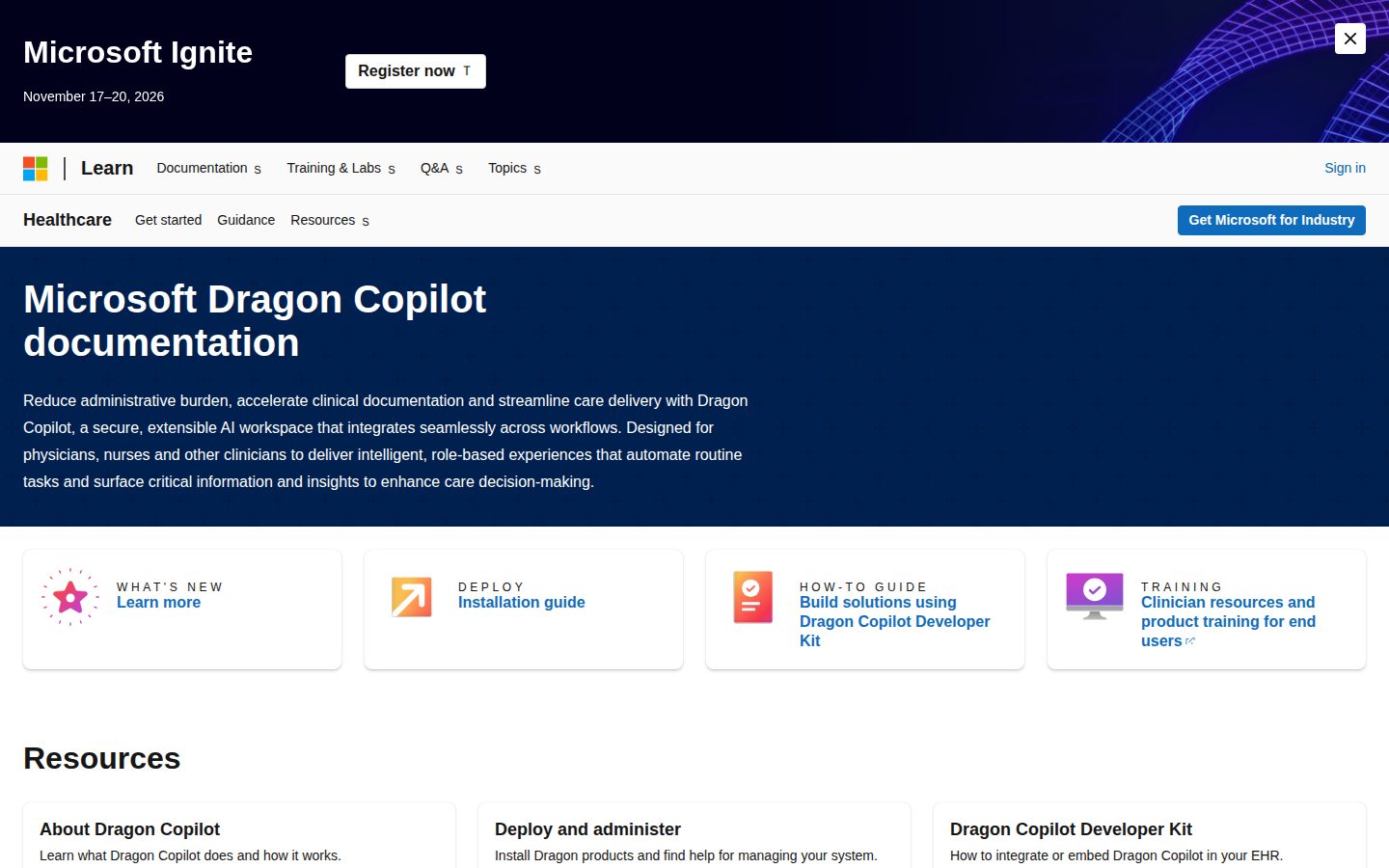
AI clinical assistant for ambient notes, dictation and task automation
Microsoft Dragon Copilot is an AI clinical assistant that drafts notes from patient encounters and automates routine tasks.
AI Panel Score
6 AI reviews
Reviewed
Facts checked against learn.microsoft.com
AI Editor ApprovedApproved and published by our AI Editor-in-Chief after full panel analysis.Microsoft Dragon Copilot is an AI clinical assistant that combines DAX ambient listening with Dragon Medical One dictation, turning physician-patient conversations into draft clinical documentation. It integrates with electronic health record systems to reduce the administrative burden on clinicians while improving documentation quality. Sold by Microsoft and certified partners, it has role-based editions for physicians, nurses and radiologists and runs as web, desktop and mobile apps or embedded in EHRs such as Epic. Seat pricing is quote-based, Flex licenses meter ambient and AI features at $0.25 per AI-assisted session, and there is no free plan or trial. Capabilities include ambient note drafting, voice dictation, a built-in mobile mic, task automation, nursing flowsheet documentation and health data protection, and its ambient mode removes the need to narrate the note. TopReviewed's six-seat AI review panel scored it 8.0/10, praising Microsoft ownership that removes viability concerns and a production-grade Epic integration while noting that unlisted pricing and the absence of a free trial make internal business cases harder to build.
Microsoft Dragon Copilot is an AI clinical assistant that combines the voice dictation of Dragon Medical One with the ambient listening of DAX, both built by Nuance, now part of Microsoft. It captures multi-party, multilingual physician-patient conversations during clinical encounters, then converts them into specialty-specific, customizable draft notes. The technology operates passively in the background, requiring minimal interaction from the clinician during the visit.
The product is primarily targeted at healthcare organizations, hospitals, and physician practices looking to reduce documentation time and administrative overhead. Physicians, nurses and radiologists each get a role-based edition, and clinicians across a range of specialties can use Dragon Copilot to streamline note creation, with the system generating draft notes that are then reviewed and submitted to the EHR by the provider.
Dragon Copilot runs as standalone web, desktop and mobile apps for iOS and Android, or embedded in electronic health record platforms such as Epic. The workflow typically involves a clinician activating the app before or during a patient encounter, after which the AI processes the audio and produces a draft clinical note. The clinician reviews and approves the note before it is finalized in the patient record.
Microsoft offers Dragon Copilot as the migration path for Dragon Medical One customers, whose auto-texts, step-by-step commands, vocabulary and settings carry over. Its ambient mode adds what dictation-only Dragon Medical One lacks, removing the need for the physician to narrate the note separately after or during the encounter.
Dragon Copilot is licensed per user through Microsoft or a certified partner. Microsoft publishes the license types (Physician Per User, Physician Flex, Nurse Per User) and a pay-as-you-go rate for ambient and AI features, but per-seat prices are quoted on request.

Partners can build AI apps and agents that run inside Dragon Copilot's clinical workflow through its extension marketplace.
Ambiently captures multi-party, multilingual conversations and orders at the point of care, or on-demand recordings, and turns them into specialty-specific, customizable draft notes.
Dragon Copilot for nurses turns the recorded nurse-patient conversation into EHR flowsheet rows; nursing is available in the US only.
Goes beyond note-taking with coding suggestions, clinical evidence summaries, referral letters and after-visit summaries, pulling the relevant details from the encounter.
Dictate wherever the cursor is in Dragon Copilot desktop, web, mobile or embedded, with Dragon Medical One's auto-texts, step-by-step commands, vocabulary and settings migrated over.
EHR vendors can embed Dragon Copilot through SDKs for JavaScript, Android and iOS (DAXKit) and partner REST APIs for licensing, ambient sessions and note delivery.
The Dragon Copilot mobile app for iOS and Android doubles as a wireless microphone that pairs with the web and desktop apps, in place of the separate PowerMic Mobile app.
Audio is encrypted at capture, data moves over TLS 1.3 and is stored with AES-256; Microsoft lists SOC 1 and SOC 2 Type II, with ISO/IEC 27001 certification pending.
One monthly per-user fee covers every Dragon Copilot feature for the patient-provider encounter, including front-end speech, ambient and AI features, with no additional charges. Bought through Microsoft or a certified partner under an MCA, CSP or Enterprise Agreement; the per-seat price is quoted.
Front-end speech for one monthly per-user fee, with ambient and AI features billed pay-as-you-go at $0.25 per AI-assisted session (rate as of May 4, 2026). Each license adds 10 included sessions a month, and an Azure subscription linked to Dragon admin center is required. The seat price is quoted.
Per-user license for nursing staff, including RNs, LPNs, CNAs and PCTs, using flowsheet-based workflows. Bought through Microsoft or a certified partner; the per-seat price is quoted.
Microsoft's $19.7B bet on ambient clinical AI is the safest enterprise healthcare buy right now.
“Dragon Copilot is Microsoft-owned, built on Nuance technology used in 77% of U.S. hospitals, and directly addresses the documentation crisis burning out physicians. No public per-seat price is the one friction point.”
Microsoft paid $19.7 billion for Nuance in 2022. That's not a startup moonshot — that's a committed platform play. Dragon Copilot isn't going anywhere, and neither is the Epic integration anchoring it inside existing clinical workflows.
The ambient model is the real differentiation here. Dragon Medical One required narration. Dragon Copilot's ambient mode listens passively, then generates the draft note. Clinicians review and submit — that's it. Versus competitors like Suki or Abridge, Dragon Copilot has the EHR depth and the enterprise sales infrastructure that health systems actually require.
The tradeoff: no public per-seat price, no free trial, no self-serve path. Smaller practices won't get a fast answer. Procurement cycles here are long. But for health systems with 50+ providers already on Epic, this is the obvious call.
Deeper EHR integration than Suki or Abridge, with Microsoft's healthcare ecosystem as a durable moat.
77% of U.S. hospitals trust Nuance — board won't raise an eyebrow.
Ambient documentation reduces note time immediately, but enterprise deployment cycles slow the payback window.
Dragon Copilot's task automation and its nursing and radiology editions go beyond note automation into broader workflow transformation.
Microsoft's own product, built on the $19.7B Nuance acquisition in 2022 — zero realistic existential risk.
Health systems with 50+ providers running Epic who need to address physician burnout at scale.
Small practices wanting a fast, self-serve pilot with transparent pricing.
Microsoft's ambient documentation layer is the closest thing healthcare has to infrastructure.
“Dragon Copilot, built on Microsoft's $19.7B Nuance acquisition, is the ambient documentation standard from a vendor whose products 77% of U.S. hospitals already use. The clinical workflow fit is genuine, but a still-pending ISO 27001 certification and quote-only per-seat pricing are real governance concerns.”
Dragon Copilot building ambient capture on top of Dragon Medical One's dictation is the right architecture. You get speech recognition as a foundation layer, then ambient automation above it — that's how clinical documentation should be structured, not flipped. Epic integration is the unlock that makes this deployable at health-system scale without a custom integration project.
Security is better documented than the product page lets on: Microsoft's Dragon Copilot white paper and FAQ cover HIPAA support, HITRUST-certified Azure hosting, SOC 2 Type II, TLS 1.3 in transit and AES-256 at rest. The gap I'd escalate before any enterprise procurement is that ISO/IEC 27001 is still listed as certification pending — that's a compliance conversation, not a feature toggle.
If we adopt this, in 3 years we've structured our documentation workflow around a Microsoft dependency. That's not inherently wrong — the Microsoft for Healthcare ecosystem has genuine depth — but Epic plus Azure plus Dragon Copilot creates a concentrated vendor surface that needs governance planning from day one.
Nuance's 77% U.S. hospital footprint and Microsoft backing make Dragon Copilot the default ambient documentation standard; Suki and Abridge compete but lack the infrastructure depth.
Passive ambient capture with clinician review-and-approve before EHR submission matches how attending physicians actually want to interact with documentation tools.
Named Epic integration plus a built-in mobile mic plus Microsoft for Healthcare ecosystem gives this one of the widest EHR surface areas in the ambient documentation category.
Microsoft's $19.7B commitment signals durability, but a three-vendor lock (Epic + Azure + Dragon Copilot) creates a concentrated dependency that needs active governance.
Layered architecture of Dragon Medical One dictation plus DAX ambient capture plus generative AI shows genuine clinical workflow thinking, not a single-feature wrapper.
Health systems already on Epic that need ambient documentation at multi-specialty scale with minimal workflow disruption.
Independent practices or federally qualified health centers need transparent per-seat pricing before any vendor engagement.
$0.25 per AI-assisted session is public, but the Dragon Copilot seat price still takes a quote.
“Microsoft publishes three Dragon Copilot licenses and a $0.25 pay-as-you-go session rate. The per-seat monthly fee is still quote-only through a Microsoft rep or partner.”
Ask for a Dragon Copilot seat price and you get a Microsoft rep. Ask what an AI-assisted session costs and it's public. Physician Flex bills ambient and AI features pay-as-you-go: 25 consumption units at $0.01, or $0.25 a session as of May 4, 2026. Each Flex license includes 10 sessions a month.
Assume 50 physicians at 400 sessions a month. That's 19,500 billable after the 500 included. 19,500 × $0.25 = $4,875 a month, about $58.5K a year. Meter only. The Flex dictation fee sits on top.
The catch is that fixed fee. Seats come through an MCA, CSP partner or Enterprise Agreement, priced by quote. I couldn't find a free trial. But the meter can be fenced: Microsoft says customers can turn the AI features off at any time to control cost. Variable cost with a ceiling.
Bought via MCA, CSP partner or Enterprise Agreement, with Flex metered through Azure; I couldn't find a trial.
Per User, Flex and pay-as-you-go licenses can be mixed; I couldn't find term length or renewal terms.
License types and a $0.25 per-session pay-as-you-go rate are public; per-seat monthly fees are quote-only.
Per-session billing ties AI spend to actual use, though the unpublished seat fee blocks a full payback model.
The ambient meter models cleanly at $0.25 a session, but the unpublished seat fee anchors year-3 cost.
Health systems that want to meter ambient AI before committing per seat.
You need a published per-seat price before your first sales call.
Ambient documentation that actually disappears into the visit — if your org can deploy it
“Dragon Copilot does the hardest thing in clinical AI: it gets out of the way during the encounter. The real friction isn't the tool, it's the enterprise procurement wall.”
77% of U.S. hospitals already run some Nuance product. That EHR install base — especially the Epic integration — matters more than any feature list. Dragon Medical One has been in exam rooms for years, and Dragon Copilot builds on that trust. Ambient capture that generates a draft note before you've walked the patient to checkout is a genuine workflow shift. No post-visit dictation queue. That alone is worth attention.
Day three reality: the note review step is where habits form or break. If draft quality degrades on complex multi-problem visits, you're editing instead of approving — and editing a bad AI note takes longer than dictating clean. Dragon Copilot's broader task automation sounds compelling, but the docs don't show specialty-specific performance data. Versus Suki or Ambience Healthcare, Dragon Copilot's Microsoft backing means deeper EHR hooks but potentially slower product iteration.
No public per-seat price and no free trial. Deploying this means a contract negotiation before any clinician touches it. For a solo practice or small group, that's a hard stop. For a health system already in the Microsoft ecosystem, the procurement path is probably already paved.
Ambient passive capture removes the dictation habit entirely, but note review quality on complex encounters is undocumented and determines whether day-3 feels like approval or repair.
Microsoft lists specialty-optimized models for dozens of specialties, but no accuracy benchmarks or specialty-specific note examples are publicly visible.
App activation before each encounter is low friction, but contract-first procurement and a still-pending ISO 27001 certification mean IT and compliance teams generate their own friction during rollout.
Dragon Copilot promises broader automation beyond dictation, and Microsoft lists specialty-optimized models (inpatient, interventional cardiology and surgery among them), but I couldn't find the advanced configuration options a high-volume hospitalist or proceduralist would need.
Epic integration plus a built-in mobile mic means the tool lives inside existing EHR workflows rather than sitting alongside them — a real structural advantage over bolted-on transcription tools.
Health systems already in the Microsoft or Epic ecosystem looking to cut post-visit documentation time at scale.
You're a small practice or independent physician who needs to evaluate and deploy in weeks, not quarters.
Doctors actually look at their patients again — that's the whole story
“Microsoft Dragon Copilot passively listens to physician-patient conversations and auto-generates clinical notes straight into Epic and other EHRs. Microsoft paid $19.7 billion for Nuance in 2022, which tells you how seriously they're taking this.”
Seventy-seven percent of U.S. hospitals already trust Nuance products. That's not demo glow — that's installed base. Dragon Copilot sits on top of that foundation, and its ambient mode replaces the old Dragon dictation ritual where doctors narrated into a microphone like a 1990s news anchor. The ambient approach is the real differentiator here. Clinician starts the app, sees the patient, Dragon Copilot handles the rest. That workflow change alone is worth paying attention to.
The tricky part is that Microsoft publishes no per-seat price. Enterprise agreements mean a long buying cycle and zero self-serve. Dragon Copilot is a procurement project, not a software purchase. That's a real gap for smaller practices or solo physicians who just want to try it.
Dragon Copilot is where DAX now lives — one assistant that folds DAX's ambient notes and Dragon Medical One's dictation together, with broader task automation on top. Microsoft's public release notes run through Dragon Copilot 5.1, so momentum is easy to track. And the Microsoft Healthcare ecosystem backing and Epic integration mean this isn't going anywhere. For any mid-size or large health system already inside the Microsoft stack, this is a very easy yes.
The ambient passive workflow suggests someone thought hard about reducing friction, and public release notes through Dragon Copilot 5.1 show polish shipping steadily.
Ambient listening removes most active steps, but Dragon Medical One switchers lose some formatting commands and advanced options, which will slow month-one adoption for heavy dictation users.
Dragon Copilot mobile turns the phone into a mic for dictation and note navigation, and the full workflow runs on iOS and Android — mobile isn't an afterthought here.
No free trial and contact-only pricing means onboarding starts with a sales call, not the product — that's homework before you even open the app.
Nuance's 77% U.S. hospital footprint, a 99.9% uptime commitment and a $19.7B Microsoft acquisition suggest production-grade infrastructure, not a startup betting on uptime.
Mid-size to large health systems already inside the Microsoft or Epic ecosystem that want to cut documentation time at scale.
You're a solo practice or small clinic that needs transparent pricing and a self-serve trial before committing.
Safe bet, two loose ends: ISO 27001 is still pending and Dragon Medical One is still sold on its own
“Ambient clinical documentation category has bodies everywhere — Suki, Abridge, Nabla all fighting for the same EHR real estate. Dragon Copilot has the Microsoft backstop and a Nuance footprint in 77% of U.S. hospitals that most rivals can't touch.”
Three tells. One: no public per-seat price, which is standard enterprise healthcare but still a friction flag. Two: Dragon Copilot now absorbs Dragon Medical One's dictation and DAX's ambient notes, yet Dragon Medical One is still sold on its own — a consolidation that hasn't finished. Three: ISO/IEC 27001 is still listed as certification pending, which a compliance team will ask about.
The Microsoft acquisition in March 2022 at $19.7 billion is the single most important fact here. This isn't a seed-stage ambient note startup. Epic integration is real. The 77% hospital figure, if it holds up, means IT procurement conversations are already half-won before Dragon Copilot enters the room.
Tradeoff: you're locked into enterprise contracting with no trial, no per-seat price list, and partner-gated developer APIs. Migration off this — pulling structured notes out of Epic — won't be clean. Dragon Copilot is a long commitment, not a tool you swap in six months. That's the ask.
Microsoft ecosystem plus a built-in mobile mic and existing Dragon Medical One install base gives real separation from Abridge and Suki, who lack the EHR footprint.
Partner-only APIs, enterprise contracts only, and notes living inside Epic workflows make this sticky by design — migration would be painful.
Microsoft-owned product with deep healthcare infrastructure and $19.7B committed — category-level viability risk here is basically zero.
Marketing copy is grounded — 'reduce administrative burden' is measurable — and Microsoft publishes a feature-by-feature Dragon Medical One comparison, but Dragon Medical One is still sold on its own, so the consolidation hasn't fully landed.
Nuance's 77% U.S. hospital footprint plus a named $19.7B acquisition matches the pattern of durable enterprise winners, not shuttered startups.
Health systems already on Epic or inside the Microsoft for Healthcare ecosystem that want ambient documentation at scale.
You're a small or independent practice without an enterprise procurement team to navigate opaque custom pricing.
Common questions answered by our AI research team
Dragon Copilot keeps most Dragon Medical One dictation features and adds ambient recording. Existing auto-texts, step-by-step commands, vocabulary and settings migrate over, but dictation in Epic Haiku isn't available.
Dragon Copilot is built to support HIPAA, PIPEDA, GDPR and GDPR-UK. Data is encrypted with TLS 1.2 or 1.3 in transit and AES-256 at rest, audio and transcripts are kept up to 90 days, and it is SOC 1 and SOC 2 Type II compliant.
Yes. Dragon Copilot runs embedded in Epic with full dictation support, and single sign-on is currently available only in the Epic-embedded version. The Dragon Copilot desktop app also dictates into most other EHRs and all Microsoft 365 apps.
Dragon Copilot runs as a browser web app with no installation, a Windows desktop app that delivers text straight into the EHR, and a mobile app with offline ambient recording. Users can record on mobile and finish the note on the web.
Yes. Dragon Copilot for nurses ambiently captures nurse-patient conversations and turns them into structured flowsheet entries in the EHR. It also drafts narrative nursing notes for unexpected events, patient requests or safety concerns.
Who Microsoft Dragon Copilot competes with, and how each one differs
Competes across the full Microsoft stack: Gemini against Copilot, Google Workspace against Microsoft 365 and Teams, and Google Cloud with Vertex AI against Azure OpenAI Service. Its distribution leans on consumer search and Android rather than enterprise licensing agreements.
The largest cloud infrastructure provider, ahead of Azure; Bedrock counters Azure OpenAI Service with a multi-model catalog (Anthropic, Meta, Mistral) instead of a single flagship model partner.
Partner turned rival: Microsoft resells OpenAI models through Azure OpenAI Service, yet ChatGPT competes directly with Microsoft Copilot for consumer and enterprise assistant seats, and the OpenAI API competes with Azure for developer spend.
Frontier-model rival to Azure OpenAI Service; Claude is distributed mainly through AWS and Google Cloud and targets the same enterprise assistant, coding, and API workloads with a safety-forward positioning.
Competes for enterprise AI agent budgets: Agentforce against Microsoft Copilot Studio and Slack against Teams. Salesforce anchors its agents in CRM data, while Microsoft anchors on the Microsoft 365 productivity graph.
Microsoft is a Redmond, Washington-based technology company that develops software, cloud services, hardware, and AI products including Windows, Microsoft 365, and Azure.