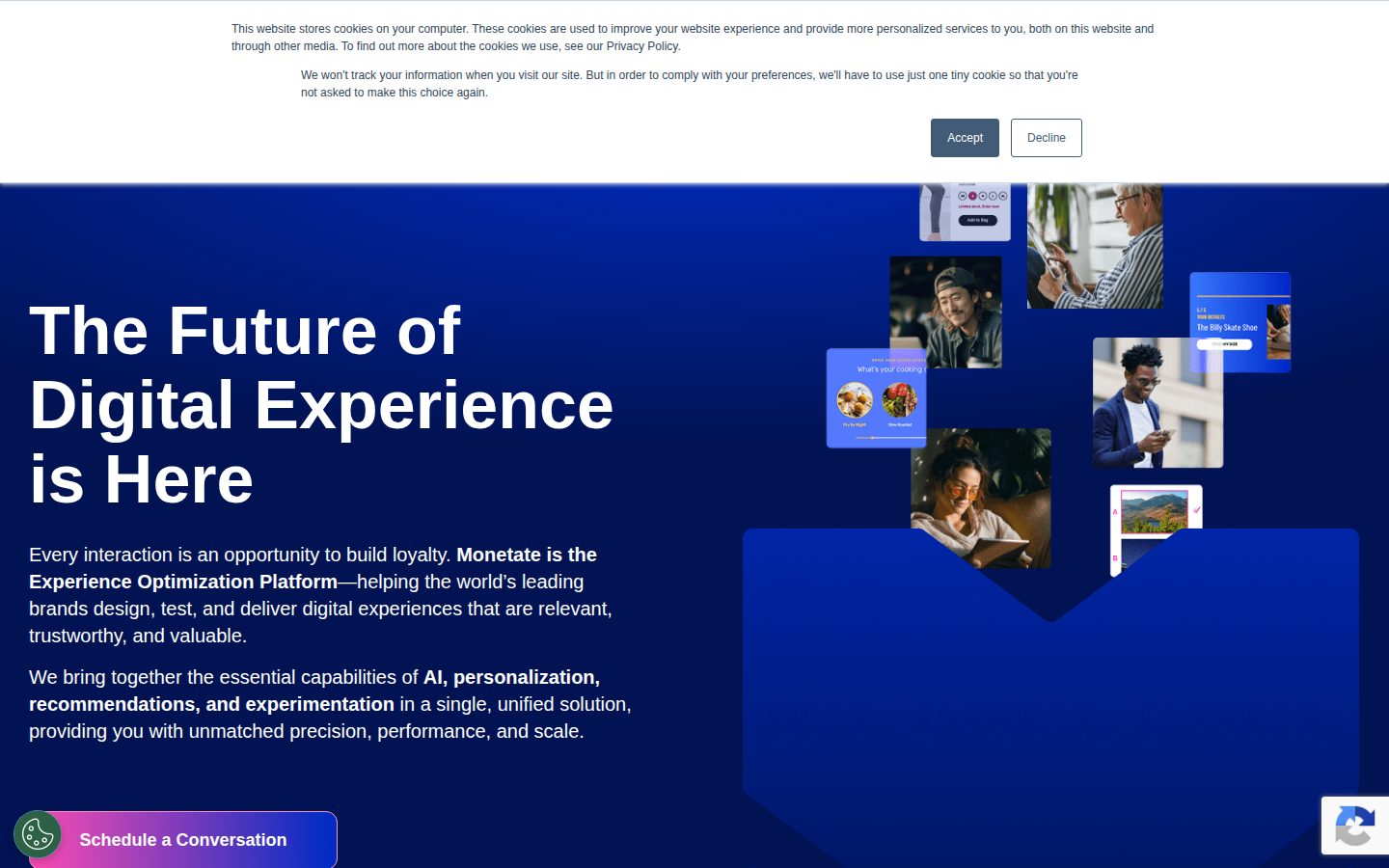
Experience optimization platform for enterprise digital businesses
Monetate is a web personalization and experience optimization platform for enterprise retail and digital brands.
AI Panel Score
6 AI reviews
Reviewed
In practice, users build and deploy personalized experiences through a library of action templates — including banners, lightboxes, social proof toasts, tooltips, and countdown timers — without requiring full engineering involvement. Campaigns are targeted to audience segments defined by behavioral signals, device type, traffic source, or offline CRM data, and can be tested against control groups to measure impact on KPIs such as conversion rate, revenue per session, average order value, and bounce rate.
Distinctive capabilities highlighted by Monetate include automated personalization powered by machine learning, dynamic testing that goes beyond standard A/B splits, and a product recommendations engine for use across web and email channels. The platform also includes a feature called Forte, described as enabling experimentation in regulated and complex environments. Social proof functionality allows merchants to surface real-time signals like view counts on product listing and detail pages.
Monetate targets enterprise and mid-market brands primarily in retail, fashion and apparel, travel, food and beverage, and building and construction. It positions against tools like Adobe Target, Optimizely, and Dynamic Yield. Pricing is not publicly listed; prospective customers are directed to contact sales, indicating a contract-based model. The platform has documented partner integrations with LoginRadius, Zuko, Bounteous, PeakActivity, and Carahsoft.
Monetate operates across web, mobile, email, and in-store channels. It offers an API and integrates with third-party CRM and identity platforms. Documentation is available for technical implementation.

Uses machine learning to automatically tailor website and digital experiences to individual visitors based on behavioral, CRM, and contextual data.
Delivers personalized product recommendation experiences across web, mobile, and email channels to drive product discovery and increase average order value.
Enables marketers to define and target specific visitor segments as a foundational building block for delivering personalized experiences.
Automatically displays a configurable lightbox overlay when a visitor's mouse movement signals exit intent or after a defined period of inactivity.
Allows users to run controlled A/B experiments on web experiences to compare variants and optimize conversion rates and revenue per session.
Enables more advanced multi-variant experimentation beyond standard A/B tests to dynamically optimize digital experiences.
Delivers personalized experiences across website, mobile, email, and in-store channels from a single platform.
Allows merchandisers to boost or bury specific products within search results to improve customer experience and drive higher profit margins.
Provides pre-built, configurable templates (banners, tooltips, lightboxes, countdown timers) that teams can deploy to create on-site experiences without custom development.
Displays configurable social proof messages (such as toast notifications on product listing and detail pages) to influence visitor purchase decisions.
Ingests offline CRM data to power targeted offers and personalized experiences for identified customer segments.
Enables secure experimentation for regulated and complex environments where standard testing approaches may not meet compliance requirements.
Customized pricing plan tailored to your organization's size, industry, and specific personalization needs. Contact Monetate to build a plan.
Enterprise personalization with real depth, but zero pricing transparency slows the deal.
“Monetate's MONET AI engine and zero-flicker server-side testing put it in serious contention against Dynamic Yield and Optimizely. No public pricing and no free trial means every evaluation starts with a sales call.”
Monetate has been in this category long enough to matter. Symphony for 1:1 personalization, Maestro for experimentation, and a Concierge managed service option — that's a full stack, not a feature list. The searchandising capability and CRM data integration are the kind of depth that separates real enterprise tools from mid-market pretenders.
The tradeoff is speed. No pricing page, no free trial, no self-serve. Every competitor in this space, including Dynamic Yield post-acquisition, can get a pilot started faster. If your procurement cycle is already slow, Monetate makes it slower.
Two things give me confidence in the 36-month bet. One: Forte secure experimentation signals they're selling into regulated verticals — that's stickier revenue. Two: managed service via Concierge means they're embedded, not just installed. Hard to rip out when they're doing the work.
Zero-flicker server-side experimentation via Maestro is a genuine differentiator against client-side tools that still fight the flicker problem.
Positions directly against Adobe Target and Optimizely — the board won't raise an eyebrow at this category or this vendor.
Action templates reduce engineering dependency, but contact-only pricing and no trial means weeks before a pilot even starts.
Multichannel personalization across web, mobile, email, and in-store with CRM data integration advances revenue strategy, not just cost reduction.
No public funding data, but enterprise contracts in retail and travel plus a managed service offering suggest durable, sticky revenue — not a startup on fumes.
Mid-market to enterprise retail or travel brands running omnichannel experiences who need AI personalization and rigorous experimentation under one contract.
Your team needs a fast self-serve pilot before committing budget to a contact-sales negotiation.
Enterprise-grade personalization with server-side muscle that Dynamic Yield should worry about.
“Monetate's Symphony/Maestro architecture separates AI-driven 1:1 decisioning from experimentation — that's a mature product split, not a feature list. Zero-flicker server-side testing and MONET's autonomous optimization signal a platform built by people who've felt the pain of client-side tooling at scale.”
The Symphony/Maestro split tells me something important about who designed this. Most platforms bolt personalization and experimentation into one undifferentiated module. Separating decisioning orchestration from experimentation discipline means the team understands that a merchandiser running a promotion and an analyst running a multivariate test have fundamentally different operational needs. That's architecture thinking, not feature thinking.
Searchandising with boost/bury controls, CRM-fed segmentation, and cross-channel delivery — web, mobile, email, in-store — from one platform is a serious omnichannel footprint. The Concierge managed service option matters for enterprise buyers who are long on ambition and short on in-house personalization engineers. Forte secure experimentation for regulated environments is a real differentiator if you're in fintech-adjacent retail or building products.
The tradeoff is opacity on pricing and no free trial, which means your procurement cycle is purely sales-led. If you're a mid-market brand without enterprise budget confidence, you're in a long conversation before you see a single test result. Optimizely and Dynamic Yield have similar entry friction, but that doesn't make it painless.
Positioned directly against Dynamic Yield and Adobe Target with a credible server-side differentiation story and a managed service layer that enterprise buyers actually need.
Searchandising, social proof toasts on PDPs, and CRM-fed audience targeting map directly to how enterprise merchandising and CRO teams actually operate.
Documented CRM integration, API availability, and partners like Bounteous and PeakActivity suggest a workable enterprise integration surface, though API evidence from the scrape is limited.
Contract-based pricing with no public tiers means switching costs accumulate fast — data models, segment libraries, and action templates will be deeply embedded within 18 months.
Zero-flicker server-side experimentation via Maestro and MONET's autonomous optimization engine indicate platform depth well beyond standard A/B tooling.
Enterprise retail or omnichannel brands running high-traffic sites that need server-side experimentation and AI personalization under one contract.
You're a mid-market brand without a dedicated CRO or personalization function to drive ROI from a contract-based platform.
Zero published pricing: enterprise personalization with full black-box cost structure.
“Monetate is a feature-complete enterprise personalization platform with no public pricing. At this category's typical $60K–$200K+ annual contract range, year-3 TCO is genuinely unpredictable.”
No pricing page. No tiers. No starting number. Procurement teams start blind. Category norm for enterprise personalization — Adobe Target and Dynamic Yield both do the same — but that doesn't make it less painful. Expect a 6–12 week sales cycle before a number lands on paper.
The feature set is real. MONET AI engine, Symphony for 1:1 decisioning, Maestro for zero-flicker server-side experimentation, Forte for regulated environments. That's a serious stack. Concierge managed services add cost — the docs indicate it's a separate engagement. CRM data integration and multichannel delivery across web, mobile, email, and in-store justify enterprise-tier pricing, but only if your team can actually use 80% of it.
TCO risk is high. No published overage rates. No self-serve trial. No free tier. Migration from Optimizely or Dynamic Yield adds implementation cost — estimate 3–6 months of professional services. Year-3 all-in for a 50-person digital team could run $400K+ once you count contract, Concierge, and integration work. Needs a sharp pen at renewal.
No self-serve, no free trial, no published payment terms — high procurement friction by design for enterprise sales motion.
No public contract terms; category norm is annual with 60-day auto-renewal windows and limited termination-for-convenience clauses.
Zero public pricing; no tiers, no ranges — contact sales only, per their pricing page.
A/B and dynamic testing against conversion rate, revenue per session, and AOV give measurable output — ROI story is evidence-based, not hand-wavy.
No published overage rates, Concierge managed service is an add-on, and no trial means integration costs are discovered post-signature.
Enterprise retail or travel brands already running six-figure martech contracts who need multichannel personalization with measurable testing infrastructure.
Your team needs pricing transparency, self-serve onboarding, or a contract you can exit inside 12 months.
Enterprise personalization muscle, but your merchandising team needs runway to ramp
“Monetate's MONET AI engine and zero-flicker server-side experimentation are the real deal for mid-market and enterprise retail. No public pricing and no free trial means you're committing to a sales cycle before you see the product.”
Action templates — banners, lightboxes, countdown timers — mean merchandising can push campaigns without filing an IT ticket. That's the daily win. Searchandising lets you boost or bury products in search results without a developer, which is exactly the kind of control a store manager actually needs heading into a promotional weekend. Symphony versus Maestro isn't marketing fluff either; separating personalization orchestration from experimentation gives teams cleaner ownership.
The zero-flicker server-side testing is a genuine differentiator over Optimizely's client-side default. CRM data ingestion means your loyalty segments actually drive on-site experiences, not just email. Concierge managed service matters for lean teams who can't staff a full optimization practice.
The friction is real though: no free trial, no public pricing, no changelog visible. You're flying blind on implementation complexity until a sales call. The docs exist, but with no blog or changelog surfaced, it's hard to know how actively the platform evolves. Commitment-heavy for teams still building the business case.
Action templates and Concierge support reduce daily dependency on engineering, but opaque onboarding and no trial means day-3 friction is unknown until you're already contracted.
Docs are available per the evidence, but no blog or changelog suggests documentation may lag the product's actual state.
No changelog and no self-serve trial create recurring uncertainty; the docs exist but API capabilities aren't confirmed, which adds integration guesswork.
Dynamic testing, MONET AI engine, Forte secure experimentation, and CRM data ingestion give advanced users real depth well beyond basic A/B splits.
Multichannel delivery across web, mobile, email, and in-store from one platform fits how retail merchandising teams actually plan campaigns across touchpoints.
Enterprise and mid-market retail brands with dedicated merchandising teams and budget for a contracted platform relationship.
You need self-serve onboarding or a trial before committing to a vendor conversation.
Enterprise personalization that actually sweats the details most competitors skip
“Monetate is a serious platform for enterprise retail brands that need real multichannel personalization without leaning on engineering every time. No public pricing means you're negotiating a contract, but the feature breadth is legitimately deep.”
The action templates library — banners, lightboxes, countdown timers, social proof toasts — is the kind of thing that saves a marketing team from opening a Jira ticket every Tuesday. Marketers can actually ship things. The zero-flicker server-side experimentation via Maestro is a real differentiator too; client-side flicker is embarrassing in 2024 and Optimizely still lets it happen in some configurations.
Six core KPIs tracked out of the box, CRM data ingestion, the MONET AI engine doing real-time optimization in the background. That's a complete loop. The Forte feature for regulated environments is niche but smart — if you're in a sector where standard A/B testing creates compliance headaches, that's not a footnote, that's the reason you're here.
The tradeoff is real though: no free trial, no pricing page, no self-serve anything. Day one is a sales call. That filters out smaller teams fast. Monetate Concierge managed service helps if you have budget but no internal capacity — but budget is doing a lot of work in that sentence.
The action templates and pre-built experience library suggest a team that's thought about what marketers actually need to do every day without dev help.
Segmentation, dynamic testing, and AI-automated personalization create real depth, but the Symphony vs. Maestro suite split means there's genuine complexity to navigate by month two.
Multichannel delivery explicitly includes mobile as a first-class channel alongside web, email, and in-store, which is better than most competitors in this space.
No free trial, no self-serve, contact-sales-only entry means the first ten minutes is someone else's calendar — not a product experience at all.
Zero-flicker server-side experimentation is a concrete reliability signal; they've clearly thought about what breaks trust in production environments.
Mid-market and enterprise retail or fashion brands that need real multichannel personalization and have both the budget and the internal team to run it.
You need self-serve onboarding, transparent pricing, or you're not yet running enough traffic to justify enterprise contract complexity.
Mature bones, zero pricing transparency, two flags worth watching
“Monetate has been in this space long enough to have earned a real feature set — Symphony, Maestro, MONET AI, server-side zero-flicker. But the public evidence is thin in exactly the places it matters for a long-term bet.”
Three tells on the landing page. '#1 experience optimization platform' in the meta. No pricing page. No changelog. That's not disqualifying for enterprise — it's normal. But it means I'm buying blind on cost and shipping cadence.
The actual capability stack is credible. Server-side zero-flicker experimentation beats Optimizely's client-side default. Forte for regulated environments is a real differentiator. CRM data ingestion for offline segments is table stakes here, but it's present. The product recommendations engine across web and email competes directly with Dynamic Yield, which Mastercard acquired and repriced out of reach for mid-market. That creates real room.
The exit story is the weakest link. No API listed in site capabilities despite the description claiming one. Contract-based, no free trial, no self-serve. If this relationship sours at month 14, you're in a data-extraction negotiation. That's category-normal, but it's still a flag.
Zero-flicker server-side experimentation via Maestro and Forte for regulated environments are concrete gaps vs. Adobe Target and Optimizely's default client-side stacks.
Contract model, no self-serve, no confirmed API in site evidence — migration off this platform in 18 months looks like a negotiation, not a switch.
No public funding data, no changelog, no blog listed in site capabilities — hard to read shipping cadence or team growth from public signals alone.
'#1 experience optimization platform' with no third-party citation is exactly the kind of superlative that ages poorly — and no pricing page means the sales call is doing work the website won't.
Monetate predates most of its current competitors and hasn't been folded into a conglomerate graveyard — patterns match survivors like Qubit (acquired) more than casualties like Evergage (absorbed into Salesforce and quietly diminished).
Enterprise retailers or regulated-industry brands already past $50M in digital revenue who need server-side experimentation and can absorb an opaque contract negotiation.
You want pricing clarity upfront, a free trial to validate fit, or a clean migration path if priorities shift in 18 months.
Common questions answered by our AI research team
Monetate works across web, mobile, email, and in-store channels, delivering personalized experiences across all digital and physical touchpoints.
Symphony is the personalization suite orchestrating AI, data, and decisioning into 1:1 experiences. Maestro is the experimentation suite focused on enterprise-grade testing and optimization without flicker or friction.
Yes. MONET, Monetate's AI engine, adapts and optimizes in real time, autonomously refining personalization and maximizing performance behind the scenes.
Yes. Monetate Concierge offers a fully managed, white-glove service handling design, development, and execution end-to-end, plus flexible options including staff augmentation and targeted support.
Monetate uses zero-flicker server-side experimentation, ensuring every decisioning call is made server-side before the page renders, eliminating the visual flash associated with client-side testing.