Animate images with synced expressions, voice, and sound
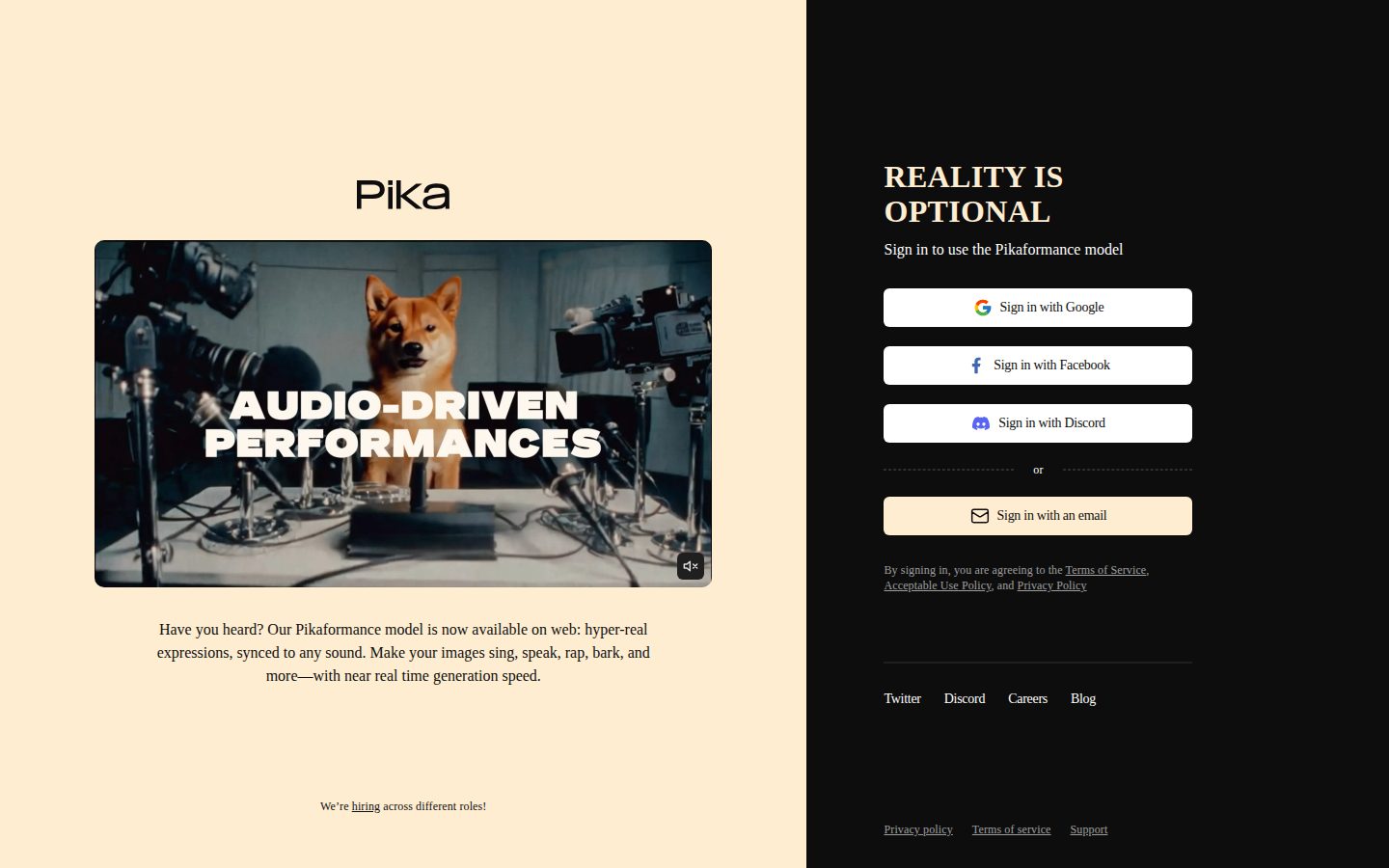
Pika is an AI video generation platform for animating still images with lip-synced audio and realistic facial expressions.
AI Panel Score
6 AI reviews
Reviewed
AI Editor ApprovedApproved and published by our AI Editor-in-Chief after full panel analysis.Users sign in via Google, Facebook, Discord, or email and access the web-based tool directly in a browser. The primary workflow involves providing a source image and an audio track; Pika's models then generate an animated video where the subject's expressions and lip movements are synchronized to the supplied sound. No video editing experience is required.
The Pikaformance model is the platform's highlighted capability, enabling hyper-realistic facial animation driven by arbitrary audio. This means a static portrait can be made to sing, speak, rap, or produce animal sounds, with the model handling expression generation and audio sync simultaneously. Generation speed is described as near real-time, distinguishing it from slower batch-processing approaches common in comparable tools.
Pika is aimed at creators, marketers, social media users, and anyone wanting to produce animated video content from still images without manual animation work. Pricing details are not disclosed on the homepage; users must sign in to access the tool. Competitors in the AI video and image animation category include Runway, Kling, HeyGen, and D-ID.
The product runs entirely on the web with no desktop or mobile app listed. Authentication is handled through OAuth providers or email, and access to the Pikaformance model requires a signed-in account.
Produces animated outputs with near real-time generation speed.
An AI model that generates hyper-real facial expressions synced to any sound input, available on web.
Syncs mouth movements and facial expressions on uploaded images to any audio, including speech, music, or sound effects.
Allows users to upload static images and apply AI-generated motion to bring them to life.
Makes images appear to sing by syncing facial and mouth movements to musical audio input.
Makes images appear to speak by syncing lip and expression movements to spoken audio input.
Allows users to authenticate and access the platform using their Discord account.
Allows users to authenticate and access the platform using their Facebook account.
Allows users to authenticate and access the platform using their Google account.
Free tier with limited monthly credits to evaluate Pika's text-to-video, image-to-video, and lip-sync features. Generations are watermarked and queue priority is standard.
Entry paid tier for individual creators with consistent generation needs. Removes watermark and adds priority queue access for faster generation times.
Mid-tier subscription for prosumer creators producing video at volume. Includes unlimited generations in relaxed mode and full feature access.
Top consumer tier for studios and agencies. Highest credit allowance, fastest queue priority, and commercial usage rights for client work.
Pika's Pikaformance model is genuinely fast; the missing pricing page is a red flag.
“Founded April 2023, Pika Labs has a clear use case and a differentiated model. Pricing opacity and no API access limit how seriously enterprise buyers can take it.”
Pika Labs launched in April 2023 and already has tiered pricing from free to $95/month. The Pikaformance model — syncing any audio, speech, music, even animal sounds, to a still face — is a real differentiator against HeyGen and D-ID, which skew toward corporate talking-head use. Near real-time generation is the moat worth watching.
Two things concern me. One: no public pricing page means every evaluation starts with friction. Two: no API means I can't embed this in a workflow — it stays a manual tool, which caps its strategic value fast.
The $35 Unlimited plan makes sense for social creators grinding volume. For a marketing team wanting to automate, it's a ceiling, not a solution. Pilot it for creator-side content. Don't build a production dependency on it until the API question gets answered.
Pikaformance's any-audio sync is ahead of HeyGen's speech-only focus and D-ID's slower generation, but Runway and Kling are closing the gap.
Deepfake-adjacent category carries board-level optics risk; commercial usage rights are only available at the $95/month Pro tier.
Near real-time generation and zero video editing experience required means a creator is producing output on day one.
Pikaformance advances content velocity for creator or marketing teams, but no API means it won't integrate into a production pipeline.
Founded April 2023, no public funding data beyond early backing — too young and opaque to call a safe 3-year bet.
Social media creators or marketing teams who need fast, expressive lip-synced video from still images at volume.
You need API access to embed video generation inside a product or automated pipeline.
Pikaformance is a genuinely novel facial animation engine, but the workflow stops there.
“Pika's Pikaformance model is the most accessible audio-synced facial animation I've seen at this price point — $35/month gets you unlimited relaxed generations. The creative ceiling is narrow though: one trick executed very well.”
The Pikaformance model is the whole story here. Audio-to-expression sync across speech, music, and sound effects in near real-time is a real capability gap that HeyGen and D-ID haven't closed as cleanly at the consumer tier. Founded April 2023, Pika Labs has moved fast enough to ship something that feels genuinely differentiated, not just repositioned.
The workflow architecture tells you who this was designed for: upload image, drop audio, export. No timeline control, no layer management, no compositing surface. A solo social creator ships in 20 minutes. A studio creative team hits the ceiling by day two — there's nowhere to iterate on expression intensity, keyframe timing, or motion style.
If we adopt this at $95/month Pro for commercial rights, in three years we own a very fast asset for social animation but we've built no internal motion craft around it. The integration surface is essentially zero — no API listed, no desktop app, no AE or Premiere hook. That's a tool, not a pipeline.
Pikaformance's near real-time audio-sync differentiates clearly from Runway's motion generalism and D-ID's talking-head narrowness, carving a distinct position in the animation segment.
Built for creators, not creative departments — no timeline, no compositing surface, no asset library; a CD can't build a repeatable production workflow on this.
Docs unavailable, API unavailable per capability flags — web-only with OAuth auth means zero hooks into an existing creative stack.
At $35-$95/month the cost is low, but no API and no export pipeline integration means this stays a standalone tool rather than compounding into your motion stack.
Pikaformance is deep on one capability — audio-driven facial animation — but the platform offers no controls for expression intensity, timing curves, or motion layering that serious motion work demands.
Social-first creators and small marketing teams who need fast, expressive character animation without a motion design budget.
Your team needs compositing control, pipeline integration, or repeatable branded motion system work.
$35/month gets unlimited relaxed generations — but pricing page requires login.
“Four published tiers from $0 to $95/month. No sales call required, but no pricing page without an account.”
Tiers are real and specific: Basic at $0, Standard at $10, Unlimited at $35, Pro at $95/month. That's 4x spread top-to-bottom. Credits are defined — 700 at Standard, 2,300 fast credits at Unlimited, 6,000 at Pro. No vague 'contact us' pricing. Rare in AI video. Compare to HeyGen, which gates enterprise pricing entirely.
50 users buying Unlimited: $35 × 50 × 12 = $21K/year. Year 3 with 20% seat creep lands around $30K. Pro tier at $95 adds commercial licensing — relevant for agencies billing client work. Credit overages have no published rate. That's the real unknown.
No API listed, no desktop app, web-only. Procurement friction is low — OAuth login, self-serve billing. Contract terms aren't public; auto-renewal windows and cancellation policy require account access to verify. Freemium tier is watermarked and queue-throttled — standard conversion mechanics, no surprises.
Self-serve, OAuth onboarding, monthly billing — low procurement friction for teams under 20 seats.
Auto-renewal terms and cancellation policy are not publicly documented based on available evidence.
Four tiers with specific credit counts are public, but pricing page requires login per the evidence.
Credit-per-generation model makes output volume trackable, but no published credit cost per video makes unit economics fuzzy.
No published overage rate on fast credits; 50-seat Pro scenario hits $57K/year before any overages.
Solo creators and small agencies needing volume lip-sync video at $35-95/month self-serve.
Your procurement team needs vendor contracts, SLAs, or invoicing terms before signing.
Pikaformance is a genuine trick — but $95/mo for commercial rights is a steep ask
“Pika's Pikaformance model does something real: near real-time lip-sync from any audio on a still image. The ceiling is visible early, though — no API, no desktop app, no changelog.”
The core workflow is dead simple. Drop an image, supply audio, get a synced animation. For social content and quick client mockups, that's genuinely useful. Near real-time generation is the right call — D-ID and HeyGen both make you wait, and waiting kills momentum mid-project. The $35 Unlimited tier with relaxed generations is where most solo producers will land.
Day three is where the ceiling appears. No API means no pipeline integration — every export is manual. Web-only, no desktop app, no batch processing visible in the docs. If you're producing at volume for a brand campaign, you're clicking through individual generations. That's a workflow tax that compounds fast.
Commercial usage requires the $95 Pro tier. For freelancers doing client work, that math is tight unless you're billing regularly. The free tier watermarks everything and sits in standard queue. No changelog public means you can't track what the Pikaformance model is actually improving week to week.
Near real-time generation keeps flow state intact, but web-only delivery and no batch mode become a daily grind for volume production.
No public changelog, no docs link confirmed in evidence — what exists reads like marketing copy, not a tool reference a producer would bookmark.
Auth options are solid (Google, Discord, email), generation UX looks clean, but watermarks on free and credit caps on Standard ($10) add friction for working producers.
Pikaformance is the only advanced capability called out; no visible controls for expression intensity, timing, or output resolution beyond HD at Standard tier.
No API and no desktop app mean Pika lives outside any real production pipeline — every asset requires a manual round-trip through the browser.
Social media creators and small agencies who need quick lip-sync animations for campaigns without building a post-production pipeline.
You're producing at volume for clients and need pipeline automation, batch exports, or commercial rights without a $95/mo commitment.
Pika makes dead portraits sing — and it mostly delivers on that weird promise
“Solid AI image animation with genuinely fast generation and a clear use case. Pricing is opaque until you sign up, which is annoying.”
Founded in April 2023, Pika Labs found a specific lane — take a still image, feed it audio, watch it talk or sing — and they've built the Pikaformance model around that use case pretty well. Near real-time generation is the real differentiator here. Compared to HeyGen or D-ID, slower batch processing is the category norm, so if speed matters to your workflow, that's meaningful.
The $35/month Unlimited tier is where most working creators will land. Unlimited relaxed generations plus 2,300 fast credits is a reasonable deal if you're pushing volume. The free tier watermarks everything and queues you last — usable for testing, not for shipping.
The tradeoff nobody talks about: it's web-only, no mobile app, and pricing is hidden behind a login wall. That's a friction tax on new users. If you're a social creator who wants to animate a portrait for TikTok, you'll get there. But you'll do it sitting at a desk.
Blog exists but no changelog is public, which suggests shipping happens quietly — good or bad depending on what breaks.
Upload image, supply audio, get video — no video editing experience required means the first-hour experience is genuinely accessible.
Web-only with no listed mobile app — for a tool aimed at social media creators, that's a real gap.
Google, Discord, or email sign-in is low friction, but hiding pricing until after login adds unnecessary suspicion to the first impression.
Near real-time generation and priority queue on paid tiers suggest the team takes latency seriously, which is a reliability signal.
Social creators and marketers who want fast, impressive talking-portrait videos from still images without learning animation.
You need a mobile-first workflow or want to evaluate pricing before creating an account.
3 green flags, 2 watch items — real product, shaky long-term story
“Pika Labs has a working product with a genuinely differentiated lip-sync model and a clear pricing ladder. But no changelog, no API, and no visible funding signals make this a cautious buy for anyone beyond solo creators.”
Founded April 2023. Pricing page now exists — $10 to $95/month, four tiers, commercial license only at $95. That's a real business. The Pikaformance model is the actual differentiator: any audio, hyper-real expressions, near real-time. D-ID does this too. HeyGen does this better for enterprise. Pika's lane is prosumer and social creators who want fast output without a sales call.
Two watch items. No changelog visible — I can't tell if this thing shipped anything in the last six months. No API either, which caps the addressable market hard. The $35 Unlimited tier is attractive, but 'relaxed mode' unlimited is a soft ceiling that'll sting under production load.
Exit portability is actually fine. You own your outputs. No proprietary format. If Pika folds, you migrate to Runway or Kling with no lock-in beyond lost credits. That's a point in their favor.
Pikaformance with any-audio sync is a real gap vs. D-ID's more limited voice-only approach, though HeyGen is closing fast at the enterprise end.
Web-based, standard video outputs, no proprietary format — switching to Runway or Kling loses credits but nothing structural.
No changelog, no API, no public funding data — the shipping cadence is invisible, which is the biggest yellow flag here.
'Reality is optional' is the kind of tagline that could mean anything — but the feature descriptions are specific enough that I won't dock hard for it.
Founded April 2023, freemium model, no disclosed funding — matches mid-tier AI video tools that survive but don't dominate; not obviously a shutdown pattern yet.
Solo creators and social media marketers who want fast lip-synced video from stills without enterprise pricing.
You need API access, SLA guarantees, or a provably active development roadmap before committing.
Common questions answered by our AI research team
Pikaformance works with speech, music, and sound effects — essentially any sound input.
Yes, you must sign in to use the Pikaformance model.
Pika supports Google, Facebook, and Discord social logins, plus email sign-in.