Text-to-image generation up to 2K resolution with an ultra-fast mode
Imagen 4 is Google DeepMind's text-to-image model, successor to Imagen 3, for photorealistic and stylized images from text prompts.
AI Panel Score
6 AI reviews
Reviewed
AI Editor ApprovedApproved and published by our AI Editor-in-Chief after full panel analysis.Imagen 4 is Google DeepMind's text-to-image model for generating photorealistic and stylized images from text prompts. It renders styles from photorealism to abstract illustration, with fine detail rendering, accurate in-image text and typography, and an ultra-fast mode described as up to 10x faster than the previous model, alongside output resolutions up to 2K across five aspect ratios. Generation is billed per image on Google Cloud: $0.02 for Imagen 4 Fast, $0.04 for Imagen 4, and $0.06 for Imagen 4 Ultra, with upscaling to 2K, 3K, or 4K at $0.06 per image and enterprise access through the Gemini Enterprise Agent Platform. Other capabilities include mask-based image editing, brand and style customization, built-in safety filters, and SynthID digital watermarking for provenance on every output. TopReviewed's six-seat AI review panel scored it 7.8/10, praising the built-in SynthID watermarking most competitors lack while noting that no free image allowance is published, so meaningful testing runs on paid credits. It best fits developer teams and creative ops already in Google Cloud needing scalable, compliant image generation.
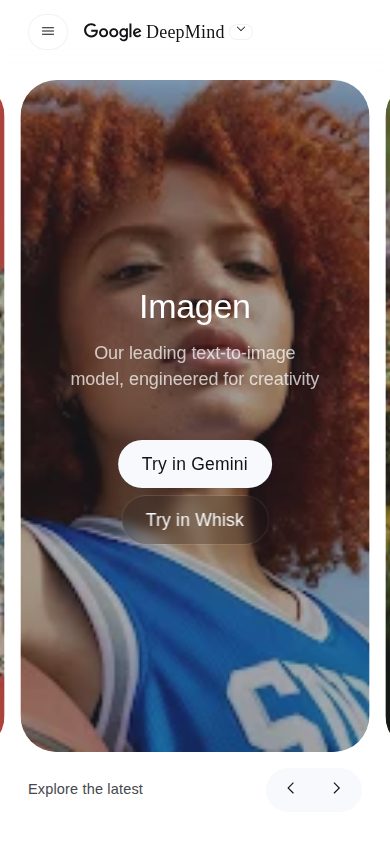
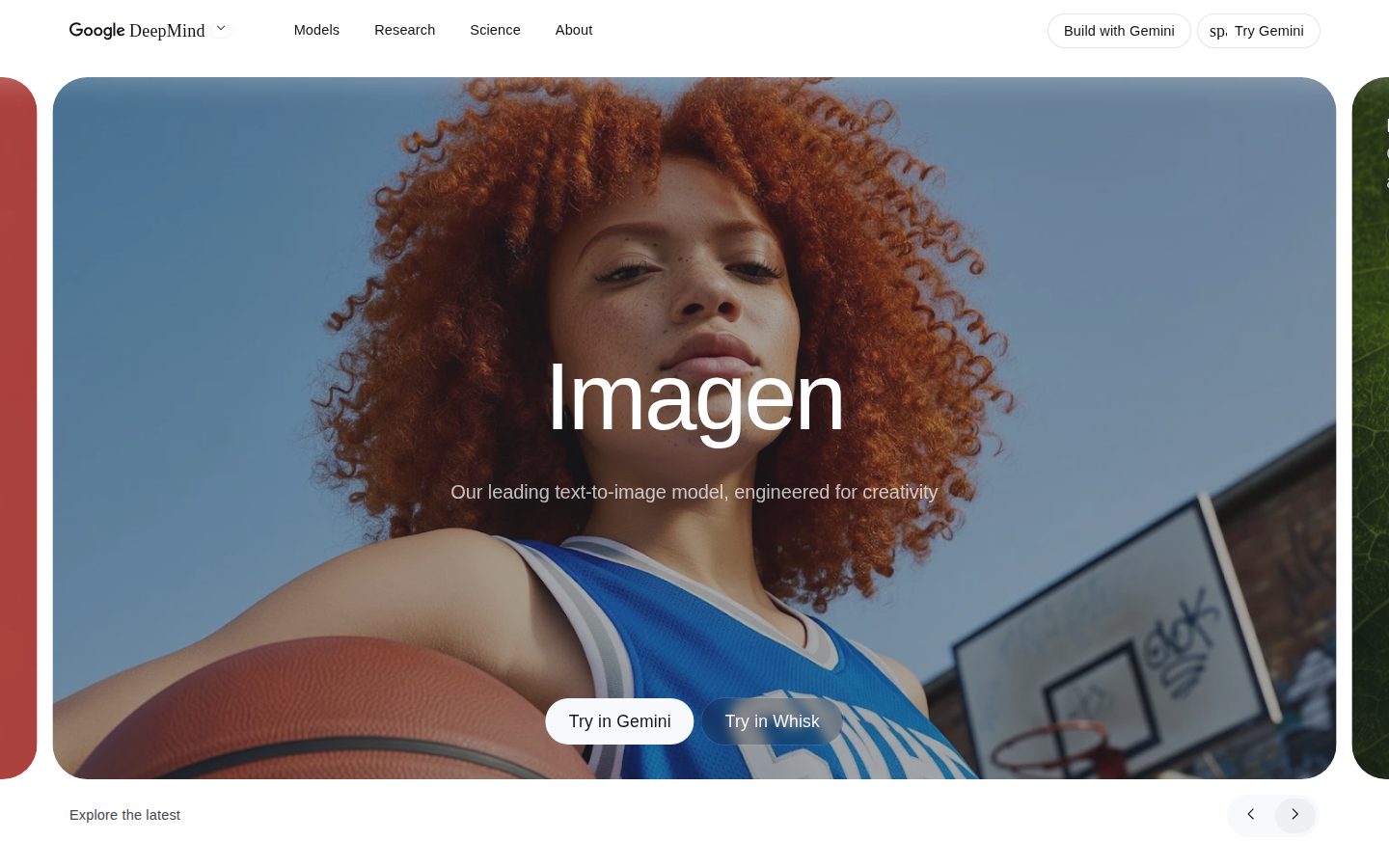
Users interact with Imagen 4 by entering descriptive text prompts, which the model interprets to generate images. The workflow is accessible through Google's Gemini interface and the Whisk tool, meaning no standalone application is required. Prompts can specify subject matter, lighting, camera style, mood, and art direction, and the model attempts to render those instructions with high fidelity.
The model emphasizes several specific technical capabilities: an ultra-fast mode for rapid iteration across multiple prompt variations, resolution output up to 2K, improved color depth and gradient handling for close-up and macro-style images, and enhanced text rendering within generated images. The website also highlights accuracy across a wide range of art styles, including impressionism, illustration, and cinematic photography aesthetics.
Imagen 4 is positioned for creative professionals, designers, and developers who need high-quality image generation at scale or for rapid ideation. It can be tried in the Gemini app, in Whisk, and in Google AI Studio, and is billed per generated image on Google Cloud. Competing products in the text-to-image category include Midjourney, OpenAI's DALL-E 3, Stability AI's Stable Diffusion, and Adobe Firefly. Generation is priced per image: $0.02 for Imagen 4 Fast, $0.04 for Imagen 4, and $0.06 for Imagen 4 Ultra.
Imagen 4 is a web-based product accessed through Google Gemini and Whisk. An API is available through Google Cloud's Vertex AI platform, enabling developers to integrate the model into their own applications. No desktop or mobile app is required for standard use. Google lists the Imagen API models as deprecated and points developers building new integrations to its Nano Banana image models in Gemini.

Accurately renders legible, stylized text within generated images across multiple languages and scripts, enabling creation of posters, infographics, and marketing materials.
Generates images across a wide spectrum of styles—from photorealistic photography to oil paintings, watercolors, claymation, digital art, cinematic, and vintage looks.
Accurately interprets detailed natural language prompts specifying camera angles, lighting conditions, color palettes, spatial relationships, and compositional elements.
Accurately captures small, often-overlooked details such as skin wrinkles and complex surface textures like knitted fabrics, producing images that rival professional photography.
Imagen 4 Fast is speed-optimized with a mode up to 10x faster than the previous model, while Imagen 4 Ultra targets maximum output quality for high-stakes work.
Allows users to edit specific regions of an image using a mask (inpainting/outpainting), such as updating product backgrounds or isolated scene elements via text prompt.
Supports five standard aspect ratios (1:1, 4:3, 3:4, 16:9, 9:16) and 1K or 2K output resolution, with up to four images per request, to optimize outputs for different platforms and use cases.
Generates high-fidelity, photorealistic images from text prompts, surpassing previous Imagen versions in detail, lighting, and artifact reduction.
Enables businesses to infuse their own brand identity, logos, subject matter, and visual style into newly generated images for consistent marketing and advertising assets.
Available as a fully managed model on Google Cloud's Vertex AI and via the Gemini API, enabling developers to integrate image generation into their own applications and workflows.
Includes built-in safeguards and red-team-tested filters to prevent generation of harmful or biased content, aligned with Google's Responsible AI Principles.
Embeds an invisible, pixel-level digital watermark into every generated image that persists through cropping, resizing, compression, and filters to identify AI-generated content.
For developers and small projects evaluating Imagen 4. New Google Cloud customers get $300 in free credits that can be spent on image generation, and Imagen 4 can be tried in the Gemini app, in Whisk, and in Google AI Studio.
Pay-as-you-go access to Imagen 4 on Google Cloud's Vertex AI for developers and businesses requiring high-quality text-to-image generation. Priced at $0.04 per generated image with no subscription commitment.
The speed-optimized variant of Imagen 4, billed at $0.02 per generated image. Suited to high-volume iteration where throughput and cost matter more than maximum fidelity.
The highest-fidelity variant of Imagen 4, billed at $0.06 per generated image, for work where output quality matters more than speed or cost.
Large-scale deployments of Imagen 4 with custom security, compliance, support, and SLAs via Google Cloud's Vertex AI / Gemini Enterprise Agent Platform. Pricing requires contacting Google Cloud sales.
Google's image model at $0.04 per image is a serious default choice.
“Imagen 4 is a Google DeepMind product with full Vertex AI backing, SynthID watermarking, and pay-as-you-go pricing that's hard to argue against. The vendor risk is essentially zero; the strategic question is whether you need this or Midjourney.”
Google DeepMind isn't going anywhere. Imagen 4 sits on Vertex AI, ships through Gemini, and carries SynthID watermarking baked in — that's enterprise-grade provenance most buyers won't get from Midjourney or Stability AI at any price. At $0.04 per image on Vertex AI, the cost math is almost a non-issue.
The tradeoff worth noting: Google already marks the Imagen API models deprecated and steers new builds toward its Nano Banana image models in Gemini. Buyers should confirm how long they need this specific model in production before standardizing workflows.
For developers and creative teams, the Vertex AI integration plus mask-based editing and in-image text rendering cover the real production use cases. No free image allowance is published, so the only sandbox is Google Cloud's $300 new-customer credit — you pay from image one.
Midjourney still leads on aesthetic output quality, but Imagen 4's API depth and Google ecosystem integration are genuine differentiators.
No board will question a Google DeepMind product with built-in responsible AI filters and enterprise SLAs.
Pay-as-you-go at $0.04 per image with no subscription commitment means value starts at the first API call.
SynthID watermarking and Vertex AI integration advance compliance posture, not just creative output speed.
Google DeepMind is one of the most well-resourced AI labs on the planet — no runway concern here.
Developer teams or creative ops already in Google Cloud who need scalable, compliant image generation with API depth.
Your team prioritizes aesthetic output quality above all else and isn't locked into the Google ecosystem.
Google's infrastructure advantage makes Imagen 4 a serious creative pipeline bet.
“Imagen 4 delivers library-grade output capabilities — photorealism, broad style range, in-image typography — backed by Google Cloud's enterprise scale. At $0.04 per image with SynthID watermarking built in, the IP hygiene story is cleaner than most competitors can claim.”
SynthID watermarking on every generated asset is the feature I'd present to any legal team without flinching. That's not table stakes — Midjourney still doesn't have a comparable provenance story. Pair that with mask-based inpainting and Brand & Style Customization via Vertex AI, and this starts looking less like a prompt toy and more like a production asset pipeline. The text rendering accuracy across multiple scripts is genuinely useful for anyone generating localized marketing at volume.
The constraint worth naming: five supported aspect ratios and a 2K generation ceiling, with anything larger billed as a separate upscale step. Adobe Firefly's generative fill workflow feels more integrated into the actual design system lifecycle. If your creative team lives in Creative Cloud, Imagen's integration surface requires a deliberate bridge build.
If we adopt this at the API tier, in 3 years we have a cost-efficient generation layer deeply coupled to Google Cloud governance — useful if that's already your stack, limiting if it isn't. Google now steers new image work toward its Nano Banana models in Gemini, so treat this lineage as mature rather than actively expanding, which matters for long-term craft ceiling.
SynthID watermarking and Google's responsible AI infrastructure give Imagen 4 a provenance and compliance moat that Midjourney and Stable Diffusion haven't matched at equivalent scale.
Complex prompt adherence for camera angles and lighting is strong, but the five-aspect-ratio cap and Gemini/Whisk-only no-code access don't match how senior art directors manage multi-platform asset pipelines.
Gemini API and Vertex AI cover developer and enterprise workflows cleanly, but there's no native Creative Cloud or Figma plugin — the design system connection requires custom build.
Vertex AI integration creates durable enterprise governance leverage; the tradeoff is progressive lock-in to Google Cloud's model management layer as usage scales.
Fine detail rendering, accurate in-image typography, and broad style reproduction from impressionism to cinematic photography indicate model depth beyond most mid-tier generators.
Creative and marketing teams already on Google Cloud who need compliant, high-volume asset generation with a defensible IP watermarking story.
Your creative team's production workflow is Adobe-native and you don't have engineering resources to build the integration bridge.
$0.04 per image, pay-as-you-go, no hostage contract — rare in this category.
“Imagen 4 prices at $0.04/image on Vertex AI, $0.02 Fast and $0.06 Ultra. Volume math is predictable; enterprise Vertex AI pricing disappears behind a sales call.”
$0.04/image, pay-as-you-go, no subscription commitment. 1,000 images = $40. 10,000/month = $400/month, $4,800/year. Add 30% volume creep by year 3 — call it $6,240/year. Three-year TCO for a mid-size team doing moderate volume: roughly $16K-$18K. That's a real number, not a guess.
Midjourney runs $96-$576/year per seat depending on tier, plus seat count scales linearly. At 50 users, Midjourney Basic is $4,800/year before overages. Imagen 4's consumption model wins on cost at moderate volume. The tradeoff: Vertex AI enterprise pricing is opaque — contact sales, no published rate. SynthID watermarking is non-negotiable on all outputs, which matters for certain commercial workflows.
No free image allowance is published — generation is billed from the first call, against $300 in new-customer Google Cloud credits if you have them. The Fast variant runs $0.02/image and Ultra $0.06/image, so the rate card spans a factor of three. No auto-renewal risk on pay-as-you-go. Procurement won't fight this one.
Gemini API pay-as-you-go invoicing is standard Google Cloud billing — low friction, but Vertex AI enterprise onboarding adds procurement complexity.
No subscription, no auto-renewal, no termination clause — pure consumption billing is as flexible as it gets.
$0.04/image is published and clear; the Vertex AI enterprise rate still requires a sales call.
Cost-per-image is measurable; value depends on output quality and workflow fit, which requires testing against actual creative briefs.
Pay-as-you-go consumption model makes year-3 TCO calculable; no seat minimums or forced add-ons visible in public tiers.
Developer teams or agencies needing predictable per-image costs without seat-based subscription overhead.
Your workflow requires guaranteed enterprise SLAs and you won't tolerate a sales call to get a number.
Google's image engine earns its keep at $0.04, but the workflow is still API-first
“Imagen 4 generates genuinely strong photorealistic and stylized outputs with solid prompt adherence. The access model — routed through Gemini or Vertex AI rather than a purpose-built design tool — creates real daily friction for anyone who isn't also a developer.”
Prompt adherence is the standout here. Specifying camera angle, lighting mood, and color palette actually lands, which isn't a given — Midjourney still fights you on compositional specifics unless you know the right syntax. In-image text rendering across multiple scripts is legitimately useful for poster and marketing asset work. At $0.04 per image pay-as-you-go, or $0.02 on the Fast variant, iteration costs stay low even across a dozen variations.
The workflow gap is real though. There's no layer panel, no direct export to artboards, no plugin path into Figma. Mask-based inpainting exists, but accessing it means either the Gemini web UI or building against the API. For a designer who wants to drop into an ideation sprint and rapidly composite, that's a context-switch every single time.
Five aspect ratios with a 2K generation ceiling is the quiet limit. Anything larger means running the upscale step, which is billed separately. Adobe Firefly sits inside Creative Cloud natively; Imagen 4 does not. That integration gap is the daily fight.
No native design tool integration means every generation requires leaving your working environment, which compounds across a full week of asset production.
Docs exist and the API is well-structured for Vertex AI, but the creative prompt-crafting guidance reads like it was written for developers, not art directors.
SynthID watermarking on every output and no changelog visible means you can't track model behavior changes that affect your style consistency week to week.
Brand and style customization, mask-based editing, and Vertex AI fine-tuning give serious depth for teams willing to invest in the API layer.
Accessible via Gemini and Whisk but no Figma plugin, no direct artboard export — designers have to bridge the gap manually every time.
Design teams already operating in Google Cloud infrastructure who need scalable, API-driven image generation for marketing asset pipelines.
You want a distraction-free visual ideation tool that lives inside your existing Figma or Adobe workflow without touching an API.
Google's image engine is quietly very good — and very buried
“Imagen 4 punches hard on quality and has the Google infrastructure to back it up. But you'll spend real time figuring out where it actually lives.”
At $0.04 per image with pay-as-you-go access, Imagen 4 is priced to undercut a lot of the field. SynthID watermarking baked into every output is a nice touch — the kind of thing that shows someone thought about what happens after the image is generated, not just during. Text rendering inside images has been a longstanding embarrassment for this category, and from what's published, Imagen 4 takes it seriously. That's a real differentiator over Midjourney.
The access story is messier than it needs to be. Gemini, Whisk, Google AI Studio, Vertex AI, the Gemini Enterprise Agent Platform — these aren't options, they're a maze. And there's no free image allowance to start on. Day three, someone's definitely going to hit a wall and not know which door to knock on.
Mobile parity here is basically whatever Gemini's mobile browser gives you, which is fine but not designed. The docs already mark the Imagen API models deprecated and point new builds at Nano Banana, so this line may be on its way to legacy. Buy with eyes open.
SynthID watermarking and style range show real craft, but the multi-platform access story introduces daily friction that shouldn't exist.
Complex prompt adherence and five aspect ratio options give experienced users real control; the learning curve is in finding where to go, not in using it once you're there.
Web-only via Gemini browser means mobile is whatever your phone's browser decides to do with it, not a designed experience.
No free image allowance is published, meaning new users hit a paywall before they generate a single image.
Google Cloud and Vertex AI infrastructure behind it is category-grade reliable — no reason to worry about uptime.
Developers and creative teams who want pay-as-you-go quality image generation inside an existing Google Cloud workflow.
You want a clean, self-contained creative tool with a real free trial before you commit.
Google's image engine, priced right, but the docs are already selling Nano Banana
“Imagen 4 is a real product with real infrastructure behind it. The $0.04/image API pricing and Vertex AI enterprise path are credible. But the docs already push developers toward Nano Banana, which is a tell worth watching.”
Three flags before I score this. One: the API docs mark the Imagen models deprecated and steer new builds to Nano Banana. That's not a fatal flaw — it's Google, they ship fast — but it means you're buying a model the vendor is already migrating off. Two: no changelog linked anywhere I could find. Three: the per-image rate lives on the Cloud pricing page, not the Gemini API one, so you have to know where to look. That's a discrepancy worth noting.
The actual product is defensible. SynthID watermarking is a concrete differentiator Midjourney doesn't match. The $0.04/image pay-as-you-go beats subscription-bundled image credits for high-volume API use. Vertex AI enterprise path is real infrastructure, not a landing page promise.
Tradeoff: you're accessing this through Gemini or Whisk, not a purpose-built creative tool. Adobe Firefly wins on workflow integration for designers. Imagen 4 wins on raw API flexibility and price.
SynthID watermarking and $0.04/image API pricing are concrete edges over Midjourney and other subscription-bundled generators, but Firefly owns the design workflow and Stable Diffusion owns the self-hosted cost play.
Images are standard files; SynthID watermarks don't block export, and the Gemini API means no proprietary SDK lock-in beyond standard REST calls.
Google DeepMind backing, a live Vertex AI SLA path, and a published successor line in Nano Banana confirm this isn't a side project — cadence looks real.
The docs already promote Nano Banana over Imagen, the per-image rate is published on the Cloud pricing page rather than the Gemini API one, and the free-plan label buries that every generated image is billed.
Google DeepMind shipping successive Imagen versions with live API and Vertex AI enterprise backing matches the pattern of durable category infrastructure, not vaporware.
Developers who need scalable, pay-as-you-go image generation via API without committing to a subscription.
You need a purpose-built creative tool with layer-level workflow integration like Adobe Firefly offers.
Common questions answered by our AI research team
Imagen 4's ultra-fast mode is up to 10x faster than the previous model.
Imagen 4 supports output resolutions up to 2K.
Imagen 4 can render photo realism, impressionism, abstract, and illustration styles, among other diverse art styles.
You can try Imagen directly in Gemini or in Whisk, with no building required.
Yes, Imagen integrates with Google Gemini — the "Try in Gemini" option is available throughout the product page.


Google DeepMind is an AI research lab headquartered in London, formed in 2023 by the merger of DeepMind and Google Brain, focused on developing general-purpose AI systems.