Cloud data platform for data engineering, analytics, and AI workloads
Snowflake is a fully managed cloud data platform for enterprises that need to store, process, analyze, and build AI applications on their data.
AI Panel Score
6 AI reviews
Reviewed
Users interact with Snowflake through a web-based interface or supported clients to build data pipelines, run SQL queries, train and deploy ML models, and share live datasets with other organizations or cloud environments. Core workflows include creating automated data pipelines in the language of choice, running analytics at scale, and deploying large language models or ML models using the Cortex AI suite.
Snowflake highlights several platform-specific capabilities: Snowflake Intelligence, which lets business users query data using natural language through a personalized enterprise AI agent; Cortex Code, a tool for generating and deploying code and AI workflows with minimal configuration; and Snowpark, a developer framework used for processing large datasets in languages beyond SQL. The platform also supports open table format interoperability, enabling integration with external data ecosystems.
Snowflake targets enterprise data teams, data engineers, analysts, and AI/ML practitioners across industries including financial services, healthcare, retail, energy, and the public sector. Pricing is usage-based, charged on compute and storage consumption rather than fixed seats. Named competitors in the cloud data warehouse and lakehouse category include Google BigQuery, Amazon Redshift, Databricks, and Microsoft Fabric.
Snowflake runs on AWS, Azure, and Google Cloud, and is delivered entirely as a managed service with no infrastructure provisioning required from the customer. It offers unified security, governance, observability, and disaster recovery across regions and cloud providers. A 30-day free trial is available without a credit card.

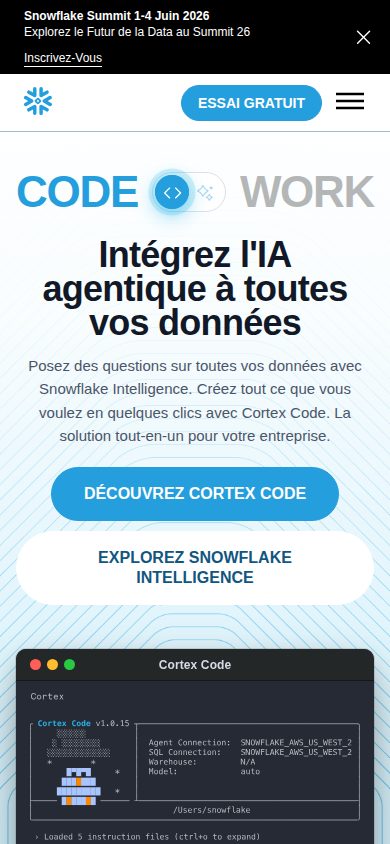
Enables creation of applications and AI solutions in a few clicks by integrating agentic AI across all data.
Enables secure creation and deployment of LLMs and ML models adapted to the organization's data.
Allows every user to answer complex questions in natural language using a personalized enterprise AI agent.
Accelerates data analysis at controlled cost with near-zero maintenance required.
Allows sharing of up-to-date data across different clouds and with external organizations.
Provides tools to develop, distribute, and scale data and AI applications within the platform.
Builds reliable and continuous data pipelines in the user's choice of programming language.
Operates as a fully managed service that eliminates the need to build, configure, and administer infrastructure.
Supports sharing and operating data across different cloud providers and organizations with open table format compatibility.
Connects users to integrated technologies and migration experts to maximize Snowflake deployment via partner applications and solutions.
Delivers continuous unified security, governance, observability, and disaster recovery across any cloud or region.
Consumption-based pricing model where you pay for what you use. No fixed tiers — costs scale with compute and storage consumption.
Snowflake is the default enterprise data platform bet for a reason.
“Publicly traded, multi-cloud, fully managed — this isn't a startup gamble. The cost model is the only thing that bites you if you're not watching.”
Snowflake Inc. is a public company with a decade in market. The viability question isn't on the table. Cross-cloud interoperability with open table format support — including Open Catalog — is a real moat against Databricks and Microsoft Fabric, both of which want to own your stack. That matters at the board level.
The usage-based model is a double edge. No upfront commitment is attractive. But compute credits compound fast at scale, and I've seen teams triple their projected cloud spend in year two without a governance layer watching consumption. Build that controls before you standardize.
Snowflake Intelligence and Cortex Code are genuine AI additions, not rebranded filters. Natural language querying on live enterprise data is what every analyst team has asked for. Databricks matches depth on ML, but Snowflake wins on managed simplicity for teams that don't want to run infrastructure.
Open table format support differentiates against Databricks and Microsoft Fabric on multi-cloud deployments.
Category default in financial services, healthcare, and retail — no board will question this logo.
Fully managed with no infrastructure setup accelerates deployment, but the consumption model requires governance work before teams see clean ROI.
Snowflake Intelligence and Cortex Code advance AI roadmaps, not just cost reduction on existing analytics.
Public company, decade in market, AWS/Azure/GCP coverage — this vendor isn't going anywhere.
Enterprise data teams that need one managed platform across multiple clouds without owning infrastructure.
Your workloads are small or your team can't govern consumption costs actively from day one.
Snowflake is the default enterprise data platform bet for teams who need to ship and govern at scale.
“Snowflake unifies warehousing, lakehouse, ML, and AI workloads on a single managed plane across AWS, Azure, and GCP. For enterprise data teams, that's a serious platform, not just a query engine.”
Cortex AI suite plus Snowpark plus open table format support — that's a modern data architecture signal. Someone on the product side understands that data teams don't want to choose between SQL analysts and Python ML engineers. Snowflake Intelligence letting business users query in natural language without touching the pipeline is the kind of feature that reduces ticket volume on overloaded data teams.
The consumption-based pricing has no published floor, which means cost governance becomes your problem at scale. If a data engineering team runs hot workloads without credit alerts configured, the bill spikes fast. Databricks competes hard on the ML/AI layer and will price aggressively on pipeline-heavy workloads — that's the honest comparison to make before committing.
If we adopt Snowflake, in 3 years we have a unified governance layer via Horizon, cross-cloud data sharing as a genuine capability, and a managed platform we aren't babysitting. The lock-in lives in Snowpark adoption depth, not the SQL layer.
Sits above Redshift on governance, competes directly with Databricks on AI workloads, and outpaces Fabric on multi-cloud neutrality.
Covers the full data team stack — ingestion, SQL analytics, ML, and NL querying — without forcing a tool sprawl.
Snowflake Partner Network plus API access plus multi-cloud coverage means it fits into most existing enterprise stacks cleanly.
Open table format support and cross-cloud interoperability limit lock-in, but deep Snowpark adoption creates real switching friction.
Cortex Code, LLM deployment, and Snowflake Intelligence show platform-level AI depth, not feature-flag AI.
Enterprise data teams who need a single governed platform across SQL analytics, ML, and AI without managing infrastructure.
Your workload is pure ML/AI with minimal SQL analytics and you're already deep in the Databricks ecosystem.
Consumption pricing: no sticker shock, but year-3 invoices are unpredictable
“Snowflake prices on compute credits and storage, not seats. That's procurement-friendly until query volume spikes unexpectedly.”
No published per-seat rate. Costs tied to compute credits and storage consumption. The pricing page exists, but no consumption table numbers are visible in public evidence. That's a gap — you're negotiating blind until a rep quotes your workload.
Year-3 TCO is genuinely hard to model. Enterprise data teams historically underestimate query growth by 40-60%. Databricks runs similar consumption math. BigQuery has committed-use discounts that are publicly documented. Snowflake's equivalent enterprise pricing requires a sales call. No termination-for-convenience terms visible publicly.
The upside: fully managed means $0 infrastructure ops labor, which is real TCO savings at 50+ engineers. Horizon unified governance and cross-cloud interoperability reduce integration spend. But no published overage rate is the real procurement risk — not the platform, the invoice you can't forecast at budget time.
Pay-as-you-go with no upfront commitment reduces procurement friction, but no invoice predictability without a usage cap or committed contract.
No public auto-renewal window, term length, or termination-for-convenience terms visible in evidence.
Consumption model confirmed but no public credit rates or storage costs; a sales call is effectively required.
SQL Analytics, Snowflake Intelligence, and Cortex AI are concrete value levers, but ROI quantification depends entirely on customer-specific workload benchmarks.
Fully managed eliminates infra ops cost, but unpredictable credit consumption makes 3-year modeling speculative without vendor-provided estimates.
Enterprise data teams willing to trade pricing opacity for a fully managed, cross-cloud platform with unified governance.
Your finance team needs a predictable annual budget line before signing.
Snowflake is where enterprise data engineering actually lives — if you can navigate the bill
“Snowflake's fully managed cross-cloud platform removes infrastructure overhead and lets data engineers focus on pipelines and SQL. The consumption-based pricing is powerful and dangerous in equal measure.”
Snowpark is the detail that tells me someone on the product team actually builds pipelines. Writing transformations in Python or Java without leaving the platform means fewer context switches, fewer credentials, fewer 'why does this work locally but not in prod' fights. Cross-cloud interoperability with open table format support is genuinely useful — Databricks interop isn't theoretical, it's a real daily need for teams running mixed stacks. SQL Analytics with near-zero maintenance is the managed promise that actually holds up at scale.
The tradeoff is the credit model. Usage-based pricing sounds clean until a runaway query or an unoptimized pipeline burns credits before lunch. No seat cost, no ceiling. That's a warehouse monitoring problem on day 3, not day 30. Compared to BigQuery's on-demand model, Snowflake's credit consumption requires active cost governance — warehouses, auto-suspend settings, query tagging — that adds a new operational surface.
Cortex AI and Snowflake Intelligence look promising on the feature list, but the docs will determine whether ML engineers can actually wire LLM deployment into existing pipelines without a support ticket. The changelog and API availability suggest a mature platform. Power-user depth is there — the question is how fast new engineers find it.
Fully managed platform removes infra provisioning, but credit consumption without upfront commitment means cost governance becomes a daily engineering habit fast.
Docs, changelog, and API availability are all confirmed — the changelog presence in particular signals engineering-led documentation cadence rather than marketing-page updates.
Web-based interface plus API and docs coverage suggest low ramp friction, but auto-suspend configuration and warehouse sizing are recurring tuning surfaces the platform doesn't fully abstract away.
Snowpark, Cortex AI suite, LLM and ML model deployment, Horizon governance, and Open Catalog together represent a deep surface that scales well beyond SQL analytics into serious ML engineering.
Snowpark supports Python and Java pipelines natively, and cross-cloud open table format interoperability means Databricks and external ecosystems don't require re-architecture.
Enterprise data engineering teams running multi-cloud pipelines who need managed infrastructure, SQL analytics, and ML deployment on a single governed platform.
Your team is small, cost-sensitive, or lacks dedicated FinOps discipline to monitor compute credit consumption.
Snowflake is the serious enterprise data platform that earns its complexity
“Fully managed, cross-cloud, and genuinely feature-complete for enterprise data teams. The learning curve is real, but so is the payoff.”
Snowflake isn't trying to be approachable. It's trying to be indispensable. And for data engineering teams drowning in cloud silos, it mostly succeeds. The fully managed model means nobody's babysitting infrastructure at 2am, and cross-cloud interoperability with open table formats is a real differentiator against Databricks and Google BigQuery — not just marketing copy. Cortex AI and Snowflake Intelligence are the newer bets, letting business users actually ask questions in plain English without bugging the data team.
The tradeoff is that the first 10 minutes feel like homework, not welcome. Usage-based pricing sounds friendly until your first bill surprises you — there's no fixed seat cost, just compute credits that scale with everything you run. Month one, you're guessing. Month three, you're calibrated.
Daily polish is solid for power users. For analysts who just want a query window, it can feel like operating a spaceship. Mobile is basically decorative. This is a desktop-first, data-team-first tool, and it doesn't pretend otherwise.
SQL Analytics and pipeline tooling feel deliberate and well-maintained, but the interface rewards specialists over casual users.
Snowpark, Cortex Code, and Snowflake Intelligence are powerful but each has its own learning surface; month three looks very different from day one.
Web-only platform — mobile isn't a use case Snowflake is designing for, and it shows.
30-day free trial with no credit card is a good start, but the platform breadth — Snowpark, Cortex, Data Sharing — means new users need a map before they need a welcome screen.
Fully managed with unified disaster recovery across regions and clouds via Horizon; category norm for enterprise data platforms is high uptime, and Snowflake's architecture is built around it.
Enterprise data teams that need one platform to cover pipelines, analytics, ML, and AI across multiple clouds without managing infrastructure.
You're a small team that wants simple, predictable pricing and a fast ramp — better-scoped tools exist.
Category incumbent with a real moat — but the bill will surprise you
“Snowflake is a legitimate enterprise data platform with cross-cloud interoperability and a unified governance story that Databricks and Redshift don't fully match. Usage-based pricing with no published starting number is the catch that every buyer discovers too late.”
Three observations before the scores. One: Snowflake Intelligence and Cortex Code are genuine differentiators — not rebadged GPT wrappers. Two: Snowpark letting data teams work beyond SQL is a real architectural choice. Three: the 30-day free trial with no credit card is a clean onboarding signal. Category incumbents don't usually need to do that.
Exit portability is the honest concern. Open table format support helps — Open Catalog does reduce hard lock-in versus where Snowflake was five years ago. But compute credits, proprietary Snowpark pipelines, and Cortex AI dependencies mean migration is never cheap. BigQuery and Fabric have similar gravity. Category norm here.
Long-term viability reads strong. Public company, named enterprise verticals, multi-cloud delivery, changelog active. This isn't Starburst or Dremio hoping for acquisition. Two flags: starting price unknown, and 'Snowflake Intelligence' is the kind of naming that could mean anything in 18 months.
Cross-cloud interoperability and unified security via Horizon are genuine gaps versus Databricks and Redshift; Fabric is the closest threat and closing fast.
Open Catalog and open table formats reduce lock-in on paper, but Cortex AI, Snowpark pipelines, and credit-based compute create deep switching friction in practice.
Public company, active changelog, multi-cloud delivery, and named enterprise verticals — this is a 5-year bet, not a 5-quarter one.
Claims are mostly substantiated by named features like Snowpark and Horizon governance, but 'answer complex questions in natural language' for Snowflake Intelligence is aspirational language that needs proof in production.
Snowflake is a public company operating at scale across financial services, healthcare, and retail — pattern matches durable category winners, not pre-revenue pitches.
Enterprise data teams running multi-cloud environments who need unified governance and can afford to optimize compute costs over time.
Your budget is fixed and unpredictable — usage-based pricing at Snowflake's scale bites fast without active spend controls.
Common questions answered by our AI research team
Snowflake supports interoperability with open table formats, allowing organizations to connect across their data estate without vendor lock-in. Open Catalog enables managing and governing data across multiple engines and storage locations.
Security, governance, observability, and disaster recovery are unified and continuous across any cloud or region via Horizon, which integrates compliance, security, privacy, and access controls into the platform.
Yes, Snowflake is cross-cloud and fully managed, supporting data sharing and application deployment across different cloud providers and regions.
Yes, a free trial is available — a "essai gratuit" (free trial) option is prominently offered on the homepage.
Company
Snowflake Inc.Founded
2012Pricing
Usage-basedFree Trial
Available


Snowflake is a publicly-traded cloud data platform company headquartered in Bozeman, Montana, providing data warehousing, data lakes, and AI/ML workloads across AWS, Azure, and Google Cloud.