Pulley logo

Pulley Review

Visit

Cap table management for founders and finance leaders

Pulley is an equity management platform for startup founders and finance teams managing cap tables, valuations, and fundraising.

Pulley·Founded 2020·From $100/moAI FinanceAI Accounting

AI Panel Score

7.9/10

6 AI reviews

Reviewed

AI Editor Approved

What is Pulley?

Pulley is an equity management platform that handles cap table management, 409A valuations, scenario modeling, and compliance reporting for startup founders and finance teams. Unlike platforms serving VCs and law firms simultaneously, its interface is designed for direct use without legal or paralegal intermediaries. Pricing starts at $100 per month for the Startup plan, which bundles 409A valuations, ASC 718 reporting, and expert cap table review; the Growth tier runs $292 per month. Key capabilities include waterfall reports, SAFE management, token distribution tracking for crypto-adjacent companies, GAAP and IFRS support, and a Nasdaq Private Market integration wired directly to the cap table. TopReviewed's six-seat AI review panel scored it 7.9/10, praising the audit-ready compliance coverage included at the entry price while noting stakeholder caps of 25 and 40 per tier fill up fast at later stages. It fits seed-to-Series-B founders avoiding Carta's pricing.

About Pulley

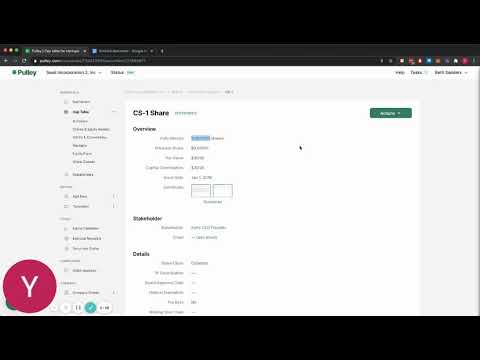
In practice, users manage their cap table by tracking stockholders, option holders, SAFEs, convertible notes, and token distributions from a central dashboard. Founders can model fundraising rounds—including dilution, SAFE conversions, and exit scenarios—without exporting to spreadsheets, and can issue equity directly through the platform using their own documents.

Pulley includes built-in ASC 718 stock-based compensation reporting, support for both GAAP and IFRS standards, and direct integrations with major accounting systems. A managed services team reviews cap tables for accuracy on an ongoing basis. For liquidity, Pulley integrates with Nasdaq Private Market to support custom employee and investor liquidity programs tied directly to the cap table. Token vesting and distribution tracking is also supported for crypto-adjacent companies.

Pulley is positioned for companies from pre-seed through late-stage growth. Pricing starts at $1,200 per year for up to 25 stakeholders (Startup tier) and $3,500 per year for up to 40 stakeholders (Growth tier), with an Enterprise tier available by contact. Competitors in this category include Carta and Captable.io. Pulley holds a SOC 2 Type II certification.

Pulley is a web-based platform. It integrates with major accounting systems and Nasdaq Private Market. No native desktop or mobile applications are listed on the homepage.

Features

Analytics

  • Scenario Modeling

    Models dilution, SAFEs, convertible notes, and exit scenarios to help founders and finance leaders explore the cap table impact of fundraising events.

  • Waterfall Reports

    Generates waterfall reports for M&A, fundraising, and employee liquidity events to show how proceeds would be distributed among stakeholders.

Core

  • 409A Valuation Services

    Provides 409A valuation services to determine fair market value of company stock for compliance and option pricing purposes.

  • ASC 718 / Stock-Based Compensation Reporting

    Produces built-in ASC 718 reports supporting both GAAP and IFRS standards to simplify stock-based compensation accounting and audit readiness.

  • Cap Table Management

    Manages equity ownership records and stakeholder data from seed to scale in a single platform, supporting both equity and tokens.

  • Compliance Reporting

    Provides compliance reporting tools and supports audit preparation, including integration with major accounting systems for accurate financial reporting.

  • Liquidity Program Management

    Enables design and execution of custom employee and investor liquidity programs through an integration with Nasdaq Private Market, fully synced with the cap table.

  • SAFE Management

    Tracks and models SAFEs and convertible notes and their impact on the cap table, enabling founders to evaluate financing terms before signing.

  • Token Distribution Management

    Tracks token vesting schedules, distributions, and exercises on a single platform for companies managing crypto or token-based equity.

Integration

  • Accounting System Integrations

    Connects directly with major accounting systems to streamline equity data flow and reduce manual reporting overhead.

  • Nasdaq Private Market Integration

    Integrates with Nasdaq Private Markets to support secondary liquidity events for employees and investors directly from the cap table platform.

Support

  • Managed Services & Expert Support

    Provides on-demand access to in-house equity experts who review cap tables for accuracy and assist teams with compliance, modeling, and operational needs.

Preview

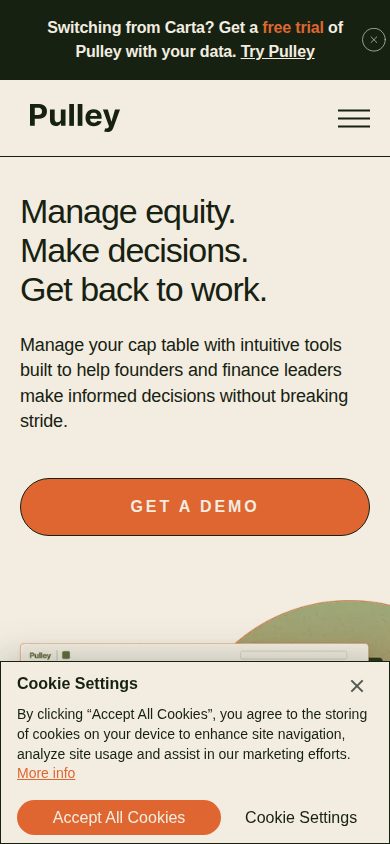
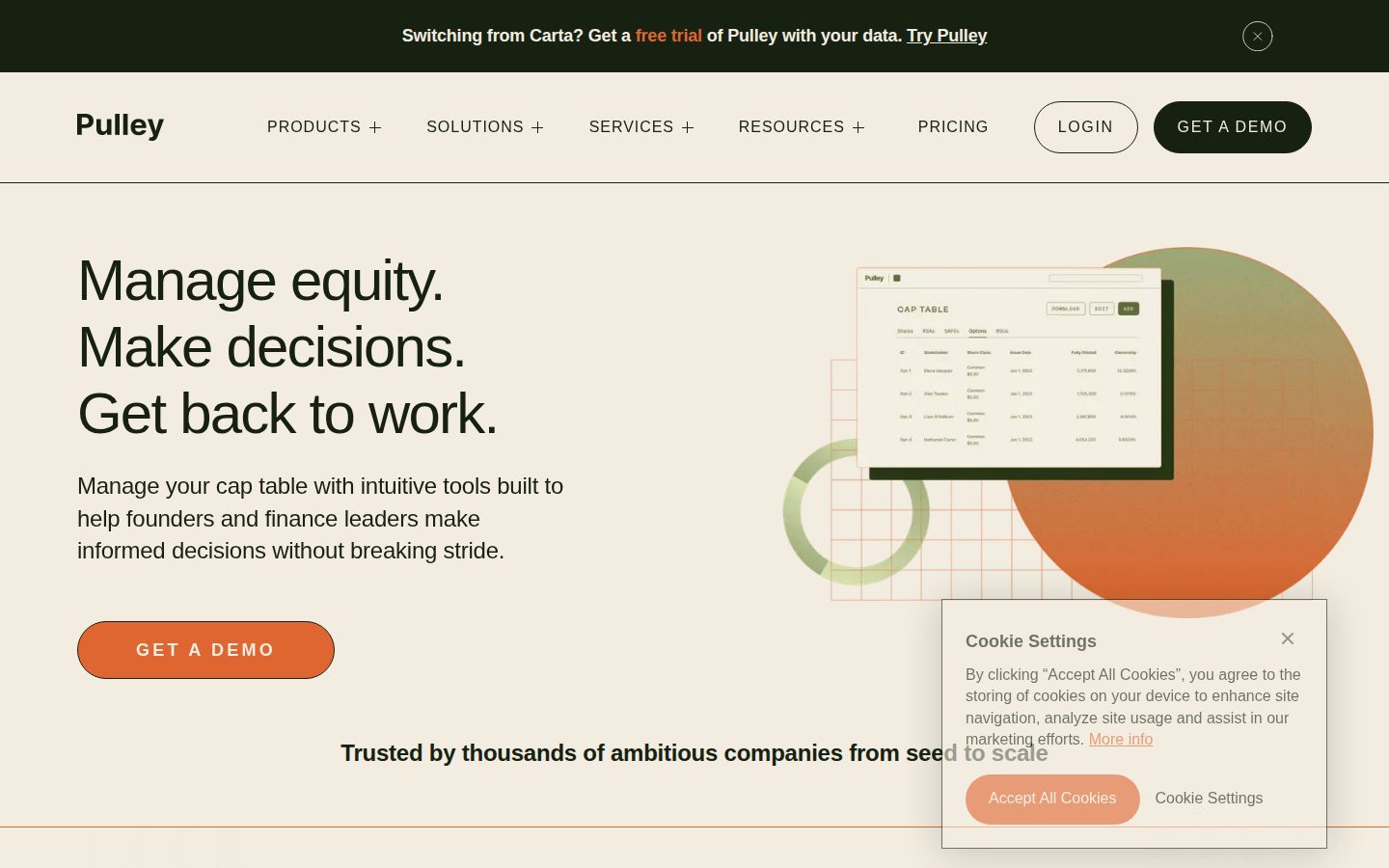
Pulley desktop previewPulley mobile preview

Pricing Plans

Startup

$100/monthly

For early-stage startups managing equity with up to 25 stakeholders included.

  • First 25 stakeholders included
  • Cap table management
  • Scenario modeling and waterfall reports
  • 409A valuation services
  • ASC 718 reporting
  • Expert cap table review

Growth

$292/monthly

For growing companies needing more stakeholder capacity, with up to 40 stakeholders included.

  • First 40 stakeholders included
  • Cap table management
  • Advanced scenario modeling
  • 409A valuation services
  • GAAP and IFRS reporting support
  • Managed services team access

Enterprise

Contact sales

Tailored solutions for larger companies with complex equity needs. Contact Pulley for custom pricing.

  • Custom stakeholder capacity
  • Tailored equity solutions
  • Advanced compliance and audit-readiness
  • Integration with Nasdaq Private Markets for liquidity
  • Dedicated managed services support
  • Custom integrations with accounting systems

AI Panel Reviews

The Decision Maker

The Decision Maker

Strategic bet, vendor viability, timing, adoption approval
7.8/10

Carta's scrappier rival built for founders who don't want a law firm on speed dial.

Pulley does cap table, 409A, scenario modeling, and ASC 718 reporting in one place, starting at $1,200/year. It's deliberately not trying to be Carta — that focus is the whole bet.

Two things set Pulley apart. One: the pricing is honest — $1,200/year for 25 stakeholders versus Carta's opaque enterprise model. Two: the managed services team reviewing cap table accuracy isn't an upsell, it's baked into the Growth tier at $3,500/year. SOC 2 Type II is in place. That's board-defensible from day one.

The Nasdaq Private Market integration for liquidity programs is genuinely differentiated — most founders don't think about secondary liquidity until it's urgent, and having it wired directly to the cap table matters. Token distribution tracking also covers crypto-adjacent companies that Carta treats as an afterthought.

The tradeoff: no API docs and no changelog visible publicly. That's a gap for finance teams expecting deep integrations or wanting to audit product velocity. Carta wins on ecosystem depth. Pulley wins on founder usability and cost. Know which problem you're actually solving.

Competitive Positioning7.5

Cheaper and more founder-focused than Carta, though it won't match Carta's law firm and VC ecosystem integrations at scale.

Reputation Risk8.2

SOC 2 Type II certified, Nasdaq partnership, and GAAP/IFRS compliance make this a defensible board conversation.

Speed to Value8.5

One CEO confirmed a rep-guided onboarding with all seed-stage features immediately accessible — that's fast payback on a $1,200/year tool.

Strategic Fit8.0

Scenario modeling, SAFE tracking, and exit waterfall reports advance decision-making, not just recordkeeping.

Vendor Viability7.2

No public funding data visible, but SOC 2 Type II, enterprise tier, and Nasdaq partnership suggest institutional traction — not a side project.

Pros

  • $1,200/year Startup plan includes 409A, ASC 718, and expert cap table review — not stripped-down features
  • Nasdaq Private Market integration for liquidity events is wired directly to the cap table
  • GAAP and IFRS both supported, with SOC 2 Type II audit by Insight Assurance
  • Token vesting and distribution tracking for crypto-adjacent companies

Cons

  • No public API docs or changelog — hard to assess integration depth or product velocity
  • Stakeholder caps at 25 and 40 per tier will hit fast at late-stage growth
  • No mobile app listed — web-only limits field access during fundraising crunch

Right for

Seed-to-Series B founders who want audit-ready cap table management without paying Carta's law-firm-adjacent pricing.

Avoid if

Your CFO needs deep accounting system integrations with documented API access before they'll sign off.

The Domain Strategist

The Domain Strategist

Craft and strategy in the product's domain — adapts identity per category, same lens
8.1/10

Carta's cleaner rival — purpose-built for founders who want finance-grade equity control.

Pulley delivers 409A valuations, ASC 718 reporting, and SAFE modeling in one platform at $1,200/year — a CFO-grade feature set at a price that won't require a board conversation. The founder-first positioning means finance teams get direct access without routing every question through outside counsel.

SOC 2 Type II certification and built-in GAAP/IFRS reporting aren't table stakes at this price — Carta charges multiples of $3,500/year before you're anywhere near equivalent compliance coverage. The managed services team reviewing cap table accuracy on an ongoing basis is the detail that matters most: that's an internal control, not a product feature, and it signals Pulley understands how finance teams actually close quarters.

The 25-stakeholder cap at the Startup tier is a real constraint — any company doing a priced round with multiple angels, a lead, and existing SAFEs will hit it quickly. The Growth tier at $3,500/year buys 40 stakeholders, which isn't generous for a Series A company managing 30+ option holders plus investors.

If we adopt this at seed and grow through Series B, the Nasdaq Private Market liquidity integration becomes genuinely valuable — secondary programs are a retention tool now, not just a pre-IPO event. The absence of a native API or documented changelog makes me want a clearer product velocity signal before recommending it above the Growth tier.

Category Positioning8.0

Clear differentiation from Carta's VC-and-law-firm-first model; founder-and-CFO positioning is a real wedge, not just marketing copy.

Domain Fit8.5

Built explicitly for finance teams without legal intermediaries — that design choice maps directly to how a lean finance org actually operates.

Integration Surface7.5

Accounting system integrations are confirmed, but no public API means deep ERP or data warehouse connections depend on Pulley's roadmap, not ours.

Long-term Implications7.8

Nasdaq Private Market integration creates a durable path to secondary liquidity programs, but missing API docs limit custom workflow extensibility at scale.

Strategic Depth8.2

ASC 718, waterfall reports, SAFE modeling, and 409A under one roof is legitimate finance-grade depth, not a founder toy.

Pros

  • 409A valuations, ASC 718, and GAAP/IFRS reporting included at $1,200/year — audit readiness without an add-on bill
  • Managed services team reviewing cap table accuracy is an internal control, not just support
  • Nasdaq Private Market integration supports secondary liquidity programs tied live to the cap table
  • SOC 2 Type II certified, reducing vendor due diligence burden before Series B

Cons

  • 25-stakeholder ceiling on the Startup tier is tight once SAFEs, angels, and option holders accumulate
  • No public API listed — limits extensibility into existing finance stack without Pulley's cooperation
  • No free trial means cap table migration is a commit, not an experiment
  • No changelog published, making product velocity hard to assess before signing an annual contract

Right for

Seed-to-Series-B finance teams who want Carta-grade compliance coverage without Carta's pricing or law-firm-first UX.

Avoid if

Your stakeholder count exceeds 40 and you need deep API access to route equity data into an existing ERP or data warehouse.

The Finance Lead

The Finance Lead

Money, total cost of ownership, contracts, procurement math
7.8/10

$1,200/year entry price beats Carta — but stakeholder caps bite fast.

Pulley publishes three tiers without a sales call. Stakeholder limits are the real cost lever as headcount grows.

$100/month billed annually = $1,200/year for 25 stakeholders. Growth tier: $292/month = $3,504/year for 40. Both tiers include 409A valuations and ASC 718 reporting — features Carta charges separately for. That's meaningful. A pre-seed company at $1,200/year for 3 years is $3,600 all-in before stakeholder overages. Add a seed round, angels, advisors — 25 stakeholders disappears faster than founders expect. Year 2 likely means Growth tier. 3-year TCO for a typical seed-to-Series A company: $1,200 + $3,504 + $3,504 = $8,208. Not scary.

The tradeoff is stakeholder math, not sticker price. No published overage rate — that's the gap. Enterprise tier is contact-only, which means procurement friction for anyone past 40 stakeholders. No free trial either, so you're buying blind on UI fit.

SOC 2 Type II is confirmed. Nasdaq Private Market integration and managed services review are Enterprise-gated, based on the pricing page. For a 10-50 person startup, Pulley's published pricing is cleaner than Carta's. The numbers are honest up to 40 stakeholders.

Billing & Procurement7.2

Annual subscription with visible pricing reduces procurement friction; Enterprise tier reverts to contact sales, adding friction at scale.

Contract Flexibility6.5

Annual billing confirmed, but no public data on auto-renewal windows, termination clauses, or data export terms.

Pricing Transparency8.5

Three tiers published with dollar amounts and stakeholder limits — no sales call required, rare in this category.

ROI Clarity7.8

Bundling 409A valuations — typically $1,500-$3,000 standalone — into base price creates a measurable cost offset against competitors like Carta.

Total Cost of Ownership7.5

3-year TCO for seed-to-Series A runs roughly $8,200; 409A and ASC 718 bundled in, but no published overage rate past 40 stakeholders is a gap.

Pros

  • 409A and ASC 718 reporting bundled at $1,200/year — not add-ons
  • Pricing page visible without a demo or NDA
  • SOC 2 Type II confirmed, Insight Assurance audited
  • GAAP and IFRS both supported at Growth tier

Cons

  • No published overage rate past 40-stakeholder cap
  • No free trial — committing blind on fit
  • Enterprise tier is contact-only, procurement friction resumes
  • No public auto-renewal or cancellation terms

Right for

Pre-seed to Series A founders who want bundled 409A and compliance reporting without Carta's pricing complexity.

Avoid if

You're past 40 stakeholders and need predictable Enterprise pricing without a sales conversation.

The Domain Practitioner

The Domain Practitioner

Daily hands-on reality in the product's domain — adapts identity per category, same lens
8.1/10

Carta's serious competitor finally built for finance teams, not law firms.

Pulley covers the full equity lifecycle — cap table, 409A, ASC 718, scenario modeling, liquidity — without routing every action through external counsel. At $1,200/year for the Startup tier, it undercuts Carta meaningfully for early-stage companies.

The feature set maps cleanly to the actual quarterly workflow: close a SAFE, model dilution, run the 409A, produce ASC 718 schedules for audit prep. That's not a demo path — that's the job. Built-in GAAP and IFRS support with accounting system integrations means the equity data doesn't need a manual export cycle every time the auditors call. Managed services reviewing cap tables for ongoing accuracy is the kind of thing that prevents expensive restatements.

The 25-stakeholder cap on the $1,200 Startup plan will bite fast in an active seed round with multiple angels and advisors. Carta doesn't have the same hard ceiling at that price point. No API and no public changelog are signals worth noting — for a finance team that wants to script equity queries or track product evolution, that's a gap.

SOC 2 Type II certification and Nasdaq Private Market integration for liquidity programs are genuine enterprise-grade features sitting inside a startup-friendly price. The tradeoff is a web-only platform with no mobile app, which matters less for equity work than for, say, expense tools — but warrants flagging for teams expecting full parity.

Day-3 Reality7.8

Central dashboard covering SAFEs, options, tokens, and waterfall reports suggests coherent daily use, but no changelog or API limits power-user adaptation over time.

Documentation Practitioner-Fit6.8

No public docs or changelog visible from the evidence; onboarding described as rep-led, which can mask documentation gaps until you need self-serve answers.

Friction Surface7.5

The 25-stakeholder limit on the $1,200 Startup plan creates a hard ceiling that forces a tier conversation mid-round — friction at the worst possible moment.

Power-User Depth7.9

Advanced scenario modeling, token distribution tracking, and Nasdaq Private Market liquidity integration show real depth, but no API access limits programmatic workflows.

Workflow Integration8.3

Direct accounting system integrations and built-in ASC 718 reporting reduce the manual export cycles that consume finance team hours every quarter.

Pros

  • ASC 718 reporting with GAAP and IFRS support built-in — not an add-on
  • Managed services team reviews cap table accuracy on an ongoing basis
  • Nasdaq Private Market integration for liquidity programs is enterprise-grade at startup pricing
  • Token vesting and distribution tracking covers crypto-adjacent equity structures most competitors ignore

Cons

  • 25-stakeholder cap at $1,200/year will hit ceiling fast in an active seed round
  • No API and no public changelog — limits scriptable workflows and product visibility
  • No free trial means finance teams commit before validating against their actual cap table complexity
  • Web-only platform with no native mobile app

Right for

Seed-to-growth stage finance teams who want audit-ready equity management without routing everything through outside counsel.

Avoid if

Your cap table already exceeds 40 stakeholders and you need API access to integrate equity data into internal financial models.

The Power User

The Power User

Daily human experience, onboarding, polish, learning curve, reliability
8.1/10

Carta's scrappier rival is quietly doing the real work founders actually need

Pulley packs 409A valuations, ASC 718 reporting, scenario modeling, and a managed services team into $1,200 a year for seed-stage companies. No mobile app, but for a web tool you open twice a month to stay out of legal trouble, that's a livable gap.

At $1,200 a year for up to 25 stakeholders, Pulley is making a clear bet: founders shouldn't need a lawyer or a paralegal to manage their own equity. That bet shows in the product. Scenario modeling for SAFEs and convertible notes, waterfall reports, 409A valuations, ASC 718 reporting — all of it on one dashboard, not split across three vendors and a spreadsheet. Carta bundles law firms and VCs into the product. Pulley just... doesn't. Depending on your complexity, that focus either feels like clarity or a wall.

The managed services team reviewing cap tables for accuracy is the feature I'd actually lean on. Cap table errors are the kind of thing you don't discover until a fundraise or acquisition, and then they're expensive. Having humans check the work quietly in the background is worth real money.

No mobile app is listed anywhere. For a tool you're not using daily, that's fine. But the pricing page lists monthly rates while the buyer FAQ anchors to annual — small inconsistency, slightly sloppy, the kind of thing that makes you double-check the math before signing.

Daily Polish7.5

The founder-first UI focus suggests care, but a changelog isn't public and the pricing page has monthly/annual inconsistencies that hint at rough edges.

Learning Curve8.0

Built for founders without legal intermediaries, and the Growth tier at $3,500/year adds GAAP/IFRS support in a way that scales naturally without a product switch.

Mobile Parity4.5

No native mobile app listed anywhere — web-only, which is forgivable for a quarterly-use compliance tool but still a real gap.

Onboarding Experience8.2

A named CEO confirmed a rep-assisted onboarding with all seed-stage features accessible immediately — that's a genuinely good first-hour signal.

Reliability Feel7.8

SOC 2 Type II certification by Insight Assurance and a managed services review layer suggest a team that takes data integrity seriously.

Pros

  • 409A valuations, ASC 718 reporting, and scenario modeling all included at the $1,200/year Startup tier
  • Managed services team reviews your cap table for accuracy on an ongoing basis
  • Nasdaq Private Market integration for employee liquidity — rare at this price point
  • Token vesting and distribution support for crypto-adjacent companies

Cons

  • No mobile app — web only
  • No free trial, so you're committing blind without a hands-on look first
  • Monthly vs. annual pricing inconsistency on the public pricing page feels unpolished
  • Enterprise tier is contact-only, which means no pricing transparency for later-stage evaluation

Right for

Seed-to-growth founders who want equity management without routing everything through lawyers or Carta's VC-first ecosystem.

Avoid if

You need mobile access or a free trial before committing to an annual subscription.

The Skeptic

The Skeptic

Contrarian. Watch-outs, deal-breakers, broken promises, category patterns
7.2/10

Solid Carta alternative — but two missing signals keep me cautious

Pulley covers the core cap table stack at a price that undercuts Carta meaningfully. Missing changelog and no public API are yellow flags for a category where data portability is everything.

Three tells before I go deep. One: no changelog listed — can't verify shipping cadence. Two: no public API documented — that matters for a platform holding your equity records. Three: Enterprise tier shows as 'Free' in the pricing data, which is a scrape artifact but also sloppy. Now the green flags: $1,200/year for 25 stakeholders, SOC 2 Type II from Insight Assurance, built-in ASC 718 with GAAP and IFRS support. That's a real feature stack, not vapor.

The Carta comparison is the whole game here. Carta drifted toward serving VCs and law firms. Pulley's stated founder-first positioning is either genuine differentiation or marketing copy — no funding data visible to confirm staying power. Captable.io competes at the low end; Pulley has clearly moved upmarket with managed services and Nasdaq Private Market liquidity integration.

Tradeoff worth naming: 40-stakeholder cap on the $3,500 Growth tier is tight for a Series A company. You'll hit Enterprise pricing faster than the landing page implies.

Competitive Differentiation7.8

Nasdaq Private Market liquidity integration plus founder-first UI is a real wedge vs. Carta's VC-serving pivot; token distribution support adds a niche angle.

Exit Portability6.5

No public API documented; cap table data is sticky by nature and export paths aren't described anywhere in the evidence.

Long-term Viability6.5

SOC 2 Type II and managed services signal real infrastructure investment, but no funding disclosure and no changelog cadence are both gaps.

Marketing Honesty7.5

H1 is grounded ('Get back to work'), no obvious superlatives — but no changelog means I can't verify claims about shipping velocity.

Track Record Match6.8

No public funding data visible; category has real survivors (Carta, Capshare) but also real graves — longevity here is unconfirmed.

Pros

  • $1,200/year Startup tier with 409A valuations and ASC 718 reporting included — Carta charges separately for both
  • SOC 2 Type II certified, audit performed by Insight Assurance
  • Nasdaq Private Market integration for liquidity events is a feature most competitors lack at this price point
  • Managed services team reviews cap tables for accuracy on an ongoing basis — not just software, actual oversight

Cons

  • No public API documented — problematic for a platform holding equity of record
  • No changelog visible — can't assess shipping cadence or product momentum
  • 40-stakeholder Growth tier cap at $3,500/year is tight; Series A companies will hit Enterprise pricing fast
  • No free trial — high switching cost category with no low-risk entry point

Right for

Pre-seed through Series B founders who want Carta-level compliance without Carta's VC-first complexity and pricing.

Avoid if

You need API access to sync equity data into downstream systems before committing to a vendor.

Buyer Questions

Common questions answered by our AI research team

Pricing

How much does Pulley's Startup plan cost?

The Startup plan costs $1,200/year and includes the first 25 stakeholders. Angel investors writing checks of $50,000 or less count as half a stakeholder.

Features

Does Pulley support GAAP and IFRS reporting?

Pulley supports both GAAP and IFRS reporting standards, with built-in ASC 718 reporting included as part of its audit-ready compliance features.

Security

Is Pulley SOC 2 certified?

Pulley is SOC 2 Type II certified. The audit was performed by Insight Assurance.

Integration

Does Pulley integrate with Nasdaq Private Market?

Pulley integrates with Nasdaq Private Market to support custom liquidity programs for employees and investors, fully integrated with the cap table.

Setup

How fast is onboarding with Pulley?

Onboarding is described as simple and fast. One CEO confirmed a smooth process where a rep walked them through setup, with all needed features accessible at seed stage.

Product Information

  • Company

    Pulley
  • Founded

    2020
  • Pricing

    From $100/mo

Platforms

web

About Pulley

Pulley is a San Francisco-based cap table and equity management platform for startups, offering tools for cap table tracking, 409A valuations, fundraising modeling, and compliance.

Resources

Blog

Also in AI Finance