SambaNova logo

SambaNova Review

Visit

AI inference infrastructure built on custom RDU chips

SambaNova is an AI inference platform for running large language models and agentic AI workloads.

AI Panel Score

7.2/10

6 AI reviews

Reviewed

AI Editor Approved

About SambaNova

Working with SambaNova typically means choosing between two access paths: calling models through SambaCloud, a serverless inference service with OpenAI-compatible APIs, or deploying SambaStack, a full-stack combination of RDU hardware and software installed on-premises or in a private cloud. In either case, the workflow centers on sending inference requests against pre-loaded open-source models and getting responses back, with SambaNova's dataflow architecture handling the underlying compute rather than general-purpose GPU infrastructure.

The distinguishing element is the Reconfigurable Dataflow Unit (RDU), a chip SambaNova designed specifically for inference rather than adapting general-purpose hardware. The company markets the RDU on tokens-per-watt efficiency and speed for agentic AI workloads, and has published benchmark claims around serving large models such as DeepSeek-R1 671B. SambaManaged extends this into a managed infrastructure service for data centers that want the hardware operated on their behalf, and SambaRack packages the hardware (including the SN50 RDU generation) at rack scale for organizations building their own data center capacity.

SambaNova positions its sovereign AI offering for governments and regions that want AI infrastructure hosted within their own borders, with named data center partners including Argyll in the UK, Infercom and OVHcloud in the EU, and SouthernCrossAI in Australia. Beyond sovereign deployments, its customer base includes enterprises, national research labs (such as Argonne, Oak Ridge, and Lawrence Livermore), and telecom operators like SoftBank. Pricing for SambaCloud is usage-based per published rate cards, while SambaStack and SambaRack deployments are sold on a contact/quote basis; direct competitors in AI inference infrastructure include Groq, Cerebras, and NVIDIA-based cloud inference providers.

SambaCloud exposes an OpenAI-compatible API, allowing existing applications built against OpenAI's API format to be pointed at SambaNova's endpoints with minimal changes. Documentation, quickstarts, and API references are published at docs.sambanova.ai, and the platform is also available through AWS Marketplace.

Features

AI

  • RDU (Reconfigurable Dataflow Unit)

    SambaNova's purpose-built AI chip designed for agentic inference, optimized for speed and tokens-per-watt efficiency.

Collaboration

  • Developer Community

    A dedicated forum where developers can discuss, troubleshoot, and share knowledge about building on SambaNova's platform.

Core

  • Dataflow Architecture

    A dataflow processing approach underlying SambaNova's chips and software stack that structures how computation is executed.

  • SambaCloud

    Serverless AI inference cloud service offering OpenAI-compatible APIs for fast inference on open-source language models.

  • SambaRack

    Rack-scale hardware system for AI inference workloads, including the SN50 RDU generation.

  • SambaStack

    Full-stack enterprise AI platform combining RDU hardware and software, deployable on-premises or in the cloud.

Integration

  • OpenAI-Compatible API

    Provides an API interface compatible with OpenAI's format so developers can integrate SambaCloud inference into existing applications.

Security

  • Sovereign AI Deployments

    Enables nations and regions to host AI inference infrastructure within their own borders via partners like Argyll (UK), Infercom (EU), OVHcloud (EU), and SouthernCrossAI (Australia).

Support

  • Developer Documentation & API Reference

    Quickstarts, API reference material, and integration guides for building applications on SambaNova's platform.

  • Early Access Program

    Gives developers early access to new SambaNova models and platform capabilities before general release.

  • SambaAcademy

    Free short-video training courses covering AI fundamentals, dataflow concepts, and how to get started with SambaCloud.

  • SambaManaged

    Managed AI infrastructure service that operates and maintains data center deployments on behalf of customers.

Preview

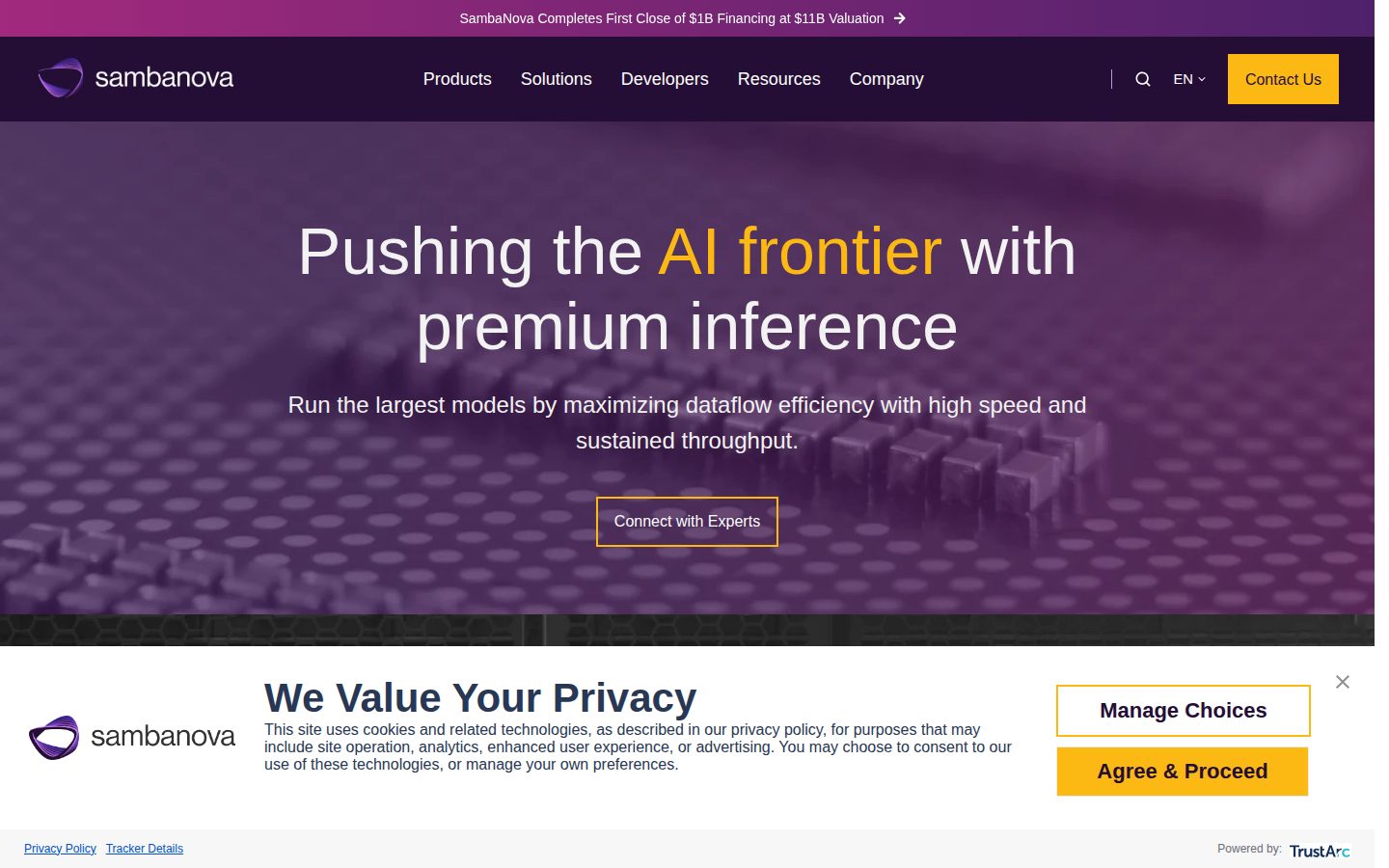
SambaNova desktop previewSambaNova mobile preview

Pricing Plans

Free Tier

Free

For developers testing SambaNova Cloud's API without a payment method; suited for experimentation and small-scale prototyping.

  • Access to SambaNova Cloud playground and API
  • OpenAI-compatible API
  • Rate-limited access to supported open models (Llama, DeepSeek, gpt-oss, etc.)
  • No payment method required
Popular

Developer Tier

Contact sales

Pay-as-you-go plan billed per million tokens, with prices varying by model — for example $0.22/$0.59 per 1M input/output tokens for gpt-oss-120b, $0.60/$1.20 for Meta-Llama-3.3-70B-Instruct, and $3.00/$4.50 for DeepSeek-V3.1. No single flat monthly price exists since SambaNova Cloud is priced per model per million tokens rather than as a flat plan fee.

  • Pay-per-token billing with separate input/output rates per model
  • $5 of free credit provided at signup, expiring after 3 months
  • Higher rate limits than Free tier (e.g., 240 RPM on Meta-Llama-3.3-70B-Instruct and 60 RPM on other production models, versus 20 RPM on Free)
  • Access to full curated model catalog (Llama, DeepSeek, gpt-oss, Gemma, MiniMax, etc.)
  • OpenAI-compatible API for easy migration

Enterprise

Contact sales

For enterprises and data centers needing dedicated capacity, higher throughput, and negotiated contract terms. Specific pricing for this plan is not publicly listed and requires contacting SambaNova's sales team.

  • Custom/negotiated pricing and volume discounts
  • Dedicated capacity and higher throughput/rate limits
  • Available via cloud marketplaces (AWS, Azure) with usage-based billing
  • Premium support

AI Panel Reviews

The Decision Maker

The Decision Maker

Strategic bet, vendor viability, timing, adoption approval
7.2/10

Custom silicon, real customers, but a hardware bet you're making alongside them.

SambaNova has national labs and telecom customers, plus an OpenAI-compatible API that lowers switching cost. The RDU chip is a genuine differentiator, but betting on non-GPU silicon carries its own risk.

Argonne, Oak Ridge, Lawrence Livermore, SoftBank. That's a real customer list, not logos on a landing page.

Two things stand out. One: the RDU chip is a legitimate architectural bet against Nvidia's GPU dominance, and DeepSeek-V3.1 671B benchmarks back the tokens-per-watt claim. Two: sovereign AI partnerships in the UK, EU, and Australia give this a government-procurement angle Groq and Cerebras don't emphasize as hard.

The tradeoff: custom silicon vendors have a mixed survival record. Betting infrastructure on RDUs instead of GPUs means less community tooling, fewer engineers who've touched it, more vendor lock-in if SambaNova stumbles.

$0.22/$0.59 per 1M tokens at the entry end is competitive. Free tier removes the pilot-cost objection entirely.

Competitive Positioning6.8

Groq and Cerebras chase the same inference-speed niche; SambaNova's sovereign-AI angle is a differentiator but unproven at broad market scale.

Reputation Risk7.0

Government sovereign AI deployments read as credible; niche chip architecture may raise eyebrows versus safer Nvidia-based choices.

Speed to Value7.8

OpenAI-compatible API and free $5 signup credit mean integration in minutes per their own docs.

Strategic Fit7.5

Custom RDU architecture and agentic inference focus advance capability, not just cost-cutting on existing GPU spend.

Vendor Viability7.0

National lab and telecom customers plus multi-region sovereign partnerships signal staying power, though no public funding data that I could find.

Pros

  • OpenAI-compatible API lowers migration cost
  • Named sovereign AI partners across UK, EU, Australia
  • Real national lab and telecom customers
  • Free tier plus $5 signup credit for testing

Cons

  • Custom RDU chip means less mature tooling than GPU ecosystem
  • Enterprise and SambaStack pricing is quote-only, hard to budget upfront
  • Competes against well-funded Groq, Cerebras, and every Nvidia cloud provider

Right for

Teams running agentic or open-source LLM workloads who want inference speed and sovereign deployment options.

Avoid if

Avoid if your stack depends on GPU-specific tooling or you can't tolerate architecture lock-in risk.

The Domain Strategist

The Domain Strategist

Craft and strategy in the product's domain — adapts identity per category, same lens
7.6/10

Custom silicon buys real inference speed, but you're betting on RDU as a durable second architecture next to GPUs.

SambaNova's OpenAI-compatible API lowers migration friction from day one. The three-year question is whether the RDU ecosystem matures as fast as CUDA's alternatives, or whether you're stuck with a single vendor's roadmap.

The OpenAI-compatible API on SambaCloud is the right call architecturally — point your existing client at a new endpoint, no rewrite. That de-risks adoption at the prototype stage. Pricing per model (gpt-oss-120b at $0.22/$0.59 per 1M tokens, DeepSeek-V3.1 at $3/$4.50) is transparent enough to model costs before committing.

The real bet is the RDU. If dataflow architecture holds its tokens-per-watt advantage on frontier models like DeepSeek-V3.1 671B, you get durable cost and latency wins over GPU-based Groq or Cerebras. If it doesn't keep pace, you're locked into SambaStack's on-prem hardware with a much smaller ecosystem than NVIDIA's.

Sovereign deployment partners (Argyll, OVHcloud, SouthernCrossAI) are a genuine differentiator for regulated workloads. But SambaRack and SambaStack pricing is quote-only — no public rate card means real procurement lock-in risk before you've seen total cost of ownership.

Category Positioning8.0

Named research lab customers (Argonne, Oak Ridge, Lawrence Livermore) and sovereign AI deals with national partners signal credible enterprise traction against Groq and Cerebras.

Domain Fit7.5

OpenAI-compatible API matches how teams already build, letting existing tooling port over with minimal rewrite.

Integration Surface7.7

AWS Marketplace availability plus OpenAI API compatibility eases entry into existing cloud and app stacks.

Long-term Implications7.0

SambaStack on-prem deployment ties you to RDU hardware refresh cycles (SN40 to SN50) outside the GPU ecosystem's gravity.

Strategic Depth7.8

Purpose-built RDU chip with published benchmarks on DeepSeek-R1 671B shows genuine hardware differentiation, not just repackaged GPU cloud.

Pros

  • OpenAI-compatible API cuts migration cost to near zero for existing apps
  • Sovereign AI partnerships (UK, EU, Australia) address data residency requirements competitors don't emphasize
  • Transparent per-model token pricing on SambaCloud, plus a no-payment-method free tier

Cons

  • SambaStack and SambaRack are quote-only, obscuring true infrastructure TCO until sales engagement
  • RDU ecosystem is far smaller than CUDA's, meaning fewer third-party tools and hires who already know the stack
  • No changelog published, making it hard to track platform maturity and release cadence externally

Right for

Enterprises and government buyers who need data-sovereign inference and can tolerate a custom-silicon vendor relationship.

Avoid if

You need a GPU-portable stack with a large existing tooling ecosystem and no appetite for quote-based procurement.

The Finance Lead

The Finance Lead

Money, total cost of ownership, contracts, procurement math
6.9/10

Per-token pricing is honest. Enterprise tier is not — that's the tax on real usage.

Free tier and Developer tier rate cards are public, down to $0.22/$0.59 per 1M tokens on gpt-oss-120b. Scale up, and you hit Enterprise, quote-only, same as Groq and Cerebras.

$0.22/$0.59 per 1M input/output tokens at the entry end. $3/$4.50 for DeepSeek-V3.1. Real numbers, published, no sales call. Developer tier gives $5 free credit, expiring in 3 months. Fine for prototyping, thin for a real eval cycle.

Team running agentic workloads at volume lands in Enterprise: dedicated capacity, negotiated contract, custom pricing. That's where the TCO story breaks down — no rate card, no way to model year-1 spend without a rep. SambaStack and SambaRack are quote-only too, standard for on-prem hardware deals but still a black box.

Compare to Groq and Cerebras — same pattern, quote-gated at scale. NVIDIA-based cloud inference at least has more public benchmarking to anchor cost-per-token claims. SambaNova's OpenAI-compatible API keeps migration cost low. That's a real number: near-zero switching cost if you're already on OpenAI's format.

Billing & Procurement7.0

Available via AWS Marketplace for usage-based billing, cutting procurement friction versus a pure direct-sale model.

Contract Flexibility6.0

No published term length or auto-renewal data for Enterprise/SambaStack; usage-based SambaCloud tiers imply month-to-month flexibility.

Pricing Transparency7.0

Free and Developer tiers publish per-model token rates; Enterprise, SambaStack, SambaRack are quote-only.

ROI Clarity7.0

Tokens-per-watt and DeepSeek-R1 671B benchmark claims give a measurable axis, though third-party verification is absent.

Total Cost of Ownership6.0

Token costs are cheap at small scale but Enterprise contract terms and hardware deployment costs are invisible pre-sales-call.

Pros

  • Published per-model token rates for Free and Developer tiers
  • OpenAI-compatible API keeps migration cost near zero
  • AWS Marketplace availability simplifies procurement

Cons

  • Enterprise, SambaStack, SambaRack pricing all quote-only
  • $5 free credit expires in 3 months
  • No public overage or contract-term data for larger deployments

Right for

Teams prototyping on open-source models who can measure cost per million tokens directly.

Avoid if

You need a fixed 3-year budget number before talking to a sales rep.

The Domain Practitioner

The Domain Practitioner

Daily hands-on reality in the product's domain — adapts identity per category, same lens
7.6/10

OpenAI-compatible endpoints and real token pricing, but RDU quirks will surface by week two.

SambaCloud is a drop-in swap for OpenAI-format apps with published per-model token pricing instead of opaque tiers. The real question is what breaks when you hit the RDU's dataflow architecture instead of a GPU stack you already know how to debug.

Pointing an existing OpenAI client at SambaCloud takes minutes per their own claim, and the rate card is refreshingly explicit: $0.22/$0.59 per 1M tokens at the entry end, $3/$4.50 on DeepSeek-V3.1. That's the kind of pricing transparency Groq and Cerebras customers will recognize and appreciate.

Day-3 reality is murkier. Free tier gives you $5 credit expiring in 3 months — fine for a prototype, tight for a real evaluation cycle. Rate limits scale with tier (20 RPM free, 240 on Llama 3.3 70B once a card's on file), which means load-testing before committing spend is mandatory, not optional.

The RDU architecture is the actual unknown. Dataflow chips behave differently under load than GPU clusters everyone's already debugged for years. Docs cover quickstarts and API reference, but nothing I could find suggests deep troubleshooting content for dataflow-specific failure modes. SambaOrchestrator's auto-scaling and load balancing sound solid on paper — untested against NVIDIA-based providers' maturity.

Day-3 Reality7.0

OpenAI-compatible API lowers initial friction, but RDU-specific behavior under sustained load is unproven from the outside.

Documentation Practitioner-Fit6.8

Quickstarts and API reference exist at docs.sambanova.ai but no changelog, suggesting thinner ongoing practitioner content.

Friction Surface7.2

$5 credit expiring after 3 months and tiered rate limits (e.g. +50% RPM) force early capacity planning.

Power-User Depth7.8

SambaOrchestrator, SambaManaged, and SambaRack SN50 give a real scaling path from playground to rack-scale deployment.

Workflow Integration8.0

OpenAI-compatible API format means minimal code changes for teams already building against that spec.

Pros

  • OpenAI-compatible API for fast migration
  • Transparent per-model, per-token pricing
  • Clear scaling path: SambaCloud to SambaStack to SambaRack

Cons

  • Free tier credit expires after 3 months
  • Dataflow architecture debugging is unfamiliar territory versus GPU-based competitors
  • No changelog visible, limiting visibility into platform iteration

Right for

Teams already on OpenAI's API format who want cheaper per-token pricing and a sovereign-deployment option.

Avoid if

You need battle-tested GPU-stack tooling and can't risk time debugging an unfamiliar dataflow architecture.

The Power User

The Power User

Daily human experience, onboarding, polish, learning curve, reliability
7.2/10

Fast chips, real docs, but this is a developer tool wearing an enterprise suit.

SambaNova sells speed and sovereignty, backed by an OpenAI-compatible API that's genuinely easy to drop in. The day-to-day feel is more spec sheet than product, though.

First ten minutes here is signup, $5 free credit, and a playground — that part's fine, no payment method needed, and if you've used an OpenAI-style API before you're not relearning anything. The OpenAI-compatible endpoint is the real onboarding win. Point your existing app at it, swap a key, done.

But this isn't a polished daily-use product in the Groq or Cerebras sense of 'watch tokens fly and feel good about it.' It's infrastructure. Pricing is per-model-per-million-tokens, which means every time you switch from a small model to a frontier one you're doing math again — $0.22/$0.59 versus $3/$4.50. That's honest pricing, not friendly pricing.

Mobile doesn't exist here, which is fine — nobody's running inference from their phone — but it means there's no casual-check-in layer, just dashboards and docs. The learning curve stretches once you go from SambaCloud to SambaStack or SambaRack, where 'quote basis' means sales calls, not self-serve. Fine for enterprise buyers. Rough if you wanted a quick weekend project.

Daily Polish6.5

Docs, playground, and SambaAcademy videos exist, but no changelog listed means unclear ongoing craft investment.

Learning Curve6.8

Easy to start with SambaCloud, but SambaStack/SambaRack/SambaOrchestrator stack adds real complexity at scale.

Mobile Parity2.0

Platforms listed as web-only; category norm for inference APIs, but a real gap for on-the-go monitoring.

Onboarding Experience7.8

Free tier with no payment method and OpenAI-compatible API make first integration fast.

Reliability Feel7.0

Named national lab and telecom customers (Argonne, SoftBank) suggest production-grade trust, though no public uptime data given.

Pros

  • OpenAI-compatible API makes migration low-friction
  • Per-token pricing is transparent even if it's granular
  • Sovereign deployment options with named partners like OVHcloud and Argyll

Cons

  • No free trial for anything beyond the rate-limited free tier
  • Enterprise and SambaStack pricing hidden behind sales calls
  • No mobile experience at all

Right for

Developers and enterprises who want fast open-source model inference without building on raw GPU infrastructure.

Avoid if

You want a self-serve path into on-premises deployment without talking to a sales team.

The Skeptic

The Skeptic

Contrarian. Watch-outs, deal-breakers, broken promises, category patterns
6.7/10

Custom silicon is a real bet. Custom silicon is also how Cerebras and Groq keep score.

SambaNova's RDU chip is a genuine differentiator, not vaporware — but so was every custom-silicon story before the market consolidated around GPUs anyway. The OpenAI-compatible API is the safety net here.

"Fastest AI inference platform" is the H1. Every inference vendor says this — Groq says it, Cerebras says it. The DeepSeek-R1 671B benchmark claims are specific enough to be checkable, which is more than most.

The pattern worry: custom-chip AI infra has a graveyard. Graphcore didn't make it. Habana got folded into Intel and quieted down. SambaNova's national research lab customers (Argonne, Oak Ridge) and sovereign deals in the UK and Australia are real anchors, not vapor — that's the strongest signal here.

Exit is the good news. OpenAI-compatible API means SambaCloud migration is genuinely low-friction — swap the endpoint, keep the code. SambaStack, the on-prem full-stack version, is the opposite: hardware lock-in, quote-only pricing, no clean exit once racks are installed.

$5 in free credits expiring after 3 months is thin for real evaluation.

Competitive Differentiation6.8

RDU architecture is a real technical wedge vs. GPU-based providers, but Groq and Cerebras claim the same speed lane.

Exit Portability7.5

OpenAI-compatible API on SambaCloud is low-friction; SambaStack on-prem hardware is not.

Long-term Viability6.5

Sovereign deals with named partners (Argyll, OVHcloud, SouthernCrossAI) and lab customers suggest funding runway; no public funding figures given.

Marketing Honesty6.5

"Fastest" superlative is unverified in isolation, but benchmark specifics (DeepSeek-R1 671B) give it something to check against.

Track Record Match6.0

Custom-silicon AI infra has a mixed history (Graphcore, Habana); national lab and telecom customers are a genuine counter-signal.

Pros

  • OpenAI-compatible API lowers switching cost on SambaCloud
  • Named enterprise and research-lab customers (Argonne, Oak Ridge, SoftBank) suggest real deployments, not just pilots
  • Sovereign AI angle with named regional partners is a genuine differentiator vs. Groq/Cerebras

Cons

  • $5 free credit expiring in 3 months limits real evaluation time
  • SambaStack/SambaRack pricing is quote-only, opaque for budget planning
  • Custom-chip AI infra category has a track record of consolidation and shutdowns

Right for

Enterprises or governments needing sovereign, on-prem inference who can tolerate quote-based pricing and hardware lock-in.

Avoid if

You want transparent pricing and zero lock-in risk from day one.

Buyer Questions

Common questions answered by our AI research team

Integration

Is SambaNova's API compatible with OpenAI's API?

Yes. SambaNova's APIs are OpenAI compatible, letting you port your application to SambaNova in minutes.

Features

What's the difference between SambaRack SN40 and SN50?

SN40-16 is the fourth-generation system optimized for low-power inference (average 10 kWh) and running many models simultaneously. SN50 is the fifth-generation system optimized for fast agentic inference at lower cost while running the largest models like gpt-oss-120b and DeepSeek.

Security

Can SambaNova be deployed on-premises for data sovereignty?

Yes. SambaStack is a deployable full-stack platform for on-premises or private cloud use, and SambaNova powers sovereign AI data center partners in the UK, EU, and Australia to keep AI within national borders.

Features

Which open-source models does SambaCloud support?

SambaCloud supports MiniMax M2.7, DeepSeek models including the 671-billion-parameter DeepSeek-V3.1, Meta's Llama 3.3 70B Instruct, and OpenAI's gpt-oss-120b, plus MiniMax-M3, DeepSeek-V3.2, and Google's gemma-4-31B-it in preview.

Setup

How does SambaOrchestrator manage multi-data-center AI workloads?

SambaOrchestrator simplifies managing AI workloads across data centers, letting teams monitor and manage model deployments and scale automatically to meet user demand, alongside features like auto scaling, load balancing, monitoring, and model management.

Also in AI APIs

SambaNova Review — AI Panel Score 7.2/10 | TopReviewed.ai