Personal voice AI agents for the in-between moments of your day
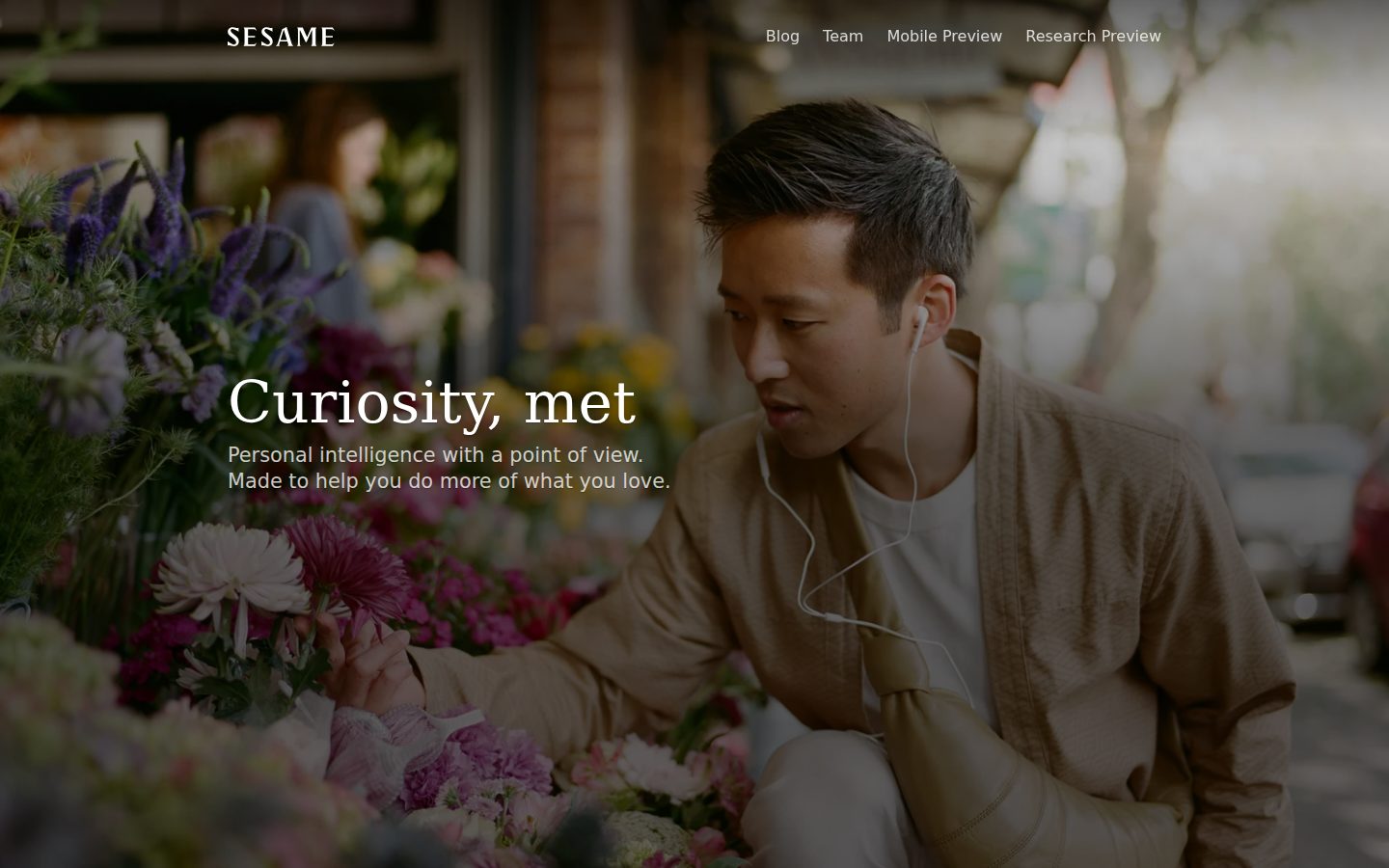
Sesame is a personal voice AI agent platform designed for ambient, hands-free interaction.
AI Panel Score
6 AI reviews
Reviewed
Sesame centers on a collection of personal AI agents built for spoken, conversational interaction. Rather than requiring typed prompts or structured commands, the product is designed for users to think out loud, follow a train of thought, or explore a topic in a more free-form, voice-driven way. The stated use case is for 'in-between moments' — brief windows during a day where a user might want to talk something through rather than open an app and type.
The website highlights a mobile preview and a research preview as current ways to access the agents, indicating the product is in an early or limited-availability stage rather than a broad public release. Alongside the software, Sesame is developing eyewear intended to pair with the agents, offering all-day wearable comfort and audio quality so users can interact hands-free while keeping their attention on what's in front of them. This hardware is described as coming in 2027, positioning it as a longer-term extension of the voice agent product rather than an immediate offering.
Sesame appears aimed at general consumers interested in ambient, voice-first AI assistance rather than enterprise or developer audiences, based on the consumer-facing framing of 'personal agents' and wearable eyewear. No pricing information, subscription tiers, or free-plan details are published on the site. The broader category includes other conversational AI assistants and voice-based AI products, such as those offered by OpenAI, Google, and Humane, though Sesame's site does not name specific competitors.
Sesame has released updates that improve the agent's ability to filter out background noise while keeping conversations smooth.
Sesame's research uses semantic and acoustic tokens to generate high quality conversational prosody and natural, expressive speech in real time.
The voice model senses emotional nuance and modulates pitch, pauses, and rhythm to reflect emotional cues and natural conversational timing like turn-taking and pacing.
Sesame agents are designed for the in-between moments of daily life, such as commuting or walking, to support spontaneous thinking.
Logging into Sesame unlocks longer calls with the personal agent beyond the limits available in the anonymous research preview.
Sesame is building lightweight, all-day-wear eyewear with high-quality audio so users can talk to their agent hands-free, planned for 2027.
An ever-present conversational AI agent designed to keep users informed and organized through natural, humanlike voice interaction.
Users can hold live, spoken conversations with their agent, following a thought or working out an idea out loud.
During a voice conversation, the agent surfaces search cards with image results to help users visualize new concepts quickly.
The Sesame iOS beta adds the ability to search, text, and think alongside voice, letting the agent respond across input modes.
Sesame is extending its personal agent experience from the current iOS mobile preview to dedicated intelligent eyewear hardware for a consistent cross-device agent.
A preview of Sesame's personal agent is available on iOS, letting users talk to their agent on the go, with Android support planned.
Sesame (sesamehr.com) does not publish fixed self-serve pricing; quotes are customized based on company size, region, and selected modules (time tracking, absence management, HR documents, etc.). Pricing requires contacting the vendor for a quote.
A research preview with a 2027 hardware promise and no pricing page — that's not a vendor decision yet.
“Sesame has a genuinely interesting voice model, but there's nothing here to buy. This is a follow list, not a pilot.”
No pricing page. No API. No docs. Just an iOS research preview and a promise about eyewear in 2027. That timeline alone tells you this isn't a decision for this board cycle.
The Conversational Speech Model work looks real — emotionally aware pacing, turn-taking, background noise filtering. That's a legitimate technical asset. But a consumer research preview competing against OpenAI's voice mode and Google's Gemini Live isn't a vendor relationship, it's a product to watch.
Three questions, none answered: Who's funding this past the eyewear launch? What's the business model? Why would we adopt before Sesame even ships self-serve pricing? Skip it. Revisit when there's a contract to sign.
OpenAI and Google already ship voice assistants at scale; Sesame's CSM work is interesting but unproven against them.
Piloting a pre-revenue consumer research preview would raise eyebrows, not confidence, in a board review.
iOS-only research preview with login-gated call limits offers no measurable business payback today.
Consumer ambient-assistant framing doesn't map to enterprise workflows we'd actually deploy.
No funding data, no team size, no pricing page — a 2027 hardware date is the only firm signal we have.
Consumer-tech watchers tracking voice AI research, not enterprise buyers needing a deployable tool.
Skip if you need a vendor with published pricing, an API, or any near-term deployment path.
A research preview with a 2027 hardware bet and zero integration surface today.
“Sesame's conversational speech model is genuinely differentiated, but there's no API, no docs, and no pricing page — nothing here a CTO can architect against yet.”
Sesame's CSM work — semantic and acoustic tokens for real-time prosody — is legitimate research, not a wrapper on someone else's TTS. That's the part worth watching. But the product surface today is an iOS research preview with login-gated call length limits, no Android yet, and no documented API. There's nothing to integrate.
Compare to OpenAI's voice mode or Google's Gemini Live: both ship SDKs and enterprise terms today. Sesame ships a consumer preview and a 2027 eyewear promise. If you adopt Sesame now, you're not adopting infrastructure — you're beta-testing a hardware roadmap with no docs, no changelog, no pricing page, and 'contact sales' as the only commercial motion.
If the eyewear ships on schedule in 2027, this becomes an interesting ambient-computing bet. Until then, it's not part of any serious stack decision — it's a company to watch, not a vendor to build on.
No pricing page, no tiers, no numbers. $0 disclosed on a 2027 hardware bet.
“Zero published pricing, zero contract terms, zero procurement path. Can't model TCO on a research preview.”
No pricing page. No tiers. No free plan. Contact sales, presumably, though there's no sales link either — just an iOS preview.
TCO math is impossible here. $0 published price × unknown seat count = no model. Compare to Humane, which at least shipped a SKU with a number attached before it died. Sesame won't even give you that. The eyewear — the actual monetization hook — lands in 2027. That's a 2-year-plus wait before any invoice exists.
Billing model: unknown. Auto-renewal: unknown. Term length: unknown. Procurement teams can't approve what finance can't price. Extended conversations require login, which suggests a future paywall, but there's no tier structure to evaluate. Right now this is a research preview, not a purchase decision. Revisit when there's an invoice to read.
No invoicing model, no payment terms, product is iOS preview only, not procurable.
No terms, no renewal language, no cancellation process disclosed for a research preview.
No pricing plans, no tiers, no starting price published anywhere on site.
Value framed as ambient companionship, not a measurable outcome or output metric.
Can't compute 3-year cost with zero pricing data and a 2027 hardware dependency.
Individual early adopters willing to test a free preview with no cost commitment.
Avoid if you need a priced, contractable product to evaluate this quarter.
A research preview with no docs, no API, and no pricing page — nothing to build on yet.
“Sesame's CSM voice model sounds genuinely impressive on paper, but there's zero developer surface here. This is a consumer iOS preview, not a platform you can integrate against.”
No API listed, no docs page, no changelog. capabilities flags on the site confirm it: blog=Y, everything else N. As an engineer evaluating this for actual integration work, that's a dead end before I even open Xcode.
What's shipped is an iOS research preview with anonymous sessions capped short — you have to log in just to get 'extended' calls, and there's no stated limit on what extended means. Android is 'planned.' The eyewear, the actual hands-free hardware story, is 2027. That's a three-year gap between the pitch and the product.
Compare to OpenAI's Realtime API or Google's Gemini Live — both give you actual SDKs today. Sesame gives you a mobile preview and a promise. The CSM research (semantic + acoustic tokens for prosody) is legitimately interesting reading, but interesting research isn't a workflow. Nothing here is buildable yet.
Anonymous sessions are capped and login-gating 'extended' calls with no published limit is a daily annoyance, not a feature.
docs=N and API=N on the site's own capability flags; the blog reads like research marketing, not practitioner reference.
Login wall for extended conversations plus no pricing page means every session starts with unknowns.
Search cards and text/voice input are the only stated 'advanced' features; no extensibility path beyond the app itself.
No API, no docs, iOS-only with Android 'planned' — nothing to hook into existing tooling or scripts.
Consumers curious about ambient voice AI who want to poke at an early iOS preview.
You need an API, SDK, or documented integration path for building anything today.
A voice you can talk to today, glasses you can't wear until 2027
“Sesame's conversational speech model sounds genuinely impressive on paper. But there's no pricing, no Android yet, and the actual hardware pitch is three years out.”
Right now Sesame is a mobile preview on iOS, Android "planned," and a research demo where logging in just gets you longer calls. That's the whole product today. The Conversational Speech Model stuff — semantic and acoustic tokens, emotional pacing, turn-taking — reads like real research, genuinely more thoughtful than most voice assistants bother with. OpenAI's voice mode and Google's Gemini live features exist as the obvious comparison, and Sesame doesn't say a word about either.
Here's my day-3 worry: there's no pricing page, no free trial, no tiers. Contact-only pricing on a consumer product is a weird ask for something you're supposed to talk to during your commute.
The eyewear is the actual dream, hands-free, all-day audio, stay-focused-on-the-world stuff. But 2027 is a long wait, and by then Meta and everyone else will have shipped three generations of smart glasses. Today you get a preview app. That's it.
Search cards and text/voice blending show care, but it's still labeled a research preview, not a finished daily tool.
Talking naturally has almost no learning curve up front, but the long-term payoff depends on eyewear that won't ship until 2027.
iOS has a real preview app; Android is only 'planned,' which is a real gap for a voice-first product.
Get-the-Preview flow on iOS is simple, but anonymous mode capping call length feels like homework before you even start.
No changelog or docs published, and background-noise-filtering is still listed as an ongoing fix, suggesting rough edges remain.
Consumers curious about ambient voice AI who don't mind an early, iOS-only preview with no pricing yet.
Avoid if you need Android support, transparent pricing, or a product that's ready today rather than in 2027.
Hardware promised for 2027, pricing promised never. Preview only.
“No pricing page, no docs, no changelog. Everything except the demo lives in the future tense.”
Three tells. One: hardware timeline is 2027 — that's a long time for a research preview to hold interest. Two: no pricing anywhere, not even a range. Three: 'contact' as a pricing model on a consumer product usually means there isn't one yet.
I've seen this pitch before. Humane shipped the AI Pin and shut down within a year. Rabbit shipped and got roasted for doing what an app could. Sesame hasn't shipped hardware at all yet — it's asking for trust two years out, on top of a mobile preview that's already gated behind login for anything beyond short calls.
The CSM voice research looks genuinely solid, better prosody than most competitors including OpenAI's voice mode. But that's software. The wearable is the actual bet, and 2027 is a long runway for a startup with no visible funding data or team page.
Emotionally aware CSM voice model is a real technical angle vs. OpenAI and Google voice assistants.
No API, no docs listed — conversational history and agent context likely don't export anywhere.
No funding, team, or pricing info public; 2027 hardware date is the only concrete commitment.
Site is upfront that eyewear is 2027 and mobile is a 'preview,' not overselling readiness.
Consumer AI wearable pitch echoes Humane's AI Pin, which shut down after one year on the market.
Early adopters curious about voice-first AI who don't mind an unfinished, ungated-nothing product.
You want pricing clarity or a product you can evaluate today rather than a 2027 roadmap.
Common questions answered by our AI research team
Sesame's personal agents are conversational AI built for the in-between moments of daily life rather than dedicated task sessions—made for thinking out loud, following a thread, or discovering something unexpected.
No. Sesame's eyewear is coming in 2027, pairing high-quality audio with hands-free access to your agent.
Yes. Sesame's eyewear is designed to let you talk to your agent hands-free so you can stay focused on what's in front of you, and this is planned for 2027.
You can get the Preview directly from Sesame's homepage via the "Get the Preview" option for Mobile Preview.


Sesame is a San Francisco-based startup developing personal AI agents and voice assistants, with plans to expand into intelligent eyewear.