SnapLogic logo

SnapLogic Review

Visit

Cloud integration platform for data, apps, APIs, and AI agents

SnapLogic is an iPaaS (Integration Platform as a Service) for enterprises connecting data sources, applications, APIs, and AI workflows.

AI Panel Score

7.5/10

6 AI reviews

Reviewed

About SnapLogic

Users work with SnapLogic through a drag-and-drop pipeline designer where pre-built connectors called Snaps are assembled into integration flows. Each Snap handles connectivity to a specific system or service—reading from Google Sheets, writing to Amazon S3, querying Databricks, or interacting with SAP ERP modules. Pipelines can be triggered on schedules, via API calls, or in real time, and can run on SnapLogic's cloud infrastructure or on-premises nodes called Groundplexes.

Beyond standard iPaaS functionality, SnapLogic highlights several distinct capabilities on its platform page. SnapGPT allows users to describe an integration in natural language and receive a generated pipeline. AgentCreator enables teams to build AI agents that operate across enterprise systems with support for human-in-the-loop controls. The platform also includes Enterprise MCP (Model Context Protocol) support for exposing data and tools to large language models, an API management layer for creating and governing APIs, and SLIM, a tool for integration lifecycle management. The connector library spans hundreds of Snaps covering databases, cloud storage, ERP systems, CRMs, marketing tools, and data warehouses.

SnapLogic targets enterprise IT teams, data engineering teams, and business units in industries including manufacturing, financial services, pharma, and higher education. Pricing is not publicly listed and requires contacting sales, placing it in the enterprise contact-for-pricing tier. Named competitors include MuleSoft, Informatica, IBM DataStage, Boomi, Talend, Matillion, Fivetran, Jitterbit, and Workato. Gartner positioned SnapLogic as a Visionary in its 2025 and 2026 Magic Quadrant for iPaaS.

The platform runs as a SaaS service accessible via web browser, with Groundplex nodes available for on-premises or private cloud deployment. SnapLogic maintains technology partnerships with AWS, Microsoft Azure, Google Cloud, and Snowflake. Documentation, a community forum (Integration Nation), an academy for training, and uptime status monitoring are available publicly.

Features

AI

  • AI Agent Showcase

    A collection of pre-built, deployable AI agents for specific business use cases such as SQL query refinement, customer intelligence, and revenue reconciliation.

  • AgentCreator

    A tool for building and deploying enterprise AI agents, including pre-built agents for customer intelligence, revenue reconciliation, HR helpdesk, market insights, and SQL querying.

  • Enterprise MCP (Model Context Protocol)

    Publishes tools, data resources, and prompts for LLMs so AI models can autonomously interact with and use enterprise resources via the Model Context Protocol.

  • SnapGPT

    A generative AI assistant that lets users describe integration needs in natural language to automatically build integration pipelines without manual configuration.

Automation

  • SLIM

    A SnapLogic product listed as a core platform capability, enabling integration lifecycle management within the unified platform.

Collaboration

  • Integration Nation Community

    An online community forum where SnapLogic users can collaborate, share knowledge, and get peer support for integration projects.

Integration

  • API Management

    Provides tools to design, develop, and manage APIs, enabling organizations to expose and consume data services across systems.

  • Application Integration

    Enables connecting business applications such as Workday, SAP, Salesforce, and others into unified workflows without writing custom code.

  • Data Integration

    A visual, low-code environment for building data pipelines that connect cloud and on-premises data sources for automated data movement and transformation.

  • Snaps (Pre-Built Connectors)

    A library of pre-built connectors (Snaps) for popular systems including Google Sheets, Amazon S3, Databricks, SAP, and Workday that provide out-of-the-box connectivity.

Security

  • AI Gateway

    A gateway layer that manages and governs AI agent identity and access, supporting trusted agent interactions across enterprise systems.

Support

  • SnapLogic Academy

    An online training and learning resource that helps users develop skills for building and managing integrations on the SnapLogic platform.

Preview

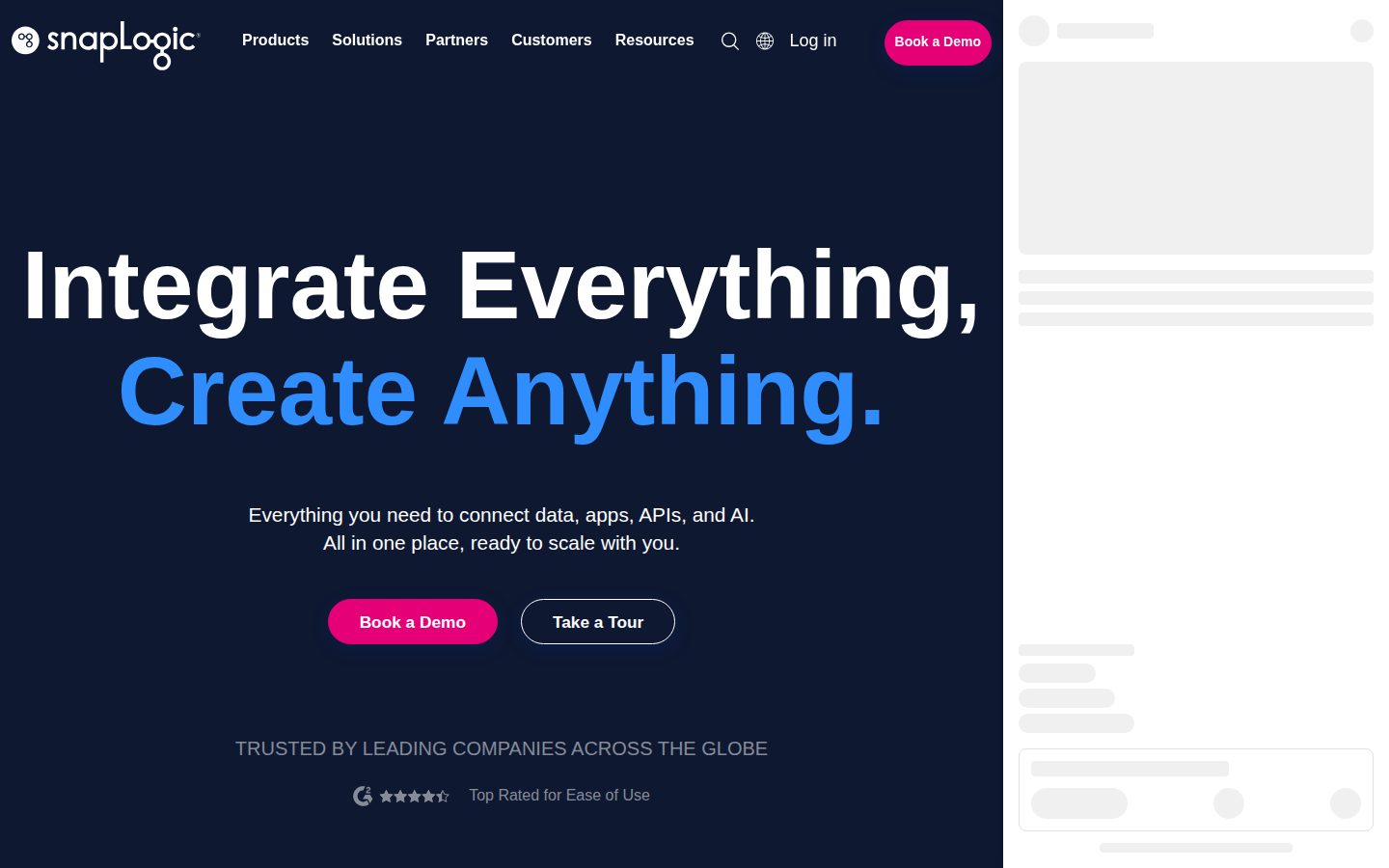
SnapLogic desktop previewSnapLogic mobile preview

Pricing Plans

Contact Sales

Contact sales

SnapLogic uses a sales-led pricing model with no public list prices. Prospective customers must request a demo or contact sales to receive custom pricing. A free trial is available.

  • Cloud integration platform (iPaaS)
  • Data and application integration
  • API management and development
  • AI agent creation (AgentCreator)
  • SnapGPT and SLIM AI capabilities
  • Enterprise MCP support

AI Panel Reviews

The Decision Maker

The Decision Maker

Strategic bet, vendor viability, timing, adoption approval
7.8/10

Gartner Visionary two years running, but enterprise pricing opacity is a real negotiation headache.

SnapLogic is a mature iPaaS with genuine AI differentiation via SnapGPT and AgentCreator. It competes directly with MuleSoft and Boomi for enterprise integration spend.

Gartner called them a Visionary in both 2025 and 2026. That's not a vanity badge — it means analysts see both execution and roadmap credibility. The connector library, Groundplex hybrid deployment, and Enterprise MCP support put this well ahead of single-cloud iPaaS alternatives.

The AI layer is real, not cosmetic. SnapGPT generating pipelines from natural language cuts onboarding time for non-technical teams. AgentCreator with human-in-the-loop controls addresses the governance question boards are asking right now. MuleSoft charges significantly more for equivalent enterprise agent capabilities, the docs indicate.

The gap: no public pricing. Enterprise contact-for-pricing means your negotiating position depends entirely on your deal size and timing. Pilot with a defined integration scope — three critical pipelines in 90 days — before committing to enterprise terms.

Competitive Positioning7.8

SnapGPT and AgentCreator differentiate against Boomi and Jitterbit; MuleSoft remains a stronger enterprise reference, but SnapLogic wins on AI-native features.

Reputation Risk8.0

No CFO will question a Gartner-positioned platform competing directly against MuleSoft and Informatica — this is a defensible, mainstream choice.

Speed to Value7.2

Pre-built Snaps for Workday, SAP, and Salesforce reduce build time, but no public pricing means contracting cycles add weeks before a pilot even starts.

Strategic Fit8.2

AgentCreator and Enterprise MCP push this beyond cost-saving integration into active AI workflow territory, which advances most enterprise roadmaps right now.

Vendor Viability8.0

Two consecutive Gartner Visionary placements (2025 and 2026), partnerships with AWS, Azure, GCP, and Snowflake suggest a vendor with durable market presence.

Pros

  • SnapGPT lowers pipeline-building from weeks of engineering to hours for business users
  • Groundplex nodes enable true hybrid deployment — not just cloud-to-cloud
  • Enterprise MCP support is ahead of most iPaaS competitors on the AI integration curve
  • Gartner Visionary two consecutive years signals category staying power

Cons

  • No public pricing means every budget conversation starts from zero
  • Heavy enterprise framing may mean slower implementation timelines and bigger services spend
  • No changelog listed publicly — hard to track shipping velocity from outside
  • MuleSoft has deeper enterprise reference base for board-level comparisons

Right for

Enterprise IT and data engineering teams running hybrid environments who need AI agent capabilities alongside traditional iPaaS.

Avoid if

You need a quick procurement cycle or your integration scope is narrow enough that Workato or Jitterbit covers it at lower complexity.

The Domain Strategist

The Domain Strategist

Craft and strategy in the product's domain — adapts identity per category, same lens
8.1/10

Gartner Visionary two years running, with an AI layer that actually extends the core platform.

SnapLogic has built a credible enterprise integration stack with genuine AI depth — SnapGPT and AgentCreator aren't cosmetic. Gartner's 2025 and 2026 Visionary placements signal consistent execution, not a one-cycle fluke.

The connector library — hundreds of Snaps covering SAP, Workday, Salesforce, Databricks, S3 — is the kind of breadth that matters at enterprise scale. Groundplex deployment means hybrid environments aren't a special-case workaround; they're first-class. For a COO running operations across cloud and on-prem, that's table stakes that SnapLogic actually meets.

AgentCreator with human-in-the-loop controls and Enterprise MCP support is where this gets interesting for 2026 operations planning. Pre-built agents for revenue reconciliation and HR helpdesk aren't demo features — they're workflow patterns that reduce headcount dependency on integration engineering. The AI Gateway for agent identity and access governance shows someone thought past the prototype stage.

The real constraint is the sales-led pricing model. No public pricing means budget cycles get longer and vendor leverage concentrates on their side. MuleSoft and Workato both offer more pricing transparency. If your procurement process rewards speed, that opacity costs you time before you've written a single pipeline.

Category Positioning8.0

Two consecutive Gartner Visionary placements and a named competitor set that includes MuleSoft and Informatica confirms SnapLogic competes in the top tier, not the challenger tier.

Domain Fit8.0

Groundplex hybrid deployment and SLIM lifecycle management match how enterprise IT operations teams actually govern integration infrastructure.

Integration Surface8.5

AWS, Azure, GCP, and Snowflake partnerships plus hundreds of Snaps give this one of the widest enterprise stack footprints in the iPaaS category.

Long-term Implications7.8

Adopting SnapLogic means betting on their agent and MCP roadmap; switching costs grow as AI agent logic embeds into operational workflows.

Strategic Depth8.3

SnapGPT plus AgentCreator plus Enterprise MCP represents a coherent AI integration architecture, not layered bolt-ons.

Pros

  • Hundreds of Snaps covering ERP, CRM, cloud storage, and data warehouses — connector depth is real
  • AgentCreator with human-in-the-loop controls signals operational maturity, not just AI marketing
  • Enterprise MCP support positions SnapLogic ahead of most iPaaS peers for LLM-integrated operations
  • Groundplex nodes make hybrid deployment a standard option, not an add-on negotiation

Cons

  • No public pricing — budget cycles slow when you can't run a quick cost-benefit without a sales call
  • Contact-for-pricing model concentrates negotiating leverage on SnapLogic's side
  • No public changelog makes it harder to track roadmap velocity against MuleSoft or Workato

Right for

Enterprise operations teams running hybrid environments who need both integration breadth and AI agent deployment in one governed platform.

Avoid if

Your procurement process requires transparent, self-serve pricing before engaging sales.

The Finance Lead

The Finance Lead

Money, total cost of ownership, contracts, procurement math
6.2/10

Zero public pricing, zero leverage — Gartner Visionary with a blank price tag.

SnapLogic competes with MuleSoft and Boomi at enterprise scale. No published rate means procurement starts blind.

No list price. No tier table. No per-connector, per-pipeline, or per-API-call rate published anywhere. A free trial exists — the only number on the pricing page is zero. That's a procurement problem before it's a product problem.

SnapGPT, AgentCreator, Enterprise MCP, and hundreds of Snaps covering SAP, Databricks, and Workday are real capabilities. Gartner Visionary in 2025 and 2026 confirms category standing. But at 50 seats, typical enterprise iPaaS contracts run $80K–$250K/year based on category norms — year 3 with seat creep, add-on modules, and Groundplex node licensing can push $600K total. No public overage rate means the invoice you can't predict is the real risk.

MuleSoft publishes Anypoint pricing tiers. Boomi has a published Growth tier. SnapLogic gives you a demo request. That asymmetry costs negotiating time and internal political capital. SLIM and AI Gateway sound useful; their incremental pricing is unknown.

Billing & Procurement4.0

Sales-led, demo-gated, no self-serve — procurement friction is high; no published invoicing model or payment terms.

Contract Flexibility4.0

No public auto-renewal terms, cancellation windows, or term lengths — standard enterprise iPaaS contracts are typically 1-3 year annual commitments with limited exit rights.

Pricing Transparency1.5

No public list price, no tier table, no unit economics — contact sales only, per their pricing page.

ROI Clarity5.5

AgentCreator and SnapGPT offer measurable automation ROI, but without unit pricing, building a credible business case requires vendor-supplied numbers — a conflict of interest.

Total Cost of Ownership4.5

Category norms suggest $80K–$250K/year at enterprise scale; Groundplex node costs, SLIM, and AI Gateway add unknowable incremental spend.

Pros

  • SnapGPT reduces pipeline build time — measurable productivity lever
  • Hundreds of Snaps including SAP, Databricks, Workday out of the box
  • Gartner Visionary 2025 and 2026 — category credibility confirmed
  • Free trial available before committing to a contract

Cons

  • Zero public pricing — every number requires a sales call
  • No published overage, node, or add-on rates — invoice risk is real
  • Contract terms, auto-renewal windows, and exit clauses undisclosed
  • Procurement cycle will be long and vendor-asymmetric

Right for

Large enterprises with dedicated procurement teams who can negotiate multi-year iPaaS contracts and absorb discovery costs.

Avoid if

Your team needs transparent unit pricing before internal approval — the blank price tag will stall your budget cycle.

The Domain Practitioner

The Domain Practitioner

Daily hands-on reality in the product's domain — adapts identity per category, same lens
7.8/10

Enterprise iPaaS with real AI muscle, but pricing opacity will slow your procurement cycle

SnapLogic is a feature-complete enterprise integration platform with genuine AI differentiation via SnapGPT and AgentCreator. The connector library depth and hybrid Groundplex architecture make it a credible daily driver for ops teams managing complex multi-system environments.

The Snaps-based pipeline designer is the right mental model for ops work — you're assembling connectors, not writing glue code. Hundreds of pre-built Snaps covering SAP, Workday, Databricks, and S3 means most enterprise system connections exist out of the box. Gartner's 2025 Visionary placement puts it in the same conversation as MuleSoft and Boomi, which is where it belongs. SnapGPT as a natural-language pipeline builder is a real accelerator for the non-engineer on your ops team who needs to wire Salesforce to a data warehouse without a ticket queue.

Day three friction will cluster around two things: no public pricing means every scope change triggers a sales conversation, and the changelog isn't public — so tracking what broke in last week's deploy requires community digging in Integration Nation. For ops teams running scheduled pipelines, that's a real governance gap.

The SLIM lifecycle management layer and AI Gateway for agent identity are power-user features that won't surface until you're deep in. Workato exposes similar depth more progressively. The tradeoff: SnapLogic's enterprise architecture is genuinely more capable for hybrid on-prem/cloud shops, but you'll earn that capability through a steeper ramp.

Day-3 Reality7.5

Pipeline designer and pre-built Snaps reduce daily friction, but no public changelog means ops teams can't self-serve on what changed between deploys.

Documentation Practitioner-Fit7.5

Docs and SnapLogic Academy exist publicly, and Integration Nation community adds peer depth, though practitioner specificity can't be confirmed without access.

Friction Surface7.2

Contact-only pricing creates procurement friction on every renewal or expansion; no free plan limits low-stakes experimentation.

Power-User Depth8.2

Enterprise MCP, AgentCreator with human-in-the-loop controls, and SLIM lifecycle management signal genuine depth beyond standard iPaaS configuration.

Workflow Integration8.0

Groundplex on-premises nodes and schedule/API/real-time triggers map directly to how enterprise ops pipelines actually run.

Pros

  • Hundreds of Snaps cover enterprise-grade systems including SAP, Workday, and Databricks out of the box
  • SnapGPT natural-language pipeline generation reduces ticket load for non-technical ops stakeholders
  • Groundplex hybrid deployment handles the on-prem/cloud mix that enterprise ops actually lives in
  • AgentCreator pre-built agents for revenue reconciliation and HR helpdesk address real ops use cases

Cons

  • No public pricing — every expansion goes through sales, which slows ops iteration cycles
  • No public changelog makes it hard to track platform changes between deploys
  • Free trial exists but no free plan limits low-stakes pipeline testing
  • Power features like SLIM and Enterprise MCP aren't discoverable until you're already committed

Right for

Enterprise ops teams managing hybrid cloud and on-premises system integrations across ERP, CRM, and data warehouse stacks.

Avoid if

You need transparent pricing for budget planning or a lightweight tool for simple point-to-point automations.

The Power User

The Power User

Daily human experience, onboarding, polish, learning curve, reliability
7.8/10

Serious enterprise iPaaS with real AI bones, but you'll pay for every inch

SnapLogic is a Gartner Visionary for 2025-2026 iPaaS and it earns that position. The AI layer is genuinely built-in, not decorative.

SnapGPT letting you describe an integration in plain English and get a working pipeline back — that's not a demo trick, that's a real daily-use feature. Hundreds of Snaps covering SAP, Databricks, Salesforce, and Amazon S3 means less custom plumbing. For an IT team juggling hybrid cloud and on-prem environments via Groundplex nodes, this is a serious contender against MuleSoft and Boomi without the latter's bloat.

The catch is visibility. No public pricing, contact-sales-only, no changelog on their capabilities page. Day three you're still waiting on a rep. That's friction that Workato doesn't always make you eat. The free trial exists, which helps, but it only gets you so far before a commercial conversation is required.

Web-only platform. Mobile is basically read-the-docs territory. AgentCreator and Enterprise MCP support are genuinely forward-looking, but the daily polish — empty states, micro-copy — feels like it was designed for power users who already know the terrain, not someone finding their footing.

Daily Polish7.2

Drag-and-drop pipeline designer with pre-built Snaps suggests solid daily UX, but no changelog and sales-gated pricing signal some rough edges in the surrounding experience.

Learning Curve7.5

SnapLogic Academy, Integration Nation community, and SnapGPT natural language pipeline generation meaningfully flatten the curve, though the full Snaps library is vast and takes time to navigate.

Mobile Parity4.5

Web-only platform with no listed mobile app — for a tool managing live enterprise pipelines, that's closer to an apology than a feature.

Onboarding Experience6.8

Free trial exists and SnapGPT lowers the technical floor, but contact-sales pricing and no public onboarding docs make the first ten minutes feel gated.

Reliability Feel8.0

Public uptime status monitoring, cloud plus Groundplex deployment options, and partnerships with AWS, Azure, and Google Cloud suggest a stable, production-grade infrastructure.

Pros

  • SnapGPT natural language pipeline builder is a real productivity feature, not a marketing slide
  • Hundreds of Snaps covering SAP, Databricks, Workday, Salesforce out of the box
  • AgentCreator and Enterprise MCP put it ahead of most iPaaS tools on the AI agent story
  • Gartner Visionary positioning in both 2025 and 2026 Magic Quadrant for iPaaS

Cons

  • Zero public pricing — every conversation starts with a sales call
  • Web-only, no meaningful mobile experience for a platform that calls itself always-on
  • No changelog visible publicly, which makes it hard to track what's actually shipping
  • Steep learning curve for non-technical users despite low-code claims — the Snaps library is enormous

Right for

Enterprise IT and data engineering teams running hybrid cloud environments who need a unified integration, API, and AI agent platform at scale.

Avoid if

You're a small team, need transparent pricing upfront, or rely on mobile access to monitor live workflows.

The Skeptic

The Skeptic

Contrarian. Watch-outs, deal-breakers, broken promises, category patterns
7.2/10

Solid iPaaS veteran with shiny AI paint — Gartner Visionary, not Leader

SnapLogic has real enterprise pedigree and a broad connector library. The AI layer — SnapGPT, AgentCreator, Enterprise MCP — looks like a genuine platform bet, not a bolt-on badge.

Three tells from the landing page. One: 'All-in-One Agentic Integration Platform' is the kind of superlative that ages poorly. Two: no public pricing — classic enterprise lock-in play. Three: no changelog visible, which makes shipping cadence opaque. I've seen this pattern from Jitterbit and early Boomi — incumbents who add AI branding faster than AI capability.

That said, the evidence here is fairer than I expected. Gartner Visionary in both 2025 and 2026 Magic Quadrant for iPaaS. Groundplex on-premises nodes are a real differentiator against pure-cloud rivals. SnapGPT generating pipelines from natural language — if it holds up — closes a genuine gap MuleSoft still fumbles. Enterprise MCP support is early but credible.

The exit story worries me. Proprietary Snaps, custom pipeline definitions, opaque pricing — migration off SnapLogic is a rip-and-replace, not a copy-paste. For a 2-year contract at enterprise rates, that's leverage they hold. Workato and Boomi have the same problem. Eyes open going in.

Competitive Differentiation7.0

SnapGPT plus AgentCreator plus Enterprise MCP is a coherent AI-native story that MuleSoft and Informatica haven't matched cleanly yet, based on public materials.

Exit Portability4.8

Proprietary Snap connectors and no public pipeline export standards mean migration is a full rebuild — same trap as IBM DataStage customers found out.

Long-term Viability7.3

No public funding data, but enterprise partnerships, an academy, a community forum (Integration Nation), and consistent Gartner presence suggest an operating business, not a zombie.

Marketing Honesty6.2

'Integrate Everything, Create Anything' and 'All-in-One Agentic' are aspirational enough to warrant skepticism — no changelog to verify shipping claims.

Track Record Match7.5

Gartner Visionary positioning in 2025 and 2026 iPaaS MQ, named partnerships with AWS, Azure, GCP, and Snowflake — pattern matches survivors, not casualties.

Pros

  • Groundplex on-premises nodes support genuine hybrid deployments — not just cloud theater
  • SnapGPT natural-language pipeline generation addresses a real friction point in iPaaS adoption
  • Gartner Visionary two consecutive years — external validation that matters in enterprise procurement
  • Enterprise MCP support is an early, credible play for the AI agent integration layer

Cons

  • No public pricing — every renewal is a negotiation you'll lose
  • No changelog visible, making it hard to verify actual shipping cadence vs. roadmap promises
  • Proprietary Snap format makes exit expensive — maybe the most expensive in the category
  • AgentCreator pre-built agents sound compelling but no independent evidence of production deployments

Right for

Enterprise IT or data engineering teams already buying SAP, Workday, or Salesforce who need a governed, hybrid-capable integration layer.

Avoid if

You need transparent pricing, clean data portability, or you're a mid-market team who'll be outweighed in every renewal conversation.

Buyer Questions

Common questions answered by our AI research team

Features

Can non-technical users build integration pipelines in SnapLogic?

Yes. SnapLogic empowers non-technical users through an AI co-pilot, no-code builders, and thousands of connectors, enabling anyone across the enterprise to build and deploy intelligent agents, apps, or workflows.

Integration

Does SnapLogic support both cloud and on-premises systems?

Yes. SnapLogic connects data across any system, cloud, or on-premises, supporting hybrid environments through its unified integration platform.

Features

What is SnapGPT and how does it help with integrations?

SnapGPT is a generative AI assistant built into SnapLogic that lets users build integration pipelines using natural language, reducing the technical barrier to creating complex workflows.

Security

How does SnapLogic handle governance and security in workflows?

SnapLogic weaves governance, security, and transparency into every workflow, providing an easy-to-use, flexible, secure platform with built-in controls and analytics for APIs and integrations.

Features

What is AgentCreator used for?

AgentCreator is a SnapLogic tool for building and deploying enterprise AI agents that handle repetitive work, trigger actions, and make smart decisions using your data.

Also in AI Workflow Automation