AI-native master data management for unified, trusted enterprise data
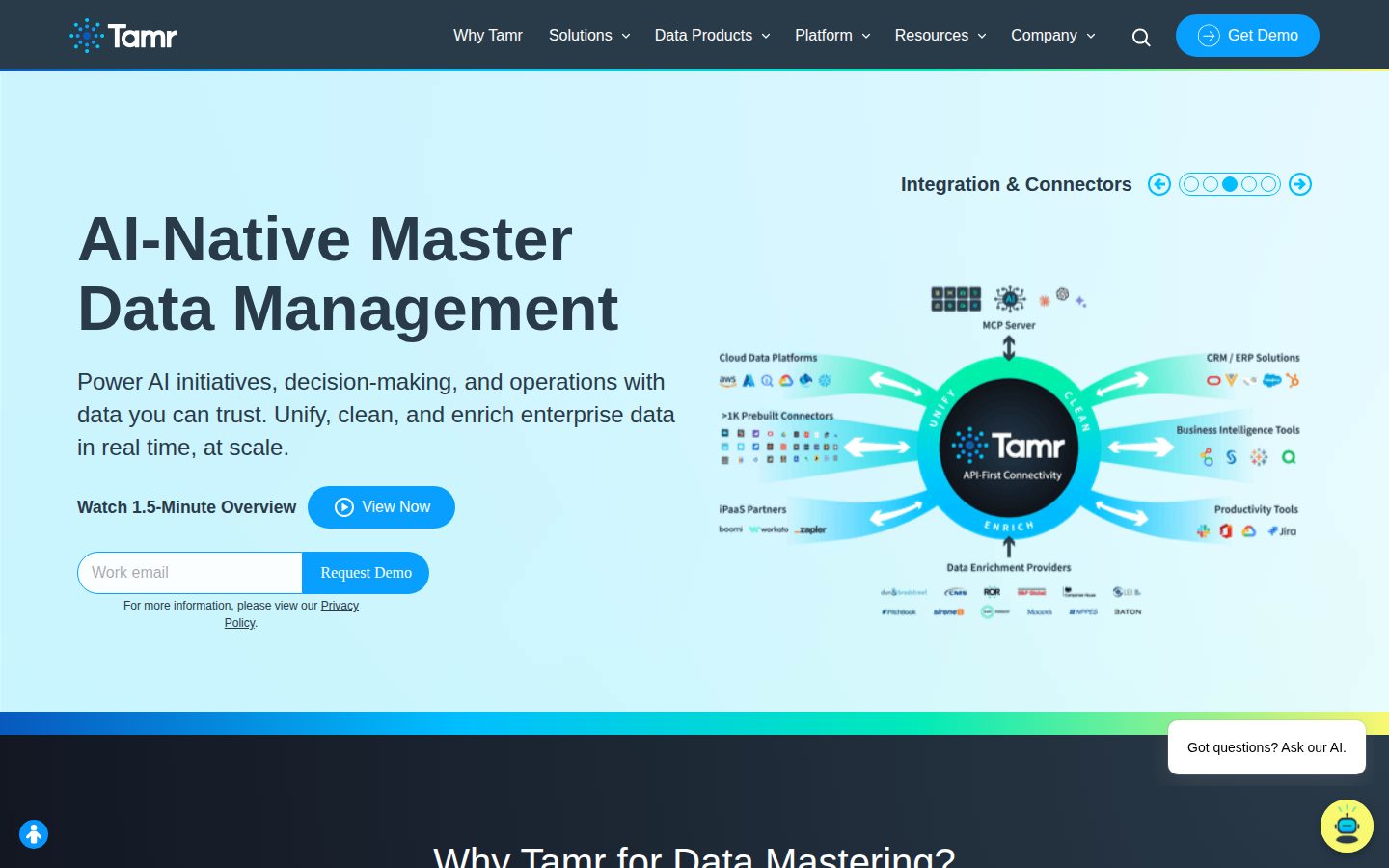
Tamr is an AI-native master data management (MDM) platform for enterprises that need to unify and master data across complex systems.
AI Panel Score
6 AI reviews
Reviewed
Tamr is an AI-native master data management platform that unifies and masters data across complex enterprise systems. Using AI-driven entity resolution, it identifies, matches, and consolidates records from CRM, ERP, and other sources into authoritative golden records. Its agentic data curation approach pairs AI agents with human oversight, while Tamr RealTime delivers mastered data back into operational systems as changes occur. The platform serves enterprises dealing with duplicate, inconsistent, or fragmented records spread across many business systems. Pricing is quote-based across Starter, Advanced, and Enterprise tiers, with no free plan or trial. Key capabilities include an enterprise knowledge graph, LLM connectivity through MCP, data quality monitoring, data enrichment, governance controls, and prebuilt integrations and connectors, with security and compliance features supporting enterprise deployment. It fits organizations that need trusted, deduplicated master data feeding analytics, AI initiatives, and operational workflows at enterprise scale.
In practice, users connect Tamr to existing data sources—CRM systems, ERPs, healthcare databases, or other enterprise applications—and the platform ingests records from those systems. Tamr's entity resolution engine identifies duplicate or related records across sources and merges them into a single, authoritative master record. Stewards can review, approve, or override AI-suggested curation decisions through a human-in-the-loop workflow before publishing clean data downstream.
Tamr offers several distinct platform capabilities beyond basic record matching. Its Enterprise Knowledge Graph connects people and organization data to surface relationships and hierarchies. Tamr RealTime pushes mastered data back into operational systems immediately after curation. The platform also supports LLM connectivity via the Model Context Protocol (MCP), allowing AI agents and large language models to query trusted master data directly. Data enrichment capabilities let users standardize and augment records using third-party data sources.
Tamr targets large enterprises in industries such as financial services, life sciences, and healthcare, with packaged data products for B2B customers, B2C customers, contacts, suppliers, healthcare providers, and healthcare organizations. It competes with traditional MDM vendors such as Informatica MDM, IBM MDM, and Semarchy, as well as newer platforms like Reltio and Ataccama. Pricing is not publicly listed and appears to be quote-based, suggesting enterprise contract pricing.
Tamr is deployed as a cloud-based platform with integration connectors for operational systems and data pipelines. It supports data governance workflows and maintains documented security, compliance, and privacy practices for enterprise deployments.

Combines AI agents with human oversight to streamline and accelerate the process of curating and managing master data.
Uses AI and built-in external data to identify, match, and link records across enterprise systems for more reliable mastering results.
Connects people and organization data to reveal relationships and insights across the enterprise data landscape.
Standardizes, matches, and enriches records by incorporating data from reputable third-party sources.
Strengthens data governance and stewardship practices by ensuring master data is clean and trustworthy.
Improves the accuracy and completeness of records through Tamr's mastering platform.
Consolidates and unifies records from multiple source systems into a single authoritative master record per entity.
Delivers unified and mastered data immediately back into operational systems to ensure teams always have access to the most current trusted records.
Unifies and synchronizes data across CRM, ERP, and other critical enterprise systems to provide teams with fresh, trustworthy data.
Connects Tamr with operational systems, data pipelines, and enterprise applications such as CRM and ERP platforms.
Connects AI applications and agents to trusted master data using the Model Context Protocol (MCP).
Provides security, compliance, privacy, and trust controls governing the Tamr platform.
Get started quickly with analytical use cases
Supports operational and analytical use cases
Scales to the size and needs of any business; custom pricing for 10M+ IDs
Real MDM category, real customer proof, but pricing opacity means the board sees a black box.
“Tamr masters enterprise data with entity resolution and human-in-the-loop review, backed by SOC 2 Type II and a customer who mastered 3.2M provider records in weeks. It competes directly with Informatica MDM and Reltio, but you won't know what it costs until legal is already involved.”
3.2M provider records mastered in weeks. That's a real number from a real customer, not a slide. Golden records, entity resolution, RealTime push-back into operational systems — this is a mature category with a credible player.
Two things worry me. One: pricing is quote-based per golden record, no dollar figure anywhere, which means procurement negotiates blind. Two: competes against Informatica MDM and Reltio, both entrenched incumbents with deeper enterprise footprints — Tamr has to win on AI-native positioning, not incumbency.
SOC 2 Type II, CE+, NIST 800-171, regional data isolation across five geographies. That's enterprise-grade trust infrastructure, not a startup checkbox. The MCP connectivity for LLM agents is forward-looking and differentiates from legacy MDM. Worth a serious look if data quality is blocking your AI roadmap.
Competes against entrenched Informatica MDM and Reltio; AI-native framing is the differentiator, not scale.
Named MDM category with life sciences and healthcare customers reads as a sound, boring-in-a-good-way choice to a board.
One customer mastered 3.2M records in weeks and cut manual prep 90%, per Tamr's own claims.
MCP connectivity for LLM agents means this advances AI initiatives, not just cleans up legacy CRM sync.
No public funding data, but SOC 2 Type II and multi-region deployment suggest an established operation, not a startup on fumes.
Large enterprises in financial services, life sciences, or healthcare with fragmented CRM and ERP data blocking AI initiatives.
You need transparent self-serve pricing or a free trial before committing budget.
Entity resolution done right, priced per golden record, built for the multi-decade MDM commitment.
“Tamr's agentic curation and MCP connectivity for LLMs put it ahead of legacy MDM on architecture. The pricing model and human-in-the-loop workflow both demand real organizational maturity to pay off.”
Golden records aren't a feature, they're a governance philosophy, and Tamr's human-in-the-loop steward workflow reflects that correctly. Entity Resolution plus Enterprise Knowledge Graph gives you both the match layer and the relationship layer — most vendors ship one and call it done. Usage-based pricing per mastered record (not input volume) is the right unit economics for MDM, but at 10M+ IDs that Enterprise tier becomes a real budget line, not a rounding error.
Domain fit is strong for financial services, life sciences, healthcare — anyone who's lived the pain of six CRM instances disagreeing about customer identity. Tamr RealTime pushing mastered data back into operational systems immediately is the difference between MDM as a reporting exercise and MDM as infrastructure. LLM connectivity via MCP is forward-looking; it's positioning master data as the trust layer under agentic AI, ahead of Informatica MDM and IBM MDM on that specific bet.
Three years in, you're committed: golden record schemas and steward workflows don't migrate cleanly. Compared to Reltio and Ataccama, Tamr's agentic curation is the differentiator worth the lock-in risk.
MCP-based LLM connectivity puts Tamr ahead of Informatica MDM and IBM MDM on AI-agent readiness.
Steward review workflow and 50+ native connectors match how enterprise data teams actually govern master data.
Runs natively on AWS, Azure, GCP, Databricks, and Snowflake with real-time update APIs in Advanced/Enterprise tiers.
Golden record schemas and curation rules create real switching cost; SOC 2 Type II and NIST 800-171 support long enterprise tenure.
Entity Resolution combined with Enterprise Knowledge Graph covers matching and relationship-mapping in one platform, rare in this category.
Enterprises in financial services, life sciences, or healthcare needing operational-grade MDM with real-time delivery back into source systems.
You need transparent self-serve pricing or a lightweight data quality tool rather than full master data governance.
Priced per golden record, quote-only. Procurement has nothing to model.
“Three tiers listed, zero dollars attached. Enterprise deals here are negotiated blind.”
50k records free-tier ceiling. Above that, quote-based, priced per golden record — mastered output, not input volume. That's a metering model finance teams can't forecast without a vendor call.
Compare to Informatica MDM or Reltio, both also quote-based. Category norm is opacity here — Tamr isn't unusual, just unhelpful. No published per-record rate means year 3 TCO depends entirely on entity volume growth, which for CRM/ERP consolidation tends to compound, not flatten.
SOC 2 Type II, CE+, NIST 800-171 — compliance box checked, contract terms not. No public term length, no auto-renewal disclosure, no cancellation process. Enterprise MDM deals typically run 1-3 year terms with negotiation room, but you won't see that until legal's involved. ROI story leans on case studies — 3.2M provider records mastered in weeks, 90% cut in manual prep — real numbers, but yours may vary.
Quote-based sales cycle; same-day onboarding claimed but invoicing model undisclosed.
No public term length or auto-renewal terms disclosed; standard enterprise opacity.
Tiers named (Starter, Advanced, Enterprise) but no dollar figures published anywhere.
Case studies cite 90% reduction in manual prep and 3.2M records mastered in weeks.
Per-golden-record billing scales with entity growth, making 3-year cost hard to bound.
Large enterprises in financial services or healthcare needing entity resolution at 10M+ ID scale.
You need a fixed number for next year's budget before talking to sales.
Golden records at 10M+ IDs, but pricing per mastered output is a planning headache
“Tamr's entity resolution and connector breadth look solid for enterprise MDM work. The per-golden-record pricing model and lack of a sandbox make it hard to validate before signing a contract.”
Native connectivity to 50+ sources ships in every tier, including Starter's 50k-record cap. Good sign for a pilot. But usage-based pricing per golden record — not input volume — means I can't forecast cost until entity resolution actually runs. That's a bad daily fight to have with finance mid-project.
Agentic Data Curation with human-in-the-loop review matches how stewardship actually works: AI proposes, someone senior approves before it hits production. Tamr RealTime pushing mastered data straight back into operational systems is the differentiator over static batch MDM from Informatica or Semarchy. MCP support for LLM querying against master data is forward-looking, though I'd want to see how it behaves under concurrent agent load before trusting it in a pipeline.
Docs page exists but no changelog, no public API reference, no sandbox. SOC 2 Type II and AES-256 at rest cover compliance boxes. For a platform claiming 3.2M records mastered in weeks, I'd want more visibility into schema mapping and connector configuration before committing.
Same-day onboarding claimed, but no trial means day-3 friction is discovered inside a signed contract.
Docs and blog exist but no API reference or changelog surfaced, thin for engineers debugging connector behavior.
Per-golden-record pricing and no public dollar figures create ongoing cost-forecasting friction across a project.
Enterprise tier adds real-time update APIs and 10M+ ID scaling, showing real headroom past the Starter tier.
Runs on AWS, Azure, GCP, Databricks, and Snowflake, fitting existing pipeline architecture rather than forcing a new stack.
Enterprises in financial services, life sciences, or healthcare needing golden records across CRM and ERP at 10M+ ID scale.
You need to validate entity-resolution accuracy on your own data before committing to a quote-based enterprise contract.
Solid enterprise MDM guts, but this isn't a tool you get a feel for in an afternoon.
“Tamr does the unglamorous work of merging your CRM and ERP into one trustworthy record. Just don't expect to poke around it on your phone or figure it out before lunch.”
This isn't a daily-use app for a person, it's infrastructure a data steward lives inside for years, so my usual 'day 3' lens bends a bit. Still — the plans page lists real tiers, Starter capped at 50k records, Enterprise for 10M+ IDs, and one customer mastered 3.2M provider records in weeks. That's a concrete number, which is more than most enterprise vendors give you.
The stuff that'll matter three months in: human-in-the-loop review queues, Tamr RealTime pushing golden records back into operational systems, MCP hooks for LLMs. All named, all real capabilities, not vaporware buzzwords.
But there's no pricing page, no free trial, no changelog listed. Compared to Informatica MDM or Reltio, that's category-normal, not a red flag, but it means your first ten minutes is a sales call, not a sandbox. Mobile isn't mentioned anywhere — for a stewardship tool that's probably fine, but don't pretend it's 'always with you.'
Named features like Enterprise Knowledge Graph and Data Enrichment suggest depth, but no UI/empty-state evidence is public.
Tiered plans (Starter to Enterprise) suggest scalable complexity but 90% manual-prep reduction claim implies real ramp-up first.
Platforms listed as web-only, no mobile mentioned anywhere in the evidence.
No free trial, no pricing page — evidence shows 'same-day access' claims but the entry point is a sales conversation.
SOC 2 Type II, CE+ certified, AES-256 at rest, TLS 1.2+ in transit — this is the strongest evidenced dimension.
Large enterprises in financial services, life sciences, or healthcare with dedicated data stewardship teams.
You want to try before you buy or need anything resembling a mobile workflow.
MDM is a 20-year-old category. 'AI-native' doesn't erase the migration risk.
“Tamr's got SOC 2 Type II, real customers, and named tiers up to 10M+ IDs. But the pricing page lists three 'Free' tiers that clearly aren't, and that's the kind of superlative that ages poorly.”
Informatica MDM, IBM MDM, Reltio — this category has a long tail of vendors that got acquired, gutted, or quietly sunset. Tamr's been around long enough to have SOC 2 Type II and multi-region storage, which is real signal. The '3.2M provider records in weeks' claim is specific enough to half-believe.
But the pricing table says Starter, Advanced, and Enterprise are all 'Free' — with Enterprise needing custom quotes for 10M+ IDs. That's not free, that's a marketing template someone forgot to edit. No pricing page, no changelog, no API docs listed either.
Exit story is the real worry. Golden records live inside Tamr's entity resolution engine — once your CRM and ERP depend on Tamr RealTime pushing data back, unwinding that is a multi-quarter project, not a config change.
MCP-based LLM connectivity is a genuine newer angle vs. Informatica or IBM MDM, though Reltio and Ataccama are chasing the same thing.
Golden records and RealTime sync into operational systems mean deep entanglement, not a clean swap.
No public funding figures, but SOC 2 audits, multi-cloud support, and documented enterprise deployments suggest real infrastructure spend.
Three pricing tiers labeled 'Free' that require custom enterprise quotes — sloppy, not fraudulent, but a real flag.
SOC 2 Type II, NIST 800-171, and named customer outcomes match how surviving MDM vendors present themselves.
Large enterprises in financial services or healthcare already committed to multi-year MDM contracts.
You want transparent self-serve pricing or a lightweight tool you can unwind quickly.
Common questions answered by our AI research team
Tamr uses quote-based, usage-based pricing charged per golden record — mastered output records, not input volume. Tiers are Starter (up to 50k records), Advanced, and Enterprise, with custom pricing for 10M+ IDs and no public dollar prices.
Tamr is an AI-native master data management platform for entity resolution, data quality, governance, and enrichment. Named capabilities include Entity Resolution, Tamr RealTime, Enterprise Knowledge Graph, Agentic Data Curation, and LLM Connectivity with MCP.
Tamr offers native connectivity to 50+ sources in all tiers and runs on major cloud platforms including AWS, Azure, Google Cloud, Databricks, and Snowflake. The Advanced tier adds real-time search APIs and job orchestration APIs.
Tamr is a multi-tenant SaaS platform, and all packages include same-day access, onboarding, and support. One customer mastered 3.2M provider records in weeks, and another cut manual data preparation by 90%.
Yes — Tamr is SOC 2 Type II certified with yearly audits, CE+ certified, and follows the NIST 800-171 framework. Data is encrypted in transit (TLS 1.2+) and at rest (AES-256), with isolated regional storage in the US, Canada, EU, UK, and APAC.