Enterprise platform for AI agents, MCP governance, and 700+ system integrations
Tray.ai is an enterprise orchestration platform for building AI agents, governing MCP, and integrating data across business systems.
AI Panel Score
6 AI reviews
Reviewed
Users interact with Tray.ai through two authoring modes: Tray Build, a low-code visual canvas, and Tray Headless, a code-first approach for developers. From either interface, teams configure workflows, wire together connectors, and publish AI agents. The Merlin Agent Builder provides a no-code environment where agents are assembled with knowledge bases, tool access, and guardrails, then registered in a composable agent hub for reuse across the organization.
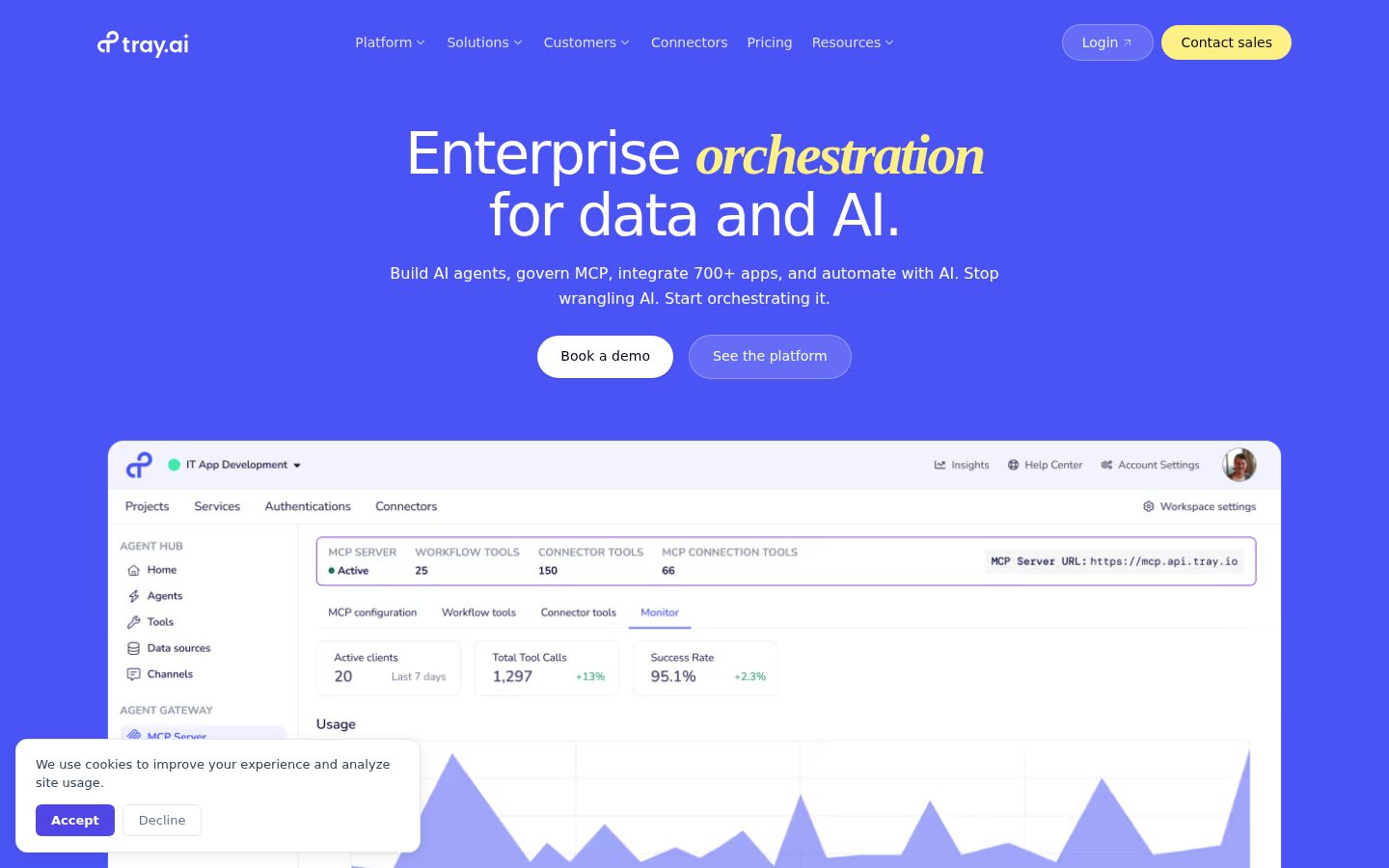
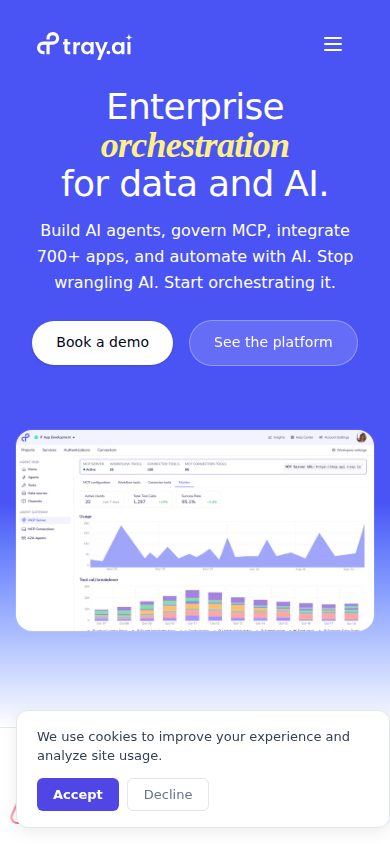
A highlighted differentiator is the Agent Gateway for MCP, which gives enterprises a governed layer for Model Context Protocol deployments. It exposes Tray's 700+ connectors as MCP-compatible tools, enforces role-based access control (RBAC), and logs every agent action for audit purposes. The Intelligent iPaaS layer handles process automation, data integration, API management, and connector orchestration. Compliance certifications listed include SOC 2, HIPAA, and GDPR, with a stated uptime target of 99.99%+.
Tray.ai targets enterprise IT, operations, and engineering teams — specifically roles like CIO/CTO, VP IT, marketing ops, and data engineering. Named customers include GitHub, Eventbrite, Mixpanel, Zuora, and Apollo. The platform is positioned against MuleSoft, Workato, Boomi, Zapier, Make, Microsoft Power Automate, SnapLogic, and Salesforce Agentforce, among others. Pricing is not publicly listed; plans are sold under enterprise contract. No free plan is advertised, though a free trial may be available on request.
Tray.ai runs as a cloud-hosted SaaS platform accessible via web browser. It supports prompt management, model routing, and versioned building blocks for AI development. Amazon Bedrock is a named integration partner for AI model infrastructure. The platform also supports human-in-the-loop workflow patterns for processes that require manual approval steps.

Supports both low-code canvas authoring and code-first headless development with prompt management, model routing, and versioned composable building blocks.
Enables an agent-of-agents architecture where independent, reusable agent components can be freely combined and reconfigured without rebuilding from scratch.
A no-code/low-code platform for building AI agents with knowledge, tools, guardrails, and a composable agent hub that can reason, act, and learn.
Embeds human approval, review, or decision steps into otherwise automated processes to keep people accountable for consequential decisions.
Executes business processes such as onboarding, approvals, order-to-cash, and incident response automatically via defined workflow sequences triggered by events.
A browsable catalog of pre-built Tray.ai workflows organized by industry, use case, and role to accelerate deployment of common automation patterns.
A library of pre-built integrations covering 700+ enterprise systems including Salesforce, Slack, Snowflake, and others, usable as workflow steps or governed agent tools.
Provides tooling to publish, secure, monitor, and version APIs so teams can expose data and services without building custom infrastructure for every integration.
Tracks and streams real-time database changes — inserts, updates, and deletes — rather than re-pulling full datasets on a schedule.
A process automation and data integration engine that connects 700+ enterprise applications via pre-built connectors and manages APIs in a unified platform.
Provides observability, audit trails, role-based access control, and compliance certifications including SOC 2, HIPAA, and GDPR with 99.99%+ uptime SLA.
A governed Model Context Protocol layer that deploys managed MCP Servers, exposes 700+ connectors as agent tools, and provides RBAC and full audit observability for every agent action.
For specific use cases
For multiple use cases within a department
For multiple departments and partner integrations
Tray.ai has the connectors, governance, and timing to win enterprise AI automation deals.
“Enterprise-grade iPaaS with MCP governance built in — that's a real differentiator right now. No public pricing is a friction point, but the feature stack is serious.”
700+ connectors, SOC 2 Type II, HIPAA, GDPR, 99.99% uptime SLA, and an Agent Gateway that governs MCP tool calls with full audit trails. That's not a feature list — that's a compliance officer's checklist. The Merlin Agent Builder and composable agent hub let both no-code ops teams and developers ship on the same platform, which matters when you're trying to standardize across departments without a rebuild every time.
The MCP governance layer is where Tray.ai separates from Workato and Boomi right now. Most iPaaS vendors are retrofitting AI. Tray's built the governed MCP layer natively. Airbnb compressed an 8-week project to one week — that's the speed-to-value story I'd take to the board.
The tradeoff: no public pricing means every conversation starts with a negotiation. That slows internal approvals. If your org needs a quick pilot budget approved, you're buying time before you buy software.
MCP governance is a category gap that MuleSoft and Workato haven't credibly closed yet — Tray has first-mover positioning here.
SOC 2, HIPAA, GDPR certifications and a dedicated Slack channel at Enterprise tier make this a board-defensible vendor choice.
Solutions Library of pre-built workflows plus under-one-week first-agent claim — and the Airbnb 8-to-1-week compression — points to real deployment speed.
Agent Gateway for MCP plus 700+ connectors as governed agent tools advances AI strategy, not just cost reduction on existing workflows.
Named customers include GitHub, Eventbrite, and Zuora — real enterprise logos — but no public funding data makes the 36-month runway question genuinely unanswerable.
Enterprise IT or ops teams that need AI agents, iPaaS, and MCP governance under one contract with real compliance coverage.
You need transparent pricing upfront or a self-serve trial before internal budget approval.
Tray.ai is the enterprise integration bet that actually includes AI governance out of the box.
“700+ connectors, SOC 2/HIPAA/GDPR compliance, and a governed MCP layer in one contract — that's an ops leader's consolidation dream. The ceiling is high; the unknown is price and how quickly connector depth translates to deployment speed at scale.”
Tray.ai is selling a single contract where MuleSoft, a point AI agent tool, and a separate governance layer would normally mean three vendor relationships and three renewal cycles. The Agent Gateway for MCP with full RBAC and audit trails is the operational differentiator — most iPaaS vendors are still retrofitting governance onto agents, while Tray.ai's changelog suggests it was designed in. The Airbnb example of compressing 8 weeks to 1 week is a deployment velocity signal worth taking seriously.
The dual authoring model — Tray Build for ops teams, Tray Headless for engineering — means you're not forcing a single workflow on two very different internal constituencies. That's organizational fit, not just product fit. The Composable Agent Hub's agent-of-agents architecture also matters: it lets teams build once and reuse, which is how you control the long-term cost of AI operations.
The tradeoff is opacity on pricing. Enterprise-contract-only means your total cost of ownership doesn't clarify until late in procurement, and lock-in risk is real given the breadth of what Tray.ai absorbs. If your organization runs lean IT procurement, that friction will show.
Positioned directly against MuleSoft and Workato on integration, while also competing with Salesforce Agentforce on agents — that's a wide front, but the MCP governance layer is a differentiator neither of those owns cleanly.
Human-in-the-loop workflows, RBAC, 180-day log retention on Enterprise, and dedicated Slack support are exactly the controls a COO needs before signing off on autonomous agent deployment.
700+ pre-built connectors including Salesforce, Slack, and Snowflake, plus Amazon Bedrock for AI infrastructure, covers the realistic enterprise stack without requiring custom connector builds.
Consolidating integration and agent governance under one contract simplifies the vendor map for 3 years, but depth of lock-in scales with adoption — 700+ connected systems is a large surface to migrate off.
Five integrated pillars including AI Governance and MCP layer signals platform-level thinking, not feature bundling — someone designed this for ops scale, not demo appeal.
Enterprise ops and IT teams that need to consolidate integration, AI agents, and compliance governance under one contract.
Your organization needs transparent self-serve pricing or a fast no-commitment trial before engaging procurement.
700+ connectors, zero public price — enterprise math you can't model without a call
“Tray.ai lists three tiers on its pricing page, all marked 'Free' as labels with no dollar amounts. Real cost is behind a sales call — standard enterprise play, but procurement teams budget blind.”
The pricing page shows Pro, Team, and Enterprise tiers. All three are labeled 'Free' — which means free to explore the tier details, not free to use. No seat price, no base fee, no published overage rate. At 50 seats, year-3 TCO is genuinely unmodelable without an invoice. Category norm for enterprise iPaaS is $50K–$200K+ annually at that scale. Workato and MuleSoft carry similar opacity; at least Tray publishes tier names.
The feature stack is real. Agent Gateway for MCP with RBAC and audit trails is a legitimate differentiator — competitors like Zapier and Make don't govern MCP tool calls at all. SOC 2, HIPAA, GDPR certifications are listed. 99.99%+ uptime is stated. Log retention is 7 days on Pro, 180 days on Enterprise — that gap matters for compliance teams running HIPAA workflows.
The tradeoff: everything that matters financially is opaque. Add-ons are 'available for purchase' on Team tier with no published rates. Auto-renewal terms aren't disclosed publicly. Procurement teams will spend 2–4 weeks just getting numbers. Budget accordingly.
Contact-only pricing means 2–4 weeks of procurement friction minimum before budget approval — higher onboarding cost than Workato or Zapier Enterprise.
No public auto-renewal window, no termination-for-convenience terms disclosed — standard enterprise contract risk, unverifiable without a sales process.
Three tiers visible, zero dollar amounts published — all plans labeled 'Free' with real cost gated behind sales contact.
Airbnb compressing an 8-week project to one week is a concrete anchor; human-in-the-loop and audit trail features support measurable compliance ROI claims.
No published seat price, no overage rate, add-ons unpriced on Team tier — 3-year model requires contract disclosure before pencil touches paper.
Enterprise IT or ops teams with a procurement function, a compliance mandate, and budget to absorb an opaque contract process.
You need a sticker price before a sales call, or your team is under 20 seats where Zapier or Make would land at a fraction of the cost.
700 connectors, real MCP governance, and a day-3 workflow that actually holds up
“Tray.ai packs Merlin Agent Builder, Agent Gateway for MCP, and 700+ connectors into one contract — that's a real consolidation play for ops teams tired of stitching Zapier, Workato, and a separate governance layer together. Enterprise-grade SOC 2/HIPAA compliance plus human-in-the-loop patterns mean it's scoped for real process work, not toy automations.”
The dual-authoring model is the right call. Ops builds on the visual canvas; engineering drops into Tray Headless for the messy edge cases. That split means you're not constantly handing tickets to developers for anything beyond a basic trigger-action flow — a daily fight in tools like Boomi where the visual layer hits a wall fast. The Solutions Library and Composable Agent Hub let you reuse work instead of rebuilding, which is where most ops teams hemorrhage time.
The 7-day log retention on Pro and Team tiers is a real constraint. Incident reviews, compliance audits, process debugging — ops needs more than a week of history. Enterprise tier gets 180 days, but pricing is contract-only, so you're negotiating blind. Compare that to MuleSoft, where at least you know the pricing pain upfront.
The Agent Gateway for MCP with full RBAC and audit trails on every tool call is legitimately differentiated. Most platforms bolt AI onto existing iPaaS with no governance story. Tray built the governance layer in. For ops teams running consequential workflows — order-to-cash, incident response, approvals — that auditability isn't a nice-to-have.
Dual authoring modes and the Composable Agent Hub reduce daily rebuild friction, but 7-day log retention on lower tiers creates real operational gaps for debugging and compliance reviews.
Docs are confirmed present and changelog is active — signs of a maintained platform — though no public evidence of workflow-specific runbooks or ops-role-targeted guides beyond marketing copy.
No public pricing forces a sales conversation before you can even scope a pilot, and the gap between Team and Enterprise tiers (log retention jumps from 7 days to 180) creates awkward mid-tier pressure.
Tray Headless, prompt management, model routing, and versioned building blocks signal real depth for advanced users, and the agent-of-agents architecture in the Composable Agent Hub supports complex orchestration at scale.
700+ pre-built connectors plus Change Data Capture means most enterprise systems connect without custom work, and human-in-the-loop patterns map directly to how ops approval flows actually run.
Enterprise ops teams consolidating iPaaS, AI agent deployment, and MCP governance under one auditable platform.
You need transparent seat-based pricing or self-serve onboarding without a sales process.
Enterprise automation that actually sweat the governance details most competitors skip
“Tray.ai is a serious enterprise orchestration platform with 700+ connectors, real MCP governance, and dual low-code/code-first authoring. It's built for IT and ops teams who've outgrown Zapier and aren't ready to pay MuleSoft money for a consultant-dependent mess.”
The Agent Gateway for MCP is the thing that makes Tray.ai worth a second look. Most platforms are scrambling to bolt MCP on after the fact. Tray built a governed layer with RBAC and full audit trails across every tool call. That's not a marketing feature. That's the thing your security team stops the meeting over.
Pricing page shows three tiers — Pro, Team, Enterprise — all listed as free to start, which honestly read confusing on first pass. The real enterprise contract details aren't public. That's normal for this category, but it adds a sales cycle you can't avoid. Workato does the same thing. The tradeoff: you get unlimited workspaces and 180-day log retention at the top tier, but you won't know what it costs until someone calls you back.
Learning curve is real. Two authoring modes, a Composable Agent Hub, Change Data Capture, API management — there's a lot of surface area. The Solutions Library helps. Airbnb reportedly compressed an 8-week project to one week, which is a good signal. But day three for a new admin is going to be dense.
Changelog and docs exist, dual authoring modes suggest intentional UX investment, but no public evidence of sweated empty states or transition details.
Tray Build plus Tray Headless plus Merlin plus Agent Gateway is a genuinely wide platform; the Solutions Library helps, but month-one is a real investment.
Web-only platform — no mobile app listed anywhere, which is expected for enterprise workflow tooling but still means zero field access.
Solutions Library and under-a-week first-agent claim are promising, but the surface area of five core pillars is a lot to navigate on day one.
99.99%+ uptime SLA, SOC 2 Type II, HIPAA, GDPR, and audit trails across every agent action signal a team that takes infrastructure seriously.
Enterprise IT and ops teams who need governed AI agent deployment across dozens of business systems and can't afford integration chaos.
You're a small team or solo operator who needs simple workflow automation — Zapier or Make will get you there faster and cheaper.
MCP governance is a real differentiator — if MCP actually sticks
“Tray.ai has built a credible enterprise iPaaS with a genuine MCP governance angle that Workato and MuleSoft don't match yet. The pricing page says 'Free' on all three tiers, which is either a stale page or a category-redefining move — I'd verify before signing anything.”
Three tells right away. One: the pricing page lists Pro, Team, and Enterprise all as 'Free' — that's almost certainly a website error, but it's the kind of thing that erodes trust before the first sales call. Two: 700+ connectors is a real number, but so does Workato, Boomi, and Make. The connector count isn't the moat. Three: the Airbnb '8 weeks to 1 week' claim is marketing, not a benchmark.
The Agent Gateway for MCP is actually interesting. RBAC plus audit trails on every MCP tool call — that's a real gap in the market right now. Whether MCP becomes a durable protocol or a 2024 buzzword is the open question. If it sticks, Tray has a head start. If it doesn't, this pillar evaporates.
Exit portability is the soft underbelly. No public API listed in capabilities, opaque enterprise contracts, and workflow logic locked inside a proprietary canvas. Migrating off Boomi or MuleSoft is painful — expect the same here. Not a dealbreaker for enterprise, but go in eyes open.
Agent Gateway for MCP with RBAC and full audit trails isn't something MuleSoft or Boomi are shipping yet — that's a narrow but real window of differentiation.
No public API listed, proprietary visual canvas, enterprise-locked contracts — migration off this would be a multi-month project, category norm for iPaaS but still a real cost.
Blog, changelog, and docs are all active; no public funding data visible, but enterprise customer logos and 24/7/365 support tier suggest operational maturity.
Pricing page shows 'Free' on all tiers — almost certainly incorrect — and the Airbnb speed claim reads as marketing copy, not validated benchmark.
Named customers include GitHub, Eventbrite, and Zuora; changelog is active; pattern looks more like Workato's durable climb than Stamplay's quiet exit.
Enterprise IT or ops teams already managing 20+ system integrations who need governed AI agent deployment with audit trails.
You need transparent pricing upfront or expect to migrate workflows off-platform within two years.
Common questions answered by our AI research team
Tray.ai connects to 700+ apps via its Intelligent iPaaS and Agent Gateway, with connectors available as governed MCP tools across the full platform.
Tray.ai is SOC 2 Type II, HIPAA, and GDPR compliant, with audit trails across every agent action, MCP tool call, and workflow run.
Most customers ship their first agent or integration in under a week. Airbnb compressed an 8-week project into one week using Tray.ai.
Yes. AI Governance includes audit trails across every agent action and MCP tool call, with RBAC, instrumentation, analytics, and compliance baked in platform-wide.
Yes. Tray Build offers visual low-code canvas building, while Tray Headless supports native code development (including in Claude Code) — both available on one platform.