A modern terminal for agentic coding
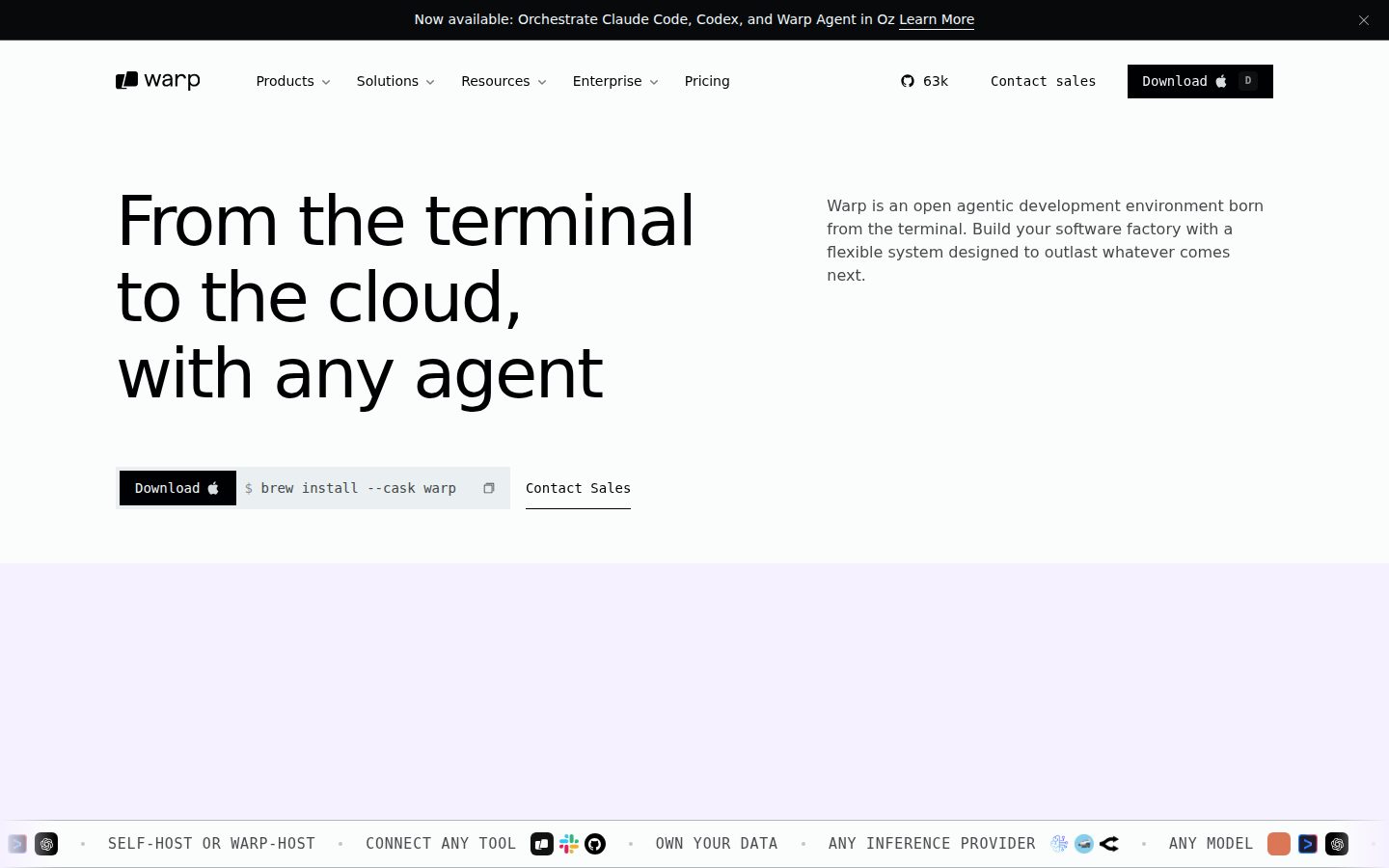
Warp is a terminal application and coding agent platform for developers working with AI in the command line.
AI Panel Score
6 AI reviews
Reviewed
AI Editor ApprovedApproved and published by our AI Editor-in-Chief after full panel analysis.Using Warp starts with the terminal itself: a rebuilt command-line interface that replaces traditional shell text streams with a structured, block-based input/output model. Commands, their outputs, and AI responses are organized into discrete blocks that can be referenced, edited, and reused, rather than scrolling text. From this same interface, developers can invoke Warp Agent to write code, run and interpret commands, investigate bugs, or carry out refactors, with the agent operating alongside manual terminal use rather than as a separate tool.
Beyond the terminal, Warp offers Oz, described as an orchestration-native agent platform for coordinating multiple agents at scale, including cloud agents, triggers, integrations, custom environments, and support for self-hosting. Warp documents specific use cases for its agents, including first-pass code review on pull requests, bug reproduction and fix routing, scoping and validating migrations, and summarizing next steps during incident response. The product also includes Warp Drive for shared team knowledge, Git worktree support, and a code editor built into the same environment as the terminal.

Reproduces reported bugs and routes fixes to the appropriate owners.
Provides first-pass automated review on every pull request.
An orchestration-native coding agent that can execute commands, edit code, and coordinate multi-step development tasks.
Investigates alerts and summarizes next steps during incidents.
A platform for building a 'software factory' by running and coordinating cloud agents across development tasks.
Scopes, executes, and validates code refactors and migrations.
Integrated code editing and Git worktree management for handling code review and version control directly within Warp.
A rewritten, modern terminal interface built for agentic coding workflows.
A gallery of pre-built agent configurations users can deploy for common tasks.
Runs Oz, Claude Code, Codex, and Gemini CLI agents locally or in the cloud with fine-grained control.
A machine-readable OpenAPI specification enabling developers to programmatically interact with and control Oz agents.
Offers secure, compliant agentic development environments tailored for regulated industries like financial services and insurance.
For developers who want a modern terminal with support for agentic coding
For developers who want flexible access to AI that scales with their usage
For developers who need maximum AI capacity with all the flexibility of Build
For teams scaling AI-powered development (up to 25 seats)
For organizations needing advanced control, security, and scale; custom pricing via Contact Sales
A rebuilt terminal with real agent orchestration, priced like a metered API bill.
“Warp bundles a block-based terminal with Oz, a cloud agent platform for review, bugs, and incidents. Credit-based pricing means the bill moves with usage, not seats.”
Block-based terminal, Git worktrees, a built-in editor. Warp isn't just another AI wrapper on bash — the interface itself is different, and that's a real bet, not a feature checkbox.
The pricing is the tell. $18/month buys 1,500 credits, roughly $20 of agent usage at API rates. That's usage-based cost dressed as a subscription. Fine for a five-person pilot, murky for budgeting at 200 seats.
Competes directly with Cursor and GitHub Copilot's CLI push, plus raw Claude Code and Codex, which Warp itself lets you run inside it. That's smart hedging — they're not betting the house on one model vendor. Terminal-based agentic coding is still early. No public funding data here, so runway is a guess, not a fact.
Multi-agent support for Claude Code, Codex, and Gemini CLI keeps it from locking you into one model vendor.
Terminal tools are low-visibility to the board; credit-based billing could raise cost-control questions.
Free plan and $18 Build tier let a team validate value in days, not a procurement cycle.
Moves teams toward agent orchestration (Oz) rather than just automating existing terminal work.
No public funding data in evidence, but active docs, changelog, and blog suggest ongoing investment.
Engineering teams already living in the terminal who want agent orchestration without leaving it.
Skip it if your team needs predictable flat-rate seat pricing for budget approval.
Warp bets the terminal itself becomes the agent orchestration layer, and that bet is defensible.
“A block-based terminal rebuild that turns into a multi-agent control plane via Oz. Credit-metered pricing means cost scales with usage, not seats, which cuts both ways.”
Rebuilding the terminal around structured blocks instead of scroll-text is a real architectural choice, not a skin. It changes how commands, output, and agent responses get referenced and reused, which matters once you're running Claude Code, Codex, and Gemini CLI side by side instead of one vendor's harness.
The credit model ($18/mo for 1,500 credits, 12x at $180 for Max) ties cost directly to agent usage at API rates. That's honest pricing versus flat-seat tools like Cursor, but it also means a heavy refactor month hits the bill directly — plan for variance, not a fixed line item.
Oz is the real long-term bet: self-hosted cloud agents, an OpenAPI spec, bring-your-own-LLM at Enterprise. If that orchestration layer matures, you've adopted a software factory, not a terminal. If it doesn't, you're left with a very good shell.
Positioned above Copilot-style autocomplete and toward orchestration, competing more directly with emerging agent-platform plays than with classic terminals.
Git worktree support and an in-terminal editor match how senior engineers already context-switch between shell and code.
Multi-agent support for Claude Code, Codex, and Gemini CLI avoids single-vendor lock-in that GitHub Copilot's IDE-bound model doesn't.
Credit-metered usage ($20 baseline, 12x at Max tier) creates cost unpredictability that flat-rate competitors avoid.
Block-based I/O model plus Oz orchestration is genuine architecture, not a themed CLI wrapper.
Engineering teams already running multiple AI coding agents who want one control surface instead of juggling separate CLIs.
Avoid if your team needs fixed per-seat cost predictability over usage-based flexibility.
$18/seat buys $20 of credits. Metered pricing means the invoice moves.
“Build tier is $18/month for 1,500 credits, priced as $20 of usage at API rates. That's not a seat license — it's a consumption meter with a subscription wrapper.”
Free plan exists, real terminal, bring-your-own-inference. Build is $18/month, 1,500 credits, roughly $20 of agent usage. Credits run out, you reload. That's the real cost driver, not the sticker.
50 seats × $18 × 12 = $10.8K/year, base case. Add reload credits once teams burn through 1,500/month — category norm is heavy users blow past included usage by 2-3x. Year 3 could land $25-30K, not $10.8K. Max tier at $180/month (12x Build's credits) exists precisely because Build undersizes for power users.
Business tier is $45/seat, capped at 25 seats, adds SAML SSO — no separate SSO tax, unlike some competitors in this category. Enterprise is custom, contact sales, unlimited seats. Compare to GitHub Copilot Business at $19/seat flat — no credit metering, easier budget forecast. Warp's ROI story ties to Oz's PR review and incident response, but credit consumption makes cost per outcome hard to pin down.
Self-serve tiers up to 25 seats; SAML SSO included rather than sold as an enterprise add-on.
Monthly tiers with a free plan and no SSO tax on Business ($45/seat) — low commitment risk.
Every tier from free to Max ($180/month) is published with credit counts; only Enterprise hides behind a sales call.
Value ties to Oz's PR review and incident response, but credit metering makes cost-per-outcome hard to pin down.
50 seats at $18 is $10.8K/year on paper, but 2-3x credit overruns push year-3 toward $25-30K.
Engineering teams that want published pricing and can actively monitor per-seat credit burn.
You need a flat, predictable per-seat invoice like Copilot's before finance signs off.
Block-based terminal that actually rethinks the shell, not just a chat sidebar bolted to bash
“Warp rebuilds the terminal around structured blocks instead of scrolling text, then layers an agent and cloud orchestration platform (Oz) on top. Credit-metered pricing at $18/month is the real day-3 question, not the UI.”
The block model is the actual pitch: commands, output, and agent responses become discrete objects you can reference and reuse instead of grepping through scrollback. That's a genuine daily-workflow change, not a skin. Git worktree support baked in means agent-driven refactors don't collide with your main working tree — something tmux-plus-Copilot setups handle badly.
Day-3 friction shows up in the credit system. Build tier gives 1,500 credits (~$20 of usage) — burn through that mid-sprint on a multi-agent refactor and you're either reloading or throttled. That's a metered-usage anxiety Cursor and Claude Code subscribers don't deal with the same way. Multi-agent support (Oz, Claude Code, Codex, Gemini CLI) is a strong integration story on paper, but running four agent backends through one orchestration layer is more surface area to debug when something silently fails mid-task.
Docs cover Oz's SDK/CLI/API paths, which reads like engineers wrote it, not marketing. Power-user ceiling is high — Agent Kits, self-hosted cloud agents, Analytics API — but onboarding a solo dev into that depth takes real ramp time.
Block-based UI holds up past the demo, but credit metering on Build introduces usage anxiety mid-task.
OpenAPI spec and SDK/CLI docs for Oz suggest engineer-authored docs, not brochure copy.
Multi-agent orchestration (Oz, Claude Code, Codex, Gemini CLI) adds real value but also more failure points to trace.
Agent Kits, self-hosted cloud agents, and Analytics API give real depth beyond the free tier's basic terminal.
Git worktree support and in-terminal code editing mean agent work doesn't fork off into a separate tool.
Teams already running multiple coding agents who want one terminal to coordinate them with worktree-safe refactors.
You want predictable flat-rate agent usage instead of tracking credit burn mid-sprint.
A terminal that actually got rebuilt, not just skinned with a chat box
“Warp rethinks the terminal into blocks instead of scrolling text, then layers agents on top. The pricing is where you'll feel the friction, not the interface.”
Block-based input/output is the real idea here. Commands and outputs become discrete chunks you can reference and reuse instead of squinting at scrollback, which is the kind of change that sounds small until you've lost an hour to copy-pasting terminal history. That's the stuff that actually saves time on day one, not the AI pitch.
The agent side is where it gets busy. Warp Agent, Oz, Agent Kits, multi-agent support for Claude Code, Codex, Gemini CLI — that's a lot of surface area for week one. Compare it to something like Cursor, which mostly hides its complexity behind a chat box. Warp asks you to understand orchestration concepts pretty early.
Credits are the sneaky part. Build is $18/month but only $20 of usage, and Max jumps to $180. Mobile isn't even in the conversation, this lives on your laptop only. No mobile parity to judge means no afterthought either, but three months in, your bill is the thing you'll actually be thinking about.
The block-based rewrite of the terminal itself shows real sweat on a daily-use surface, not just a bolted-on chat panel.
Agent Kits and docs help discoverability, but Oz's orchestration model and credit system add real conceptual overhead by month three.
Platforms listed are mac, windows, linux only — mobile isn't part of the product at all.
Free plan lets you start immediately with bring-your-own-inference, but Oz, Agent Kits, and multi-agent orchestration are homework by hour two.
Structured blocks and Warp Drive suggest deliberate state management, though no public data on agent error handling or autosave specifics.
Developers who live in the terminal daily and want agent orchestration without leaving it.
Avoid if you want a lightweight AI coding assistant without a credit-metered bill to watch.
A rewritten terminal is real. 'Software factory' is the kind of phrase that should worry you.
“Warp's core terminal rebuild is a genuine, demonstrable product. Oz and the 'agentic development environment' pitch are aspirational overlays on top of a crowded field.”
Three tells before pricing. One: title tag lists OpenAI four times — scraped noise, or SEO stuffing, unclear either way. Two: 'software factory' for Oz. That's the kind of superlative that ages poorly — Devin said similar things in 2024. Three: credit-based pricing ($18/mo for 1,500 credits, $180/mo for 18,000) means your real cost floats with model usage, not the sticker price.
The terminal itself is credible. Block-based I/O, Git worktrees, a built-in editor — concrete, shippable, differentiated from raw Claude Code or Codex CLI usage. That's the strong half.
Oz is the risky half. Orchestrating Claude Code, Codex, and Gemini CLI as a neutral layer is smart positioning, but it's also a bet that Anthropic or OpenAI don't just absorb this into their own CLIs. Exit is fine — it's still a terminal, you can walk away. Enterprise self-hosting is a real signal of viability, not just a checkbox.
Block-based UI and worktree integration are distinct from raw terminal + CLI agent setups, though vendor-native CLIs are closing the gap.
It's a terminal wrapping standard shells and named third-party agents (Claude Code, Codex, Gemini CLI), so reverting isn't catastrophic.
Enterprise self-hosting, SAML SSO, and an Oz API suggest real infrastructure investment beyond a demo product.
'Agentic development environment' and 'software factory' oversell Oz relative to what's documented; the terminal claims are grounded.
Multi-agent orchestration mirrors early Devin and Cognition-style pitches — some of those stalled once model vendors built native equivalents.
Teams already using multiple CLI coding agents who want one terminal to coordinate them.
You want predictable flat pricing rather than credit-based billing tied to model usage.
Common questions answered by our AI research team
Warp's Free plan is $0/month and includes a state-of-the-art modern terminal, support for bringing your own AI inference, limited cloud agents access, use of any harness in the cloud (beta), individually configured data controls, and limited Warp Drive and collaboration feature access with limited cloud conversation storage.
The Build plan starts at $20/month and includes 1,500 credits, equal to $20 of included agent usage at API rates. You can reload credits with volume-based discounts, auto-reload, and a team-wide spend cap once you use them up.
Yes. The Free plan lets you bring your own AI inference, while Build and higher tiers give full Warp Agent access to frontier and open-source models from OpenAI, Anthropic, z.ai, and more. Enterprise plans also support bringing your own LLM.
Oz is Warp's cloud agent platform for launching and coordinating agents across tasks like code review, bug investigation, refactors, and incident response. It can be accessed programmatically via SDK or CLI, natively from Warp Terminal, or through seamless local-to-cloud handoff.
Yes. The Enterprise plan includes self-hosted cloud agents on your infrastructure, along with custom codebase indexing, enterprise data governance, and bring-your-own-LLM support.
Company
WarpFounded
2020Pricing
From $18/moFree Trial
AvailableFree Plan
Available


Warp is a New York-based developer of an AI-powered terminal application used for coding with agents locally or in the cloud.