AI documentation and coding for clinicians, built for 200+ specialties
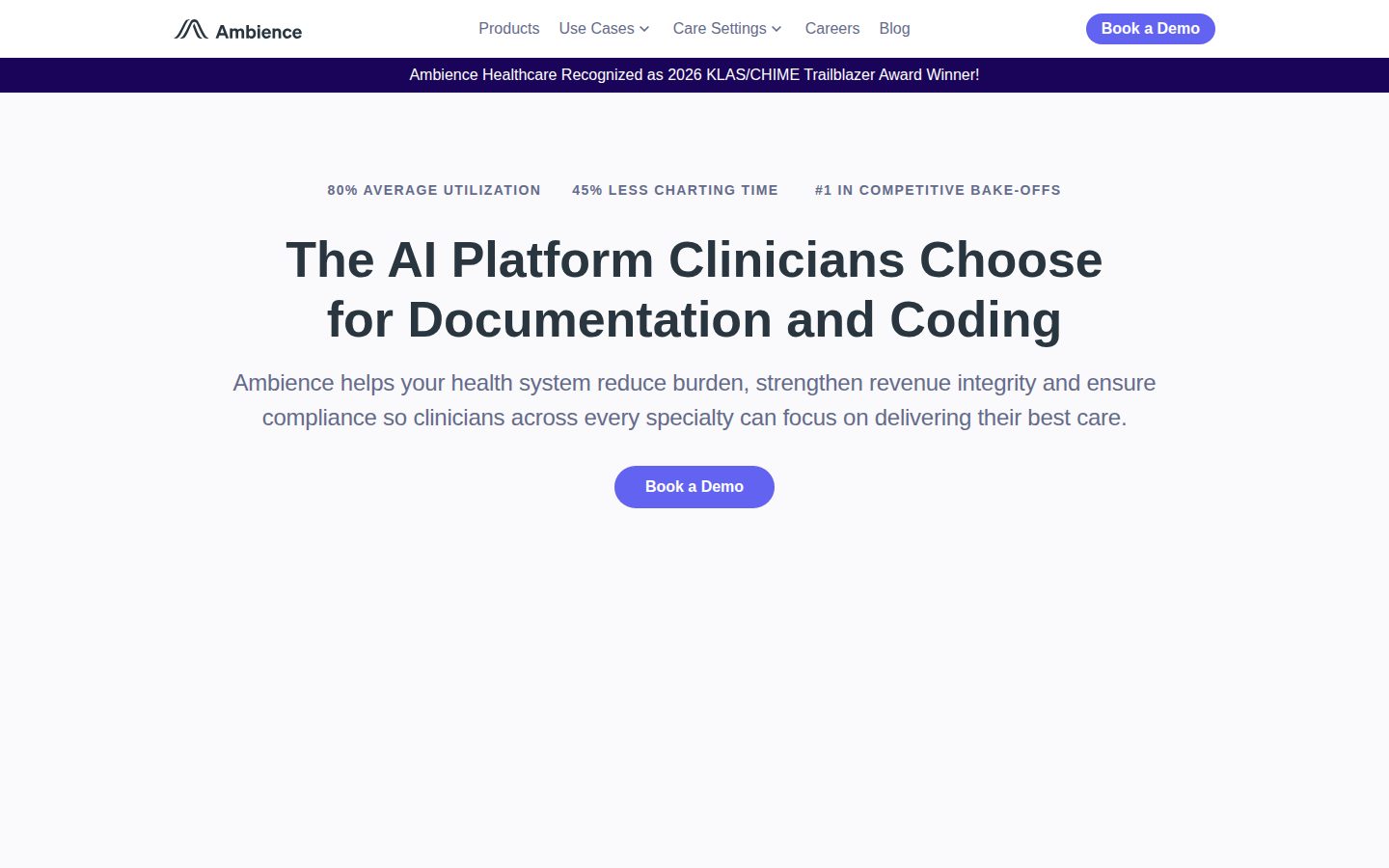
Ambience Healthcare is an AI platform for clinical documentation and medical coding used by health systems.
AI Panel Score
6 AI reviews
Reviewed
AI Editor ApprovedApproved and published by our AI Editor-in-Chief after full panel analysis.Ambience captures the clinical encounter as it happens and organizes the conversation into structured documentation in real time. Clinicians use it during patient visits so notes are drafted as care is delivered, reducing the need to complete charting after hours or catch up on documentation between appointments.
The platform is built to support coding and revenue integrity alongside documentation: it surfaces HCC (Hierarchical Condition Category) opportunities, helps guide E/M level selection, and suggests ICD-10 and CPT codes as notes are generated, rather than as a separate post-visit step. It integrates natively with Epic through the Epic Ambient Module and FHIR APIs, running inside Epic Toolbox, Hyperdrive, and Haiku so clinicians work within their existing EHR rather than switching between tools. The company reports specialty-specific coverage across more than 200 areas of medicine, including oncology, psychiatry, cardiology, and emergency medicine, with published E/M coding accuracy and ICD-10 substantiation figures by specialty.
Ambience is designed for health systems and hospital groups rather than individual clinicians purchasing directly, with deployment typically negotiated at the institutional level. It competes in the ambient clinical documentation category alongside vendors such as Nuance DAX (Microsoft), Abridge, Suki, and Nabla. Pricing is not publicly listed and is arranged through direct sales contact.
Ambience is delivered as a cloud-based service that integrates with Epic EHR environments via the Epic Ambient Module and native FHIR APIs, avoiding manual data transfer between the ambient documentation tool and the patient chart.

Guides evaluation and management (E/M) level selection at the point of care to ensure accurate billing.
Identifies Hierarchical Condition Category (HCC) coding opportunities in real time to support revenue integrity.
Captures patient encounters as they happen and organizes clinical notes in real time without manual transcription.
Delivers measurable E/M coding accuracy and ICD-10 substantiation rates across specialties, verified by third parties like AAPC and KLAS.
Tracks financial outcomes such as revenue per clinician generated through improved documentation and coding completeness.
Suggests ICD-10 and CPT codes automatically at the point of care based on the documented encounter.
Structures every note to support submitted codes, reducing CDI queries and strengthening audit defensibility.
Cuts charting time and after-hours documentation work by organizing notes during the encounter itself.
Adapts documentation language, priorities, and workflows to more than 200 medical specialties, including complex domains like oncology and psychiatry.
Lives directly inside Epic Toolbox, working within Hyperdrive and Haiku without copy/paste or manual uploads.
Uses the Epic Ambient Module and native FHIR APIs to read and write directly into the Epic chart, reducing friction.
Ambience does not publish list pricing; health systems and clinicians must book a demo or contact sales for a customized quote based on system size, specialty mix, and EHR integration needs.
Deep Epic integration and real coding ROI, but you'll never see a price until legal's involved.
“Ambience solves documentation and revenue leakage in one motion, with a named client result to back it up. No pricing page means every deal starts from zero.”
$13K revenue per clinician per year at St. Luke's. That's a real number from a real health system, not a projected range. Most ambient scribes stop at notes — Ambience also does E/M level guidance and HCC surfacing, which is the revenue side hospitals actually care about.
The Epic integration is the real moat here. Living inside Hyperdrive and Haiku through the Epic Ambient Module beats the copy-paste workflows competitors like Nuance DAX and Abridge sometimes still require.
Two concerns. No public pricing, no funding data, no team size — I'm evaluating a black box financially. And 200+ specialty coverage is a big claim; the KLAS and AAPC verification helps, but ask for the underlying accuracy numbers by specialty before you sign.
Direct Epic Ambient Module integration is a differentiator vendors like Suki and Nabla don't universally match.
Epic-native deployment and a named health system result (St. Luke's) make this defensible to a board.
Real-time coding suggestions and no copy/paste workflow suggest fast time-to-payback, per the $13K/clinician figure.
Moves beyond cost-saving into revenue integrity via HCC and E/M coding, not just faster notes.
No public funding or team size data; category is well-funded but crowded with Nuance DAX, Abridge, Suki, Nabla.
Health systems on Epic who want documentation AI tied directly to coding revenue, not just charting speed.
Skip if you're not on Epic or need transparent pricing before starting procurement.
Native Epic integration and third-party-verified coding accuracy make this a defensible enterprise bet, not a demo trick.
“Ambience is built for the CMIO/CFO joint decision, not the individual physician pilot. The revenue integrity framing is the differentiator that matters at renewal time.”
What gets my attention isn't the ambient capture — every vendor in this category, Nuance DAX, Abridge, Suki, does that now. It's the E/M level guidance and HCC surfacing running inline with documentation, verified by AAPC and KLAS rather than self-reported. St. Luke's citing $13K revenue per clinician per year is the number my CFO will ask about in the business case, and it's a real anchor, not vaporware.
The Epic-native path — Toolbox, Hyperdrive, Haiku, FHIR APIs, no copy-paste — is the correct architecture for a hospital group. Anything requiring manual chart transfer is a governance and audit liability I won't sign off on.
Three-year risk: this is a single-EHR-first bet. If we run Cerner or a mixed environment, I need to confirm parity before committing budget to 200+ specialty coverage we can't fully use.
Sits ahead of Suki and Nabla on coding depth, competitive with Abridge and Nuance DAX on enterprise Epic fit.
Coding and revenue integrity embedded at point of care matches how CDI and compliance actually review charts, not a bolt-on afterthought.
Native FHIR APIs and residence inside Toolbox/Hyperdrive/Haiku avoid the copy-paste failure mode that kills clinician trust fast.
Institutional contracting and deep Epic-specific integration create workflow dependency that's costly to unwind after adoption.
Published E/M accuracy and ICD-10 substantiation by specialty, third-party verified, goes beyond most ambient scribes' marketing claims.
Health systems on Epic seeking documentation relief tied directly to coding accuracy and revenue integrity.
Avoid if your system runs primarily on Cerner or another non-Epic EHR without confirmed equivalent integration.
One number published: $13K/clinician/year. Zero pricing numbers. That's the deal.
“Contact-sales-only pricing on an enterprise health system product. ROI story has one hard data point, everything else is TBD.”
No pricing page. No tiers. Just 'contact sales' — standard for this category, but it means procurement starts from zero leverage. Compare to Nuance DAX, Abridge, Suki: same story, same sales-call gate. Nobody in ambient documentation publishes list price.
One real ROI number exists: $13K revenue per clinician per year at St. Luke's. That's usable. Multiply by clinician headcount and you get a real business case — but it's one site, one case study, not a published benchmark across the 200+ specialties claimed.
Epic-native integration (Toolbox, Hyperdrive, Haiku, FHIR APIs) cuts implementation friction versus copy-paste tools. That's a real TCO offset — fewer integration hours billed by IT. But institutional deployment means long procurement cycles, negotiated terms, no visible contract length. Health systems have leverage here. Individual clinicians have none — this isn't their purchase to make.
Built for health-system-level procurement with EHR integration, not self-serve — expect long sales cycles.
Institutional negotiation likely, but no published term length, renewal, or exit terms that I could find.
No list pricing, no tiers, contact-sales only — category norm but still a black box.
$13K/clinician/year at St. Luke's is a concrete figure, though it's one case study, not a benchmark.
Epic-native integration reduces implementation cost, but unknown seat/system pricing makes 3-year math unverifiable.
Health systems on Epic wanting point-of-care coding support with negotiating leverage.
You need transparent pricing before committing procurement time to a sales call.
Lives inside Hyperdrive instead of bolting a scribe app next to the chart. That matters at 4pm.
“Ambience skips the copy/paste tax that kills most ambient documentation tools by writing directly into the Epic chart via FHIR. The coding layer is the real differentiator — most competitors stop at notes.”
The Epic Ambient Module integration is the headline: no separate tablet app, no exporting a note and pasting it into Haiku. That's the daily fight most ambient scribes lose — clinicians end up doing the transcription tool's job for it. Living natively in Toolbox and Hyperdrive means one less window, one less login, one less place for a note to get orphaned.
The coding layer is where this earns its keep beyond documentation. HCC surfacing and E/M level guidance at point-of-care, not batched to a coder three days later, is a real workflow shift — St. Luke's reportedly saw $13K revenue per clinician per year from it. Third-party validation from AAPC and KLAS gives the accuracy claims some teeth versus vendors who self-report.
No public pricing, though API docs exist, no API reference on the site — this is an enterprise sale, not a self-serve tool. Specialty coverage across 200+ areas sounds broad, but depth per specialty (psychiatry vs. cardiology) isn't verifiable from what's published. Compared to Abridge or Nuance DAX, the Epic-native angle is the bet.
Native chart write-back via FHIR removes the copy/paste step that fatigues clinicians in week one of most ambient tools.
Docs exist at docs.ambiencehealthcare.com, but the reference is request-only — evaluation leans on sales, not self-serve reading.
Real-time coding suggestions reduce post-visit CDI queries, but institutional-only sales mean individual clinicians can't just try it.
200+ specialty adaptation with published per-specialty accuracy figures suggests real depth, though oncology-level granularity isn't shown.
Runs inside Toolbox, Hyperdrive, and Haiku rather than a separate app — closer to how Epic-based clinics already work.
Epic-based health systems wanting coding and revenue integrity built into the ambient documentation workflow, not bolted on after.
You're a solo clinician or small practice wanting a self-serve tool without a procurement cycle.
Lives inside Epic where doctors already are, which is half the battle won
“No pricing page, no self-serve trial, no mobile mention — this is a sell-to-the-hospital tool, not a download-and-try one. But the Epic-native integration is the kind of detail that actually matters at 5pm on a Tuesday.”
You can't sign up for this. No free plan, no trial, contact sales only — so my usual day-3 test doesn't really apply here, because day 3 is a hospital IT project, not a click. What I can judge is the design instinct behind it, and living inside Epic Toolbox, Hyperdrive, and Haiku instead of a separate browser tab is the right call. Copy/paste between an ambient tool and the chart is exactly the kind of daily friction that wears clinicians down by 3pm.
The HCC and E/M guidance at point-of-care is smart — coding as a post-visit chore is where documentation tools usually die. St. Luke's reportedly saw $13K revenue per clinician per year, which at least gives a hospital CFO something to model against Nuance DAX or Abridge.
Docs by request, no changelog, nothing public about mobile. For clinicians rounding between floors, that's a real gap, not just a marketing oversight.
Epic-native workflow avoids copy/paste friction, a detail most competitors still make clinicians deal with.
Specialty-adaptive workflows across 200+ specialties suggest depth, but that depth likely takes real onboarding time per department.
Platform listed as web only, with no public mention of a mobile experience for rounding clinicians.
No trial or self-serve path; onboarding is an institutional sales and IT process, not a first-10-minutes experience.
Third-party verified accuracy figures (AAPC, KLAS) suggest real measurement discipline, not just marketing claims.
Health systems on Epic that want ambient documentation tied directly to coding and revenue integrity.
You're an independent clinician or small practice wanting to try a tool without a sales call.
$13K per clinician per year, one hospital, one case study. That's the whole proof set.
“Deep Epic integration and a real coding/revenue angle set this apart from pure transcription tools. But pricing is opaque, evidence is thin, and the category has a Microsoft-backed incumbent already.”
Nuance DAX has Microsoft behind it. Abridge and Suki are well-funded and moving fast. Ambience's pitch — ambient notes plus HCC and E/M coding baked in — is a real differentiation angle, not just a copycat feature set. That's worth something.
But the proof is thin. One named result: $13K revenue per clinician at St. Luke's. No pricing page, docs by request, no changelog. "AI Platform Clinicians Choose" is the kind of superlative every vendor in this space uses before the data backs it up.
Exit story is the real question. Native FHIR write-back into Epic sounds clean until the vendor leaves — then you're untangling coding workflows baked into clinical habit, not just swapping a transcription tool. Health systems don't switch EHR-adjacent tools casually. That's lock-in dressed as convenience. Fine if Ambience delivers for years. Risky if it doesn't.
HCC and E/M coding at point-of-care, not just transcription, is a genuine gap versus Nuance DAX and Suki.
Deep FHIR write-back into Epic charts and coding workflow dependence makes migration harder than a standalone scribe tool.
No public funding figures or headcount that I could find; 200+ specialty claim and Epic partnership suggest real traction but unverified breadth.
Specific accuracy claims exist but only one case study (St. Luke's) is named publicly.
Follows the ambient-documentation-plus-coding pattern also run by DAX and Abridge, unproven at Ambience's scale independently.
Health systems on Epic wanting coding-integrated ambient documentation at institutional scale.
Avoid if you want transparent pricing or a lightweight tool you can swap out easily.
Common questions answered by our AI research team
Yes. Ambience integrates directly inside Epic Toolbox, using the Epic Ambient Module and native FHIR APIs to read and write into the Epic chart without copy/paste or manual uploads.
Yes. Ambience works seamlessly inside both Hyperdrive and Haiku, letting clinicians document without toggling between systems.
Yes. Ambience suggests ICD-10 and CPT codes in real time at the point of care, helping ensure coding is complete and appropriate.
Yes. Ambience provides E/M level guidance in real time, helping clinicians select the appropriate level of service as they document.
Ambience adapts its language and workflows to more than 200 medical specialties, including complex and under-served domains like oncology, psychiatry, and emergency medicine.


Ambience Healthcare develops an AI operating system for clinicians based in San Francisco, automating clinical documentation and coding through ambient AI integrated with EHRs.