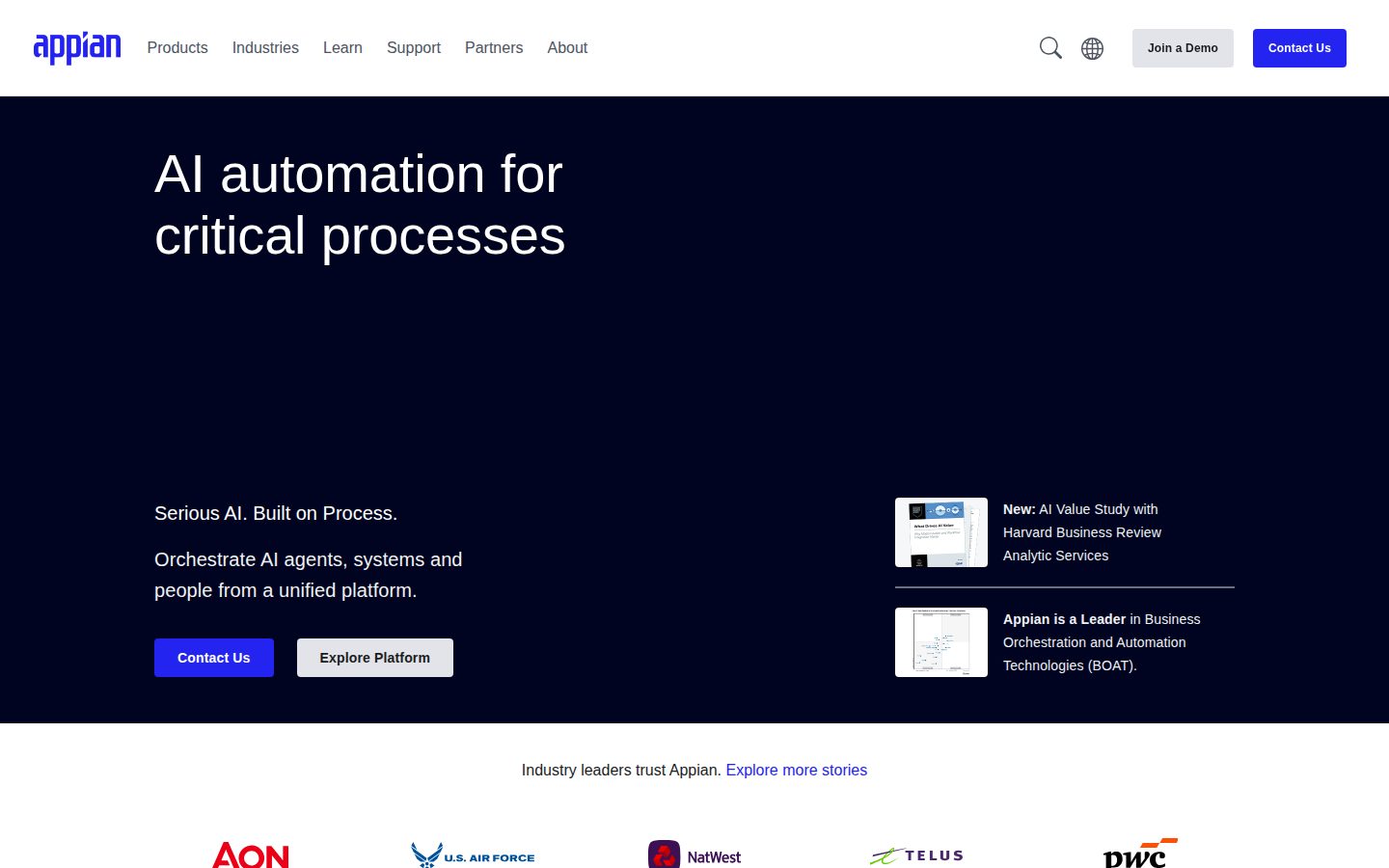
AI automation for critical business processes
Appian is a process orchestration platform for automating and connecting enterprise workflows with embedded AI.
AI Panel Score
6 AI reviews
Reviewed
AI Editor ApprovedApproved and published by our AI Editor-in-Chief after full panel analysis.Appian is used to design, automate, and manage business processes that span multiple systems and departments. Users build applications and workflows through a low-code interface, connecting to existing enterprise systems such as ERP, CRM, and legacy applications via reusable API connections rather than replacing them outright. Common use cases highlighted by the company include case management, procure-to-pay, contract lifecycle management, onboarding, and order management, with processes orchestrated end-to-end across intake, routing, approval, and resolution stages.
The platform embeds AI agents directly into process workflows, allowing them to extract data from documents, generate code from natural language prompts, and take autonomous actions within a governed process structure rather than operating independently of it. Appian markets this as giving AI "reliability and control" by grounding agent activity in defined business processes. Other highlighted capabilities include legacy application modernization tools for consolidating older systems, integrated document workflows, unified read-write access to enterprise data treated as local data, and a defense-in-depth security model with 24/7 monitoring and encryption. The company states the platform maintains compliance certifications including HIPAA and FedRAMP and advertises 99.95% uptime.
Appian is aimed at enterprise organizations, particularly in regulated industries such as insurance, financial services, and the public sector, as well as IT, finance, HR, procurement, and supply chain teams within larger companies. It competes in the business process automation and orchestration category alongside vendors such as Pega, ServiceNow, Microsoft Power Platform, and Salesforce. Appian's pricing is not published on its site and is quote-based, provided through direct sales contact.
Appian is delivered as a web-based platform with cloud deployment and also supports integration through a public API. The company positions the product within what analysts term Business Orchestration and Automation Technologies (BOAT), a category referenced in third-party analyst reports such as Gartner's Magic Quadrant.

Build, deploy, and reuse AI agents that extract data, act autonomously, and generate code from natural language prompts within defined process controls.
Automate complex document-heavy workflows with high-accuracy data extraction and processing.
Unify audit workflows, automate attestations, and maintain built-in audit trails that log every action for compliance visibility.
Accelerate employee, customer, and vendor onboarding by unifying data and removing manual steps to cut onboarding time significantly.
Orchestrate AI agents, systems, and people across departments from a unified platform to automate critical business processes.
Unify data and automate procurement and payment workflows to eliminate silos and manual errors and ensure compliance.
Unify intake, routing, and resolution of cases with AI-driven orchestration to eliminate siloed systems and speed up case closure.
Deliver 99.95% uptime through a resilient, high-availability architecture built to power critical business processes at scale.
Build and modernize enterprise applications without writing code, consolidating and reimagining legacy applications with AI.
Build modular, reusable API connections to integrate disparate systems such as ERP, manufacturing, logistics, and supplier platforms.
Treat any connected data source like local data with secure read-write access, eliminating the need to migrate or replace existing systems.
Protect enterprise data with a defense-in-depth approach including 24/7 monitoring, advanced encryption, and certifications like HIPAA and FedRAMP.
For individual developers and small teams who want to build and test applications with the Appian low-code platform at no cost, with usage limits.
For businesses and enterprises needing full-scale process automation, AI, and case management capabilities; pricing is custom-quoted based on usage, users, and modules and requires contacting Appian sales.
Appian's public, 25-year-old and proven in regulated industries. Pricing opacity is the risk you're actually taking.
“Appian's been running critical processes at insurers and government agencies for two decades. The AI layer is new, the orchestration engine underneath it isn't.”
Publicly traded. FedRAMP and HIPAA certified. 99.95% uptime guarantee, backed by an 8-week implementation promise. That's not a startup pitch, that's a vendor that's been doing this since before "AI agent" was a phrase.
The embedded AI agents — data extraction, code generation from prompts, autonomous action inside defined controls — are the new hook. But the core value is the same as it's always been: connect ERP, CRM, and legacy systems without ripping them out. Competes directly with Pega, ServiceNow, and Microsoft Power Platform, and Appian's pitch to regulated industries is control, not speed.
No published pricing, quote-only. That's normal for this tier but means you're negotiating blind. Fine for finance, insurance, or public sector. Overkill if you just need a workflow tool.
Named alongside Pega and ServiceNow in Gartner's BOAT category, a credible peer set.
Established name in insurance and government IT; low sketchiness, high board comfort.
8-week implementation guarantee is fast for enterprise, but quote-based pricing slows procurement.
Advances AI-driven orchestration for regulated enterprises, not just a cost play on existing automation.
Publicly traded, decades in market, FedRAMP-certified — low risk of disappearing.
Regulated enterprises running multi-system case management, procurement, or onboarding who need audit trails, not just automation.
Skip it if you're a mid-market team wanting fast, cheap workflow automation without a sales cycle.
Appian buys process discipline at enterprise scale, but you're signing a multi-year operating commitment, not a subscription.
“Case management, procure-to-pay, and onboarding orchestration with AI agents governed inside process controls — built for regulated industries, priced for a real procurement cycle.”
No published pricing, quote-based sales, no free trial. That's an operational tell: this is a 6-to-12-month procurement cycle with legal, security, and IT all in the room, not a departmental pilot you expense. The 8-week implementation guarantee is the right lever to push back on the sales team, but I'd want that written into the SOW with penalties, not left as a marketing claim.
The governed-AI-agent model — extraction and code generation constrained inside defined process controls — is the correct answer for anyone running audited workflows in insurance or public sector. HIPAA and FedRAMP certs plus 99.95% uptime are table stakes at this tier, but they're the reason Appian sits alongside Pega and ServiceNow rather than the low-code long tail.
Three years in, you're deep in Appian's data model and API connectors across ERP and legacy systems. That's fine if you needed orchestration, not replacement — but exiting later means unwinding case management logic threaded through finance, HR, and procurement simultaneously.
Positioned squarely in Gartner's BOAT category against Pega, ServiceNow, and Microsoft Power Platform, with compliance as the differentiator.
Case management, procure-to-pay, and onboarding use cases map directly onto how COOs actually scope cross-department automation.
Unified read-write access treating connected systems as local data is the right integration posture for multi-department orchestration.
Deep ERP/CRM integration via reusable connectors reduces rip-and-replace risk but increases operational dependency once processes are built.
Embedded AI agents operating within governed process controls, not standalone bots, is a mature architecture choice for regulated ops.
Enterprises in regulated industries running multi-department case management, procurement, or onboarding workflows that need governed AI, not experimental automation.
Avoid if your team needs departmental self-service automation without a formal procurement and compliance cycle.
Zero published pricing. Zero trial. Sales call required just to see a number.
“Appian hides every dollar behind a quote. Category norm for enterprise BOAT platforms, but it kills comparison shopping.”
No pricing page. No tiers. No free trial. Quote-based only, which means procurement starts with a sales call, not a cart. Compare to Microsoft Power Platform, which at least publishes per-app and per-user rates. Appian gives you the '8-week guarantee' instead of a number.
TCO is the real question here. Enterprise process orchestration means implementation cost, integration cost, and training cost stacked on top of the license — none disclosed. 99.95% uptime and HIPAA, FedRAMP certs matter for insurance and public sector buyers, but compliance doesn't offset an opaque contract.
No auto-renewal terms published. No termination language. No invoicing model stated. That's four of five billing questions unanswered before you've had a single call. Case management and procure-to-pay automation look solid on paper. The invoice is where you find out what solid costs.
Sales-led onboarding only, no self-serve path, no stated payment terms.
No renewal or cancellation terms published; category norm is multi-year lock-in for BOAT platforms.
No pricing plans, no starting price, quote-only — worse than Pega's partial published tiers.
8-week delivery guarantee gives a measurable milestone, but no cost-per-outcome data is published.
Low-code claims reduce dev cost but enterprise integration and legacy modernization work aren't priced anywhere.
Regulated enterprises with procurement teams built for long sales cycles and custom quotes.
Avoid if you need comparable pricing across vendors before the first call.
Solid orchestration backbone for regulated ops, but quote-only pricing means procurement pain before you even touch a workflow.
“Appian's case management and procure-to-pay modules read like they were built by people who've sat through an audit. The governance layer is real, but you'll feel the enterprise weight from week one.”
Case management and procure-to-pay automation are the modules I'd actually run day-to-day, and the audit trail logging every action is the kind of thing that saves you during a SOX walkthrough at 4pm on a Friday. The 8-week implementation guarantee is a nice change from the usual 6-month ServiceNow rollout, assuming your legacy ERP connectors cooperate.
Day-3 reality: low-code builders promise no-code speed but you still need someone who understands the API connector model to wire ERP and logistics systems together. That's normal for this category, not unique to Appian, but it means your first week is spent in integration configuration, not process design.
No published pricing, no free trial, quote-based only — that's a real friction point for an ops team trying to scope a pilot without a sales call. Compared to Power Platform's self-serve tiers, Appian asks for more trust upfront. HIPAA and FedRAMP certs matter if you're in insurance or public sector; less so if you're a mid-market team just automating onboarding.
Case management and audit trails feel operational, not demo-ware, but connector setup front-loads real integration work.
Docs and API access exist, but public marketing language on the site outweighs visible practitioner-level detail.
Quote-only pricing and no free trial add procurement friction before any workflow gets built.
Embedded AI agents generating code from prompts within process controls show real depth beyond basic workflow triggers.
Reusable API connections to ERP and legacy systems avoid rip-and-replace, matching how ops teams actually inherit systems.
Regulated enterprises like insurance or public sector needing governed AI agents inside existing case management processes.
You're a smaller ops team wanting to self-serve a pilot without a sales cycle.
Powerful plumbing for big companies, but you'll never touch it in your first ten minutes
“Appian is built for IT teams to configure, not for regular employees to poke around in. That's fine for its audience, but it means the usual day-one gut check doesn't really apply here.”
There's no free trial, no free plan, and no pricing page — just 'contact us.' That alone tells you who this is for. Not a solo user opening a tab to see what happens. This is a procurement conversation, then months of implementation, then eventually someone's daily tool. The 'Appian Guarantee' of an 8-week delivery is a nice number to see in writing, but it's also an admission that these builds usually take a while.
Once it's live, the actual daily users — HR, procurement, finance folks running case management or procure-to-pay — interact with whatever app got built on top, not the low-code platform itself. So 'onboarding' really means onboarding into someone else's configuration. Reliability-wise, 99.95% uptime and FedRAMP/HIPAA certs are the right things to advertise to a CIO, and they matter more here than a slick empty state.
Mobile isn't mentioned as a strength anywhere in the materials, which against ServiceNow and Microsoft Power Platform is a gap worth asking about before signing anything.
Evidence emphasizes governance and uptime, not micro-interactions end users would notice.
Low-code framing eases builder ramp-up, but embedded AI agents and process governance add real depth to master.
Platform listed as web-only with no mobile mention, unusual for a process tool meant to touch daily approvals.
No trial or self-serve path; onboarding is really an 8-week guaranteed implementation, per their own FAQ.
99.95% uptime commitment plus HIPAA and FedRAMP certifications signal enterprise-grade solidity.
Regulated enterprises like insurance or public sector needing governed AI agents wired into existing ERP and CRM systems.
You want to test-drive a tool yourself before involving procurement and a sales team.
20-year-old low-code vendor bolts AI agents onto a proven BPM engine. Not a startup story.
“Appian's been doing case management and process orchestration since before 'AI agent' was a category. The AI layer is new; the plumbing underneath isn't.”
No pricing page. Quote-based, sales-gated. Category norm for enterprise BPM — Pega and ServiceNow do the same — but it means no self-serve comparison, no trial.
Track record here is real, not aspirational. Appian's been public since 2017, sells into FedRAMP and HIPAA-regulated shops, claims 99.95% uptime. That's not a growth-stage pitch. It's an incumbent adding embedded AI agents — code generation, autonomous action 'within defined process controls' — to an existing low-code platform. The hedge language ('governed,' 'reliability and control') reads like a direct jab at looser agent frameworks. Fair, if it holds up in audits.
Exit portability is the real question. Low-code platforms lock you in through the apps you build on them, not the data. Eighteen months in, migrating off means rebuilding workflows, not just exporting records. Same story with Pega. Differentiation vs Microsoft Power Platform is real for regulated industries, thinner for everyone else.
Governed-agent framing differentiates vs looser AI tools but overlaps heavily with Pega and Power Platform in core BPM.
Low-code apps and orchestration logic are platform-specific; migrating off in 18 months means rebuilding, not exporting.
Public company, named compliance certifications, 8-week delivery guarantee — signals of a durable enterprise vendor, not a startup bet.
Claims (99.95% uptime, HIPAA, FedRAMP) are specific and checkable, not vague superlatives.
Matches the pattern of established BPM vendors (Pega, ServiceNow) extending into AI, not a hype-cycle newcomer.
Regulated enterprises (insurance, financial services, public sector) needing governed AI agents inside existing case management workflows.
You want transparent self-serve pricing or a lightweight tool you can swap out in a quarter.
Common questions answered by our AI research team
Appian maintains certifications to meet strict global regulations including HIPAA and FedRAMP.
Yes. The Appian Guarantee promises your project delivered in 8 weeks, guaranteed.
Yes, Appian's embedded AI agents can generate code from natural language prompts, extract data, and act autonomously within defined process controls.
Yes, Appian orchestrates workflows across the supply chain by connecting ERP, manufacturing, logistics, and supplier systems.
Appian guarantees 99.95% uptime, backed by a resilient, high-availability architecture built to power critical processes.
Appian is a McLean, Virginia-based enterprise software company that provides a low-code platform for process automation and AI agent orchestration.