Camunda logo

Camunda Review

Visit

Orchestration platform for AI agents, people, and systems

Camunda is an orchestration platform for coordinating AI agents, people, and systems across business processes.

AI Panel Score

7.3/10

6 AI reviews

Reviewed

About Camunda

Camunda lets teams model and run business processes that combine automated steps, AI agent decisions, and human tasks in one workflow. Within a process, some steps run as straight-through automation while others are handed to AI agents to apply judgment, with organizations able to adjust how much autonomy an agent has at each step over time rather than switching everything over at once. Policies, approval steps, and escalation paths are defined as part of the process definition itself, so control points are embedded in the workflow rather than added afterward.

The platform records every process execution, agent decision, and exception, providing a traceable history intended to support audit and regulatory review. It includes runtime visibility into running processes as well as ongoing performance and cost monitoring, positioned as tools for governance rather than only for technical operations. Camunda describes its approach as an "Open Orchestration Architecture," orchestrating agents from outside the agent itself while also injecting enforceable steps into the process from within.

Camunda is aimed at enterprises running mission-critical business processes that involve a mix of automated systems, AI agents, and human workers, including regulated industries such as banking. The company states more than 750 enterprises use its orchestration architecture, including several of the largest global banks. Pricing is not listed publicly on the homepage and is handled through direct contact with the company; the product competes in the business process automation and orchestration category alongside tools such as Pegasystems, Appian, and UiPath.

Camunda provides public documentation and an API for building and integrating orchestration workflows, positioning itself as an open platform that can be integrated into existing enterprise technology stacks rather than a closed, all-in-one suite.

Features

AI

  • Agentic Orchestration

    Orchestrates AI agents, people, and systems together across end-to-end business processes.

  • Outside-In Agent Control

    Orchestrates agents from the outside while injecting enforceable steps from the inside, embedding policies, approvals, and escalation paths directly into the process.

Analytics

  • Performance and Cost Insights

    Delivers continuous insights into process performance and operational costs.

  • Real-Time Runtime Visibility

    Provides real-time visibility into process and agent execution as it happens.

Automation

  • Adjustable Autonomy per Step

    Allows teams to dial autonomy up or down for individual process steps as trust in agents grows, avoiding big-bang rollouts.

  • Blended Automation and Agent Reasoning

    Combines straight-through processing for predictable steps with agent reasoning for exceptions within a single process.

Core

  • ProcessOS

    An agentic operating system for enterprise processes that runs and coordinates process execution.

Integration

  • Open Orchestration Architecture

    An open platform architecture that lets enterprises connect and orchestrate AI agents, people, and systems together in production.

Security

  • Full Audit Trail

    Captures every process execution, agent decision, and exception automatically to provide a complete trace for compliance and regulatory questions.

  • Governance and Compliance Controls

    Embeds governance mechanisms into orchestration to make compliance achievable rather than aspirational.

Preview

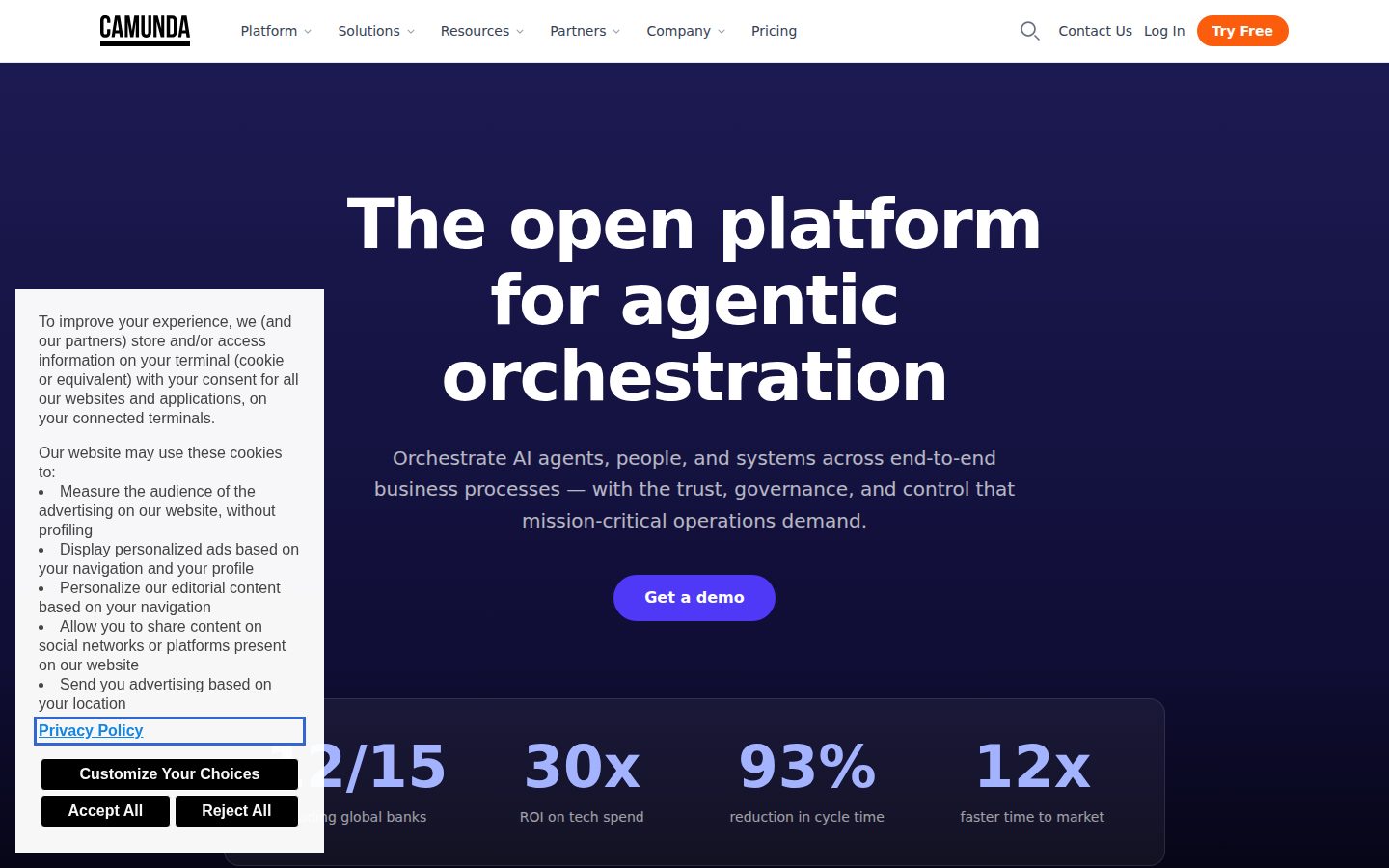
Camunda desktop previewCamunda mobile preview

Pricing Plans

Development (Self-Managed, Free)

Free

Free tier for building and testing on your own machine; no license required

  • Run locally on your own machine
  • Process engine, Operate, Tasklist, Identity, and Optimize
  • Desktop Modeler
  • Web Modeler and Console
  • Non-production use only
  • Community support

Production (Self-Managed, Enterprise)

Contact sales

For running Camunda in production on your own infrastructure; requires an Enterprise license, priced via sales

  • Everything in Development, licensed for production
  • Web Modeler and Console
  • Commercial or non-commercial licensing available
  • 24×7 support with SLAs
  • Customer Success and training
  • Cluster backups and custom data retention policies
Popular

Camunda SaaS (Enterprise)

Contact sales

Fully hosted Camunda platform with no infrastructure to manage; start with a 30-day free trial, then talk to sales for Enterprise pricing

  • Fully hosted by Camunda — no infrastructure to manage
  • Full agentic process orchestration platform
  • 24×7 support with SLAs
  • Customer Success and training
  • 30-day free trial with unlimited free modeling afterward

AI Panel Reviews

The Decision Maker

The Decision Maker

Strategic bet, vendor viability, timing, adoption approval
7.8/10

Camunda is a mature orchestration engine relabeled for the agent era, not a risky startup bet.

750+ enterprises including major banks already run this. The AI agent layer is new paint on old, proven infrastructure.

Camunda's been orchestrating processes for years before agents were the pitch. 750+ enterprises, several of the largest global banks, self-managed and SaaS tiers with real SLAs. That's not a startup gamble, that's infrastructure with a new coat of paint.

Two things stand out. One: ProcessOS and Adjustable Autonomy per Step let you dial agent control up gradually instead of a big-bang rollout, which is how risk-averse enterprises actually move. Two: the Full Audit Trail feature captures every agent decision automatically, which matters a lot more to a bank's compliance team than to a scrappy startup.

Pricing isn't public. That's normal for this tier but it means procurement, not a card swipe. Against Pegasystems, Appian, and UiPects, Camunda's open architecture is the differentiator — you're not locked into a closed suite.

Competitive Positioning7.8

Competes directly with Pegasystems, Appian, UiPath; open architecture is a real point of differentiation.

Reputation Risk8.5

Named use by major global banks makes this a defensible, unsurprising board choice.

Speed to Value6.8

No public pricing or free trial for Enterprise tiers means a sales cycle before any payback starts.

Strategic Fit7.5

Adjustable autonomy per step lets orchestration advance gradually rather than forcing a wholesale re-platform.

Vendor Viability8.5

750+ enterprise customers and multi-year market presence predating the AI pivot signals durability.

Pros

  • Full audit trail built for regulated industries like banking
  • Free self-managed dev tier and 30-day unbilled SaaS trial
  • Adjustable autonomy avoids risky big-bang agent rollouts

Cons

  • No public Enterprise pricing means a slow procurement cycle
  • No listed platform specifics or funding data to verify long-term scale

Right for

Enterprises running regulated, mission-critical processes that need agents and humans in one governed workflow.

Avoid if

You need fast self-serve pricing without a sales conversation.

The Domain Strategist

The Domain Strategist

Craft and strategy in the product's domain — adapts identity per category, same lens
8.1/10

Camunda is the operating system for mixed human-agent processes, not another point tool bolted onto the org chart.

Adjustable autonomy per step means I don't have to bet the whole operation on agents day one. The audit trail and SSO/LDAP controls are what get this past our risk committee, not the AI story.

750+ enterprises, several of the largest global banks — that's the reference base that matters when I'm defending this to the board, not the demo. What sells me operationally is adjustable autonomy per step: I can dial agent trust up gradually per process, no big-bang cutover that puts customer-facing operations at risk.

Governance is embedded in the process definition itself — approvals, escalation, full audit trail — which is the difference between compliance being achievable versus aspirational. SAP and ServiceNow integration are production features, not roadmap promises, so this slots into our existing stack rather than forcing a rip-and-replace.

Three-year view: pricing is sales-gated with no public number, which means procurement cycles and vendor lock-in risk versus Appian or UiPath, both of which compete here directly. If we adopt this, in three years we have a durable orchestration layer underneath every AI initiative — the tradeoff is we're committing to Camunda's process model as the backbone before we know the full cost.

Category Positioning8.0

Positioned against Pegasystems, Appian, and UiPath as the open, agent-aware alternative to closed suites.

Domain Fit8.3

Blended straight-through processing and agent reasoning matches how ops teams actually run exceptions, not a greenfield rebuild.

Integration Surface8.4

Production-tier SAP, ServiceNow, RPA, and SSO/LDAP integration means this drops into existing enterprise infrastructure, not around it.

Long-term Implications7.8

Adjustable autonomy avoids forced cutover risk, but sales-only pricing creates budgeting uncertainty over multi-year contracts.

Strategic Depth8.5

ProcessOS plus Outside-In Agent Control shows architectural thinking beyond a workflow builder with an AI label slapped on.

Pros

  • Adjustable autonomy per step avoids big-bang agent rollout risk
  • Governance and full audit trail built into the process definition, not bolted on after
  • Production-grade SAP/ServiceNow/SSO integration already in the Enterprise tier

Cons

  • No public pricing forces a sales cycle before you can budget
  • Self-Managed free tier is dev-only, so production cost is a black box until you talk to sales

Right for

Enterprises running regulated, mission-critical processes that need auditable human-plus-agent workflows.

Avoid if

Avoid if you need transparent self-serve pricing before committing procurement time.

The Finance Lead

The Finance Lead

Money, total cost of ownership, contracts, procurement math
5.8/10

Two 'Free' tiers, zero list prices. Enterprise means sales call, every time.

Free dev tier is real. Production and SaaS both say 'Free' but require an Enterprise license priced via sales — that's not free, that's undisclosed.

Development tier is $0, self-managed, non-production only. Fine for a pilot. Production and SaaS both list as 'Free' but require Enterprise licensing through sales. That's not a price. That's a placeholder.

No public number means no TCO model. Compare to Appian or UiPath — also sales-gated, so category norm, not a Camunda-specific sin. But 750+ enterprises, several large banks, suggests six or seven-figure deals. Add SSO, LDAP, SAP and ServiceNow integrations — all Enterprise-tier features, all part of the same undisclosed number.

30-day SaaS trial, never billed, converts to free modeling-only if you walk away. Decent no-hostage exit at the trial stage. But once you're in Enterprise territory, term length and auto-renewal aren't published anywhere I can see. Procurement will need a signed quote before anyone can build a budget line.

Billing & Procurement5.5

Sales-led onboarding for two of three tiers adds procurement friction typical of Appian/UiPath-class deals.

Contract Flexibility5.0

30-day trial has a clean no-bill exit, but Enterprise term length and renewal terms aren't disclosed.

Pricing Transparency3.5

Only the $0 dev tier is priced; Production and SaaS Enterprise tiers hide behind sales calls despite being labeled 'Free.'

ROI Clarity6.5

Full audit trail and performance/cost insights give measurable levers, but no benchmark numbers are published.

Total Cost of Ownership4.5

No list price for Enterprise means no year-1 or year-3 math is possible without a quote.

Pros

  • Free self-managed dev tier with no license required
  • 30-day SaaS trial never bills, converts to free modeling after
  • SSO, LDAP, SAP and ServiceNow integrations included at Enterprise tier

Cons

  • No published price for either production tier
  • 'Free' label on Enterprise tiers that actually require a sales-negotiated license
  • No visible contract term or auto-renewal language

Right for

Enterprises with procurement teams built for six-figure sales-led negotiations, especially regulated industries like banking.

Avoid if

You need a comparable list price before you can get budget approval.

The Domain Practitioner

The Domain Practitioner

Daily hands-on reality in the product's domain — adapts identity per category, same lens
7.8/10

BPMN-grade governance meets agent orchestration, but exception handling still needs a change ticket

Camunda extends its BPMN process engine to cover AI agents alongside humans and systems, with adjustable autonomy per step instead of a big-bang cutover. Enterprise-grade audit trail is real, but pricing opacity and self-managed complexity are the usual tradeoffs.

Adjustable Autonomy per Step is the feature that matters for ops week-to-week. You don't flip a process from manual to fully agentic overnight, you dial trust up per step and watch the exception queue shrink over sprints. That matches how I'd actually roll out automation to a skeptical compliance team, not the vendor demo version.

Full Audit Trail and Real-Time Runtime Visibility cover the governance checklist banks ask for, and 750+ enterprise customers including major banks is a credible proof point against Pegasystems and Appian in regulated-industry RFPs. SAP and ServiceNow integration ship in Enterprise tiers, not bolted on later.

Day-3 reality: the free Development tier is genuinely local and license-free, good for modeling BPMN before committing. But production pricing sits entirely behind a sales call, no published tiers, no trial for Self-Managed. For an ops team trying to scope a rollout budget in Q1, that's a real friction point, not a minor one.

Day-3 Reality8.0

Adjustable Autonomy per Step matches how automation actually rolls out to a skeptical compliance team — dial trust up, watch the exception queue shrink.

Documentation Practitioner-Fit7.5

Free local Development tier means practitioners learn on the real engine, not marketing PDFs.

Friction Surface6.5

Production pricing entirely behind a sales call makes scoping a rollout budget a real friction point, not a minor one.

Power-User Depth8.0

Full audit trail and real-time runtime visibility cover the governance checklist banks ask for.

Workflow Integration8.0

BPMN engine covering agents, humans, and systems in one model, with SAP and ServiceNow shipping in Enterprise tiers.

Pros

  • Adjustable Autonomy per Step enables gradual rollout instead of big-bang cutover
  • Full Audit Trail and Runtime Visibility satisfy regulated-industry governance checklists
  • 750+ enterprise customers including major banks — credible against Pegasystems and Appian

Cons

  • Production pricing entirely behind a sales call, no published tiers
  • No trial for Self-Managed deployment
  • Self-managed complexity is the usual tradeoff for the governance depth

Right for

Ops teams in regulated industries rolling out agent automation gradually under a real audit trail.

Avoid if

Avoid if you need to scope production licensing costs without entering a sales cycle.

The Power User

The Power User

Daily human experience, onboarding, polish, learning curve, reliability
6.9/10

Deep enough for banks, but you'll need an IT team to actually feel it.

Camunda's the kind of tool where the first ten minutes are homework, not a demo. Real power shows up around month three, if your org has the patience.

This isn't a tool you open and poke around in for fun. There's a free Development tier for building locally, no license needed, which is nice, but it's clearly built for developers modeling BPMN processes, not a regular person looking for a quick win on day one. The docs and API are there, which matters, but nothing about the site suggests a five-minute aha moment.

Where it gets interesting is the ProcessOS idea, and letting teams dial agent autonomy up or down per step instead of flipping a big switch. That's a smart, honest way to roll out AI into real workflows, especially when you're dealing with banks that need an audit trail for every decision.

But pricing is hidden behind sales calls, there's no free trial for the SaaS tier's real production use beyond 30 days, and mobile isn't mentioned anywhere. Compared to Appian or UiPath, this feels like infrastructure, not software you live in daily.

Daily Polish6.0

Feature set is serious but nothing in the evidence points to sweated micro-details like empty states or transitions.

Learning Curve6.5

Adjustable autonomy per step suggests a deliberate ramp, but documentation-heavy setup implies real onboarding effort.

Mobile Parity4.0

No mobile platform mentioned anywhere in the evidence, which for an enterprise orchestration tool may be fine but is unconfirmed.

Onboarding Experience5.5

Free Development tier exists but requires local setup and BPMN modeling knowledge, not a guided first-run.

Reliability Feel7.5

Full audit trail and real-time runtime visibility are built-in, which matters for trust in mission-critical processes.

Pros

  • Adjustable autonomy per step avoids risky all-at-once agent rollouts
  • Full audit trail built for regulated industries like banking
  • Free self-managed development tier with no license needed

Cons

  • No public pricing, everything routes through sales
  • First-hour experience leans on BPMN modeling skill, not casual use
  • Mobile experience unaddressed in any evidence

Right for

Enterprises in regulated industries like banking that need governance baked into AI-plus-human workflows.

Avoid if

You want a quick-start tool without a developer team and a sales call.

The Skeptic

The Skeptic

Contrarian. Watch-outs, deal-breakers, broken promises, category patterns
7.4/10

Old BPM vendor relabels itself agentic. The 750-customer number is the tell that matters.

Camunda's been doing process orchestration since before 'agentic' was a word — that history is either its biggest asset or its biggest baggage. Depends on whether the agent layer is real or a rebrand.

Three tells. One: 'ProcessOS' — new noun for an old BPM engine. Two: 'Open Orchestration Architecture' is the kind of coined-term branding that shows up right before a pivot. Three: no pricing on the page, sales-gated, standard enterprise move but it hides how much the agent features actually cost versus the workflow engine you already know.

What's real: 750+ enterprises, named banks, SSO/LDAP, SAP and ServiceNow integrations. That's not vaporware. That's a company with actual production deployments predating the AI pivot — Camunda's been a BPMN engine for a decade, competing with Pegasystems, Appian, UiPects.

Exit portability is genuinely good here — it's a workflow engine underneath, self-managed option exists, no lock-in to a black-box model. The risk isn't the company dying. It's the agent layer being marketing paint on a mature product that already does 90% of this without AI in the name.

Competitive Differentiation6.5

Blending human tasks, agents, and automation in one process is a real angle vs. Appian and UiPath, but all three are racing to say the same thing now.

Exit Portability7.8

Self-Managed free dev tier plus production self-hosting means you're not locked to their cloud if direction shifts.

Long-term Viability7.9

Docs, API, SLA-backed enterprise tiers, and named bank customers suggest a company built for multi-year contracts, not a demo.

Marketing Honesty6.8

Coined terms like 'ProcessOS' and 'Open Orchestration Architecture' read aspirational; the underlying BPMN engine claims are grounded and verifiable.

Track Record Match8.0

750+ enterprise customers and bank deployments match a real BPM incumbent pattern, not a hype-stage startup pattern.

Pros

  • 750+ enterprise customers including major banks, per company claims
  • Self-managed free dev tier with no license required
  • SAP and ServiceNow integrations included at Enterprise tier
  • Adjustable per-step autonomy avoids all-or-nothing agent rollout

Cons

  • No public pricing — full cost only visible after a sales call
  • Coined branding ('ProcessOS') outpaces evidence of what's genuinely new
  • Competing against Appian and UiPath who are making the identical agentic pivot

Right for

Enterprises already running BPMN-style processes who want to layer AI agents into existing workflows with an audit trail.

Avoid if

You want a lightweight AI-native workflow tool and don't need SOC-grade governance or SAP integration.

Buyer Questions

Common questions answered by our AI research team

Pricing

Is Camunda free to use for development?

Yes. Camunda Self-Managed is free to download and run locally for development and non-production use, including the process engine, Operate, Tasklist, Identity, Optimize, Desktop Modeler, and Web Modeler and Console. No license is required for this development tier.

Pricing

What's included in the 30-day SaaS trial?

The 30-day SaaS trial gives you full process execution capability plus free, unlimited modeling that continues even after the trial ends. Usage during the trial is never billed, during or after, and you can then move to a free modeling-only account or Enterprise (SaaS).

Integration

Does Camunda integrate with SAP and ServiceNow?

Yes. Both SAP integration and ServiceNow integration are included as production features in Camunda's Enterprise tiers (Self-Managed production and Camunda SaaS), alongside Robotic Process Automation (RPA) and a broader integration framework/SDK.

Features

Can Camunda combine automated steps with human tasks?

Yes. Camunda orchestrates AI agents, human tasks, and software systems within a single end-to-end process, blending straight-through processing for predictable steps with agent reasoning for exceptions, and dialing autonomy up or down per step.

Security

Does Camunda support SSO and LDAP for user management?

Yes. SSO and LDAP/Active Directory support are included under Security and governance in Camunda's Production (Self-Managed) and Camunda SaaS tiers, alongside user and permission management.

Product Information

  • Company

    Camunda
  • Founded

    2008
  • Free Plan

    Available

About Camunda

Camunda is a Berlin-based software company that provides an open-source platform for process orchestration and workflow automation.

Resources

Documentation
API
Blog

Also in AI Workflow Automation