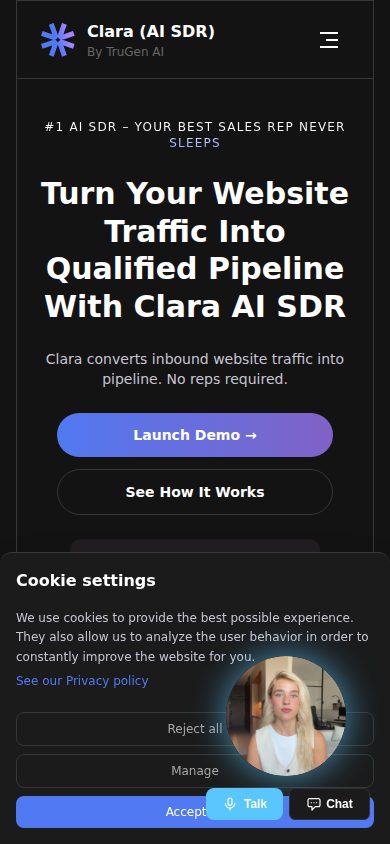
Face-to-face video AI SDR that qualifies website visitors and books meetings
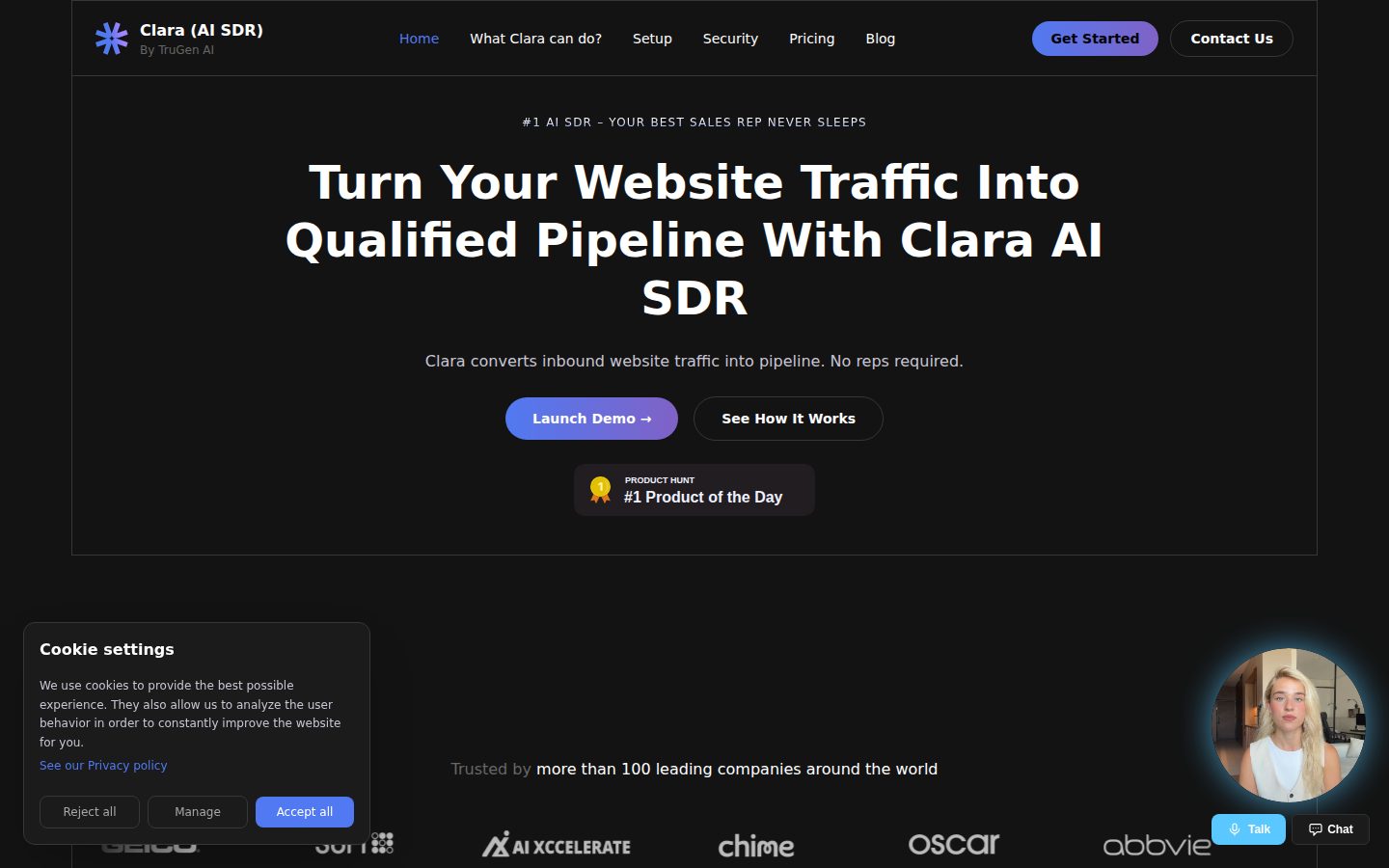
Clara AI SDR is a video AI sales development rep that turns inbound website visitors into qualified leads and booked sales meetings.
AI Panel Score
6 AI reviews
Reviewed
Clara AI SDR is a face-to-face video AI sales development rep that talks with website visitors, qualifies them and books meetings. It is built for sales and marketing teams that want inbound website traffic qualified and booked without adding SDR headcount; it does not send cold outreach. A free Starter plan includes 10 buyer conversations a month, Pay as you Go starts at $299 per month for 300 conversations plus $1 per additional buyer, and Enterprise is quote-based. Capabilities include product walkthroughs that open a live browser mid-conversation, lead scoring against BANT, MEDDIC or custom criteria, and CRM sync with HubSpot, Salesforce, Zoho CRM and Pipedrive. TopReviewed's six-seat AI review panel scored it 8.0/10, praising how qualification answers and conversation summaries land in the CRM while noting that meeting booking and product demos start at $299 a month. It fits inbound teams whose product benefits from a live demo. The vendor publishes comparisons with 1Mind, Qualified and Drift.
Setting Clara up takes three steps: create the avatar by uploading a face or generating one from a text prompt, train it on uploaded pitch decks, sales scripts, product documentation and FAQs, then launch it on a website or landing page, which the vendor says can be done within 24 hours. From then on Clara opens face-to-face video conversations with visitors, adapts the walkthrough to their industry, role and needs, and handles objections as they come up. Along the way it collects budget, timeline, authority, use case, company size and purchase intent, scores the lead against BANT, MEDDIC or custom criteria, updates the CRM, and either routes high-intent prospects to the sales team or books the meeting itself.
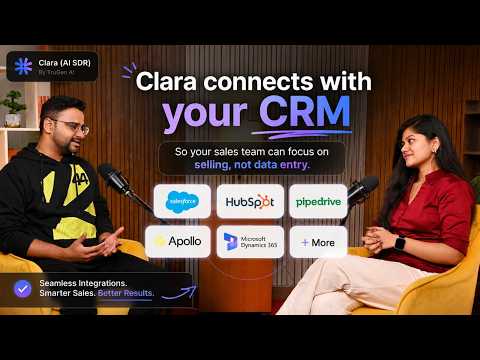
Clara runs on two models the vendor built in-house: Huma-1, a real-time avatar model, and Hawkeye-1, a vision model that lets Clara open a live browser mid-conversation and navigate to any URL, such as the product itself, a pricing page or integration docs. It can also present slides, images and videos. CRM sync covers HubSpot, Salesforce, Zoho CRM and Pipedrive, and inbound leads can be enriched with Apollo, Clay, Clearbit or ZoomInfo data; in HubSpot, Clara creates or updates the contact, maps qualification answers to contact properties, logs a conversation summary on the activity timeline, books into HubSpot Meetings and can create a Deal. Slack, Calendly, Zoho and Brevo connections are also listed, and Clara events such as qualified leads, booked meetings and completed conversations can trigger Zapier, n8n or Make workflows. Conversations run in all major languages, with adjustable accent, dialect, tone and communication style.
Clara is aimed at sales and marketing teams that want inbound website traffic qualified and booked without adding SDR headcount, and its plans are sized by monthly website visitors. The free Starter plan includes 10 buyer conversations a month and one concurrent session. Pay as you Go costs $299 a month for 300 conversations plus $1 per additional buyer, with 10 concurrent sessions, meeting booking, product demos, custom CRM integrations and Slack-based support. Enterprise is custom-priced and adds unlimited conversations, custom avatars and voices, a white-labelled experience and the AI SDR joining Zoom or Teams calls alongside human reps.
Beyond engaging visitors who arrive at the site, Clara also automates inbound prospecting and personalized outreach to keep pipeline filling. It lists SOC 2 Type II, GDPR, HIPAA and ISO 27001 compliance, and Enterprise customers can choose self-hosted or dedicated deployments.
Opens a live browser mid-conversation and navigates to any URL, such as the product, a pricing page or integration docs, using the in-house Hawkeye-1 vision model.
Greets website visitors as a talking video avatar that answers their questions and holds a real-time sales conversation without a form to fill in first.
Builds the AI SDR's on-screen persona from an uploaded face or one generated from a text prompt, with custom avatars and voices on the Enterprise plan.
Adapts each demo to the visitor's industry, role and needs, explains features, handles objections and presents slides, images and videos.
Enterprise customers can run a white-labelled Clara experience and choose self-hosting or dedicated deployments.
Syncs contacts, conversation records, qualification status and meetings to Salesforce, HubSpot, Zoho CRM and Pipedrive.
Connects over OAuth to create or update HubSpot contacts, map qualification answers to contact properties, log a conversation summary on the activity timeline, book into HubSpot Meetings and create Deals.
Carries conversation data into Slack, Calendly, Zoho and Brevo alongside the CRM integrations.
Emits structured events for qualified leads, booked meetings and completed conversations that trigger Zapier, n8n or Make workflows.
Holds conversations in all major languages, with configurable accents, dialects, tone and communication style.
Joins Zoom, Microsoft Teams and other meetings alongside human reps to answer technical questions, listed on the Enterprise plan.
Collects budget, timeline, authority, use case, company size and purchase intent during the conversation, scores the lead against BANT, MEDDIC or custom criteria and routes high-intent prospects to the sales team.
Books a meeting with a sales rep during the conversation and places it on the assigned rep's calendar with the conversation context attached.
Learns the company's messaging from uploaded pitch decks, sales scripts, product documentation and FAQs.
Free plan for companies with under 10K monthly website visitors, including 10 buyer conversations a month.
Most popular plan at $299/month for companies with 10K-100K monthly visitors, including 300 buyer conversations with overages billed at $1 per additional buyer.
Custom-priced plan for companies with 100K+ monthly visitors, quoted by the sales team.
A video avatar that qualifies and books meetings, priced on traffic not headcount.
“Clara swaps the lead-form for a face-to-face AI conversation that qualifies against BANT or MEDDIC and books the meeting itself. The $299 Pay as you Go tier is a real price point, not a quote request.”
Two models in-house, Huma-1 for the avatar and Hawkeye-1 for live browser navigation mid-conversation. That second piece is the differentiator — most chat-qualify tools can't open your pricing page and walk a visitor through it live.
Setup is three steps, live in 24 hours per the vendor, and it syncs into HubSpot deeply: contacts, properties, activity timeline, Meetings, Deals. Pay as you Go is $299 a month for 300 conversations with $1 overage, which is cheap against SDR headcount if your traffic actually converts to conversations.
The tradeoff: pricing is bucketed by monthly visitor volume, so a traffic spike or seasonal campaign could push you into overage fast, and Enterprise features like Zoom/Teams participation and white-labeling are quote-only. SOC 2, HIPAA, GDPR and ISO 27001 are all listed, which matters for anyone qualifying leads with budget and company data.
Live browser navigation via Hawkeye-1 to show pricing or docs mid-conversation is a concrete capability most chatbot-style qualifiers don't claim.
SOC 2 Type II, GDPR, HIPAA and ISO 27001 are all listed, and self-hosting is offered at Enterprise, which covers most data-handling objections.
24-hour setup claim plus meeting booking inside the same conversation means payback isn't gated behind a long integration project.
This isn't just cost-saving on an existing SDR workflow — it replaces the form-fill-and-wait pattern with a live qualifying conversation, which changes the funnel.
Docs, blog, changelog and a full pricing page are all live, with two named proprietary models suggesting active R&D, not just a wrapper.
Marketing and sales teams with meaningful inbound traffic who want visitors qualified and booked without adding SDR headcount.
Skip it if your monthly visitor volume is low or unpredictable enough to make the tier pricing a gamble.
A video SDR I'd pilot on one segment before I'd ever bet full-funnel coverage on it.
“Clara replaces the first qualifying call, not the rep who closes it. The real question for my pipeline isn't whether it can book a meeting — it's whether my reps trust the context it hands them.”
My pipeline math lives or dies on handoff quality, not conversation volume. Clara's BANT/MEDDIC scoring plus the HubSpot activity-timeline log means a rep opening a booked meeting sees budget, timeline and authority before they say hello — that's the piece that actually changes rep productivity, not the avatar novelty.
The Zoom/Teams participation feature, Enterprise-only, is the one I'd actually fight for in a renewal conversation — an AI SDR sitting in a live call answering technical objections changes how I staff technical sales support. Locking that behind custom pricing means I can't model the ROI until I'm already a committed Enterprise buyer.
Three-year risk: this is a top-of-funnel tool, and my team's muscle memory for qualifying inbound erodes the longer Clara owns that motion. If Clara's avatar or scoring logic ever misreads a visitor's intent, I have no easy way to audit that against a human rep's judgment, and that's the tradeoff I'd want solved before scaling past one market segment.
Sits ahead of basic chat-qualification tools by owning the full conversation-to-meeting motion, though Enterprise-only Zoom/Teams presence suggests the ceiling feature isn't broadly accessible yet.
Qualifying against BANT/MEDDIC and routing high-intent leads mirrors how I'd structure a real SDR's first call, not a generic chat widget script.
Deal creation and property mapping into HubSpot, plus Zapier/n8n/Make event triggers, means it slots into an existing rev-ops stack rather than demanding a new one.
Visitor-volume pricing bands mean my cost structure shifts with marketing's traffic wins, a dependency my budget doesn't currently have to plan around.
In-house Huma-1 and Hawkeye-1 models plus live browser navigation to pricing/docs pages is a genuinely deeper build than a scripted chatbot wearing a face.
Sales leaders with steady inbound traffic who want a structured first qualifying conversation before a rep ever gets involved.
Skip it if your qualification criteria change deal-by-deal and you need a human's judgment on every inbound lead, not a scored handoff.
$299 gets 300 conversations. The next 300 cost $300 more at $1 each. Math is clean.
“Clara prices by conversation volume, not seats, which is unusual and auditable. The Enterprise tier is the one gap — no number, and the features that matter most sit behind it.”
$299/month, 300 conversations, $1 overage. No seat math, no per-rep multiplier. That's a cleaner unit economics story than most SDR tools in this category post.
Year 1 at Pay as you Go: $3,588 if you stay under cap. Add overage. A site doing 450 buyer conversations a month runs $150 over cap, $1,800/year extra. Call it $5,400 year 1, all-in, before Enterprise.
The gap is Enterprise. No price shown, custom quote, and that's where white-labeling and Zoom/Teams participation live. So the features procurement wants to pilot cheap sit in the tier you can't price without a call. Starter is free, which de-risks the trial. No term length or auto-renewal language visible on the plans I reviewed — worth asking before signing, not after.
Monthly billing with Slack-based support on Pay as you Go; Enterprise procurement path is a standard sales-quote process.
No term length, renewal, or cancellation terms visible on the pricing page I checked.
$299 and $1 overage are both posted; only Enterprise is quote-gated, and that's disclosed as such.
Booked meetings and qualification scores give a countable output, but conversion-to-close isn't tracked in what Clara reports.
Overage at $1/conversation is predictable math, but traffic growth pushes you toward an unpriced Enterprise tier fast.
Teams with steady, measurable site traffic who want conversation-based pricing instead of per-seat SDR cost.
Avoid if you need Zoom/Teams participation or white-labeling and want the price before you talk to sales.
Qualifies while I sleep, but I inherit whatever it decided to ask or skip
“Clara fills my calendar with pre-qualified meetings and a conversation summary waiting in the activity timeline before I pick up the phone. The gap is what happens between the avatar's small talk and my first follow-up call.”
I walk into a booked meeting with BANT answers already logged and a conversation summary sitting on the timeline. That's real prep time saved versus a form-fill that goes stale by the time I call. The live browser navigation is the part I'd actually watch a prospect use — pulling up pricing or docs mid-pitch beats me screen-sharing on a cold call.
What worries me day-to-day: objection handling happens inside the video before I'm ever looped in, and I don't see what Clara said when a prospect pushed back on price. If the avatar fumbles an objection or misjudges urgency, I'm walking into that meeting blind to the friction that already happened.
Training it on pitch decks and scripts is a one-time lift, not a daily one, which is fine by me. But my pipeline quality now depends on how well that training held up three months later, and I have no visibility into when it drifts off-message.
Booked meetings arrive with context attached, but reps have no window into how the avatar actually handled live objections.
Docs cover HubSpot mapping and CRM sync in rep-relevant detail, though I couldn't find guidance on reviewing a specific conversation transcript.
Setup is light per the three-step flow, but conversation review and quality-checking the avatar's pitch isn't a visible daily habit.
Custom qualification criteria and Zapier/n8n triggers give room to grow, but Zoom/Teams participation sits behind an Enterprise quote I can't test.
HubSpot activity timeline logging and Deal creation slot into how I already work a pipeline without extra steps.
Reps on inbound-heavy teams who want qualified context waiting before every booked call.
Avoid if you need to audit exactly what was said to a prospect before you walk into the room.
A talking avatar that works hard on day one, but day sixty is the real test.
“Clara's pitch is strong out of the gate: a face on your website doing the qualifying work a junior SDR would do. Whether it still feels fresh after a few months of the same avatar greeting everyone is the open question.”
Ten minutes in, this is genuinely novel. A video avatar that opens a live browser mid-pitch to show your pricing page beats another chatbot typing dots at you. That's a real first-hour win, and the three-step setup (avatar, training, launch) means you're not stuck in a configuration maze before you see it work.
Three months in is where I get curious. The avatar is built once from a face or a prompt, trained once on your decks and scripts. Does it start sounding canned by week six, the way a human rep gets sharper with reps but a static script doesn't? I didn't see anything about retraining cadence or how you'd refresh the pitch as your product changes. Visitors who come back twice get the same walkthrough both times, which might feel less like a rep and more like a kiosk.
Pricing is visitor-volume based, $299 a month for 300 conversations with $1 overage, which is at least honest math you can plan around. The gap is the stuff that would matter most daily, loading behavior, error handling when the avatar misfires, mobile experience, none of which I could find discussed anywhere.
Live browser navigation and slide presentation are distinctive touches, but I found nothing on how Clara handles an awkward mid-conversation stumble.
Setup is simple, but there's no visible path for retraining the avatar as messaging or product details drift over time.
Platform is listed as web only, and a face-to-face video format on mobile data or small screens isn't addressed anywhere I could find.
A stated 24-hour setup across avatar creation, training and launch is a genuinely low-friction first-hour pitch.
Compliance badges like SOC 2 Type II and HIPAA suggest backend rigor, but I couldn't find anything on uptime or conversation failure handling.
Sales teams with steady inbound traffic who want a live qualifying face on the site without hiring another SDR.
Avoid if your product messaging changes often enough that a one-time trained avatar would fall behind within weeks.
In-house vision models and HIPAA badges, but the proof is still mostly on Clara's own pricing page.
“Two proprietary models, a 24-hour setup promise, and a $299 tier with transparent overages. Confident claims, thin third-party corroboration.”
Huma-1 and Hawkeye-1, named in-house models, is the kind of specificity that usually separates a real build from a reskinned avatar API. Worth noting: I couldn't verify either independently, so I'm taking the vendor's word on what's proprietary versus licensed underneath.
The category comparison here isn't named anywhere I found, which is itself a tell. No 'Clara vs' page, no migration guide from a rival SDR tool. That could mean genuinely new territory, or it could mean nobody's written the comparison yet because adoption is thin. Both readings are live.
Compliance badges (SOC 2 Type II, HIPAA, ISO 27001, GDPR) are table stakes claims now, easy to list, harder to audit from outside. The $299 entry price with $1 overages is genuinely transparent, more than most quote-walled competitors in adjacent categories offer. That's a real point in its favor, not a marketing gloss.
Video-avatar-plus-live-browser-navigation is a distinct mechanic I haven't seen named elsewhere in the briefing, though no direct competitor is cited to measure the gap against.
Conversation data syncs to HubSpot, Salesforce, Zoho and Pipedrive, which helps, but the trained avatar and pitch logic stay locked inside Clara with no stated export path.
Docs, blog and a changelog page exist, which is a reasonable maintenance signal for a vendor at this stage; no funding or team size data either way, which is normal and not penalized.
Specific model names (Huma-1, Hawkeye-1) ground the pitch, but 'face-to-face' and 'all major languages' are the kind of superlative phrasing that invites scrutiny.
Feature claims like live browser navigation and BANT/MEDDIC scoring are specific, but I found no case study or third-party usage data confirming they hold up at volume.
Teams comfortable piloting on the free Starter tier before committing budget to the $299 plan.
You need a documented migration path or third-party validation before trusting a new vendor with inbound qualification.
Common questions answered by our AI research team
Clara has a free Starter plan with 10 buyer conversations a month. Pay as you Go costs $299 a month for 300 buyer conversations, with $1 per additional buyer, and Enterprise pricing is custom.
Clara's documentation lists Salesforce, HubSpot, Zoho CRM and Pipedrive. In HubSpot it creates or updates contacts, logs a conversation summary and books meetings into HubSpot Meetings, and inbound leads can be enriched with Apollo, Clay, Clearbit or ZoomInfo data.
Yes. Clara tailors each walkthrough to the visitor's industry and role and can open a live browser to show your product, pricing page or docs. Product demos come with the $299 Pay as you Go plan.
Clara can go live within 24 hours. You create the avatar from an uploaded face or a text prompt, train it on pitch decks, sales scripts, product docs and FAQs, then launch it on your website.
Yes. Clara supports HIPAA alongside SOC 2 Type II, GDPR and ISO 27001 compliance. Enterprise customers can also choose self-hosted or dedicated deployments.
Who Clara AI SDR competes with, and how each one differs
Qualified runs an AI agent (Piper) on B2B websites to identify high-intent visitors and convert them into pipeline via chat — the same website-to-pipeline motion Clara targets, but shipped as a marketing-ops platform feature rather than a standalone video-avatar teammate.
Drift engages website visitors through text-based live chat and chatbots to qualify leads and book meetings; it has no live video-avatar conversation like Clara and is now sold as part of Salesloft's revenue platform rather than standalone.
Tavus sells the same category of real-time conversational AI video agent technology as TruGen's Huma-2/Hawkeye-1 stack, via its Conversational Video Interface API, but as a general-purpose developer platform rather than a packaged sales product like Clara.
11x's AI worker Julian answers inbound leads by phone, chat, and SMS the way Clara engages website visitors, but 11x pairs it with a second worker (Alice) for outbound prospecting rather than TruGen's video-avatar approach to engagement.
Artisan's AI BDR Ava automates outbound prospecting and outreach for sales teams — a different motion from Clara's inbound, website-triggered engagement — though both are pitched as autonomous AI teammates replacing headcount.


TruGen AI is a New York-based company that builds real-time AI video agents, including Clara, an AI sales development representative that engages website visitors.