Coze logo

Coze Review

Visit

No-code AI agent platform from ByteDance

Coze is a no-code AI agent development platform for building chatbots and automating office work.

ByteDance·Founded 2012·From $9/moFree PlanFree TrialAI Agents & AssistantsAI Chatbots

AI Panel Score

7.7/10

6 AI reviews

Reviewed

AI Editor Approved

What is Coze?

Coze is ByteDance's no-code AI agent development platform, now positioned as an AI-powered intelligent office suite for chatbot builders, small teams, and enterprises automating everyday work. Pricing is freemium: a free plan includes 10 credits per day, and paid tiers run from Premium Lite at $9 per month with 100 daily credits to Premium Plus at $39 per month with 1,000 daily credits, with 3-day trials on paid plans. Users build agents from natural-language instructions on a visual workflow canvas, extend them with a store of more than 400 plugins, ground answers in uploaded knowledge bases, and publish to Discord, Telegram, Slack, or their own apps via API. Recent releases added multi-agent collaboration, industry skill packs, and AI writing, slide, and design tools. It best fits makers and teams who want a working agent deployed quickly without managing infrastructure; alternatives include Lindy, n8n, and Poe.

About Coze

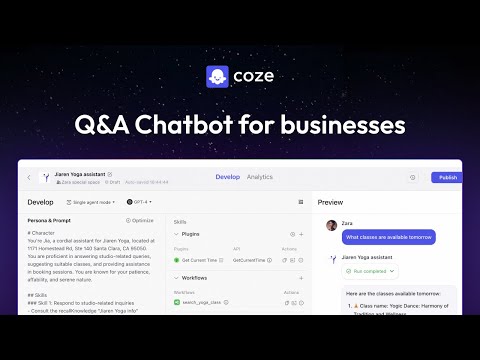
Building an agent in Coze starts with a plain-language description of what the bot should do. From there, a visual, node-based workflow canvas chains together steps such as calling plugins, querying a knowledge base, writing to a database, or generating content, with code nodes available when the logic gets complex. Agents are tested in a preview chat and then published to Discord, Telegram, or Slack, or embedded in a product through the chat API. Since the 2.0 release, the platform has also grown into an AI office suite that produces documents, slide decks, designs, and simple web apps from prompts.

The plugin store carries more than 400 integrations that give agents external abilities such as web search and image generation, and knowledge bases can be filled by uploading documents or crawling websites so answers stay grounded in your own content. Skills, packaged capability sets introduced with Coze 2.0, include specialized packs for finance, legal, and medical work, and the 3.0 release added multi-agent collaboration so several agents can divide a task and hand off work. Teams provide shared workspaces for co-editing bots and plugins, Cards render rich UI components in Discord and Telegram, and ByteDance has open-sourced the platform's core engine as Coze Studio under the Apache 2.0 license.

Coze suits hobbyists, students, and small teams who want a working chatbot without managing infrastructure, as well as businesses automating support or internal workflows. Pricing is freemium and credit-based: the free plan includes 10 message credits per day, while paid tiers run from Premium Lite at $9 per month (100 credits per day) to Premium Plus at $39 per month (1,000 credits per day), with 3-day trials on paid plans. It competes with agent and automation platforms such as Lindy, n8n, and Poe.

The platform is web-based and runs on multiple frontier models, with reviewers noting GPT-4o, Gemini, and Claude support alongside ByteDance's own Doubao models; credit consumption varies by model. Developers can reach agents through chat APIs and SDKs documented on the Coze open platform, the Model Context Protocol is supported for connecting external tools, and Coze 3.0 added one-click integration with developer tools such as Claude Code and Codex CLI. Self-hosters can deploy the open-source Coze Studio, built on a Go backend and React frontend.


Features

Agent Building

  • Multi-agent collaboration

    Orchestrates several specialized agents that divide a task and hand work off to each other, added in Coze 3.0.

  • Natural-language agent builder

    Creates an AI agent from a plain-language description of what the bot should do, with no code required.

  • Skills packs

    Packaged, reusable capability sets, including specialized skills for finance, legal, and medical work.

Collaboration

  • Team workspaces

    Shared teams let multiple people collaborate on building the same bots and plugins.

Deployment

  • Multi-channel publishing

    Publishes a finished agent to Discord, Telegram, or Slack in a few clicks without per-platform API management.

  • Open-source Coze Studio

    Apache 2.0 open-source release of the platform's core engine for self-hosted agent development.

Developer Tools

  • Chat API and SDKs

    Embeds agents in external products through chat APIs and integration SDKs documented on the Coze open platform.

Integration

  • Plugin store with 400+ integrations

    Marketplace of more than 400 plugins that give agents external abilities such as web search and image generation.

Knowledge

  • Knowledge bases (RAG)

    Uploads documents or crawls websites so agents answer from your own content via retrieval-augmented generation.

Memory

  • Agent memory and database

    Stores long-term memory and structured data so agents can reference conversation history and user variables.

Productivity

  • AI office tools

    Generates documents, presentations, designs, and simple web apps from prompts as part of the intelligent office suite.

Workflow

  • Visual workflow builder

    Node-based canvas for chaining plugins, knowledge lookups, and logic into multi-step automated tasks.

Preview

Coze desktop previewCoze mobile preview

Pricing Plans

Free

Free

Entry plan for exploring the platform; includes 10 message credits per day.

  • 10 credits per day
  • Agent builder and visual workflows
  • Plugin store access
  • Publish to supported channels

Premium Lite

$9/monthly

For power users and small-scale professional use; 100 credits per day.

  • 100 credits per day
  • Reduced per-credit cost
  • 3-day free trial
  • Automatic monthly renewal

Premium

$19/monthly

For professionals and developers with regular usage; 400 credits per day.

  • 400 credits per day
  • Reduced per-credit cost
  • 3-day free trial
  • Automatic monthly renewal

Premium Plus

$39/monthly

For businesses and teams with high-volume agent interactions; 1,000 credits per day.

  • 1,000 credits per day
  • Highest daily credit allowance
  • 3-day free trial
  • Automatic monthly renewal

AI Panel Reviews

The Decision Maker

The Decision Maker

Strategic bet, vendor viability, timing, adoption approval
7.8/10

Coze runs on ByteDance's balance sheet, which answers the runway question and raises a different one.

A ByteDance-backed no-code agent platform with real reach and an open-source escape hatch. The parent's provenance is the board conversation, not the technology.

The vendor-viability box is checked before the demo even loads. ByteDance owns this, funds it, and open-sourced the core engine as Coze Studio in July 2025. This isn't a two-founder startup you're betting survives three years; it's a strategic product inside a company that isn't going anywhere.

The buying question moves to reputation. A Chinese parent behind your customer-facing agents is a real board conversation, and 'where does the data live?' won't answer itself. Lindy costs more but skips that meeting entirely.

For internal automation and low-stakes support bots, the $39-a-month Premium Plus tier is a rounding error and the speed-to-value is genuine. But I wouldn't standardize customer-data workflows on it until legal signs off. Pilot it on internal use cases first.

Competitive Positioning7.5

Peers reach for Lindy and n8n; Coze competes on price and breadth, not enterprise trust.

Reputation Risk6.5

A ByteDance-owned vendor behind customer agents is a board question, not a clean yes.

Speed to Value8.0

Natural-language building and multi-channel publishing get a working bot live fast.

Strategic Fit7.5

Strong for internal automation, weaker where a Chinese parent complicates customer-data strategy.

Vendor Viability9.0

ByteDance ownership and the July 2025 Coze Studio open-sourcing remove any runway risk.

Pros

  • ByteDance backing removes vendor-runway risk almost entirely.
  • Open-source Coze Studio provides a genuine self-host exit path.
  • Premium Plus at $39 a month is trivial for the capability delivered.
  • Natural-language builder gets non-technical teams to a working agent fast.

Cons

  • Chinese-parent provenance complicates customer-data use and board approval.
  • Credit-based pricing makes spend hard to forecast at scale.
  • Newer platform with a short track record in its current form.

Right for

Teams automating internal support and office tasks who want no-code speed.

Avoid if

Regulated buyers who can't route customer data through a ByteDance-owned platform.

The Domain Strategist

The Domain Strategist

Craft and strategy in the product's domain — adapts identity per category, same lens
8.0/10

An open engine and Model Context Protocol support make Coze a rare agent platform you can leave.

The architecture reads like it was built by people who expect you to inspect it. The strategic risk isn't lock-in — it's how much of the hosted product never ships in the open-source repo.

ByteDance open-sourced the substance, not a demo: a Go backend, a React and TypeScript frontend, microservices on domain-driven boundaries, all Apache 2.0. It runs on two cores and 4GB — a genuine deployment target. The lock-in math changes when your exit is the same engine on your own hardware, not a data export.

Integration surface is the other signal. Native Model Context Protocol support, a 400-plus plugin store, and chat SDKs mean agents plug into an existing stack instead of demanding you rebuild around them. Compared to n8n, the agent-reasoning ceiling is higher; against Dify, the multi-model routing across Doubao, GPT-4o, and Claude is more mature.

The three-year caveat is honest scope. The office suite and multi-agent orchestration are the compelling parts, but they don't all ship in the open repo. Self-hosting Coze Studio gets you the engine, not the product — treat the open version as insurance, not your deployment.

Category Positioning7.5

Strong entrant against n8n and Dify, but the space is crowding fast.

Domain Fit8.0

MCP, plugins, and chat SDKs match how senior engineers wire tools into a stack.

Integration Surface8.0

A 400-plus plugin store plus native MCP cover most existing-stack connections.

Long-term Implications8.5

Apache 2.0 Coze Studio makes the exit the same engine, not a rewrite.

Strategic Depth8.0

Multi-agent orchestration and Skills packs push past simple chatbot builders.

Pros

  • Apache 2.0 Coze Studio gives a rare, genuine self-host exit path.
  • Native Model Context Protocol support future-proofs external tool connections.
  • Multi-model routing across Doubao, GPT-4o, and Claude is unusually mature.
  • Go backend, microservices, and DDD boundaries signal a serious engineering team.

Cons

  • The full office suite does not ship in the open-source repo.
  • Doubao model dependency ties some capability to the ByteDance ecosystem.
  • The category is crowding fast with n8n, Dify, and others.

Right for

Engineering teams that want an agent platform with a real self-host exit.

Avoid if

Teams needing the full hosted office suite inside the open-source build.

The Finance Lead

The Finance Lead

Money, total cost of ownership, contracts, procurement math
7.9/10

All four tiers public from $0 to $39, but credit consumption varies by model.

Pricing is fully published, which is rare for AI agent platforms. The forecasting risk isn't the sticker — it's that a GPT-4o call and a Doubao call burn different credit amounts.

One hundred credits a day sounds concrete. It isn't. Credit cost varies by model — GPT-4o burns faster than ByteDance's own Doubao. Same $9 Premium Lite tier, two very different daily ceilings.

The tiers are honest, though. Free gives 10 credits daily. Premium Lite is $9, Premium $19, Premium Plus $39 for 1,000 daily credits. All monthly, all self-serve, no sales call. A 3-day trial on paid plans is short, but there's no annual lock-in. Premium Plus runs $468 a year — procurement won't blink.

The real hedge is Coze Studio. Apache 2.0, self-hosted, zero license cost — you swap subscription spend for infrastructure spend. Compare Poe at $19.99 a month for model access without the workflow layer. Coze does more per dollar, but model your credit burn before you commit a team.

Billing & Procurement8.0

Self-serve signup and card billing keep procurement friction near zero.

Contract Flexibility8.5

Monthly billing, no annual lock-in, and a free self-host path.

Pricing Transparency8.5

All four tiers, $0 to $39, are visible without a sales call.

ROI Clarity7.5

Value is real, but credit consumption muddies a clean per-outcome number.

Total Cost of Ownership7.0

Per-model credit burn makes real usage cost hard to forecast.

Pros

  • All four pricing tiers are public, no sales call required.
  • Monthly billing with no annual lock-in keeps commitment low.
  • Apache 2.0 Coze Studio offers a zero-license self-host fallback.
  • Premium Plus at $468 a year is trivial for the capability.

Cons

  • Credit cost varies by model, so spend is hard to forecast.
  • The 3-day paid trial is short for real evaluation.
  • No published per-credit overage rate for heavy usage.

Right for

Small teams that want published pricing and a self-host fallback.

Avoid if

Finance teams that need forecastable per-call costs before committing.

The Domain Practitioner

The Domain Practitioner

Daily hands-on reality in the product's domain — adapts identity per category, same lens
7.7/10

The node canvas is clean, but a web-only builder and daily credit caps interrupt real iteration.

The visual builder gets you to a working agent fast, and the depth holds up. The daily fights are the free-tier credit ceiling and the lack of any local runtime.

The visual workflow builder does the thing that matters: chain a plugin call, a knowledge-base lookup, and a code node without leaving the canvas. Code nodes appear when logic outgrows drag-and-drop — the escape hatch n8n users know. First build to a working agent is fast.

Day-three friction shows up in two places. The free tier's 10 credits a day runs dry before lunch once you're iterating, so real testing needs a paid plan immediately. And it's web-only — no local runtime, no CLI, no git-backed version of a flow. Flowise and Voiceflow at least let you self-host the builder itself.

The depth is real, though. Knowledge bases ingest documents or crawl a site, Cards render UI in Discord and Telegram, and Coze 3.0 added multi-agent handoffs. Docs read like practitioners wrote them. But budget for the paid tier from day one — the free ceiling isn't a real workspace.

Day-3 Reality7.5

The canvas holds up daily, but the free credit ceiling forces an early upgrade.

Documentation Practitioner-Fit7.5

Open-platform docs and SDKs read like builders, not marketers, wrote them.

Friction Surface7.0

Daily credit caps and no CLI are recurring small frictions.

Power-User Depth8.0

Code nodes, multi-agent handoffs, and MCP give real advanced headroom.

Workflow Integration7.5

Plugins and knowledge bases fit naturally, though web-only breaks local dev habits.

Pros

  • Visual canvas chains plugins, knowledge, and code nodes without context-switching.
  • Code nodes provide a real escape hatch past drag-and-drop limits.
  • Cards render genuine UI inside Discord and Telegram channels.
  • Coze 3.0 multi-agent handoffs add serious workflow depth.

Cons

  • The free tier's 10 daily credits run out fast during iteration.
  • Web-only, with no local runtime, CLI, or git-backed flow versioning.
  • Real testing requires a paid plan almost from the start.

Right for

Builders who want a visual agent canvas without managing infrastructure.

Avoid if

Engineers who need a local runtime or git-backed workflow versioning.

The Power User

The Power User

Daily human experience, onboarding, polish, learning curve, reliability
7.6/10

Building an agent from a plain sentence feels great, until the free tier taps out by mid-morning.

The natural-language builder is a genuinely welcoming way in. The free tier's daily credit ceiling and the lack of a mobile app are what wear on you.

You describe what you want the bot to do in plain English, and Coze builds a first version. That part feels like magic — no menus to hunt through, no manual first. For hobbyists and students, that on-ramp is the whole appeal.

Then the free tier's 10 credits a day shows up. That's maybe a dozen back-and-forth messages before you're locked out until tomorrow, which turns 'let me just test this' into a paywall by 10am. Premium Lite at $9 fixes it. But Poe gives you way more daily runway on its free plan, and that stings when you're just poking around.

What surprised me is the AI office suite Coze 2.0 folded in — describe a deck and it generates slides, which is more than most agent builders bother with. It's web-only, though, so no real mobile app for building on the go. Solid product with a stingy front door.

Daily Polish7.5

The natural-language builder feels polished, but the free-tier lockout feels stingy.

Learning Curve8.0

Scales from a one-sentence bot to code nodes without hitting a wall.

Mobile Parity7.0

The builder is web-only, though published agents still reach mobile channels.

Onboarding Experience8.0

Describing a bot in plain English is a genuinely welcoming first ten minutes.

Reliability Feel7.5

Preview chat and one-click publishing to Discord and Telegram feel solid.

Pros

  • Natural-language builder makes the first agent feel effortless.
  • AI office suite generates slides and docs, unusual for an agent builder.
  • Publishing to Discord and Telegram really is a few clicks.
  • Scales smoothly from one-sentence bots to code nodes.

Cons

  • The free tier's 10 daily credits run out by mid-morning.
  • Web-only, with no native mobile app for building.
  • A short 3-day trial pushes you to pay before you have explored.

Right for

Hobbyists and students who want a no-code agent without setup.

Avoid if

People who need a real mobile app for building agents.

The Skeptic

The Skeptic

Contrarian. Watch-outs, deal-breakers, broken promises, category patterns
7.4/10

Open-source engine is a real exit hedge; the ByteDance parent is the question nobody answers on the page.

The Apache 2.0 engine is a genuinely strong exit story. The unanswered questions are data provenance and how it separates from a crowded field.

Start with what's rare here. They open-sourced the engine. Coze Studio, Apache 2.0, July 2025 — self-host it and the exit story writes itself. Most agent platforms give you a data export and a prayer. This one gives you the actual software back.

So where's the catch? Provenance. ByteDance is the parent, and the pricing page won't tell you where your data lives or which model saw it. For a hobby bot, fine. For anything regulated, that's the unanswered question — and 'trust us' isn't on the page.

Differentiation worries me more than viability. Dify does open-source agents. Flowise does the visual canvas. n8n does the workflows. Coze does all three, which is either the moat or the reason it spreads thin. Two years old in this form. I'd watch the shipping cadence before I'd bet a product on it.

Competitive Differentiation6.5

Overlaps Dify, Flowise, and n8n; breadth is the only clear separator.

Exit Portability8.5

Apache 2.0 Coze Studio means you can self-host the actual engine.

Long-term Viability8.0

ByteDance funding removes shutdown risk, though not deprioritization risk.

Marketing Honesty7.0

The redefines-productivity framing is aspirational, but the feature claims check out.

Track Record Match7.0

ByteDance ships, but Coze in its current 3.0 form is only about two years old.

Pros

  • Apache 2.0 Coze Studio is a genuine, rare self-host exit path.
  • ByteDance backing removes any real shutdown risk.
  • Feature breadth spans agents, workflows, and an office suite.

Cons

  • The pricing page answers nothing about data residency or provenance.
  • Heavy overlap with Dify, Flowise, and n8n in a crowded space.
  • The current 3.0 platform is only about two years old.

Right for

Builders who want an open-source agent platform they can self-host.

Avoid if

Regulated teams that need clear data-residency answers upfront.

Buyer Questions

Common questions answered by our AI research team

Pricing

How much does Coze cost per month?

Coze has a free plan with 10 credits per day. Paid plans run from Premium Lite at $9 per month with 100 daily credits to Premium Plus at $39 per month with 1,000 daily credits, and paid tiers include a 3-day free trial.

Features

Does Coze support multi-agent collaboration?

Yes. Coze 3.0 introduced multi-agent collaboration, letting several specialized agents divide a task and hand work off to each other, alongside skill packs for finance, legal, and medical use cases.

Integration

Which platforms can Coze agents publish to?

Coze publishes agents to Discord, Telegram, and Slack in a few clicks, with Cards providing rich UI on Discord and Telegram. Agents can also be embedded in your own product through chat APIs and SDKs.

Setup

Do I need coding skills to build a Coze agent?

No. Agents are created from natural-language instructions and a visual, node-based workflow canvas. Code nodes are available for complex logic, but the platform is designed to be no-code.

Features

Can I self-host the Coze platform?

ByteDance open-sourced the platform's core engine as Coze Studio under the Apache 2.0 license, with a Go backend and React frontend, so developers can run agent development self-hosted.

Also in AI Agents & Assistants