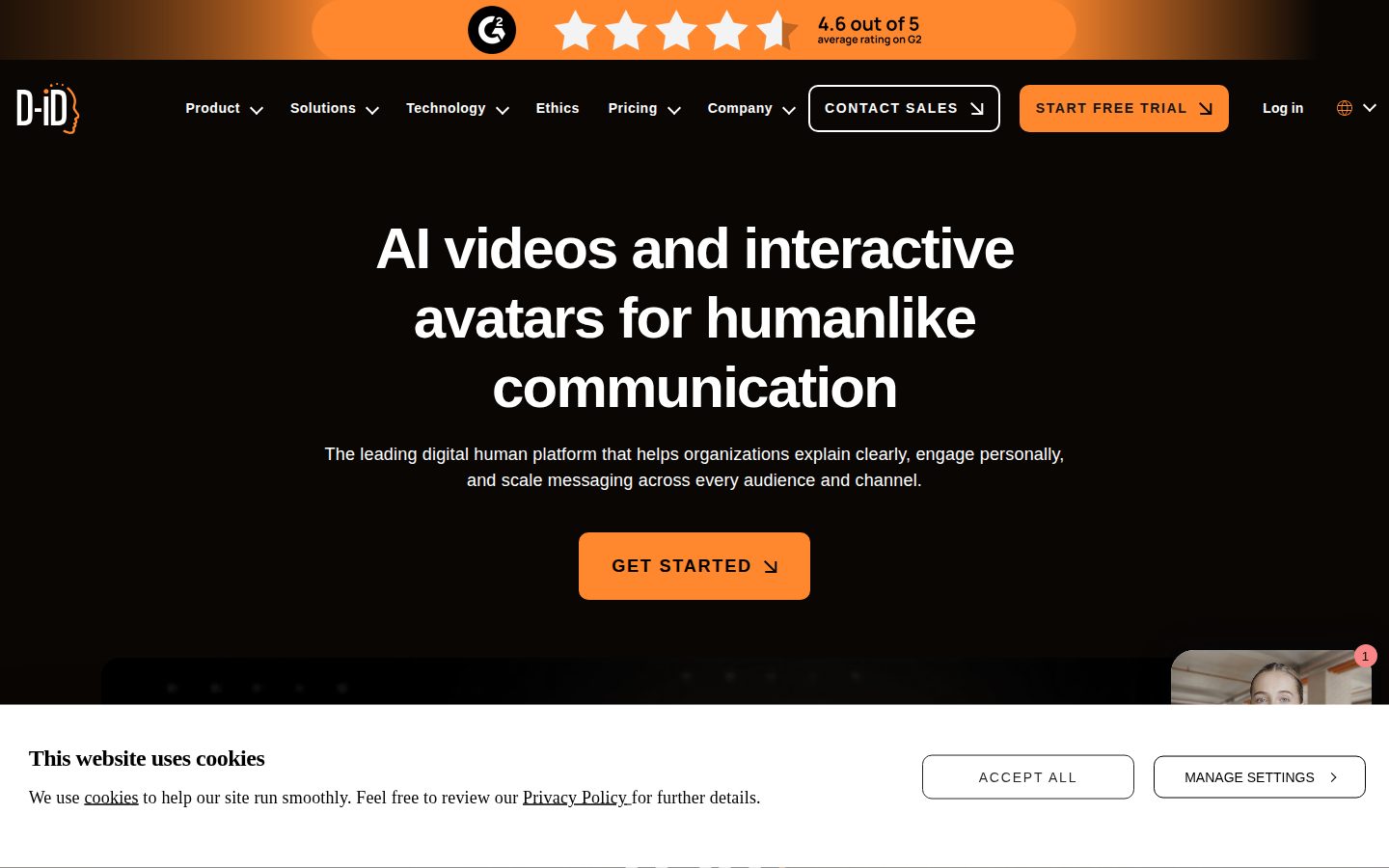
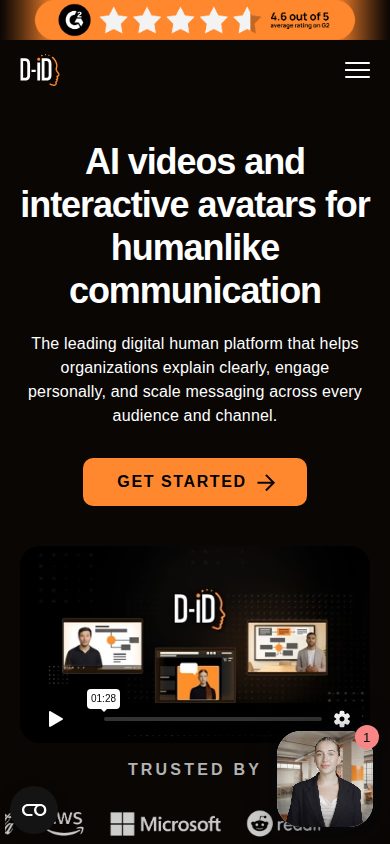
AI video avatars and real-time digital humans in 120+ languages
D-ID is an AI video generation platform for creating digital human avatars and interactive conversational agents.
AI Panel Score
6 AI reviews
Reviewed
AI Editor ApprovedApproved and published by our AI Editor-in-Chief after full panel analysis.D-ID is an AI video generation platform for creating digital human avatars, talking-head presenter videos, and real-time conversational agents. It suits marketing, sales, learning and development, and customer-experience teams that need personalized video at scale without filming. Pricing is subscription and minutes-based: a free 14-day trial covers 3 minutes, then Studio plans run from Lite at about $5.90 per month to Pro and Advanced, with separate API Build, Launch, and Scale tiers and custom Enterprise quotes. Core capabilities include Creative Reality Studio for script-to-video generation in 120-plus languages, D-ID Agents that answer visitors by voice with lip-synced facial expressions, Video Translate for multilingual localization, and voice cloning. Avatars can be generated from a single photo or chosen from a stock presenter library. It integrates with PowerPoint, Canva, and Google Slides and offers a REST and streaming API. D-ID fits teams producing avatar videos and interactive assistants; common alternatives include Synthesia, HeyGen, Colossyan, and Hour One.
In Creative Reality Studio you pick or upload a presenter image, paste a script, and choose a voice and language; D-ID then renders a talking-head video in which the avatar's lips and expressions sync to the generated audio. Videos are billed by the minute, rounded up to the nearest 15-second interval, and can be created without cameras, actors, or editing software.
Beyond static clips, D-ID Agents build real-time conversational avatars connected to an LLM and a knowledge base that answer visitors by voice with matching facial expression, and Agentic Videos let viewers ask questions and get live responses inside an otherwise passive video. The V4 Express engine uses diffusion-based rendering for expressive delivery at low latency, Video Translate localizes existing footage into other languages with matched lip-sync, and voice cloning lets narration use a custom voice. Add-ins connect the workflow to PowerPoint, Canva, and Google Slides.
D-ID is aimed at marketing, sales, learning-and-development, and customer-experience teams, from solo creators on the free trial up to Fortune 500 deployments. Pricing is subscription and minutes-based: Studio plans span a free 14-day trial plus Lite, Pro, and Advanced tiers, with separate API Build, Launch, and Scale plans and custom Enterprise quotes. It competes with Synthesia, HeyGen, Colossyan, and Hour One.
On the technical side, a REST and streaming API exposes both talking-head generation and real-time streaming avatars, drawing video and streaming minutes from a shared balance where streaming credits count at half rate. Enterprise plans add SSO, custom presenters, and security and compliance controls.

Programmatic endpoints generate talking-head clips and real-time streaming avatars, billing video and streaming minutes from a shared balance.
Generate an animated talking avatar from a single uploaded photo or choose from a stock presenter library.
Deploy real-time conversational avatars connected to an LLM and knowledge base that reply to users by voice with matching facial expressions.
Turn a passive video into an interactive experience where viewers can ask questions and receive live avatar responses.
Add-ins for PowerPoint, Google Slides, and Canva convert slides into narrated avatar videos.
Localize an existing video into another language with matched lip-sync and translated narration.
Diffusion-based rendering that produces low-latency, emotionally expressive avatar delivery for live conversations.
Enterprise plans add single sign-on, custom presenters, and security and compliance controls for regulated deployments.
Generate a talking-avatar video by picking a presenter, pasting a script, and choosing a voice and language, with lips and expressions synced to the audio.
Voice presenter videos with AI speech across 120+ supported languages and accents.
Create a custom cloned voice for presenter narration; Pro includes one clone and Advanced includes three.
Free 14-day trial for testing the platform's core tools.
Entry paid tier for casual creators and personal projects.
For regular users needing watermark-free commercial videos.
For professional teams needing higher volume and priority rendering.
Custom deployment for large organizations with advanced needs.
Developer entry plan for generating videos programmatically.
Mid API tier for growing developer workloads.
High-volume API tier for production applications.
A 2017-vintage avatar vendor betting real-time conversation will beat Synthesia's presenter-video lead.
“D-ID is a well-funded, eight-year-old player carving out the real-time conversational-avatar corner while Synthesia owns scripted enterprise video. The upside is genuine differentiation; the risk is deepfake-adjacent reputation and a founder war chest smaller than the category leader's.”
D-ID's been shipping since 2017 and raised roughly $48M, with a $25M Series B led by Macquarie Capital. That's real runway, but not leader money — Synthesia closed a $180M round. Call it a durable 24-month bet, not a safe one.
Where they're interesting is the pivot toward real-time. D-ID Agents and the V4 Express engine push conversational avatars connected to an LLM, not just canned presenter clips. That's a bet on live interaction Synthesia and HeyGen are only now chasing.
The catch is reputation. Deep Nostalgia made them famous with consumers, and that same tech makes procurement nervous about deepfakes. Speed to value is real — script in, video out — so pilot D-ID Agents on one flow before committing the org.
Real-time D-ID Agents differentiate versus Synthesia's and HeyGen's scripted focus.
Deep Nostalgia consumer fame and deepfake proximity make some buyers cautious.
Script-in, video-out in Creative Reality Studio delivers value inside a day.
Fits marketing, L&D, and CX teams wanting avatar video without a studio.
Eight years operating and roughly $48M raised signals staying power, though Synthesia is better capitalized.
Teams who want interactive conversational avatars over scripted presenter clips.
Buyers who need the most enterprise-proven scripted-video vendor available.
Enough craft depth for on-brand avatars, but the diffusion ceiling still caps hero-film ambitions.
“D-ID gives creative teams custom presenters, voice cloning, and native Canva and PowerPoint add-ins to keep avatar video on-brand. The craft ceiling is real, since 1080p output and a synthetic look make it strong for training and social but weaker for flagship brand film.”
The creative question with any avatar tool is whether output looks like your brand or a stock library. D-ID's V4 Express engine uses diffusion rendering for expressive delivery, and Advanced unlocks custom presenters plus three cloned voices. That's enough to build a consistent on-brand spokesperson, not borrow a generic face.
Where it gets thin is the craft ceiling. Premium presenters cap at 1080p, and the diffusion look still reads synthetic under scrutiny — fine for training and social, riskier for hero brand film. Synthesia and Colossyan sit in the same uncanny-valley bracket, so this is a category limit, not a D-ID failure.
The smart move is the Canva, PowerPoint, and Google Slides add-ins. If your pipeline already lives in those tools, D-ID slots avatar video into the existing workflow. But treat the avatar as one channel in the system, not your whole brand voice.
Real-time Agents differentiate from Synthesia's and Colossyan's scripted-video emphasis.
V4 Express and 120+ languages fit marketing, social, and L&D content pipelines.
Canva, PowerPoint, and Google Slides add-ins embed video into existing creative work.
Avatar likeness and voice clones become brand assets that need governing carefully.
Custom presenters and three cloned voices support a real branded-spokesperson system.
Creative teams who need on-brand avatar video inside existing design tools.
Studios who need broadcast-grade hero film from their avatars.
Minute-metered pricing from $5.90 to $196, fully published, but volume forecasting is the real work.
“D-ID publishes every Studio and API tier from $5.90 to $198 with no sales call, and streaming bills at half the video rate. The catch is minute-metered consumption, so the invoice tracks usage rather than headcount and gets harder to predict at volume.”
D-ID prices Creative Reality Studio by the minute, not the seat — mostly. Advanced is the exception at $196 per seat for 100 video minutes. Pro runs $29 a month but caps at 15 minutes. That's the trap: the sticker looks cheap until volume shows up.
Run the math. A team making 60 minutes monthly outgrows Pro's 15-minute cap and lands on Advanced at $196, or roughly $2,352 a year per seat. Annual billing cuts Pro to about $15.95 a month, a real 45% discount. But minutes, not seats, drive the invoice.
Transparency is a plus. All three Studio tiers and all three API tiers publish rates — no sales call. Streaming minutes bill at half the video rate. Against Synthesia's model, D-ID's meter is more honest but harder to forecast at scale.
Self-serve published tiers mean procurement won't fight a sales gate.
Monthly and annual options exist, with annual cutting Pro roughly 45% to $15.95.
Every Studio and API tier from $5.90 to $198 is published without a sales call.
Replacing crews, actors, and editing gives a legible cost-avoidance story.
Minute metering makes TCO usage-driven; heavy output pushes teams to the $196 Advanced tier.
Finance teams who prefer transparent published rates over quote-based pricing.
Buyers who need predictable flat per-seat costs at high volume.
Simple render loop and strong localization, but thin timeline control against Synthesia's scene editor.
“For a video producer, D-ID nails the fast presenter-render loop and Video Translate localization, and its API suits programmatic pipelines. The friction is minute-based re-rendering on every script edit and less multi-scene timeline control than Synthesia offers.”
The daily grind on any avatar tool is the revise loop. Change one line of script and you re-render the whole take — and D-ID bills that render by the minute, rounded up to 15 seconds. For a producer iterating on a 90-second explainer, those increments add up quietly.
Creative Reality Studio keeps the core workflow simple: pick a presenter, paste script, choose voice, render. Video Translate is the standout for localization — matched lip-sync into another language beats re-shooting. But compared to Synthesia's scene-by-scene editor, D-ID gives less timeline control, so multi-scene sequencing feels thinner.
Voice Cloning is capped — one clone on Pro, three on Advanced — so a producer juggling brand voices hits that wall around $196 a month. The REST and streaming API is the real power-user depth, beating HeyGen for programmatic pipelines. Docs cover the API well, studio edge cases less so.
Re-rendering per script edit, billed to the 15-second increment, becomes the daily cost.
REST and streaming API docs are solid; studio edge cases are lighter.
Limited timeline control makes multi-scene sequencing feel thinner than Synthesia's editor.
Streaming API and Video Translate give real depth beyond basic clip generation.
Creative Reality Studio and Canva add-ins slot cleanly into content workflows.
Producers who batch short presenter and localization videos at volume.
Producers who need fine multi-scene timeline editing per project.
Genuinely easy to start, but three free minutes and a Lite watermark sting.
“D-ID is one of the easiest avatar tools to start with, since you paste a script and have a video in minutes. The stingy 3-minute trial and a watermark that survives into the $5.90 Lite plan take some of the shine off.”
Three minutes. That's what the free 14-day trial gives you, and it's watermarked. Which is basically one decent test video before you're deciding whether to pay. Tells you D-ID knows minutes are the expensive part and isn't giving many away.
The good news: onboarding in Creative Reality Studio is genuinely easy. Pick a face, paste your script, hit go. No timeline, no crew, no learning curve — a talking-head video in a couple minutes. That first one feels like magic, honestly.
Day thirty is where it gets real. Lite is $5.90 a month but still slaps a watermark on your videos — paying and still branded. There are iOS and Android apps, more than HeyGen offered for a while. But the avatar keeps that slightly-off synthetic look up close, fine for a LinkedIn clip, less so for anything your CEO fronts.
Studio is clean and quick, but the synthetic avatar look shows up close.
Almost none — no timeline or crew, just presenter and script.
Real iOS and Android apps exist, more than several rivals offered early.
Paste-script-and-render onboarding gets a finished video out in minutes.
Diffusion-based V4 Express delivery is smooth, though occasional lip-sync misses happen.
Casual creators who want quick talking-head clips without any editing.
People who hate watermarks on a plan they already pay for.
Eight years and $48M turned a viral photo gimmick into a real avatar platform.
“The Deep Nostalgia viral origin looked like a gimmick, but $48M and an eight-year track record turned D-ID into a real digital-human platform. Differentiation is thinner than the marketing claims, and the deepfake overhang is the genuine long-term risk.”
D-ID went viral in 2021 with Deep Nostalgia, animating dead relatives' photos. Cute — and a gimmick that rarely survives an enterprise sales cycle. This one did. Eight years in, $48M raised, and the copy now says 'digital human platform.'
The pivot reads honest. D-ID Agents and V4 Express are real product, not a rename of the old trick. The 'NUI' branding is a superlative that ages poorly, but the real-time avatar work underneath is legitimate. Synthesia and Hour One chase the same corner, so differentiation is thinner than the copy claims.
Exit's fine. Videos export as standard files; the API is plain REST. No hostage situation. The watch item is the deepfake overhang — the same tech that makes avatars makes trouble, and regulation could reshape this fast. The funding and track record earn benefit of the doubt.
Real-time Agents help, but Synthesia and Hour One contest the same space.
Standard video exports and a plain REST API make leaving low-friction.
$48M funding is solid, though deepfake regulation is a real overhang.
'Digital human' and 'NUI' superlatives oversell, though core claims mostly hold up.
Eight years and a real enterprise pivot back the marketing better than most.
Skeptical buyers who want an exportable, standards-based avatar workflow.
Buyers worried about deepfake regulation reshaping this category.
Common questions answered by our AI research team
D-ID Studio starts with a free 14-day trial (3 minutes), then Lite at about $5.90/month, Pro at $29/month, and Advanced at $196 per seat. Separate API plans (Build, Launch, Scale) and custom Enterprise pricing are also available.
Yes. D-ID Agents create real-time conversational avatars connected to an LLM and knowledge base that reply by voice with lip-synced facial expressions. The V4 Express engine renders this delivery at low latency for live interactions.
Yes. D-ID offers a REST and streaming API with Build ($18/mo), Launch ($50/mo), and Scale ($198/mo) tiers, billing video and streaming minutes from a shared balance. Streaming credits are charged at half the rate of video minutes.
Yes. The Enterprise tier adds SSO, custom presenters, and security and compliance controls for regulated deployments, and D-ID markets enterprise-grade privacy for Fortune 500 and healthcare customers. Paid tiers above Lite also remove the watermark.
In Creative Reality Studio you pick or upload a presenter photo, paste a script, and choose a voice and language; D-ID renders a talking-avatar video with synced lips and expressions. Videos are billed by the minute, rounded up to 15 seconds.
Company
D-IDFounded
2017Pricing
From $6/moFree Trial
AvailableFree Plan
Available


D-ID is a Tel Aviv-based generative AI company that turns photos and text into interactive digital human avatars and AI-generated videos.