Dust logo

Dust Review

Visit

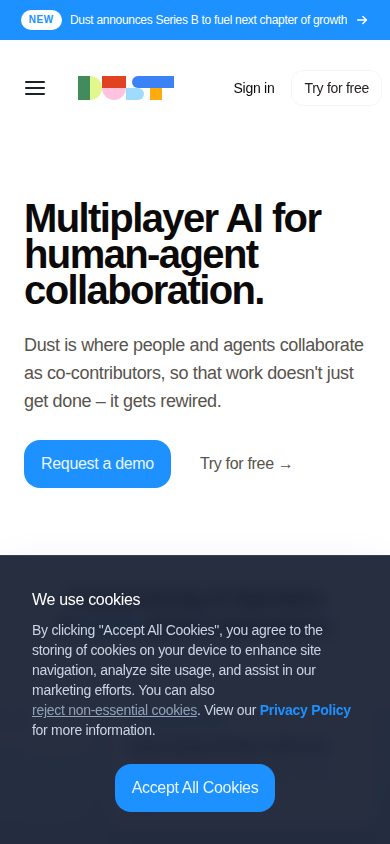
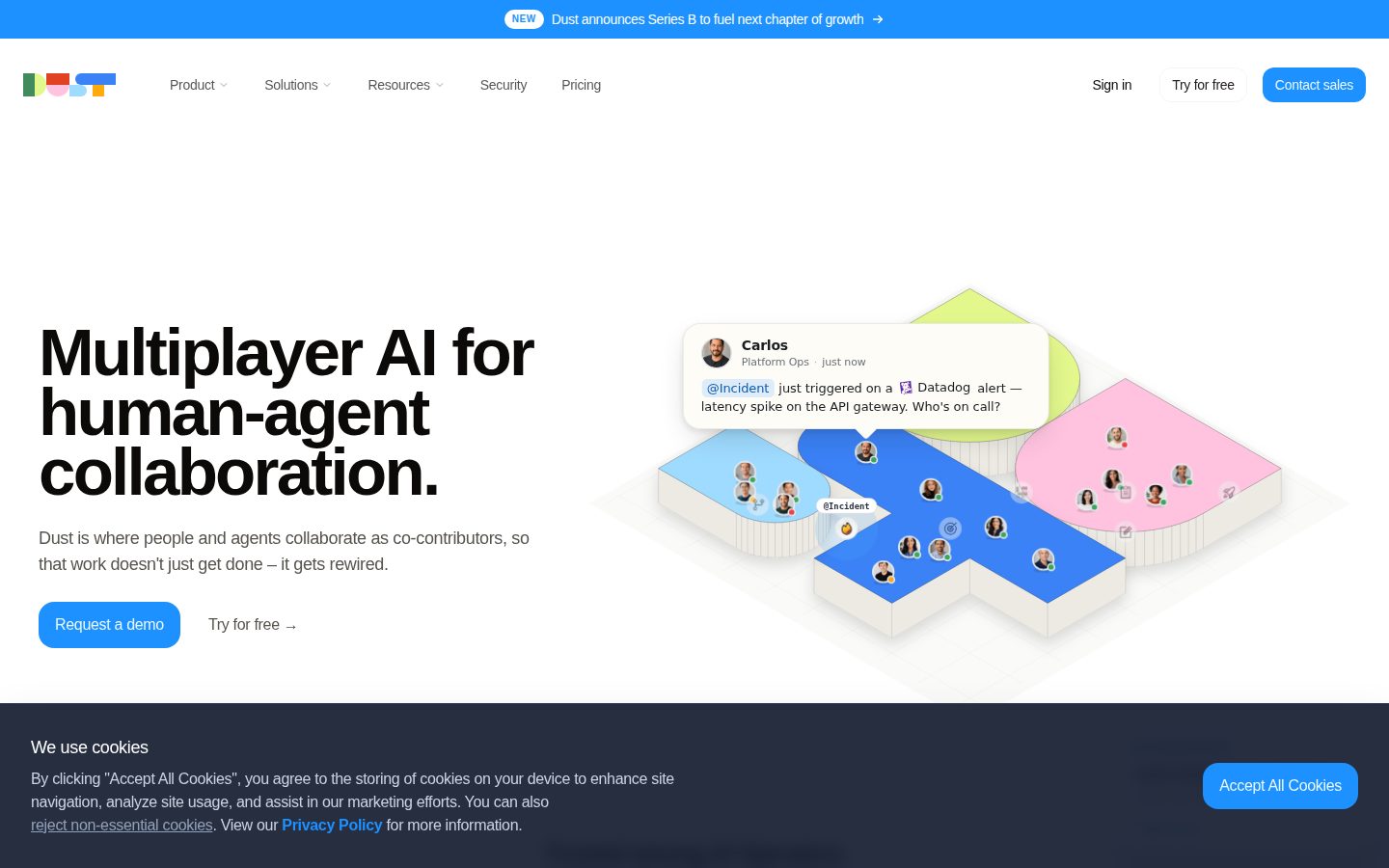
Multiplayer AI for human-agent collaboration

Dust is a platform for building and deploying custom AI agents connected to company data and tools.

AI Panel Score

7.4/10

6 AI reviews

Reviewed

AI Editor Approved

About Dust

Dust is used to create AI agents that connect to a company's existing data sources and software tools, then deploy those agents for use across a team. Users configure agents through a no-code interface, defining what data and tools each agent can access and what tasks it should perform, rather than writing custom integration code for each connection.

The platform's distinguishing focus is on 'multiplayer' agent use: agents are built to be shared and used collaboratively by multiple people within an organization, rather than functioning as individual, siloed AI assistants. Dust connects to company data repositories and business tools so agents can retrieve context and take actions grounded in that data, and it provides management capabilities for deploying, monitoring, and governing multiple agents across an organization.

Dust is aimed at companies that want to deploy AI agents across teams or departments without building custom infrastructure or requiring engineering resources for each new use case. It competes with other enterprise AI agent and orchestration platforms such as Glean, Writer, and Microsoft Copilot Studio. Pricing is contact-based, oriented toward business and enterprise customers rather than individual consumers.

The platform is delivered as a web-based product, with connections to external company data sources and tools configured through its interface rather than through self-hosted deployment by the customer.

Features

AI

  • Model-Agnostic AI

    Allows teams to choose and switch between leading LLMs such as OpenAI, Anthropic, Gemini, and Mistral to power their agents.

Analytics

  • Structured & Unstructured Data Tools

    Offers advanced tools for tasks like transcript/feedback analysis, visualization, and table queries across structured and unstructured data.

Automation

  • Automated Multi-Step Workflows

    Automates complex workflows such as multi-step processes and data orchestration directly through Dust agents.

Collaboration

  • Multiplayer Workspace

    Gives teams and agents shared access to the same knowledge, tools, conversations, and notifications in a single collaborative workspace.

Core

  • No-Code Agent Builder

    Lets any team member create and customize AI agents with tailored instructions and pre-built templates without writing code.

  • Real-Time Knowledge Synchronization

    Keeps agents grounded in current information through real-time synchronization with connected company knowledge bases and data sources.

Customization

  • Dust Apps (Custom Tooling)

    Enables developers to code custom tools and chained-block LLM/code pipelines in the Dust Builder that agents can call as parameterized functions.

Integration

  • Enterprise Data Connectors

    Provides 100+ production connectors (including Slack, Notion, GitHub, Google Drive, Salesforce, Zendesk, Jira, and Confluence) with bi-directional sync and incremental data refresh.

  • Multi-Surface Access

    Makes agents reachable from a conversation UI, Slack, a Chrome extension, a Raycast extension, and a CLI.

  • REST API & Developer Platform

    Exposes agents and data sources programmatically via a REST API, MCP servers, webhooks, and OAuth2 for custom application orchestration.

Security

  • Compliance Certifications

    Meets SOC 2, HIPAA, and GDPR standards so enterprises can deploy agents without compliance blockers.

  • Dual-Layer Permission Model

    Separates what agents can access from who can use them, using SCIM-synced groups and admin-gated overrides to prevent privilege escalation.

Preview

Dust desktop previewDust mobile preview

Pricing Plans

Free

Free

Business plan seat for occasional users or people trying Dust; lifetime credit allocation instead of monthly

  • 500 credits (lifetime)
  • 20+ frontier models (GPT, Claude, Gemini, Mistral, DeepSeek)
  • Custom agents with skills, knowledge & tools
  • Connect Slack, Notion, GitHub, Drive + 20 more
  • Team collaboration workspaces
Popular

Pro

$24/monthly

Business plan seat type best for most team members, billed yearly (24€/mo; 30€/mo billed monthly)

  • 8,000 credits/seat/month
  • 20+ frontier models with multi-modal input
  • Multi-agent workflows on schedules & triggers
  • SSO with Okta, Entra ID & Jumpcloud
  • US & EU data residency

Max

$120/monthly

Business plan seat type for power users running complex automations, deep research, or tool-heavy workflows, billed yearly (120€/mo; 150€/mo billed monthly)

  • 40,000 credits/seat/month
  • Best for heavy automation and deep research use cases
  • 20+ frontier models, custom agents & multi-agent orchestration
  • Connect Slack, Notion, GitHub, Drive + 20 more
  • SSO with Okta, Entra ID & Jumpcloud

Enterprise

Contact sales

For AI at scale; custom pricing available by talking to sales, includes everything in Business plus advanced security and support

  • Unlimited connectors & MCP servers
  • Workspace-pooled credits & volume pricing
  • SCIM, audit logs & custom data retention
  • Single-tenant deployment & US data residency
  • Dedicated CSM, priority support & SLA
  • Custom legal terms (MSA, DPA)

AI Panel Reviews

The Decision Maker

The Decision Maker

Strategic bet, vendor viability, timing, adoption approval
7.4/10

Solid multiplayer agent platform, priced right, but no public track record on durability.

Dust bets on shared team agents instead of solo copilots, backed by 100+ connectors and real compliance certs. Pricing is sane, the fundamentals are less proven.

$24/seat for Pro, 8,000 credits a month, SOC 2 and HIPAA covered. That's a real enterprise package, not a demo. The 100+ connectors — Slack, Salesforce, Zendesk, Jira — mean this isn't vaporware waiting on integrations.

The multiplayer angle is the actual differentiator against Glean and Copilot Studio, which mostly assume one user, one assistant. Shared agents with dual-layer permissions is a real architectural choice, not marketing language.

Two questions: no public funding data here, and a French entity (Permutation Labs SAS) competing against Microsoft's balance sheet is a real mismatch. Board optics are fine today. Ask again at renewal whether they're still shipping at this pace.

Competitive Positioning7.5

Distinct from Glean and Copilot Studio on shared-agent design, but adoption proof among peers is thin.

Reputation Risk7.0

SOC 2, HIPAA, GDPR certs de-risk the pitch to the board, but the vendor is still relatively unknown.

Speed to Value8.0

No-code builder and 100+ pre-built connectors mean pilots can go live in weeks, not quarters.

Strategic Fit7.8

Multiplayer agent model is a genuine architecture shift, not just cost savings on existing chatbots.

Vendor Viability6.0

No public funding data or team size; French SAS entity going against Microsoft-backed Copilot Studio.

Pros

  • 100+ production connectors with bi-directional sync
  • Multiplayer workspace is a real differentiator, not just branding
  • SOC 2, HIPAA, GDPR certifications out of the box
  • Model-agnostic across OpenAI, Anthropic, Gemini, Mistral

Cons

  • No public funding or headcount data to gauge runway
  • Contact-based enterprise pricing adds sales friction
  • Competing against Microsoft's distribution with Copilot Studio

Right for

Teams that want shared, cross-functional AI agents without building integration infrastructure.

Avoid if

Skip if you need a vendor with a long public track record before committing budget.

The Domain Strategist

The Domain Strategist

Craft and strategy in the product's domain — adapts identity per category, same lens
7.8/10

Model-agnostic architecture and a real permission model make Dust a credible three-year bet, not just a demo.

Dust separates data access from user access and doesn't lock you into one LLM vendor. That architectural choice matters more than the no-code builder headline.

The dual-layer permission model — separating what agents can access from who can use them, with SCIM-synced groups — is the part that tells me someone here has run enterprise IAM before. That's the piece competitors like Glean and Copilot Studio often bolt on late. Model-agnostic support across OpenAI, Anthropic, Gemini, and Mistral means if a frontier model provider stumbles, you're not stuck rebuilding agent logic from scratch.

100+ connectors with bi-directional sync is real integration surface, and the REST API plus MCP servers and webhooks means agents aren't a walled garden. If we adopt this, in three years we have agents woven into Slack, GitHub, and Salesforce workflows without a custom integration layer maintained by our own engineers.

The tradeoff: credit-based pricing (8,000/seat/month on Pro at $24) adds a metering layer you have to model against usage, and SOC 2/HIPAA/GDPR compliance is table stakes now, not differentiation. Dust Apps for custom tooling is the escape hatch when the no-code builder hits its ceiling.

Category Positioning7.5

Sits between Glean's search-first approach and Copilot Studio's Microsoft lock-in, differentiated on multiplayer collaboration.

Domain Fit8.2

Multiplayer/shared-agent model matches how teams actually deploy AI across departments, not single-user chat.

Integration Surface8.3

100+ connectors including Slack, GitHub, Salesforce, Confluence with bi-directional sync and incremental refresh.

Long-term Implications7.5

REST API, MCP servers, and Dust Apps give an exit path from the no-code ceiling; credit metering is an ongoing cost variable.

Strategic Depth8.0

Dual-layer permissions and model-agnostic architecture go beyond typical no-code agent tooling.

Pros

  • Model-agnostic across 20+ LLMs avoids single-vendor lock-in
  • Dual-layer permission model with SCIM groups is enterprise-grade access control
  • 100+ connectors with bi-directional sync, plus REST API and MCP servers for custom orchestration

Cons

  • Credit-based pricing adds a metering layer to forecast against usage patterns
  • Contact-based enterprise pricing obscures true cost until deep in sales cycle
  • No-code builder ceiling requires dropping into Dust Apps/code for complex tool chains

Right for

Organizations that want shared, governed AI agents across multiple departments without owning custom integration code.

Avoid if

Avoid if you need a single-user AI assistant or want fully self-hosted deployment control.

The Finance Lead

The Finance Lead

Money, total cost of ownership, contracts, procurement math
7.2/10

Credits, not seats. Pro at $24/mo hides a metering model finance needs to model carefully.

Three visible tiers plus Enterprise-by-quote. The credit system is the real cost driver, and it's not fully transparent.

Pro is $24/seat/month annual, $30 monthly. Max is $120/seat, 5x the price for 5x the credits — 40,000 vs 8,000. That's linear, at least. No hidden multiplier there.

50 seats × $24 × 12 = $14,400/year at Pro. Fine, until power users blow through 8,000 credits and get pushed to Max. Team of 50 with 10 heavy users at Max: $14,400 + 10×$96×12 = $25,920/year. Credit overage pricing isn't published — same blind spot as most agent platforms.

Annual billing implied by the 24€ vs 30€ split — standard lock-in play. Enterprise tier is contact-only, so real all-in cost at scale requires a sales call regardless. SOC 2 and HIPAA help procurement move fast. Compare to Glean or Copilot Studio: neither publishes credit-consumption math either. Category norm, not a Dust-specific flaw.

The Domain Practitioner

The Domain Practitioner

Daily hands-on reality in the product's domain — adapts identity per category, same lens
7.6/10

Real connector depth and a REST API, but credits-as-currency adds a metering tax to every workflow

Dust ships 100+ production connectors and lets developers drop into custom code via Dust Apps when the no-code builder hits a wall. The credit-based pricing model is the thing that'll bug engineers by week two.

100+ connectors with bi-directional sync (Slack, GitHub, Notion, Salesforce) is a real number, not marketing fluff — that's Glean-tier integration breadth. The REST API, MCP servers, and webhooks mean you're not stuck in the chat UI; you can wire agents into existing CI/CD or internal tooling, which Copilot Studio makes harder for non-Microsoft shops.

Day-3 friction: credits. Pro seat gets 8,000 credits/month, Max gets 40,000. Fine until a multi-agent scheduled workflow burns through a chatty LLM loop and you're watching a meter instead of debugging logic. That's a different mental model than Writer's flat-rate seats.

Dust Apps (the chained-block builder) is where power-user depth actually lives — parameterized functions agents can call, versus just prompt templates. No public docs or changelog in this evidence set, though, so I can't tell if the API reference is written by engineers or by growth marketing.

Day-3 Reality7.5

Real connectors and API access hold up past the demo, but credit metering (8,000/seat/month on Pro) becomes a visible constraint fast.

Documentation Practitioner-Fit6.0

No public docs, API reference, or changelog surfaced in the evidence — can't verify practitioner-level depth.

Friction Surface7.0

Dual-layer permissions and SCIM groups are solid but add setup overhead most no-code tools skip.

Power-User Depth8.2

Dust Apps lets developers chain custom code and LLM calls into parameterized functions, a real escape hatch beyond the no-code builder.

Workflow Integration8.0

Slack, Chrome extension, Raycast, and CLI surfaces mean agents show up where engineers already work.

Pros

  • 100+ production connectors with bi-directional sync and incremental refresh
  • REST API, MCP servers, and webhooks for custom orchestration
  • Model-agnostic across OpenAI, Anthropic, Gemini, Mistral
  • Dust Apps gives engineers a coded escape hatch from the no-code builder

Cons

  • Credit-based pricing (500 lifetime on Free, 8,000/mo on Pro) adds a metering layer to every automation
  • No visible public docs or changelog to judge documentation quality
  • Contact-based enterprise pricing obscures true cost at scale

Right for

Engineering teams that want a coded escape hatch alongside a no-code agent builder and already live in Slack, GitHub, or Notion.

Avoid if

You want flat-rate, unmetered usage without watching a credit counter on every scheduled workflow.

The Power User

The Power User

Daily human experience, onboarding, polish, learning curve, reliability
7.3/10

A solid agent builder for teams, but the credit math needs a spreadsheet before day one.

Dust does the no-code agent thing well and leans into sharing agents across a team instead of everyone building their own. The pricing structure and mobile story are where it gets a little homework-y.

Dust's whole pitch is 'multiplayer' agents, and the feature list backs it up: shared workspace, 100+ connectors (Slack, Notion, Salesforce, Zendesk), and a dual-layer permission model so admins control access without babysitting every agent. That's the kind of detail that tells me someone's actually thought about what happens after the demo, when twelve people are poking the same agent.

What worries me a bit is the credit system. Free gives you 500 credits for life, Pro is 8,000/seat/month at $24, Max jumps to 40,000 for $120. That's a lot of arithmetic for a team lead to do before rollout, and credits-as-currency always gets confusing by month two when nobody remembers what a 'query' costs.

No mobile app, web only, so if you're picturing agents in your pocket like Copilot Studio promises, that's not here yet. Against Glean or Writer, Dust's edge is the collaborative framing and model-agnostic setup (OpenAI, Anthropic, Gemini, Mistral). Onboarding looks low-friction since there's no code required, but SOC 2 and HIPAA checkboxes suggest this is built for IT approval more than solo tinkering.

Daily Polish7.0

Shared workspace and real-time knowledge sync suggest daily-use thinking, but no changelog or docs evidence to confirm sweat on small details.

Learning Curve7.0

Easy start with no-code agents, but multi-agent orchestration and Dust Apps custom tooling mean real depth takes months, not days.

Mobile Parity4.5

Platforms listed as web only; Slack, Chrome, and Raycast extensions exist but no dedicated mobile app.

Onboarding Experience7.5

No-code builder and templates lower the barrier, and a free tier with 500 lifetime credits lets you poke around before committing.

Reliability Feel7.2

SOC 2, HIPAA, GDPR compliance and incremental data refresh point to enterprise-grade plumbing, though no public uptime or status data given.

Pros

  • 100+ connectors including Slack, Salesforce, GitHub, Confluence
  • Shared 'multiplayer' agent model instead of siloed single-user bots
  • Model-agnostic across OpenAI, Anthropic, Gemini, Mistral
  • SOC 2, HIPAA, GDPR compliance out of the gate

Cons

  • No mobile app, web-only platform
  • Credit-based pricing across tiers adds a layer of math for buyers
  • No public docs, API reference, or changelog evidence to verify claims

Right for

Teams who want shared AI agents wired into existing tools like Slack and Notion without hiring engineers.

Avoid if

Avoid if you need a real mobile experience or want simple flat-rate pricing without tracking credits.

The Skeptic

The Skeptic

Contrarian. Watch-outs, deal-breakers, broken promises, category patterns
6.9/10

Multiplayer AI agents, credit-metered pricing, and a name — Permutation Labs SAS — I hadn't heard of.

Feature list is deep, connector count is real, but 'multiplayer' is doing a lot of positioning work against Glean and Copilot Studio. Credit-based pricing is the tell to watch.

Three tells before the docs. One: no changelog or blog surfaced in the scrape — hard to judge shipping cadence. Two: credits-not-seats pricing (500 lifetime free, 8,000/month on Pro at $24) is the kind of metering that gets confusing fast, ask Zendesk resellers. Three: 'multiplayer' is a positioning word, not yet a proven pattern — I've seen shared-workspace framing before, from Slack-era collab tools that later fragmented back to single-user.

That said, the connector list is concrete: 100+ integrations, SOC 2, HIPAA, GDPR, SCIM. That's not vaporware language, that's a compliance checklist enterprises actually ask for.

Exit portability is the real question. Agents, instructions, and workflows built in Dust's no-code builder don't travel to Glean or Copilot Studio without rebuilding. Model-agnostic LLM choice helps, but the orchestration layer is proprietary. Fine if Dust sticks around three years. Riskier if it doesn't.

Competitive Differentiation7.0

Shared multiplayer agents vs. single-user is a real angle against Glean and Copilot Studio, unproven at scale.

Exit Portability5.5

Agent configs and Dust Apps pipelines are proprietary; no export path mentioned.

Long-term Viability6.8

SOC 2/HIPAA/GDPR and enterprise tier signal real customers, but no changelog or team size visible.

Marketing Honesty7.0

Claims (100+ connectors, SOC 2, HIPAA) are specific and checkable, not just superlatives.

Track Record Match6.5

Fits the emerging enterprise-agent pattern but no public funding or age data to confirm durability.

Pros

  • 100+ connectors including Salesforce, Zendesk, Jira with bi-directional sync
  • SOC 2, HIPAA, GDPR compliance already in place
  • Model-agnostic across 20+ LLMs avoids vendor lock to one model provider

Cons

  • Credit-based pricing (500 lifetime free, 8,000/month Pro) adds a metering layer to track
  • No visible changelog or blog to gauge shipping pace
  • Multiplayer agent configs don't obviously export if you switch platforms

Right for

Mid-size or enterprise teams wanting shared, cross-department agents without engineering builds.

Avoid if

You want a portable, self-hosted setup or need to avoid credit-based pricing complexity.

Buyer Questions

Common questions answered by our AI research team

Features

Do I need coding skills to build agents in Dust?

No coding skills are required to build custom AI agents in Dust.

Integration

Can Dust agents connect to internal company data?

Yes, Dust agents connect to internal company data so they can act on real workflows.

Features

What makes Dust different from single-user AI assistants?

Dust emphasizes shared, 'multiplayer' use of agents across teams rather than single-user AI assistants, letting people and agents collaborate on the same tasks.

Features

Can multiple team members share the same AI agent?

Yes, Dust is built around shared, multiplayer use of agents across teams rather than single-user access.

Integration

Does Dust connect with third-party tools?

Yes, Dust connects agents to third-party tools so they can act on real workflows.

Also in AI Agents & Assistants