edX logo

edX Review

Visit

Online courses, certificates, and degrees from Harvard, MIT, and 200+ institutions

edX is an online learning platform for learners seeking university-level courses, professional certificates, and accredited degrees.

AI Panel Score

7.3/10

6 AI reviews

Reviewed

AI Editor Approved

What is edX?

edX is an online learning platform offering university-level courses, professional certificates, and accredited degrees from more than 200 partner institutions, including Harvard, MIT, UC Berkeley, Stanford, and Columbia. Learners can audit most courses free of charge or pursue structured credential paths such as Verified Certificates, XSeries, MicroBachelors, MicroMasters, and full bachelor's or master's degrees. Pricing spans one-time fees — Verified Certificates from about $50, Professional Certificate programs near $200, MicroMasters programs around $600, and online master's degrees reaching $10,000 — while edX for Business subscriptions start at $12.50 per month for the Essentials tier, with Teams at $33. Additional capabilities include discussion forums, identity verification for certificates, financial assistance for verified tracks, a mobile app with offline access, and learner outcomes and completion data. The platform fits students and professionals seeking credentialed, university-backed learning, and organizations upskilling teams through the edX for Business tiers.

About edX

On edX, learners browse a catalog organized by subject area — including computer science, business, engineering, and more — then enroll in self-paced or scheduled courses. Course content typically includes video lectures, graded assignments, discussion forums, and interactive exercises. Learners can audit many courses for free or pay to receive a verified certificate upon completion.

The platform offers multiple credential formats beyond single courses: XSeries programs bundle related courses into a sequence, Professional Certificates target specific job-ready skills, and full degree programs (bachelor's, master's, and doctorate) are offered in partnership with accredited universities. Notable standalone programs include Harvard's CS50 Introduction to Computer Science, one of the most widely enrolled online courses globally.

edX serves individual learners as well as enterprise clients through its business offering, which provides workforce training and credential programs for organizations. Many courses are auditable at no cost, with verified certificates typically priced per course; degree programs carry tuition set by the partner institution. Competitors in the online learning space include Coursera, Udemy, and Udacity.

Courses are delivered via web browser with mobile-responsive design, and the platform targets WCAG 2.1 AA accessibility standards. Content is available primarily in English, with a Spanish-language catalog also offered.

Features

Analytics

  • Learner Outcomes and Completion Recommendation Data

    edX tracks and reports program outcomes, such as the percentage of Professional Certificate, MicroBachelors, and MicroMasters completers who would recommend their program to others.

Collaboration

  • Discussion Forums

    Learners can connect with a global community of students and share ideas through course discussion forums.

Core

  • Free Audit Track

    Learners can audit most courses at no cost, gaining temporary access to video lectures, readings, and practice assignments without earning a certificate.

  • Full Degree Programs

    Learners can apply to enroll in complete bachelor's, master's, or doctoral degree programs delivered through edX.

  • MicroBachelors and MicroMasters Programs

    edX offers MicroBachelors and MicroMasters programs that let learners earn transferable college credit or advance graduate-level standing, with MicroMasters completers able to apply credit toward a full graduate degree.

  • Professional Certificate and Executive Education Programs

    edX bundles multiple courses into Professional Certificate and Executive Education programs designed for career-focused skill building from industry leaders and universities.

  • Verified Certificates

    Learners on the verified track complete graded assignments and receive an official, shareable certificate confirming course completion, each with a unique authenticating URL and ID.

Integration

  • Multiple Payment Options

    Learners pursuing verified certificates can pay course fees using either credit cards or PayPal.

  • Third-Party Authentication for Institutional Partners

    edX Edge supports third-party authentication so partner institutions can enable single sign-on between campus systems and edX courses.

Mobile

  • Mobile App with Offline Access

    The edX mobile app allows learners to download videos and transcripts for offline viewing, useful for studying without an internet connection.

Security

  • Identity Verification for Certificates

    Verified certificates require identity verification steps, such as photo ID checks, to ensure certificate authenticity.

Support

  • Financial Assistance for Verified Certificates

    Learners who want to earn verified certificates can apply for financial assistance to help cover certificate costs.

Preview

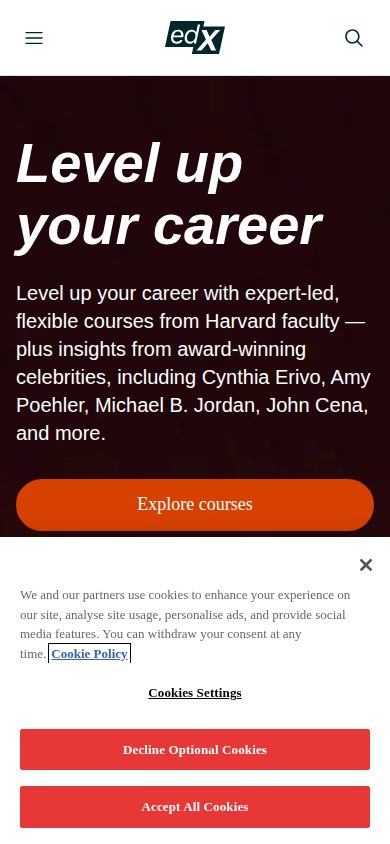
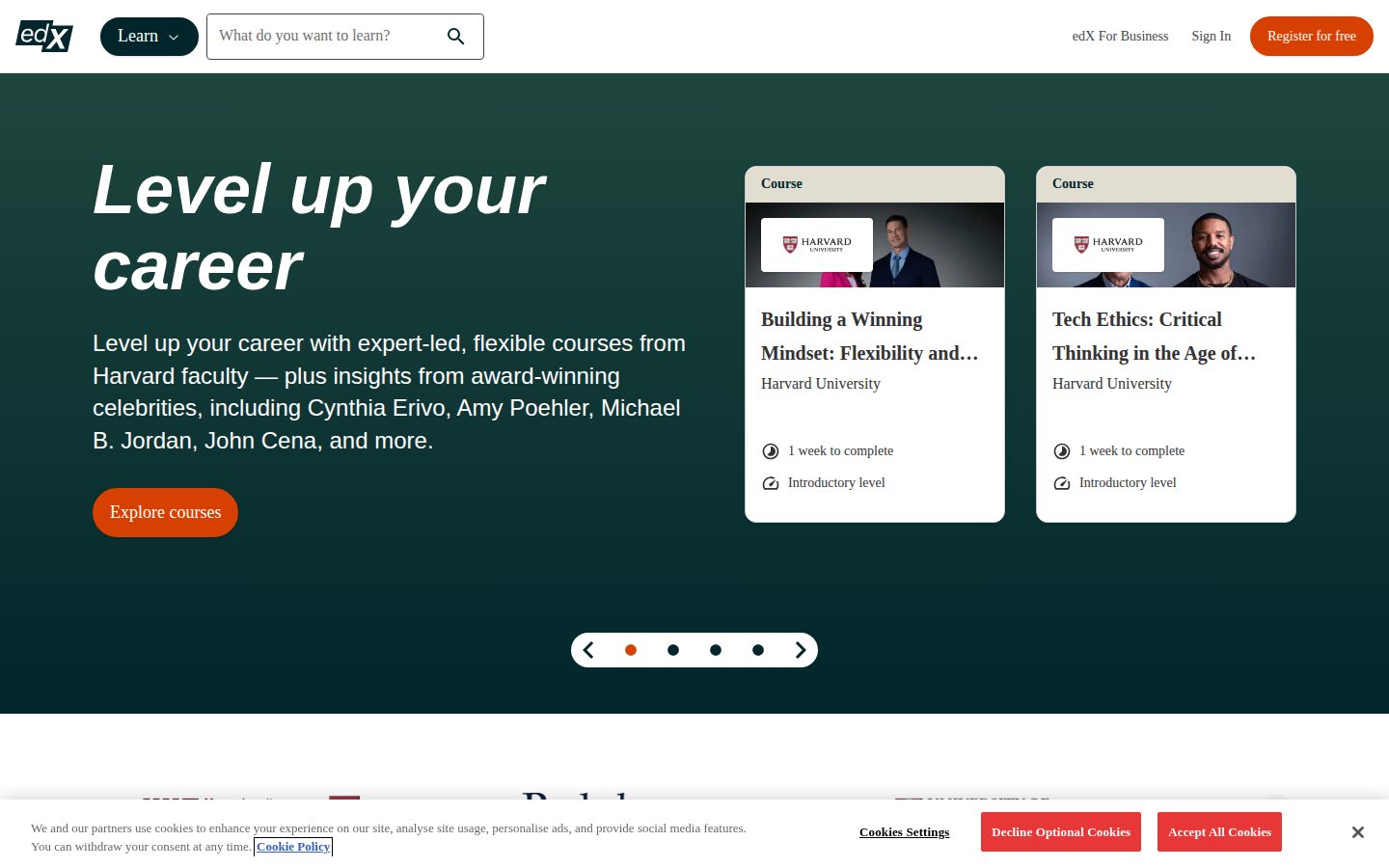
edX desktop previewedX mobile preview

Pricing Plans

Audit (Free)

Free

For learners who want to explore course content at no cost, without earning a certificate. Suitable for casual learners or those testing a subject.

  • Free access to course content for most courses
  • Self-paced learning
  • No graded assignments or certificates included
  • Access to thousands of courses from top universities
Popular

Verified Certificate

$50/one-time

For individual learners who want an accredited, shareable certificate upon completing a course. Price varies per course ($50–$300).

  • Verified certificate of completion per course
  • Graded assignments included
  • Courses from top universities (Harvard, MIT, etc.)
  • Certificates recognized by employers and industries
  • Price varies: $50–$300 per course

Professional Certificate Program

$200/one-time

For career advancers seeking a multi-course credential in a specific professional domain. Prices range from ~$200 to $2,500 depending on program.

  • Multi-course professional certificate
  • Career-focused skill building
  • Courses from universities and industry partners
  • Price range: ~$200–$2,500 per program

MicroMasters / MicroBachelors Program

$600/one-time

For learners pursuing graduate or undergraduate-level credentials as a pathway toward a full degree. Ranges from $600–$1,500.

  • Advanced academic-standing digital certificate
  • Credit pathway toward a full Master's or Bachelor's degree
  • Self-paced, 6–12 months to complete
  • Offered by partnering universities
  • Price range: $600–$1,500 per program

Online Master's Degree

$10,000/one-time

For learners seeking a fully accredited online Master's degree from a partnering university. Ranges from $10,000–$25,000.

  • Fully accredited Master's degree
  • Delivered entirely online
  • Offered via top university partners
  • Price range: $10,000–$25,000 per program

Executive Education

$1,000/one-time

For business professionals and executives seeking intensive, university-led short programs. Ranges from $1,000–$5,000.

  • Short, intensive programs led by top universities
  • Designed for working professionals and executives
  • No prior degree required
  • Price range: $1,000–$5,000 per program

edX for Business – Essentials

$13/monthly

For small teams or organizations focused on upskilling in a single area. Billed annually at $12.50/user/month.

  • 1 Academy of your choice (16 self-paced courses)
  • Certificates for completed courses
  • Admin course assignment and learner progress reports
  • Billed annually
Popular

edX for Business – Teams

$33/monthly

For teams needing broad access to edX's full subscription course library. Billed annually at $33/user/month.

  • 8 Academies included
  • 2,300+ self-paced courses
  • 300+ professional certificates
  • Admin dashboards, course assignment, and learner progress reports
  • Certificates for completed courses
  • Billed annually

edX for Business – Enterprise

Contact sales

For organizations with 50+ learners requiring the full course library plus premium services. Pricing is customized — contact edX sales for a quote.

  • Everything in Teams plan
  • Full subscription course library
  • Advanced analytics to measure skill development
  • Dedicated customer success support
  • Tailored LMS integrations (SAP SuccessFactors, Degreed, Cornerstone, etc.)
  • Volume discounts available
  • Billed annually

AI Panel Reviews

The Decision Maker

The Decision Maker

Strategic bet, vendor viability, timing, adoption approval
7.2/10

Fifteen years old, 940+ enterprise customers, and still hard to justify as a strategic bet.

edX is credible and cheap for workforce upskilling. It's not a differentiator, it's a utility.

edX has been around since 2012, backed by Harvard and MIT, now under 2U's umbrella. That's longevity, not momentum — 2U itself went through a messy restructuring. Time-in-market is real, but the parent company's financial health is a fair question for anyone signing a multi-year Enterprise deal.

Strategically, this is a cost play, not an advancement play. $33/user/month for Teams gets you 2,300+ courses and 300+ certificates, which is a fine benchmark against Coursera for Business. It doesn't move your competitive position — it just makes training cheaper.

No board member will blink at edX on an expense report. None will be impressed by it either. Fine for compliance-style upskilling, forgettable everywhere else.

Competitive Positioning6.8

940+ enterprises already use it, so it's a proven category norm rather than a differentiator versus Coursera or Udemy.

Reputation Risk7.5

Harvard, MIT, and Stanford branding makes this a safe, unremarkable choice to defend to a board.

Speed to Value7.0

Enterprise plan launches fast with prebuilt Academies and admin dashboards, but degree-track ROI takes years.

Strategic Fit6.5

Solid for workforce upskilling via edX for Business, but it's cost-optimization on training, not a growth lever.

Vendor Viability7.0

Operating since 2012 with 200+ university partners, though parent 2U's financial instability is a real risk factor.

Pros

  • Deep credential ladder from free audit to accredited master's degrees
  • Enterprise tier at $33/user/month with 2,300+ courses is competitively priced
  • Named-brand partners (Harvard, MIT, Oxford) reduce reputational risk

Cons

  • Parent company 2U's financial troubles cloud long-term viability
  • No meaningful differentiation from Coursera in workforce training use cases
  • Degree program tuition ($10K-$25K) requires serious individual commitment, not a quick team win

Right for

Companies wanting cheap, brand-safe upskilling content without building anything custom.

Avoid if

You need a training platform that gives you a competitive edge, not just a checkbox.

The Domain Strategist

The Domain Strategist

Craft and strategy in the product's domain — adapts identity per category, same lens
7.6/10

Strong credentialing depth, but the L&D workflow layer trails Coursera for Business on analytics maturity.

edX gives learning teams real academic credibility through university partners like Harvard and MIT, at a price point that scales from audit-free to enterprise. What it lacks is the granular workforce-skills mapping senior L&D buyers now expect as table stakes.

940+ enterprises already run on edX for Business, and the tiering — Essentials at $12.50/user/month up to Enterprise with SAP SuccessFactors and Cornerstone integrations — shows they understand procurement cycles, not just consumer checkout. The Teams tier's 2,300+ courses and 300+ professional certificates give a learning team real catalog depth without building content ourselves.

Where it thins out: 'advanced analytics to measure skill development' is Enterprise-only, gated behind a sales call. Coursera for Business publishes skill benchmarking more transparently. If we adopt edX at the Teams tier, in three years we own a content subscription, not a skills infrastructure — that's a real distinction for anyone building competency frameworks.

Academy structure and admin dashboards are solid operational bones. The tradeoff: strong on credential prestige (CS50, MIT MicroMasters), thinner on the workforce analytics layer that justifies budget renewal to a CFO.

Category Positioning8.0

Sits above Udemy on credential prestige; competes directly with Coursera for Business on enterprise upskilling.

Domain Fit7.5

Academies and stackable credentials (MicroMasters, Professional Certificates) map well to structured upskilling paths.

Integration Surface7.4

LMS integrations with SAP SuccessFactors, Degreed, Cornerstone exist but are reserved for Enterprise, not Teams.

Long-term Implications7.2

Teams plan at $33/user/month locks in a content subscription; skills-data ownership stays vendor-side.

Strategic Depth7.8

University-grade content (Harvard, MIT, Oxford) is genuinely differentiated, but reporting depth caps at Enterprise tier.

Pros

  • 260+ university and industry partners including Harvard, MIT, Stanford
  • Stackable credential paths from audit to full accredited degree
  • Enterprise tier includes dedicated customer success and tailored LMS integrations

Cons

  • Advanced skills analytics gated behind custom Enterprise pricing
  • No free trial for business tiers, only a free consumer audit track
  • Content primarily English, limiting global L&D rollouts

Right for

L&D teams that want brand-credible university content and are willing to negotiate Enterprise pricing for real analytics.

Avoid if

You need transparent, self-serve skills-gap reporting without a sales call.

The Finance Lead

The Finance Lead

Money, total cost of ownership, contracts, procurement math
6.9/10

Free audit track is real. Everything past it is á la carte pricing chaos.

Certificates run $50-$300. Programs stack up to $25,000. Numbers are visible, but the range is the problem.

Free audit track: $0. That's honest. Verified certificate: $50-$300 per course. Professional Certificate: $200-$2,500. MicroMasters: $600-$1,500. Online Master's: $10,000-$25,000. That's not a price. That's a price range wide enough to drive a procurement team insane.

Team of 50, Business Essentials tier: $12.50/seat × 50 × 12 = $7,500/year for one Academy. Teams tier: $33/seat × 50 × 12 = $19,800/year for 2,300+ courses. Enterprise is quote-only — the usual sales-call tax once you cross 50 learners.

Compare to Coursera for Business, similarly tiered, similarly opaque past a point. edX's individual-course pricing is at least published upfront — rare in this category. No stated auto-renewal terms in the evidence. Billed annually on the team plans, one-time per course elsewhere. ROI is measurable for certificates (completion, credential), murky for degree tuition ($10K-$25K) where outcomes depend entirely on the learner, not the platform.

Billing & Procurement6.8

Credit card and PayPal for individuals; Enterprise tier requires a sales quote past 50 learners.

Contract Flexibility6.0

Business plans billed annually with no stated cancellation or renewal terms in evidence provided.

Pricing Transparency7.0

Course and cert prices published, but ranges ($50-$300, $10K-$25K) hide the real number until checkout.

ROI Clarity7.5

edX publishes completion and recommendation rates per program, a rare measurable data point for this category.

Total Cost of Ownership6.5

Teams tier at $33/seat/year scales predictably; degree and cert stacking can push individual TCO into five figures.

Pros

  • Free audit track for most courses, no card required
  • Named-university credibility: Harvard, MIT, Oxford, Cambridge
  • Financial assistance can cut cert cost up to 90%

Cons

  • Wide, unpredictable price ranges on certs and degrees
  • Enterprise pricing hidden behind a sales call
  • No stated contract terms for Business subscriptions

Right for

Individual learners and mid-size teams who want published per-course pricing and can budget in ranges.

Avoid if

You need locked, predictable per-learner costs across degree-level programs.

The Domain Practitioner

The Domain Practitioner

Daily hands-on reality in the product's domain — adapts identity per category, same lens
7.6/10

Great for building a cohort curriculum, clunky the moment you need custom pacing controls

edX gives me real university content to build a training plan around, and the Business tier plans handle rostering at scale. But the day-to-day facilitation tools feel like they were designed for solo MOOC learners, not cohort-based training programs.

As a Trainer, my daily question is: can I build a curriculum path and actually track who's stuck? edX gives me raw material — CS50, MicroMasters, Professional Certificates — but the admin dashboard on the Teams plan ($33/user/month) is where I live, and it's thinner than Coursera for Business on granular nudging. Discussion forums exist, but there's no live cohort-pacing layer; learners drift on self-paced tracks, which is fine for individual audit learners, bad for corporate cohorts I need finishing together.

Assigning an Academy (8 included on Teams) is straightforward. Progress reports exist for admins. But intervention — flagging a learner who stalled week two — isn't a one-click action, it's a report you have to interpret yourself.

The tradeoff: incredible content depth (260+ partners) versus shallow facilitation tooling. Fine for self-directed upskilling, frustrating if you're running a structured onboarding cohort.

Day-3 Reality7.0

Course content holds up, but cohort tracking beyond audit/verified status is thin.

Documentation Practitioner-Fit6.5

No visible docs/API capability flagged in evidence; buyer Q&A reads more marketing FAQ than trainer runbook.

Friction Surface7.0

Verified ID checks and per-course pricing ($50-$300) add small approval friction for every enrollment.

Power-User Depth7.8

Stackable credentials (MicroBachelors to full Master's, $10k-$25k) show real depth from beginner to advanced path.

Workflow Integration7.5

SSO via edX Edge and LMS integrations (SAP SuccessFactors, Cornerstone) fit enterprise stacks well.

Pros

  • Deep credential ladder from free audit to full accredited Master's degrees
  • Enterprise tier includes advanced analytics and dedicated customer success support
  • 940+ enterprises already running programs, per their own numbers

Cons

  • Facilitation tools lag content depth — no live cohort-pacing layer
  • Admin intervention on stalled learners requires manual report reading
  • No visible API or docs presence for building custom reporting

Right for

Trainers building self-paced upskilling paths for individual learners or large asynchronous cohorts.

Avoid if

Avoid if you need tight, live cohort facilitation with automated stall alerts.

The Power User

The Power User

Daily human experience, onboarding, polish, learning curve, reliability
7.2/10

Great catalog, but the day-to-day still feels like a course website from 2015.

The credential ladder from free audit to full Master's degree is genuinely impressive on paper. Whether it feels good to use every day is a different question.

edX's strength is breadth. Free audit track, verified certificates at $50-$300, MicroMasters, and full Master's degrees running $10,000-$25,000 — that's a real ladder, not just a course catalog. CS50 alone pulls people in the door for free, which is smart bait.

But nothing in the evidence suggests anyone sweated the daily experience. No changelog, no docs, no visible product blog — that's usually a tell the platform side isn't iterating fast. Discussion forums are the main social layer, and forums age about as well as milk once a cohort moves on.

Mobile has offline video downloads, which is a real feature, not a token gesture. Compared to Coursera's slicker specializations or Udemy's instant-gratification single courses, edX reads more institutional, less app-native. Fine for a learner chasing a Harvard-branded certificate. Less fine if you want a tool that feels alive between login sessions.

Daily Polish6.0

No blog, changelog, or docs surfaced in evidence — nothing signals ongoing craft investment.

Learning Curve7.3

Structured paths (MicroBachelors, MicroMasters, Professional Certificates) give clear next steps beyond a single course.

Mobile Parity7.5

Offline video and transcript downloads on the app is a real feature, not window dressing.

Onboarding Experience7.0

Free audit track lets you start immediately with no payment, which lowers the homework feeling.

Reliability Feel7.0

Identity verification and unique certificate URLs suggest solid backend rigor, though no uptime data given.

Pros

  • Free audit track on most courses before you pay anything
  • Real credential ladder up to accredited Master's degrees ($10,000-$25,000)
  • Enterprise plan integrates with SAP SuccessFactors, Degreed, Cornerstone

Cons

  • No visible changelog or blog suggests slow platform iteration
  • Discussion forums as the main community feature feel dated next to Coursera
  • Certificate pricing swings wildly ($50-$2,500) depending on program

Right for

Someone chasing a specific university-branded credential who doesn't mind a plain interface.

Avoid if

You want a slick, constantly-updated app experience like Udemy's.

The Skeptic

The Skeptic

Contrarian. Watch-outs, deal-breakers, broken promises, category patterns
7.2/10

2U's bankruptcy owns this now. That changes the calculus.

edX itself is a 2012 nonprofit-turned-2U-asset with real university partners and CS50-level content. The parent company's 2024 Chapter 11 is the thing nobody puts on the pricing page.

Harvard, MIT, CS50. That's real. 940+ enterprises on the business side, 260+ partners, a $12.50/seat Essentials tier that undercuts Coursera for Business on paper. The credential ladder — audit free, verified $50-300, MicroMasters $600-1500, full Master's $10k-25k — is legible pricing, not vague 'contact sales' fog except at the top tier.

What's missing is the part that worries me: no docs, no changelog, no API listed in the evidence. For an LMS integrating with SAP SuccessFactors and Cornerstone, that's a real gap if you're an IT buyer evaluating lock-in.

2U acquired edX in 2021, then filed Chapter 11 in 2024. Coursera didn't. Udacity nearly folded its consumer side already. A degree with your name on the certificate probably survives an acquisition. A Teams subscription with admin dashboards might not survive a re-org. Verified certificates carry unique authenticating URLs, which is good for portability of what you've already earned — bad odds on what you haven't started yet.

Competitive Differentiation7.0

Full accredited degree programs from Harvard and MIT partners is a real gap versus Udemy; overlaps heavily with Coursera's degree business.

Exit Portability7.0

Certificates have unique IDs and persist post-completion, but active subscriptions and enterprise LMS integrations don't port cleanly.

Long-term Viability6.5

No docs, API, or changelog listed; parent company's 2024 bankruptcy filing is a public signal that outweighs the enterprise client count.

Marketing Honesty7.5

Pricing ranges are specific and the free audit track is real, not a bait-and-switch trial.

Track Record Match6.0

2012 nonprofit MOOC pattern that got absorbed by 2U in 2021, then 2U filed Chapter 11 in 2024.

Pros

  • Free audit track on most courses with no trial gimmick
  • Legible pricing ladder from $0 to $25,000
  • Named-brand partners (Harvard CS50, MIT, Oxford) with real accreditation

Cons

  • Parent company 2U filed Chapter 11 in 2024
  • No API, docs, or changelog visible for enterprise IT evaluation
  • Verified certificate pricing swings widely ($50-$300) with little transparency on why

Right for

Individual learners or small teams who want a specific accredited credential and don't need deep LMS integration guarantees.

Avoid if

You're an enterprise buyer needing contractual certainty about vendor stability over a multi-year Enterprise LMS rollout.

Buyer Questions

Common questions answered by our AI research team

Pricing

How much does an edX verified certificate cost?

Individual course certificates start as low as $50, with verified certificates typically running $50-$300 depending on the course and institution. Multi-course Professional Certificates start at around $500.

Pricing

Does edX offer financial aid or discounts?

Yes. edX financial assistance can cut verified course fees by up to 90%, bringing a $100-$300 course down to as little as $10-$30. edX also runs promotions, currently up to 15% off select courses with code GOALS2026.

Setup

How do I start learning on edX without paying?

Enroll in the free audit track: auditors get temporary access to edX course materials at no cost. You can start immediately, then upgrade to the verified track for graded assignments, unlimited access, and a certificate.

Features

What programs does edX offer besides single courses?

edX offers self-paced individual courses plus stackable credentials: MicroBachelors, MicroMasters, Professional Certificates, Executive Education, and full bachelor's, master's, and doctorate degrees from partners like Harvard, MIT, Oxford, and Cambridge.

Integration

Does edX offer team plans for companies?

Yes. edX For Business offers Essentials, Team, and Enterprise subscription plans with unlimited access to courses and certificate programs. Content spans 260+ university and industry partners, and 940+ enterprises use the platform.

Product Information

  • Company

    edX
  • Founded

    2012
  • Pricing

    From $13/mo
  • Free Plan

    Available

Platforms

webiosandroid

About edX

edX is an online learning platform based in Cambridge, Massachusetts, offering courses and degree programs from universities and companies. It operates as part of 2U, Inc.

Also in AI Education & Training