LogicMonitor logo

LogicMonitor Review

Visit

Infrastructure monitoring and AI-driven IT operations for enterprises

LogicMonitor is a hybrid observability platform for monitoring infrastructure, cloud, and application performance.

LogicMonitor·Founded 2008·From $16/moFree TrialAI AnalyticsAI DevOpsAI Security

AI Panel Score

7.5/10

6 AI reviews

Reviewed

AI Editor Approved

About LogicMonitor

LogicMonitor works by collecting metrics and events across infrastructure, cloud, network, and application layers into one platform, giving IT teams a consolidated view instead of switching between separate monitoring tools. Users configure the system to detect anomalies and issues across their environment, then rely on built-in context and correlation to identify root causes rather than manually piecing together data from disparate sources. Workflows can be automated with approvals, audit trails, rollback, and validation steps built in, allowing teams to act on detected issues under governed conditions rather than purely manual intervention.

A central feature is Edwin AI, a set of AI agents designed to move teams from raw alert signals to informed action. Edwin AI applies context-aware reasoning and business-aware prioritization to correlate alerts and generate recommended next steps, with the company citing under one hour to correlate alerts and deliver insights. The platform also extends beyond traditional infrastructure monitoring to cover user experience across application journeys, network paths, internal APIs, LAN, WAN, Wi-Fi, and internet dependencies, aiming to close the gap between backend infrastructure monitoring and actual user-facing service performance.

LogicMonitor is built for enterprise IT operations, network, and infrastructure teams managing complex, always-on systems, including customers such as Topgolf, Nine Entertainment Co., Syngenta, Capital Group, and Nexon. It competes in the observability and IT operations management category alongside products such as Datadog, SolarWinds, and Dynatrace. Pricing is not published in fixed tiers on the homepage and is handled through direct contact with the company, though a public pricing page exists on the site.

The platform is delivered as a cloud-based (SaaS) service accessed via a web interface, monitoring on-premises, cloud, and edge infrastructure without requiring the monitoring software itself to be self-hosted. It is recognized in the 2025 Gartner Magic Quadrant for Digital Experience Monitoring and holds ratings of 4.5/5 on G2 (635 reviews) and 4.8/5 on Gartner Peer Insights (149 reviews).

Features

AI

  • Anomaly Detection

    Analyzes log data to identify anomalies proactively, helping reduce mean time to resolution (MTTR) before manual sifting is needed.

  • Edwin AI

    Applies context-aware reasoning to correlate alerts, reduce noise, and recommend next steps for IT incidents, reporting 67% reduction in ITSM incidents and 88% noise reduction.

  • Edwin AI Problem Management

    Applies AI-driven analysis to group related incidents and manage underlying problems rather than individual alerts.

Analytics

  • Cost Optimization

    Gives IT and Cloud Ops teams visibility into multi-cloud spend, validates cost-saving recommendations, and helps prevent budget surprises.

  • LM Logs

    Empowers ITOps and DevOps teams to pinpoint root causes by showing what is happening, where, and why within log data.

Automation

  • Automated Diagnostics and Remediation

    Provides a unified approach to detecting issues, uncovering root cause in real time, and resolving incidents through intelligent, closed-loop automation.

  • Governed Remediation / Self-Healing Operations

    Introduces automated, governed remediation workflows that let teams resolve issues without manual intervention while managing risk.

Core

  • Hybrid Observability / Infrastructure, Cloud & Edge Monitoring

    Unifies infrastructure, cloud, and edge monitoring into a single system that detects issues and provides context for faster resolution.

  • Network Traffic Monitoring

    Monitors network traffic across infrastructure to identify performance issues and maintain visibility into hybrid environments.

  • Server Monitoring Management

    Tracks server performance and health metrics to support proactive infrastructure management.

Integration

  • Ansible Automation Platform Integration

    Combines Edwin AI insights with Red Hat Ansible Automation Platform to move ITOps teams from AIOps insight to governed automated action.

  • Edwin AI Integrations (New Relic, Cribl, Solarwinds)

    Connects Edwin AI with third-party monitoring and data pipeline tools like New Relic, Cribl, and Solarwinds to extend alert correlation and analysis across existing toolsets.

Preview

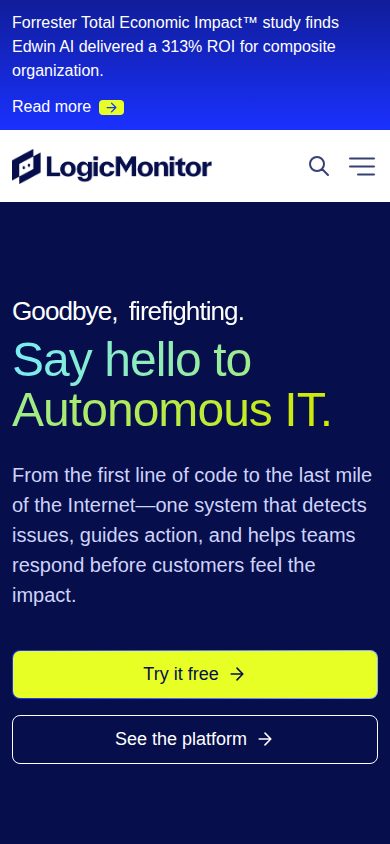
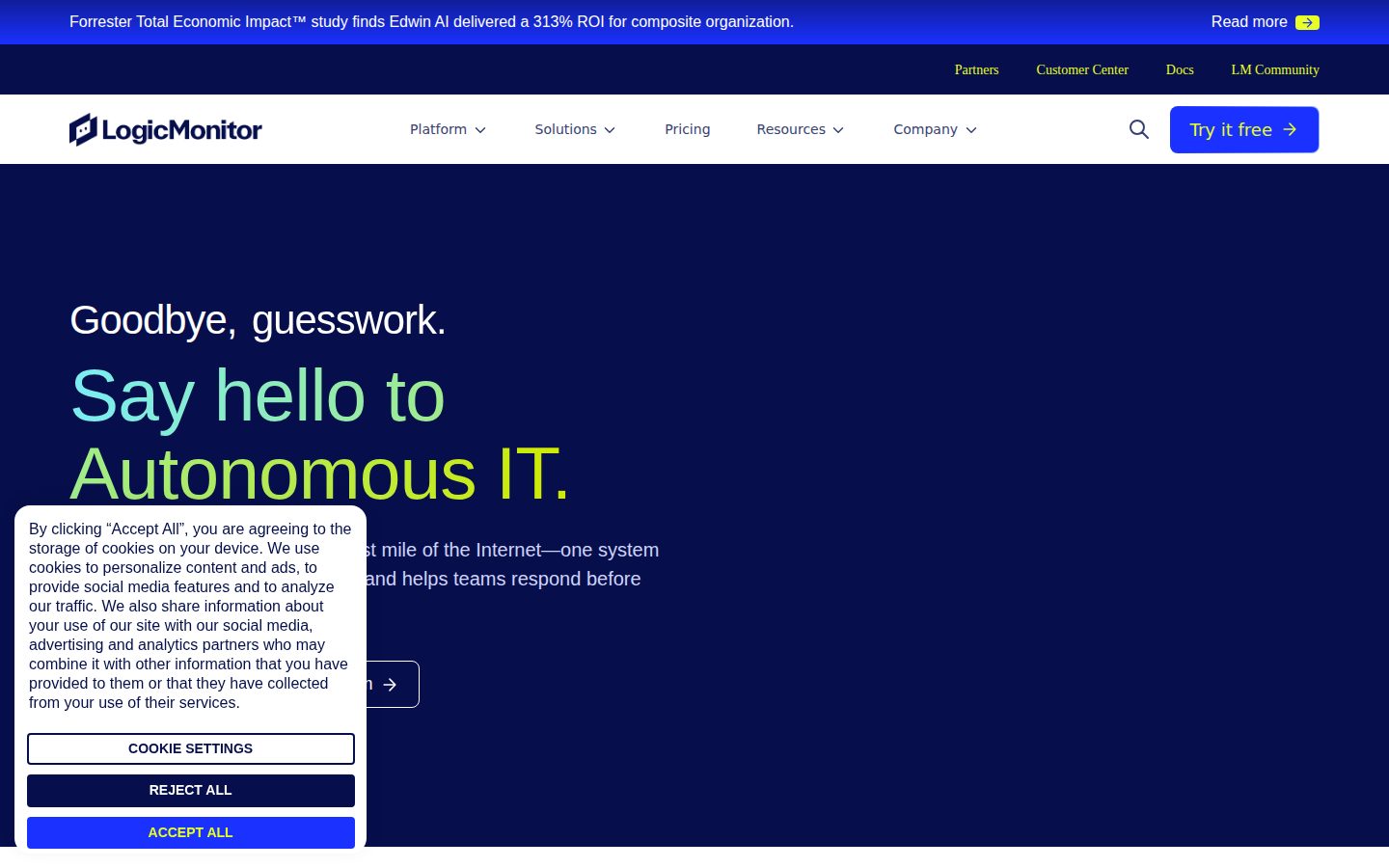
LogicMonitor desktop previewLogicMonitor mobile preview

Pricing Plans

Essentials

$16/monthly

Entry-level package for teams needing core hybrid infrastructure monitoring across on-prem, cloud, and network devices, billed per Hybrid Unit annually.

  • Hybrid infrastructure monitoring (servers, network, cloud)
  • LM Logs included in package
  • Per Hybrid Unit billing model covering multiple resource types
  • Unlimited monitored items per device
Popular

Advanced

$27/monthly

Mid-tier package for growing IT operations teams that need broader monitoring coverage and more integrations than Essentials, billed per Hybrid Unit annually.

  • Everything in Essentials
  • Expanded infrastructure and cloud resource coverage
  • LM Logs included
  • Additional integrations for alerting and workflows

Signature

$53/monthly

Top-tier package for enterprise IT and MSPs that want AIOps, machine learning-driven analytics, and full observability alongside automation capabilities.

  • Everything in Advanced
  • AIOps and machine learning-driven anomaly detection
  • Dynamic thresholds and root cause analysis
  • Advanced automation and observability tooling

Contact Sales (Custom/Enterprise Agreements)

Contact sales

For large enterprises and MSPs with complex, high-volume, or highly customized monitoring needs; actual contract pricing is negotiated directly with LogicMonitor sales and can vary significantly based on device/resource volume.

  • Custom Hybrid Unit volume discounts
  • Tailored contract terms for large device/resource counts
  • Dedicated account and renewal negotiation support

AI Panel Reviews

The Decision Maker

The Decision Maker

Strategic bet, vendor viability, timing, adoption approval
7.9/10

Mature observability vendor with real enterprise traction, priced by unit not seat.

LogicMonitor has been around long enough to sit in Gartner's Magic Quadrant with 635 G2 reviews behind it. Edwin AI adds credible correlation, not a science project.

635 G2 reviews at 4.5 stars, 149 Gartner Peer Insights reviews at 4.8. That's not a startup with a landing page — that's a vendor with install base. Customers like Topgolf and Capital Group aren't logos you fake.

The 88% noise reduction and 67% ITSM incident drop are vendor-reported, so treat them as ceiling numbers, not guarantees. But the mechanism is sound: context-aware correlation plus governed remediation with rollback, not just another alert firehose. Pricing starts at $16/month per Hybrid Unit, scaling to $53 for Signature with AIOps — transparent enough to budget against before you even call sales.

Competes directly with Datadog and Dynatrace, both of whom have deeper developer-side observability. LogicMonitor's edge is hybrid and network-layer visibility, which matters if you're not all-cloud.

Pilot Signature tier against a Datadog renewal. Don't switch cold — compare the noise-reduction claim on your own alert volume first.

Competitive Positioning7.9

Goes head-to-head with Datadog and Dynatrace on hybrid/edge coverage where cloud-native tools are thinner.

Reputation Risk8.0

Customers like Capital Group and Syngenta signal this is a boardroom-safe pick, not an experiment.

Speed to Value7.3

Claimed sub-hour alert correlation is promising but vendor-reported, not independently verified.

Strategic Fit7.8

Edwin AI and governed automation push beyond passive monitoring toward actual incident action.

Vendor Viability8.2

Long-tenured platform, 635 G2 reviews, Gartner MQ recognition in 2025 — not a fly-by-night operation.

Pros

  • Transparent starting price ($16/mo per Hybrid Unit) unusual for enterprise observability
  • Edwin AI correlation backed by named integrations (New Relic, Cribl, Ansible)
  • Strong peer validation: 4.5 G2 / 4.8 Gartner Peer Insights across 780+ combined reviews

Cons

  • 67% and 88% improvement figures are vendor-cited, not third-party audited
  • Signature tier needed for AIOps features, pushing real cost above the $16 headline
  • Less developer-mindshare than Datadog in cloud-native shops

Right for

Enterprise IT ops teams running hybrid infrastructure who need network-to-cloud visibility in one pane.

Avoid if

Skip it if you're cloud-native only and already deep in Datadog's ecosystem.

The Domain Strategist

The Domain Strategist

Craft and strategy in the product's domain — adapts identity per category, same lens
7.8/10

Solid observability data spine with real AIOps depth, but the schema lives in their cloud, not yours.

LogicMonitor's Hybrid Unit model and Edwin AI correlation layer are genuinely mature for enterprise IT ops. The tradeoff is data gravity — you're building operational intelligence on infrastructure you don't control.

Per-Hybrid-Unit billing across servers, network, and cloud at $16-$53/month is a defensible pricing architecture — it scales with resource sprawl instead of seat count, which matches how infrastructure teams actually grow. Edwin AI's 88% noise reduction and 67% ITSM incident drop are the kind of numbers I want validated against our own alert volume before I trust them, but the correlation-in-under-an-hour claim suggests real modeling work, not just threshold tuning.

Domain fit is strong for IT ops and SRE-adjacent teams: LM Logs, anomaly detection, and governed remediation with rollback map to how mature ops orgs actually operate, not how a startup dashboard imagines they do. Integration with Ansible Automation Platform and pipeline tools like Cribl and New Relic is the right move — nobody replaces their whole toolchain for one observability layer.

Three years in, you're deep in their data model and remediation workflows; migrating off means rebuilding correlation logic elsewhere. Against Datadog and Dynatrace, LogicMonitor's edge is hybrid/on-prem depth, not cloud-native breadth — pick based on where your infrastructure actually lives.

Category Positioning7.9

Recognized in the 2025 Gartner Magic Quadrant for Digital Experience Monitoring, competing directly with Datadog and Dynatrace on hybrid depth.

Domain Fit8.2

Hybrid Unit billing and LM Logs match how infrastructure/network ops teams actually scope and grow environments.

Integration Surface7.8

Named integrations with Ansible Automation Platform, Cribl, New Relic, and SolarWinds show it's built to sit inside an existing toolchain.

Long-term Implications7.2

Three years of remediation workflows and alert correlation logic built inside their platform creates real migration friction.

Strategic Depth8.0

Edwin AI's context-aware correlation and governed remediation with rollback go beyond basic anomaly detection into real closed-loop AIOps.

Pros

  • Per-Hybrid-Unit pricing scales with actual resource footprint, not seats
  • Edwin AI correlation cites concrete noise-reduction and MTTR figures
  • Governed remediation includes approvals, audit trails, and rollback

Cons

  • No self-hosted option — you're fully dependent on their SaaS data layer
  • Enterprise tier pricing requires direct sales contact, no ceiling transparency
  • Reported 67%/88% figures need validation against your own alert baseline

Right for

Enterprise IT ops teams managing hybrid infrastructure who need governed automation, not just dashboards.

Avoid if

Avoid if your infrastructure is cloud-native-only and you'd rather build correlation logic on an open data stack.

The Finance Lead

The Finance Lead

Money, total cost of ownership, contracts, procurement math
6.8/10

$16 to $53 per Hybrid Unit. Real number, unclear unit count.

Three tiers published, which beats Datadog's usage maze. But the meter — Hybrid Units — isn't sized anywhere, so the invoice stays a mystery until sales quotes it.

$16/month Essentials, $27 Advanced, $53 Signature. Per Hybrid Unit, billed annually. That's more upfront transparency than most observability vendors offer. Datadog and Dynatrace mostly hide behind 'contact us.'

But Hybrid Unit is the catch. No published conversion — how many units per server, per cloud resource. 50-person IT team, mixed cloud and on-prem, could land anywhere from $20K to $80K/year. Signature tier adds AIOps and Edwin AI. That's the tier finance needs to model, not Essentials.

Enterprise deals route through sales — custom volume discounts, negotiated renewal terms, no visibility on auto-renewal windows from public materials. 67% ITSM incident reduction and 88% noise reduction are the vendor's numbers, not independently audited. Believable, not verifiable. Budget a sales call before you budget the tool.

Billing & Procurement6.5

Enterprise deals require direct sales contact, adding procurement friction versus self-serve competitors.

Contract Flexibility6.0

Annual billing per Hybrid Unit implied; no public data on auto-renewal terms or termination clauses.

Pricing Transparency7.0

Three tiers with real dollar figures published, but Hybrid Unit sizing isn't disclosed anywhere.

ROI Clarity7.0

67% ITSM reduction and 88% noise reduction are specific, but self-reported, not third-party audited.

Total Cost of Ownership6.0

$16-$53/month per unit sounds cheap until unit count scales with device and cloud resource sprawl.

Pros

  • Published starting tiers at $16-$53/month, unusual in this category
  • Edwin AI cites concrete metrics: 67% ITSM reduction, 88% noise reduction
  • LM Logs bundled into every tier, not an add-on tax

Cons

  • Hybrid Unit pricing mechanic not sized publicly — real cost unknown until sales quote
  • Enterprise/custom tier pricing entirely opaque, negotiated per contract
  • No published data on renewal terms or termination for convenience

Right for

Enterprise IT teams who can staff a sales negotiation and need unified hybrid observability.

Avoid if

Avoid if you need exact 3-year cost modeled before picking up the phone.

The Domain Practitioner

The Domain Practitioner

Daily hands-on reality in the product's domain — adapts identity per category, same lens
7.6/10

Solid hybrid observability stack, but Edwin AI's numbers need a query, not a slide

LogicMonitor bundles infra, cloud, and log monitoring into one pane with governed automation on top. The AI story is strong on paper — 88% noise reduction, 67% fewer ITSM incidents — but those figures need a dashboard, not a press release, before I trust them in a model.

Hybrid Unit pricing ($16 Essentials, $27 Advanced, $53 Signature) is at least visible, which beats Dynatrace's pure contact-sales opacity for a first pass. Docs capability shows N on the scrape — no public docs, no changelog — which matters when I'm trying to verify claims like the 67% ITSM reduction and 88% noise reduction without a sales call.

Edwin AI's correlation-under-an-hour claim is the kind of metric I want segmented by environment size and alert volume, not aggregated. G2's 4.5/5 across 635 reviews and Gartner Peer Insights 4.8/5 on 149 reviews are decent proxy signals, but neither substitutes for a cohort breakdown.

Governed remediation with approvals and rollback is a real differentiator versus Datadog's more alert-centric model — worth flagging as a genuine tradeoff in LogicMonitor's favor for regulated shops. Still, without published methodology behind the Edwin AI stats, I'm modeling this as directionally positive, not quantified fact.

Day-3 Reality7.5

Unified infra/cloud/edge view reduces tool-switching, per the hybrid observability feature description.

Documentation Practitioner-Fit6.0

Scrape shows docs=N and changelog=N, meaning verification of the 67%/88% figures requires a sales conversation, not self-serve reading.

Friction Surface7.0

Contact-based pricing and no free plan add procurement friction before a team even tests the AI claims.

Power-User Depth8.0

Signature tier adds AIOps, dynamic thresholds, and root cause analysis, showing a real beginner-to-power-user ramp across three tiers.

Workflow Integration7.8

Ansible and New Relic/Cribl/SolarWinds integrations suggest it slots into existing ITOps toolchains rather than replacing them.

Pros

  • Governed remediation with approvals, audit trails, and rollback for risk-managed automation
  • Tiered pricing from $16 to $53 per Hybrid Unit gives a visible entry point versus pure contact-sales competitors
  • Strong third-party validation: G2 4.5/5 (635 reviews), Gartner Peer Insights 4.8/5 (149 reviews)

Cons

  • No public docs or changelog surfaced in the scrape, making self-serve verification hard
  • Headline AI stats (67% ITSM reduction, 88% noise reduction) lack disclosed methodology
  • No free plan, only a trial, raising the cost of a real evaluation

Right for

Enterprise IT operations teams managing hybrid infrastructure who need governed automation, not just alerting.

Avoid if

Avoid if you need self-serve technical docs and transparent pricing before engaging sales.

The Power User

The Power User

Daily human experience, onboarding, polish, learning curve, reliability
7.6/10

Enterprise monitoring that means business, but you'll need an IT ops badge to enjoy it.

LogicMonitor is built for network operations centers, not casual users checking a dashboard on a coffee break. Deep and capable, but the learning curve is real and mobile isn't even part of the conversation.

Nobody's opening LogicMonitor on their phone during a commute. Platform listing says web only, and for a tool that watches your entire infrastructure stack, that's a real gap when something breaks at 2am and you're not near a laptop.

That said, the depth is legit. Edwin AI correlating alerts and reportedly cutting ITSM incidents 67% and noise 88% is the kind of number that actually matters to someone drowning in tickets. Tiered pricing from $16 to $53 per Hybrid Unit is refreshingly less opaque than most enterprise tools that hide everything behind "contact sales."

Compared to Datadog, this feels more infrastructure-first, less flashy dashboard-first. First hour is homework: Hybrid Units, agents, correlation rules. Month three, once it's tuned, the automation and governed remediation stuff probably starts paying real rent. G2's 4.5 out of 635 reviews backs that up.

Daily Polish7.5

Infrastructure-first rather than flashy dashboards, but the depth is legit once tuned.

Learning Curve7.5

Homework upfront, but by month three the automation and governed remediation start paying real rent; G2's 4.5 across 635 reviews backs it.

Mobile Parity4.5

Web only — a real gap when something breaks at 2am and you're not near a laptop.

Onboarding Experience6.0

First hour is homework: Hybrid Units, agents, correlation rules.

Reliability Feel8.0

Edwin AI reportedly cutting ITSM incidents 67% and noise 88% is the number that matters to someone drowning in tickets.

Pros

  • Edwin AI alert correlation: reportedly 67% fewer ITSM incidents, 88% less noise
  • Published Hybrid Unit pricing ($16-$53) beats contact-sales opacity
  • G2 4.5 across 635 reviews supports the long-run payoff

Cons

  • Web only — no mobile story for 2am incidents
  • First hour is homework: Hybrid Units, agents, correlation rules
  • Built for NOCs, not casual dashboard users

Right for

IT ops and NOC teams who'll invest tuning time in exchange for serious alert-noise reduction.

Avoid if

You want a casual, mobile-friendly dashboard rather than an ops platform with a real learning curve.

The Skeptic

The Skeptic

Contrarian. Watch-outs, deal-breakers, broken promises, category patterns
7.3/10

67% and 88% are nice round numbers. Nice round numbers make me nervous.

Established observability vendor, real customer names, real pricing tiers. The AI stats are doing a lot of unsourced heavy lifting.

Three tells before I trust the Edwin AI numbers. One: 67% ITSM reduction and 88% noise reduction, both suspiciously clean. Two: no methodology, no cohort size, no time window. Three: 'under one hour to correlate alerts' — compared to what baseline?

That said, this isn't a two-year-old startup pitch. G2 has 635 reviews at 4.5/5. Gartner Peer Insights, 149 reviews at 4.8/5. Customers like Topgolf and Capital Group aren't logo-wall filler for a company this size. Pricing is transparent too — Essentials at $16/month per Hybrid Unit, Signature at $53 for the AIOps tier. That's rarer than it should be in this category.

Exit portability is the real question mark. Hybrid Unit billing, deep integrations with Ansible and New Relic — untangling that in 18 months isn't a export-and-go. Competes with Datadog, Dynatrace, SolarWinds — all sticky by design. Nobody in this category makes migration easy.

Competitive Differentiation7.0

Edwin AI correlation plus edge/UX monitoring differentiates from Datadog and SolarWinds, but the space is crowded.

Exit Portability6.0

Hybrid Unit billing and deep Ansible/New Relic integration make an 18-month exit non-trivial.

Long-term Viability7.5

Named enterprise customers (Capital Group, Syngenta) and tiered pricing suggest a real, funded operation, not a growth-stage bet.

Marketing Honesty6.5

'Goodbye, firefighting' headline is the aspirational kind; the 67%/88% stats lack methodology.

Track Record Match8.0

635 G2 reviews and Gartner MQ recognition match established-vendor patterns, not vaporware ones.

Pros

  • Transparent tiered pricing from $16 to $53/month, rare in this category
  • Strong third-party validation: 635 G2 reviews at 4.5/5, Gartner MQ recognition
  • Named enterprise customers with real logos, not just testimonial quotes

Cons

  • Headline AI stats (67%, 88%) have no disclosed methodology or baseline
  • No public docs or API listed in the scraped evidence — a gap for technical buyers
  • Hybrid Unit billing model adds exit friction versus simpler per-host pricing

Right for

Enterprise IT teams with complex hybrid environments who want a vendor with a track record, not a bet on a startup.

Avoid if

You need transparent self-serve pricing and portable data without a sales call and unit-based lock-in.

Buyer Questions

Common questions answered by our AI research team

Features

What does Edwin AI do in LogicMonitor?

Edwin AI applies context-aware reasoning to correlate alerts, reduce noise, and recommend next steps, helping teams resolve issues faster.

Features

How much noise reduction does Edwin AI deliver?

Edwin AI delivers an 88% reduction in alert noise.

Features

Does LogicMonitor reduce ITSM incidents?

Yes, LogicMonitor's Edwin AI capability is associated with a reported 67% reduction in ITSM incidents.

Pricing

Does LogicMonitor offer tiered pricing packages?

Yes, LogicMonitor offers tiered pricing packages ranging from foundational visibility to advanced automation and AI, letting customers choose what fits their environment.

Features

Can LogicMonitor monitor cloud and edge environments together?

Yes, LogicMonitor unifies infrastructure, cloud, and edge monitoring into a single system, covering environments from the first line of code to the last mile of the Internet.

Also in AI Analytics