New Relic logo

New Relic Review

Visit

Full-stack observability platform with AI-powered monitoring and automated remediation

New Relic is an observability platform for engineering and DevOps teams managing application performance, infrastructure, and security.

New Relic, Inc.·Founded 2008·FreemiumFree PlanAI DevOpsAI AnalyticsAI Security

AI Panel Score

8.1/10

6 AI reviews

Reviewed

AI Editor Approved

About New Relic

In practice, teams instrument their stacks using New Relic agents or OpenTelemetry, then monitor everything from APM traces and infrastructure health to digital experience sessions and AI model behavior in a single platform. Engineers set up dashboards, configure alerts, and query logs in place without moving data to a separate system. When incidents occur, correlated views link application performance signals to infrastructure events and user-facing impact.

New Relic highlights several specific capabilities that differentiate it within the observability category. Its AI and Agentic Monitoring module tracks individual LLM and AI agent interactions in real time, tracing agent reasoning to code execution to identify logic drift and cost overruns. Session Replay with AI analyzes recorded user sessions to surface friction points automatically rather than requiring manual video review. The platform also offers real-time multi-cloud and Kubernetes cost visibility, and supports OpenTelemetry as a first-class standard for ingesting telemetry data across every signal type. Over 800 pre-built integrations are available.

New Relic is used across industries including retail, finance, media, SaaS, telecommunications, and automotive—primarily by SREs, DevOps engineers, and platform teams. The platform offers a free tier with access to the full product (no credit card required), with paid plans based on data ingestion and user seats. Competitors in the observability category include Datadog, Dynatrace, Grafana, and Elastic.

New Relic is delivered as a SaaS web application. It supports OpenTelemetry for vendor-neutral instrumentation and provides an API for querying data programmatically. The platform is positioned in the 2025 Gartner Magic Quadrant for Observability Platforms as a Leader.

Features

AI

  • AI and Agentic Monitoring

    Monitors every model and agent interaction in real time to manage AI agents, control token usage and costs, and scale AI safely.

  • Agentic Platform

    Delivers observability insights to AI agents directly within the tools and workflows where engineers already work.

  • Session Replay with AI

    Replaces manual video scrubbing by using AI to automatically identify friction points within recorded user sessions.

Analytics

  • Cloud Cost Visibility

    Provides real-time visibility into multi-cloud and Kubernetes spend to help teams understand and optimize cloud costs.

  • Digital Experience Monitoring

    Uses AI to pinpoint session friction and UX flaws—including session replay analysis—before they impact user satisfaction or conversions.

Automation

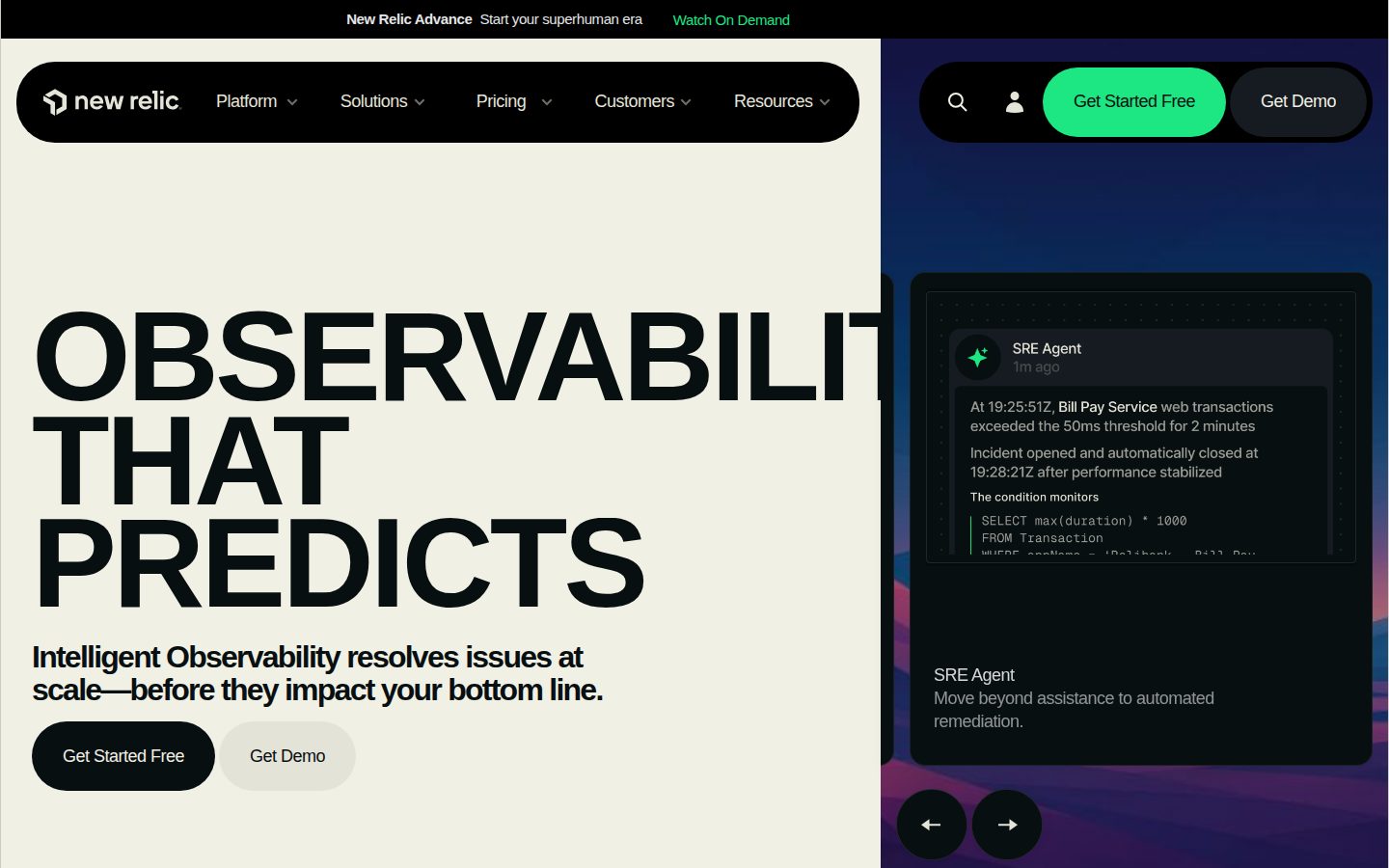
  • SRE Agent

    An agentic layer that moves beyond alerting to perform automated remediation of issues without manual intervention.

Core

  • Application Performance Monitoring (APM)

    Connects application performance metrics to customer experience and revenue, helping teams protect revenue and reduce MTTR.

  • Infrastructure Monitoring

    Provides system-wide context for cloud-native and Kubernetes environments by tying infrastructure health directly to application performance.

  • Log Management

    Enables querying of log data in place to scale logging strategy cost-effectively, simplify compliance, and reduce data toil.

Integration

  • OpenTelemetry Support

    Future-proofs observability by supporting the universal, open OpenTelemetry standard for ingesting every signal type.

  • Pre-built Integrations

    Offers 800+ pre-built integrations to connect New Relic with the full breadth of technologies across a modern tech stack.

Security

  • Security and Vulnerability Management

    Prioritizes and guides remediation of critical risks using production impact data and AI reasoning, including securing AI investments.

Preview

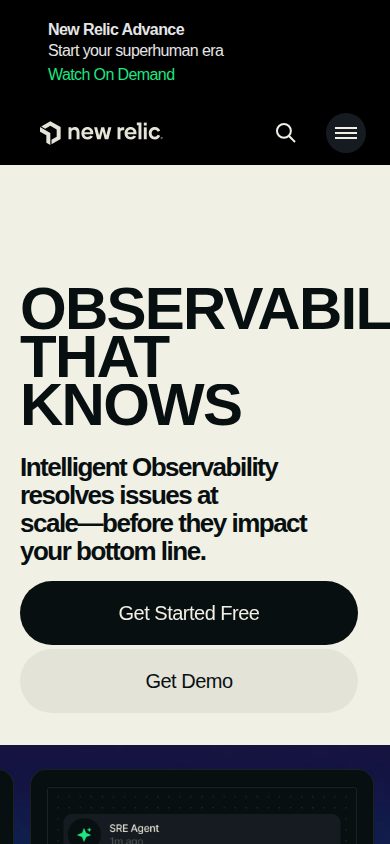
New Relic desktop previewNew Relic mobile preview

Pricing Plans

Free

Free

Perpetual free tier for individuals getting started with observability.

  • 100 GB data ingest/month
  • 1 free full platform user
  • Unlimited basic users
  • Access to 50+ capabilities
  • Default data retention (8+ days)
  • 500 synthetic checks, no credit card required

Standard

Contact sales

For small teams looking to get started with observability. Limited to 5 full platform users.

  • 100 GB free data ingest + $0.40/GB beyond
  • Up to 5 full platform users ($10/first, $99/additional)
  • Core users at $49/user
  • Ticketed support (2 business day response SLA)
  • SAML single sign-on
  • Data Plus option available at $0.60/GB
Popular

Pro

Contact sales

For teams with more than five engineers and complex workloads requiring unlimited users.

  • 100 GB free data ingest + $0.40/GB beyond
  • Unlimited full platform users ($349/user annual, $418.80/user monthly)
  • Core users at $49/user
  • 2-hour critical initial support response SLA
  • Data Plus eligibility
  • Optional full consumption pricing with no user licenses

Enterprise

Contact sales

For at-scale organizations with advanced security, compliance, and support needs.

  • Contact Sales for data ingest pricing
  • FedRAMP Moderate and HIPAA eligibility with Data Plus
  • Priority ticket routing
  • 1-hour critical initial support response SLA
  • Full platform users and core users priced via contact sales
  • Optional full consumption pricing with no user licenses

AI Panel Reviews

The Decision Maker

The Decision Maker

Strategic bet, vendor viability, timing, adoption approval
8.4/10

Gartner Leader with an SRE Agent that actually remediates — not just alerts.

New Relic is a mature, full-stack observability platform with a credible agentic layer. The free tier removes the excuse not to try it.

Gartner Magic Quadrant Leader in 2025. 800+ integrations. A perpetual free tier at 100 GB/month with no credit card. This isn't a startup bet — it's an established platform with real institutional validation. The SRE Agent doing automated remediation, not just firing alerts, is the capability worth stress-testing.

The tradeoff is pricing complexity. Pro lands at $349/user/year, and data costs scale at $0.40/GB beyond the free tier. Teams with high-volume telemetry will feel that. Datadog and Dynatrace are the direct comparison — New Relic's consumption pricing model offers more flexibility, but that flexibility requires discipline to control.

The AI and Agentic Monitoring module — tracking LLM reasoning to code execution — is a differentiator for teams running AI workloads. OpenTelemetry as a first-class standard protects against lock-in. This is a platform you can defend to the board today.

Competitive Positioning8.0

OpenTelemetry-first and consumption pricing distinguish it from Datadog's seat-heavy model, especially for teams scaling AI infrastructure.

Reputation Risk9.0

Gartner Leader, FedRAMP and HIPAA eligibility at Enterprise tier — this is a low-risk name to put in a board deck.

Speed to Value7.8

Free tier with 50+ capabilities and no credit card means day-one access, but 800+ integrations imply real configuration time before full payback.

Strategic Fit8.2

AI and Agentic Monitoring tracks LLM cost and logic drift — advances teams running AI workloads, not just cuts observability cost.

Vendor Viability8.5

2025 Gartner Leader designation and decades in market make a 36-month runway concern irrelevant here.

Pros

  • SRE Agent performs automated remediation — not just alerting
  • AI and Agentic Monitoring tracks LLM token costs and reasoning drift in real time
  • Perpetual free tier at 100 GB/month, no credit card required
  • OpenTelemetry as first-class standard reduces lock-in risk

Cons

  • Pro tier at $349/user/year gets expensive fast on large teams
  • Data ingestion costs scale at $0.40/GB — high-volume environments need budget discipline
  • No changelog visible in public evidence, making feature velocity hard to verify externally

Right for

SRE and platform teams managing complex, multi-cloud or AI workloads who need correlated observability across every signal type.

Avoid if

Your stack is simple and Grafana plus a cheap APM tool already covers it.

The Domain Strategist

The Domain Strategist

Craft and strategy in the product's domain — adapts identity per category, same lens
8.4/10

Gartner Leader with an agentic SRE layer that actually changes the on-call calculus.

New Relic has matured from APM tool into a full observability platform with a credible automation story. The SRE Agent and OpenTelemetry-first architecture are the two bets I'd want under a 3-year platform contract.

800+ integrations and native OpenTelemetry support means instrumentation debt stays low — teams aren't locked into proprietary agents to get signal fidelity. The AI and Agentic Monitoring module tracking LLM token usage and reasoning drift is genuinely ahead of where Datadog sits today on AI workload observability. That's a real differentiator if you're running model-heavy infrastructure in 2025.

The SRE Agent automated remediation is the architectural bet worth scrutinizing. If that agentic layer matures, you're reducing P1 MTTR without headcount growth. If it stalls at current capability, you've built runbook dependencies on a feature that needs constant tuning. The 1-hour critical SLA gating behind Enterprise tier means smaller teams absorb the most risk during that maturation window.

Pricing math at Pro is $349/user/year for full platform access — manageable for a 10-engineer platform team, punishing at 50+. The consumption model alternative helps, but data ingest costs at $0.40/GB scale fast on high-cardinality trace workloads. Dynatrace's per-host pricing is simpler to forecast; New Relic requires tighter FinOps discipline to avoid bill shock.

Category Positioning8.5

2025 Gartner Magic Quadrant Leader placement with an agentic remediation story positions New Relic ahead of pure-alerting competitors on the automation axis.

Domain Fit8.6

Correlated dashboards linking APM traces to infrastructure events to user sessions matches exactly how SRE incident workflows actually run.

Integration Surface8.7

800+ pre-built integrations plus OpenTelemetry ingestion across every signal type gives the widest integration surface in the category.

Long-term Implications8.0

OpenTelemetry as first-class standard reduces vendor lock-in risk, but SRE Agent dependency creates operational coupling if the agentic layer underdelivers.

Strategic Depth8.5

AI and Agentic Monitoring with reasoning-to-code-execution tracing is library-grade depth — not a bolted-on feature, based on the product description.

Pros

  • OpenTelemetry first-class support keeps instrumentation vendor-neutral
  • SRE Agent automated remediation is a genuine MTTR lever, not just alert routing
  • AI and Agentic Monitoring tracks LLM token costs and reasoning drift — rare in the category
  • Free tier with 100 GB ingest and no credit card lowers adoption friction for platform teams evaluating it

Cons

  • Pro full-platform users at $349/seat scales painfully beyond ~20 engineers
  • 1-hour critical SLA gated behind Enterprise contact-sales pricing creates support risk for mid-market teams
  • High-cardinality trace workloads will hit $0.40/GB ingest costs fast without disciplined FinOps controls

Right for

Platform and SRE teams running complex multi-cloud or AI-heavy workloads who need a single observability plane with automation potential.

Avoid if

You need predictable per-host billing and your team lacks bandwidth to tune agentic remediation workflows.

The Finance Lead

The Finance Lead

Money, total cost of ownership, contracts, procurement math
7.8/10

$349/seat annual plus data overages: model the GB before you sign

New Relic publishes three tiers with real numbers — rare for enterprise observability. The variable data ingestion model makes year-3 TCO hard to predict without usage data.

Standard and Pro pricing is visible without a sales call. Pro lands at $349/seat/year on annual terms. 50 engineers × $349 = $17,450/year in licenses alone. Add 100 GB free ingest, then $0.40/GB beyond — a team with 500 GB/month pays $160/month extra, $1,920/year. Year-3 projection with 30% data growth: closer to $25K–$28K all-in. Enterprise pricing goes dark; contact sales.

The dual-axis billing — users plus GB — is the real TCO trap. Datadog runs the same model. Budget teams underestimate ingest growth consistently. Data Plus upgrades to $0.60/GB add another layer. No published auto-renewal window in the evidence, which is a procurement concern before signing.

SSO is included at Standard — no SSO tax, which saves $3K–$6K versus category norm. SRE Agent automated remediation and 800+ integrations justify the platform cost for teams replacing 2–3 point tools. Solo operators and small teams should stay on the free tier: 100 GB and 1 full user covers a lot.

Billing & Procurement7.5

SSO included at Standard tier eliminates a common add-on cost; monthly billing available at $418.80/seat versus $349 annual — 20% premium for flexibility.

Contract Flexibility6.5

Annual seat pricing implies 12-month commitment; no public auto-renewal window or termination-for-convenience clause visible in the evidence.

Pricing Transparency8.2

Three tiers with per-seat and per-GB rates published; Enterprise requires sales contact, but Standard and Pro are fully visible.

ROI Clarity8.0

APM ties directly to MTTR and revenue impact metrics; SRE Agent automated remediation provides measurable incident-reduction math.

Total Cost of Ownership6.8

Dual-axis billing (seats + GB ingest) makes 3-year TCO unpredictable without actual usage telemetry; Data Plus at $0.60/GB adds a third variable.

Pros

  • SSO included at Standard — no add-on tax
  • 100 GB free ingest covers small teams indefinitely
  • $349/seat Pro is competitive against Datadog's equivalent tier
  • 800+ integrations reduce implementation cost

Cons

  • Dual-axis billing (seats + GB) inflates year-3 TCO unpredictably
  • Enterprise pricing requires sales call — no public numbers
  • No published auto-renewal or cancellation terms in public docs
  • Data Plus at $0.60/GB can double ingest costs quietly

Right for

SRE and DevOps teams at 10–200 engineers replacing multiple point monitoring tools with a single platform.

Avoid if

Your data ingest is unpredictable or growing fast — the per-GB model will punish you at scale.

The Domain Practitioner

The Domain Practitioner

Daily hands-on reality in the product's domain — adapts identity per category, same lens
8.2/10

Full-stack observability with an SRE Agent that actually acts — not just alerts

New Relic combines APM, infra, logs, and AI monitoring in one query surface, with a genuine agentic remediation layer that's rare in the category. The pricing model rewards scale but punishes seat growth.

The SRE Agent is the real differentiator here. Datadog alerts. Dynatrace advises. New Relic's agentic layer claims to remediate without waiting for a human to page in — that's a different operational posture. For on-call rotations where MTTR is the number that matters, automated remediation at 3am beats a Slack ping every time. The docs indicate OpenTelemetry is first-class, not an afterthought, which means instrumentation portability stays intact if you ever need to exit.

Day three friction will show up in the data ingest bill. The free tier gives 100 GB/month, which sounds generous until a high-cardinality trace spike burns through it mid-sprint. The $0.40/GB overage on Standard and Pro is predictable, but 8-day default retention on the free tier is thin for incident retrospectives. Pro full platform users at $349/seat annually adds up fast for larger platform teams.

The 800+ pre-built integrations and Kubernetes cost visibility suggest someone on the product team actually runs clusters. Session Replay with AI is a bonus for SREs debugging frontend-correlated incidents without context-switching to a separate tool.

Day-3 Reality8.0

Correlated dashboards and single-pane querying reduce tool-switching, but ingest cost spikes and 8-day default retention on free tier create real operational friction.

Documentation Practitioner-Fit7.8

Docs are available and the changelog absence from scraped evidence is a minor flag, but OpenTelemetry and Kubernetes depth suggest practitioner authorship.

Friction Surface7.5

Pricing variability across ingest, seats, and Data Plus tiers means SREs will spend cognitive load managing costs alongside managing systems.

Power-User Depth8.3

AI and Agentic Monitoring, NRQL querying, and programmatic API access give power users real depth beyond dashboards.

Workflow Integration8.5

OpenTelemetry as a first-class standard and 800+ integrations mean instrumentation fits existing stacks without ripping out agents or rewriting pipelines.

Pros

  • SRE Agent performs automated remediation, not just alerting — rare in the category
  • OpenTelemetry support is first-class, preserving instrumentation portability
  • Single platform covers APM, infra, logs, session replay, and AI model monitoring
  • Free tier requires no credit card and unlocks 50+ capabilities immediately

Cons

  • 8-day default data retention on free tier is too short for meaningful post-incident review
  • Pro seat pricing at $349/user/year scales painfully for large platform teams
  • No changelog in public evidence — hard to track what's shipping and when
  • Automated remediation via SRE Agent is a bold claim with limited public third-party validation

Right for

Platform and SRE teams running complex multi-cloud or Kubernetes workloads who need a single observability surface and are willing to pay for ingest at scale.

Avoid if

Small teams or solo engineers where Datadog's free tier or Grafana's self-hosted stack covers the need without per-seat cost exposure.

The Power User

The Power User

Daily human experience, onboarding, polish, learning curve, reliability
8.2/10

New Relic finally grew up: 800 integrations, an SRE Agent, and a free tier that's actually real

Full-stack observability with an agentic layer that can act, not just alert. Datadog gets more press, but this is a serious platform.

The free tier is legitimately generous — 100 GB ingest per month, one full platform user, 50+ capabilities, no credit card. That's not a teaser. That's enough to actually learn whether this tool fits your life before you hand over a card. Most platforms in this category give you a 14-day trial and call it fair. New Relic just lets you run.

The SRE Agent is the headline feature and it's worth taking seriously. Automated remediation, not just smarter alerts. Session Replay with AI replacing manual video scrubbing is the kind of thing that sounds like marketing until 3pm on a bad Friday and suddenly it's your favorite feature. The AI and Agentic Monitoring for LLM cost tracking is a real differentiator against Dynatrace right now.

The tradeoff is the learning curve. This is a deep platform — APM, infrastructure, logs, security, cloud cost, digital experience all under one roof. Month one will feel like homework. Pro tier is $349/user/year, which adds up fast for bigger teams. Web-only delivery means mobile is read-only at best. Not a daily driver on your phone.

Daily Polish7.5

Correlated dashboards and in-place log querying suggest real UX investment, but web-only delivery limits how polished the daily experience can feel outside a desktop.

Learning Curve6.8

APM, infrastructure, logs, security, cloud cost, and agentic features in one platform means month-one is a lot; the 50+ capabilities in the free tier at least lets you learn without a clock running.

Mobile Parity4.5

Web-only platform — no mobile app listed — which for an incident-response tool is a real gap when something breaks at midnight.

Onboarding Experience7.8

The no-credit-card free tier with 100 GB ingest and 800+ pre-built integrations removes the biggest early friction points, though the platform breadth means first-hour orientation takes work.

Reliability Feel8.5

Gartner Magic Quadrant Leader placement and broad enterprise deployment across finance, retail, and telco signal a platform teams trust under pressure.

Pros

  • Free tier with 100 GB/month ingest and no credit card — genuinely usable, not a tease
  • SRE Agent does automated remediation, not just smarter pinging
  • AI and Agentic Monitoring tracks LLM token costs and logic drift in real time
  • OpenTelemetry support means you're not locked in forever

Cons

  • Web-only — mobile is an afterthought for a platform you might need at 2am
  • Pro tier at $349/user/year gets expensive fast as teams grow
  • Platform breadth is impressive but the learning curve is real, especially month one
  • No changelog listed publicly, which makes it hard to know how fast things are improving

Right for

SRE and DevOps teams running complex, multi-cloud stacks who need observability plus automated remediation in one place.

Avoid if

You're a small team or solo developer who just needs basic APM — the depth will bury you.

The Skeptic

The Skeptic

Contrarian. Watch-outs, deal-breakers, broken promises, category patterns
7.8/10

Gartner Leader, 800+ integrations, SRE Agent that might actually work — but $349/user stings

New Relic is a legitimate full-stack observability platform, not a me-too entrant. The SRE Agent and AI-native monitoring are differentiated bets, and the OpenTelemetry-first posture is the right call for 2025.

Three things I'd check before signing. One: 'automated remediation' is the kind of claim that ages poorly without a published incident post-mortem. The SRE Agent sounds compelling — based on the feature docs, it acts without manual intervention — but I'd want a failure mode story before trusting it in prod. Two: no changelog listed in the evidence. Category norm for platforms at this price is public shipping cadence. Absence here is a yellow flag. Three: $349/user annually on the Pro tier adds up fast. Datadog and Dynatrace both do the same math to you.

The exit story is actually the strongest dimension. OpenTelemetry as a first-class standard means your instrumentation isn't proprietary. If New Relic goes sideways, the telemetry data and agents are portable. That's a real moat against lock-in — and it's the opposite of what most competitors offer.

Magic Quadrant Leader placement, 800+ integrations, and a free tier with 100 GB ingest and no credit card required. Compared to Grafana (DIY pain) and Elastic (log-heavy, less APM depth), this is a more complete out-of-the-box experience. Viable 3-year bet. Not cheap. Fair.

Competitive Differentiation7.5

AI and Agentic Monitoring for LLM cost tracking and Session Replay with AI are genuine gaps vs. Datadog; the SRE Agent is a differentiator if it holds up in practice.

Exit Portability8.0

OpenTelemetry support as a first-class standard means instrumentation isn't vendor-locked; migrating off is cleaner than most observability platforms.

Long-term Viability7.8

No public funding data listed and no changelog visible, but Gartner Leader status, 800+ integrations, and broad industry adoption suggest an established, funded operation — no public shutdown signals.

Marketing Honesty7.2

'Automated remediation' and 'reduce MTTR' are claims that need evidence from incident data, not just feature descriptions — the meta copy is grounded but the SRE Agent framing is still aspirational.

Track Record Match8.5

Gartner Magic Quadrant Leader in 2025, named against Datadog and Dynatrace — this matches the pattern of durable category players, not the pivot-then-shutdown arc.

Pros

  • OpenTelemetry-first instrumentation makes exit cleaner than most competitors
  • Free tier includes 100 GB ingest and access to 50+ capabilities with no credit card
  • AI and Agentic Monitoring for LLM cost/token tracking is a real differentiator in 2025
  • Gartner Magic Quadrant Leader — not a new entrant, pattern matches durable platforms

Cons

  • Pro tier at $349/user annually is expensive at team scale — Datadog and Dynatrace have the same problem
  • No changelog in the evidence — hard to verify shipping cadence for a platform at this price
  • SRE Agent automated remediation is compelling but unverified; no published failure mode documentation visible
  • 8-day default data retention on the free tier is short; extended retention likely requires Data Plus at $0.60/GB

Right for

SRE and DevOps teams managing complex stacks who want a single platform with AI monitoring, OTel portability, and no DIY assembly.

Avoid if

You're a solo developer or small team — the per-user pricing at scale makes this expensive fast compared to Grafana-based alternatives.

Buyer Questions

Common questions answered by our AI research team

Features

Can New Relic automatically fix issues without human intervention?

Yes. The SRE Agent moves beyond assistance to automated remediation, acting on issues without manual intervention.

Integration

Does New Relic support OpenTelemetry?

Yes. New Relic supports OpenTelemetry as a universal, open standard for every signal, described as a way to future-proof your observability stack.

Features

Can New Relic monitor Kubernetes environments?

Yes. Infrastructure Monitoring manages cloud-native and Kubernetes environments with infrastructure health tied to applications, including cost optimization and full hybrid visibility.

Pricing

Does New Relic offer a free tier to get started?

Yes. A free tier is available via the 'Get Started Free' option on the homepage.

Features

Can New Relic detect UX friction points in user sessions?

Yes. Session Replay with AI skips manual video searching—AI identifies friction points in user sessions, and Digital Experience Monitoring uses AI to pinpoint session friction and UX flaws before they impact margins.

Also in AI DevOps