AI video generation trained on licensed footage
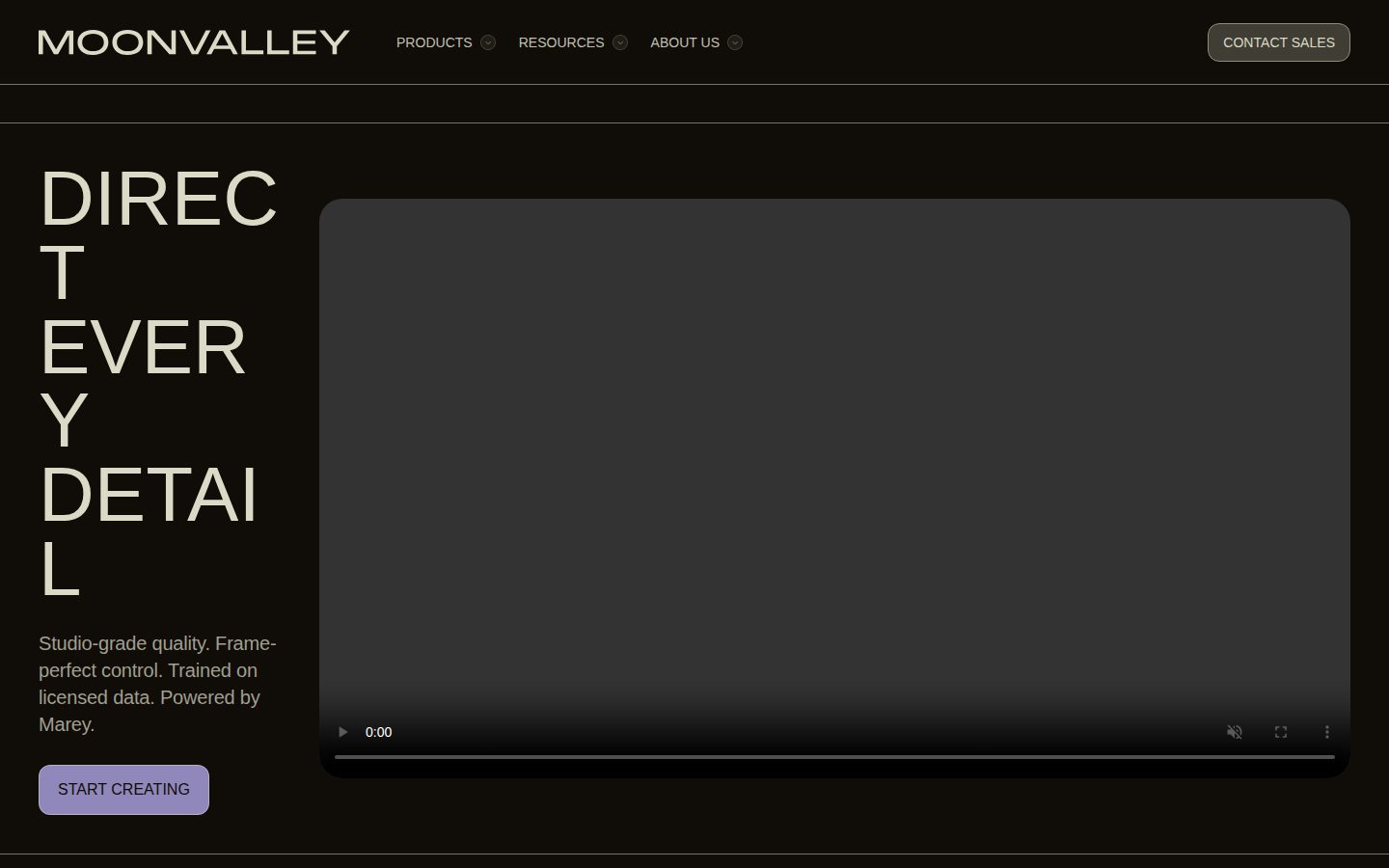
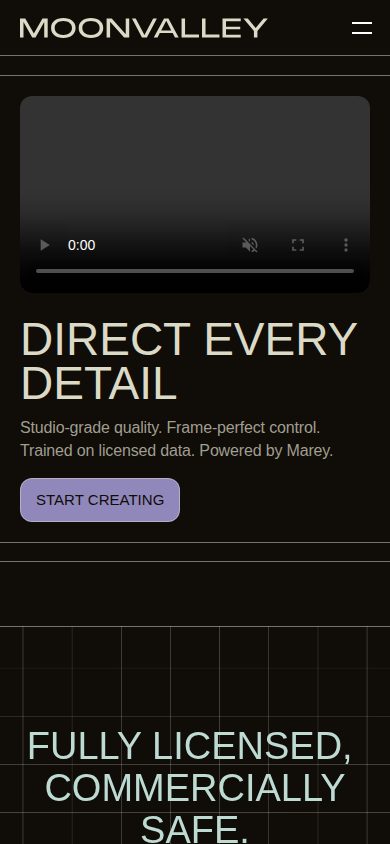
Moonvalley is an AI video generation platform for filmmakers and studio production teams.
AI Panel Score
6 AI reviews
Reviewed
Working with Moonvalley centers on the Marey model, which converts text prompts or a single reference image into video clips. Users can guide output through dedicated controls rather than relying only on text prompts: drawing a trajectory to move an object along a defined path, transferring motion from a reference video onto a new subject, applying a performance or pose from a reference image, or directing camera movement within a scene generated from a single 2D image, which Marey converts into a navigable 3D-like environment.
The site highlights several specific capabilities beyond basic generation. Composable layers allow users to combine motion, style, and camera direction as separate inputs that stack without disrupting the underlying scene structure. Marey is described as maintaining lighting continuity across frames, with shadows and highlights that respond consistently as a scene progresses, and as reproducing physical motion (weight, momentum, timing) intended to read as filmed rather than synthetic. The model is also positioned around prompt adherence, aiming to follow detailed instructions while keeping a consistent visual style across a generated sequence.
Moonvalley is aimed at filmmakers and production teams working on projects where commercial rights clearance matters, since Marey's training data is licensed rather than scraped, which the company markets as making output commercially safe to use. The site does not publish specific subscription pricing tiers on the pages reviewed. Marey is also available through third-party inference platforms, including fal.ai, and can be used within ComfyUI workflows. Competing products in the AI video generation category include Runway, Pika, Luma AI, and OpenAI's Sora.
Marey is accessible directly through Moonvalley's web application and also through fal.ai as an inference partner, as well as native integration with ComfyUI for node-based workflows. An API is listed as available via waitlist rather than general release at the time of writing.
Pulls motion from a reference video and applies it to new subjects or scenes while preserving the original timing and energy.
Uses a reference image or performance input to guide facial motion, lighting, depth, and timing when applied to a new subject.
Provides directable, physical-camera-like controls (including WASD movement, rotation, and panning) so filmmakers can create cinematic camera moves from a single image.
Enables modification of specific elements in a generated video without needing to regenerate the entire scene.
Allows users to upload multiple reference images on a timeline, with the model generating smooth, natural transitions between them.
Generates native high-definition video without upscaling artifacts, supporting multiple aspect ratios from widescreen to vertical.
Supports generating video clips directly from text prompts or from a single source image.
Lets users draw a trajectory for any element in a scene so objects move naturally along a defined path without prompts or rerolls.
Allows separate editing of foreground, mid-ground, and background layers within a generated scene.
Lets filmmakers guide generation using storyboards, sketches, and live-action references instead of relying solely on text prompts.
A companion platform (beta) that unlocks Marey's full capabilities for high-end studio production workflows.
Marey is trained exclusively on licensed, high-resolution footage with no scraped content or user submissions, reducing legal risk for commercial use.
For individuals starting out with AI video generation who need a lower-volume, entry-level credit allowance
For creators who need more generation volume than the Standard plan offers
For power users and professional filmmakers needing high-volume video generation
For organizations with significantly higher usage needs; custom pricing requires contacting Moonvalley's enterprise sales team
Licensed-data video AI with real directorial controls, but no pricing page and no free trial to test it.
“Moonvalley bets on licensed footage instead of scraped data, which matters for studios worried about lawsuits. No public pricing, no free trial, and that's a real barrier before the board even asks about output quality.”
Trained on licensed footage, not scraped data. That's the whole pitch, and for studios one lawsuit away from a rights headache, it's a real one.
Camera control, trajectory control, motion transfer, pose transfer — these are director tools, not prompt-and-pray. Runway and Pika move faster on hype cycles. Moonvalley is positioning as the legally defensible option, which is a narrower but sturdier lane.
Two problems. No pricing page, no free trial — you can't pilot what you can't price. Voyager, their production platform, is still in beta. Contact sales, wait for the API waitlist, and hope the licensing story holds up under actual studio budgets.
Distinct from Runway, Pika, Luma, and Sora on licensing, but unproven at studio scale.
Adopting a 'commercially safe' model looks smart to a board worried about IP exposure.
No free trial, no pricing page, Voyager still in beta — nothing to test before committing.
Licensed training data directly addresses commercial rights risk that Runway and Sora face scrutiny over.
No public funding data in the evidence; positioned as a research lab, API still waitlist-only.
Studios and filmmakers who need commercially clearable footage and can tolerate a sales-driven onboarding process.
Skip it if you need to test output quality this week without a procurement cycle.
Licensed training data plus true frame-level directing tools — built for people who actually block shots.
“Moonvalley is the first AI video tool that reads like it was designed by someone who's stood on a set. The craft depth is real; the commercial packaging isn't there yet.”
Trajectory control, motion transfer, pose transfer, layer-based editing on foreground/mid-ground/background — that's a control surface built for a director, not a prompt tinkerer. Compare that to Runway or Pika's mostly-textual steering, and Moonvalley's Camera Control (WASD movement through a 2D-to-3D scene) is a genuinely different craft ceiling. This is closer to virtual cinematography than slot-machine generation.
Licensed-only training data is the strategic bet that matters most. If a studio adopts Marey now, in three years they've avoided the rights-clearance mess that scraped-data models like Sora may eventually face in litigation. That's a real moat, not a marketing line.
The gap is packaging: no published pricing, no free trial, API still on waitlist. ComfyUI and fal.ai integration show they understand pro workflows, but a studio can't budget against "contact us."
Sits above Runway and Pika on directorial control, but no published pricing makes it hard to place competitively.
Camera Control and Keyframing map directly to shot-blocking and storyboard workflows filmmakers already use.
ComfyUI native support and fal.ai availability are strong, but API is waitlist-only, not general release.
Licensed-only training data reduces future legal exposure versus scraped-data competitors like Sora.
Trajectory, pose, and motion transfer plus composable layers go well beyond current prompt-and-reroll category norms.
Studios and filmmakers who need directable camera and motion control with commercially cleared training data.
Avoid if you need transparent self-serve pricing or immediate API access today.
No pricing page. No tiers. Zero dollars visible anywhere.
“Contact sales for a number that should be public. Can't model TCO on a product with no price.”
No pricing page. No published tiers. Contract model is pure enterprise sales-call, and that's before you know if Moonvalley even fits your budget.
Compare to Runway, which posts tiers starting around $12/seat, or Luma AI with visible plans. Moonvalley gives you Camera Control, Trajectory Control, Voyager beta — real features — but no number attached to any of it. Fal.ai access exists, priced by inference, but that's usage-based and unpredictable for a studio budgeting a 3-year plan.
Licensed training data is the real pitch here — commercially safe footage, no scraped-content lawsuit risk. That's worth something concrete for legal exposure. But procurement can't compare hidden enterprise pricing against Runway's public tiers. Budget owners get stuck negotiating blind, and blind negotiations rarely favor the buyer.
No invoicing model, payment terms, or self-serve checkout; API is waitlist-only, not general release.
Enterprise-style contact model implies negotiated terms, but no term length or renewal data published.
No pricing plans found, no pricing page listed in capabilities, contact-sales only.
Licensed footage reduces legal risk clearly, but production-time savings vs Runway or Pika aren't quantified anywhere.
Fal.ai usage-based access exists but no rate card; 3-year cost is unmodelable without a sales call.
Studios with legal budget for licensing risk and patience for an enterprise sales cycle.
You need a comparable number today to put next to Runway or Luma in a budget spreadsheet.
Trajectory control and licensed footage matter more on set day one than in the pitch deck
“Moonvalley's frame-level controls address real production complaints about Runway and Pika, but no visible pricing page or general API access means you're negotiating before you're generating.”
Camera Control and Trajectory Control are the two features that matter once you're past the demo. Drawing a path for an object instead of rerolling a prompt five times is the difference between a shot list and a slot machine. Motion Transfer and Pose Transfer read as genuinely production-minded, not just novelty sliders.
Day-3 reality is murkier. No pricing tiers listed on the site, no free trial, contact-sales only. For a solo editor deciding between this and Runway or Luma AI, that's a wall before you even touch the timeline. The Voyager platform is still in beta, and the API is waitlist-only, so anyone wanting to script generation into an existing pipeline is stuck waiting.
ComfyUI native support and fal.ai availability are the real workflow wins here — that's where power users will actually live, node-based, composable, layer-stacking motion and style inputs. Licensed training data solves the commercial-rights headache that keeps legal teams up at night. Worth the friction of an unlisted price if your studio needs clean chain-of-title footage.
Frame-level controls like trajectory and pose transfer reduce reroll fatigue, but gated access means most producers can't even get to day three yet.
Site listing shows no dedicated docs page, and buyer Q&A reads more like marketing FAQ than production reference material.
No pricing page, no free trial, and a waitlisted API add real friction before any footage gets generated.
Layer-based editing, keyframing across multiple reference images, and composable motion/style/camera stacking show real depth for studio-level use.
Native ComfyUI support and fal.ai inference access fit existing node-based pipelines rather than forcing a new tool habit.
Studio production teams who need commercially cleared footage and frame-level camera direction, and can work through a sales conversation to get there.
Avoid if you're a solo creator who wants to test output against Runway or Pika before committing budget.
Serious camera controls, but you'll email someone before you ever see a price tag.
“Moonvalley leans on frame-level directing tools most competitors don't offer, and licensed training data instead of scraped footage. But there's no pricing page, no free trial, and nothing to click into today.”
No pricing tiers, no free trial, contact-us only. That's a real wall before you even get to judge the day-to-day feel. For a working editor deciding what to try this afternoon, that's homework before you've done anything.
What's actually there looks good on paper. Trajectory control, motion transfer, pose transfer, camera control that turns a single 2D image into something you can pan and rotate through like it's on a dolly — that's a different pitch than Runway or Pika's prompt-and-pray loop. Licensed training data is the other half of the pitch, and for studios worried about rights clearance, that matters more than any single feature.
But there's a Voyager platform still in beta, an API still on waitlist, and no ComfyUI-native experience you can just open. This reads like a tool built for production pipelines, not for someone testing it solo at 9pm. Fine if you're a studio. Rough if you're one person trying to get a feel for it fast.
Feature set (inpainting, keyframing, layer editing) sounds deliberate, but no pricing page or public UI details to judge daily friction.
Trajectory control, motion transfer, and camera control reduce reliance on prompt rerolls, but Voyager's beta status and waitlisted API suggest the full toolkit isn't there yet.
Web-only platform listed, no mobile mention at all in the evidence.
No free trial, no free plan, contact-only pricing — the first ten minutes is an inquiry form, not a product.
Licensed-data model and native HD output signal care, but no changelog or public uptime signals to confirm it in practice.
Studios and filmmakers who need commercially cleared footage and are willing to go through sales to get it.
You want to test-drive a video model today without a sales call.
Licensed training data is a real moat. No pricing page is a real flag.
“Moonvalley's legal-safety pitch is credible and differentiated. Everything commercial around it — price, API access, support cadence — is still a waitlist.”
Three tells. One: no pricing page, contact-only. Two: API is waitlist, not general release. Three: 'Voyager Production Platform' is labeled beta. That's a lot of not-yet for a company calling itself production-grade.
The licensed-data angle is the real differentiator, though. Runway, Pika, Sora all face scraped-data lawsuits eventually. Moonvalley skips that fight by design — that's a genuine gap, not marketing gloss.
Exit story is fine. Marey runs through fal.ai and ComfyUI, so you're not locked into one web app. If Moonvalley stalls, the model's still reachable elsewhere, similar to how Stable Diffusion checkpoints survived their parent company's turbulence.
What's missing is proof of scale — no named studio clients, no changelog, no pricing tiers. Camera control and trajectory tools sound strong on paper. Fair review for an unpriced product: promising thesis, thin public record.
Common questions answered by our AI research team
Moonvalley's Marey model is trained on licensed footage rather than scraped internet data, making it commercially safe and fully licensed.
Yes, Marey generates both image-to-video and text-to-video output with cinematic detail, motion, and lighting.
Yes, Camera Control lets you create cinematic camera moves using just a single image. Marey transforms any 2D scene into a 3D environment so you can direct the camera as if on set.
Yes, Moonvalley supports building natively in Comfy through its inference partners.
Yes, Marey launched on Fal.ai and can be run there as one of Moonvalley's inference partners.