Recursion logo

Recursion Review

Visit

AI-powered drug discovery at biological scale

Recursion is a clinical-stage biotechnology company using AI and automation to accelerate drug discovery.

AI Panel Score

7.4/10

6 AI reviews

Reviewed

About Recursion

Recursion is a clinical-stage biotechnology company headquartered in Salt Lake City, Utah, that integrates artificial intelligence, machine learning, and large-scale biological experimentation to industrialize the drug discovery process. The company operates one of the largest biological and chemical datasets in the industry, generated through automated wet-lab experiments that capture cellular responses to genetic and chemical interventions at massive scale.

At the core of Recursion's approach is the Recursion OS, a vertically integrated platform that spans data generation, storage, and AI-driven analysis. The system uses high-content imaging to observe how cells change under various conditions, producing multimodal datasets that feed proprietary machine learning models. These models are designed to find patterns and relationships in biology that would be difficult or impossible to detect through traditional research methods.

Recursion serves both its own internal drug pipeline and external partners, including large pharmaceutical companies. Through partnerships and collaborations, the Recursion OS is made available to organizations seeking to accelerate their own discovery programs. Notable partners have included Bayer and Roche, reflecting the platform's positioning as an enterprise-grade infrastructure for drug discovery.

The company competes in the emerging field of AI-driven drug discovery alongside companies such as Insilico Medicine, Exscientia, and Schrödinger. Recursion differentiates itself through the scale of its experimental data generation capabilities and its fully integrated technology stack, rather than relying solely on computational modeling applied to existing datasets.

As a clinical-stage company, Recursion also advances its own therapeutic programs into human trials, giving it a dual identity as both a technology platform provider and a drug developer. Pricing and access to the Recursion OS for external partners is handled through direct commercial agreements rather than publicly listed tiers.

Features

AI

  • ADME Data Modeling

    Includes absorption, distribution, metabolism, and excretion (ADME) data within the platform to inform and optimize drug candidate selection and design.

  • AI-Powered Target Identification

    Machine learning models trained on proprietary datasets rapidly identify new biological targets for potential first-in-class and best-in-class drug candidates.

  • Molecule Design & Optimization

    AI models design and optimize novel molecules to fuel Recursion's pipeline, reducing reliance on traditional trial-and-error medicinal chemistry approaches.

Analytics

  • Patient Data Integration

    Leverages de-identified patient data within the discovery platform to improve the relevance and translational potential of AI-driven drug candidates.

  • Phenomics Data Generation

    Captures large-scale cellular phenotype data from high-throughput imaging to map how genetic and chemical perturbations affect living cells.

  • Proprietary Biological & Chemical Dataset

    Aggregates over 50 petabytes of fit-for-purpose data spanning phenomics, transcriptomics, proteomics, ADME, and de-identified patient data to fuel drug discovery models.

  • Transcriptomics & Proteomics Integration

    Incorporates transcriptomics and proteomics datasets into the platform to provide multi-modal biological context for AI model training and drug discovery.

Automation

  • High-Throughput Cell Imaging

    Automated wet lab uses robotics and computer vision to capture millions of cell experiments per week, generating imaging data from genetic and chemical perturbations.

Collaboration

  • Partner Drug Discovery Platform (Recursion OS for Partners)

    Offers pharmaceutical, technology, and data partners access to Recursion OS capabilities to accelerate collaborative discovery of new medicines.

Core

  • BioHive-2 Supercomputer

    Biopharma's most powerful supercomputer, built in partnership with NVIDIA, used to process the massive biological and chemical datasets generated by Recursion's platform.

  • Drug Development Pipeline Tracking

    Tracks therapeutic candidates across pipeline stages—Preclinical, IND-Enabling, Phase 1/2, and Pivotal/Phase 3—across oncology and rare disease indications.

  • Recursion Operating System (Recursion OS)

    An integrated drug discovery and development platform that combines data, models, and compute in a continuously improving feedback loop from hit identification to IND-enabling studies.

Preview

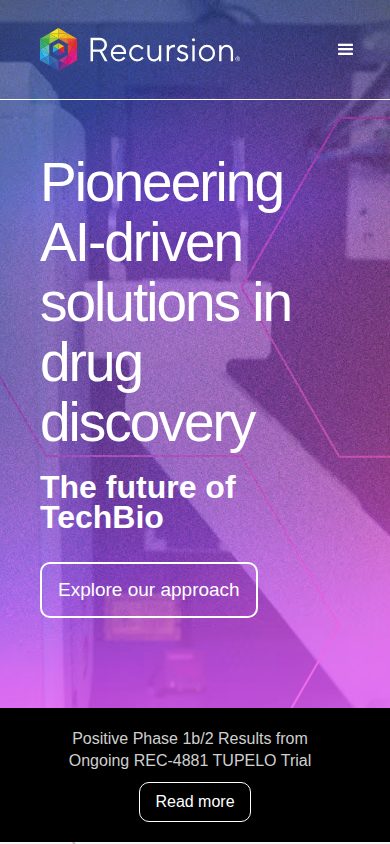
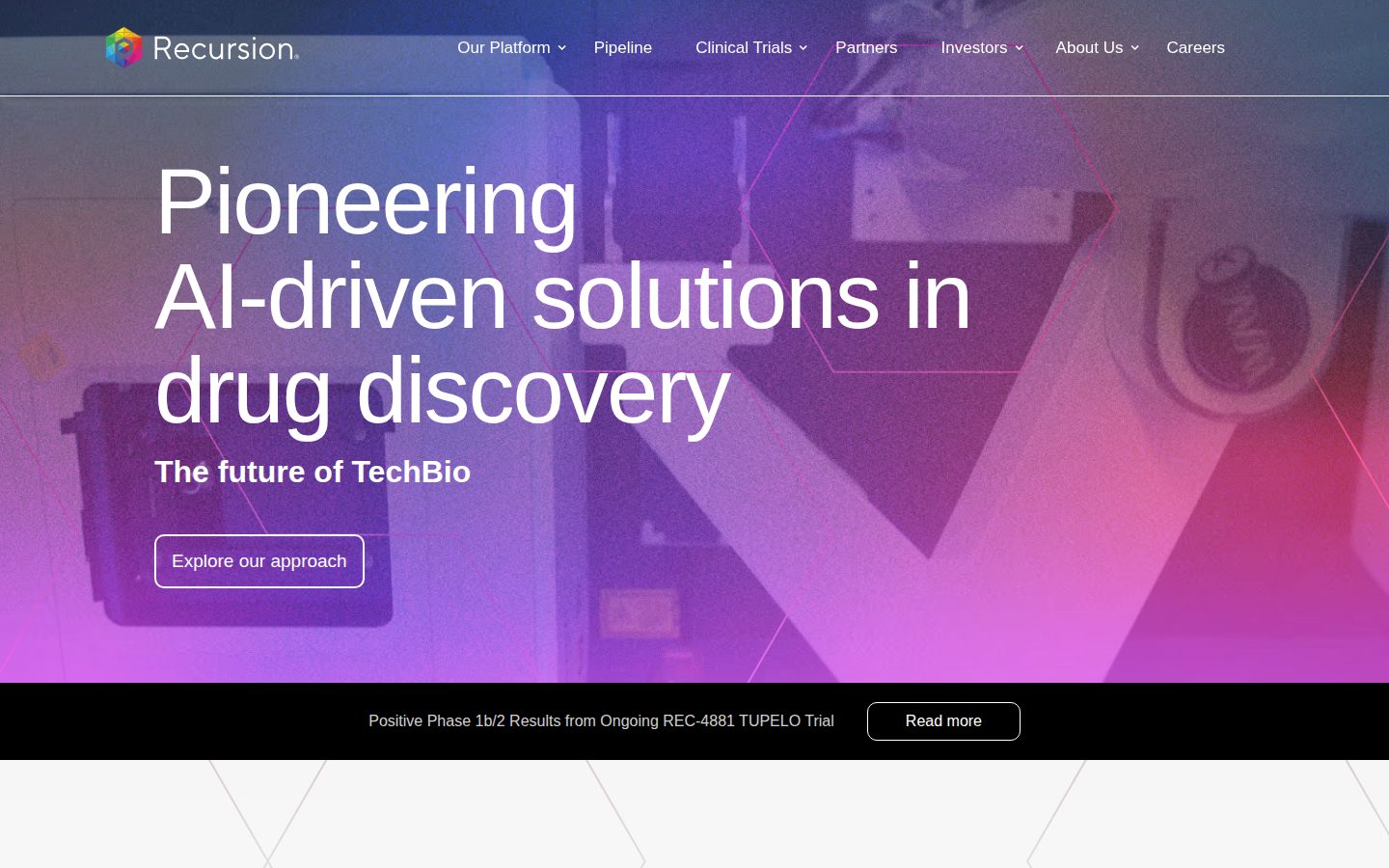
Recursion desktop previewRecursion mobile preview

Pricing Plans

Partnership Engagements

Contact sales

Recursion does not license its drug discovery platform as a self-serve SaaS product. Commercial engagement happens through pharma partnership deals, joint venture programs, and academic collaborations. Deal structures range from milestone-based licensing to multi-year strategic partnerships with major pharmaceutical companies.

  • Pharma partnership programs
  • Academic collaborations
  • Joint venture programs
  • Milestone-based licensing
  • Custom deal structures

AI Panel Reviews

The Decision Maker

The Decision Maker

Strategic bet, vendor viability, timing, adoption approval
7.8/10

50 petabytes of proprietary bio data is a real moat — if you can access it.

Recursion isn't a SaaS buy. It's a strategic partnership decision with a clinical-stage company that has Bayer and Roche already at the table.

NASDAQ-listed, Bayer and Roche as named partners, BioHive-2 built with NVIDIA. That's not a startup pitch — that's a company with institutional validation and a 36-month runway story that holds up. The 50 petabytes of phenomics, transcriptomics, and ADME data is genuinely differentiated versus Exscientia or Insilico Medicine, who lean harder on pure compute modeling without the same experimental data flywheel.

The tradeoff is access. There's no pricing page, no free trial, no API docs. You're not buying a seat — you're negotiating a milestone-based deal. That means 6-12 months before you see anything useful, and your legal team will earn their salary.

If your pipeline has a genuine discovery bottleneck and you can staff a real partnership, this is worth the conversation. If you need something that ships value in a quarter, look elsewhere.

Competitive Positioning8.0

50 petabytes of proprietary biological data puts this ahead of Exscientia and Insilico Medicine on raw discovery infrastructure.

Reputation Risk8.8

Roche and Bayer are already in — no board is going to squint at this vendor relationship.

Speed to Value5.5

Custom milestone-based deal structures and no self-serve access mean you won't see business outcomes inside 12 months.

Strategic Fit8.5

Recursion OS directly advances first-in-class drug identification — this isn't cost savings, it's pipeline acceleration.

Vendor Viability8.2

NASDAQ-listed, NVIDIA partnership for BioHive-2, and named pharma partners like Bayer and Roche signal institutional staying power.

Pros

  • 50 petabytes of proprietary multimodal bio data — phenomics, transcriptomics, ADME — is a genuine moat
  • BioHive-2 supercomputer via NVIDIA partnership means serious compute isn't a bottleneck
  • Bayer and Roche partnerships reduce partnership risk for new entrants
  • Dual identity as platform AND drug developer means the models are tested against real clinical outcomes

Cons

  • No public pricing, no API docs, no self-serve access — every deal is a custom negotiation
  • Clinical-stage means the company is still burning capital to prove its own pipeline
  • Speed to value is slow — partnership structures don't close in a quarter
  • No changelog or public docs make technical due diligence hard before you're already in talks

Right for

Large pharma or well-funded biotech with an active discovery bottleneck and a team that can manage a multi-year strategic partnership.

Avoid if

You need demonstrable ROI inside 12 months or lack the legal and science staff to manage a milestone-based licensing deal.

The Domain Strategist

The Domain Strategist

Craft and strategy in the product's domain — adapts identity per category, same lens
8.2/10

50 petabytes of proprietary biology and BioHive-2 compute is a genuine moat.

Recursion isn't a tool you adopt — it's an infrastructure bet you partner into. For pharma data science teams, the multimodal dataset depth (phenomics, transcriptomics, proteomics, ADME, patient data) is the real asset, not the ML models sitting on top.

The 50-petabyte proprietary dataset is the architectural anchor here. Most competitors — Exscientia, Insilico Medicine — compete on generative chemistry and computational modeling applied to existing public datasets. Recursion's differentiation is the wet-lab-to-model feedback loop: millions of cell experiments weekly feeding a continuously improving system. That's not a feature, that's a data flywheel, and it compounds.

The BioHive-2/NVIDIA partnership signals serious compute infrastructure, not cloud-rented capacity. For a Head of Data Science evaluating a partnership, that matters — model latency on 50PB isn't a solved problem with commodity GPUs. The tradeoff is real access friction: no API docs, no self-serve tier, no public pricing. You're negotiating milestone-based licensing, not spinning up a trial environment.

If we enter a Recursion OS partnership, in 3 years we've either co-generated proprietary data assets we own (good) or we've built discovery workflows dependent on their closed-loop platform (risk). Clarity on data ownership terms in the commercial agreement is the due diligence priority before anything else.

Category Positioning8.8

Bayer and Roche partnerships signal enterprise validation; proprietary experimental data generation separates Recursion from purely computational competitors like Schrödinger.

Domain Fit8.5

Multimodal data (phenomics, transcriptomics, ADME, patient data) maps directly to how serious drug discovery data science teams structure their feature engineering and model inputs.

Integration Surface6.5

No public API, no docs, no changelog — integration happens through negotiated partnership structures, not engineering, which limits how deeply internal data science teams can embed their own tooling.

Long-term Implications7.5

The compounding data flywheel is a strategic asset, but closed-platform dependency and opaque commercial terms create 3-year lock-in risk if data ownership isn't contractually protected.

Strategic Depth9.0

Vertical integration from automated wet lab through BioHive-2 compute to AI models is genuinely best-in-class architecture for biological-scale ML.

Pros

  • 50-petabyte fit-for-purpose dataset spanning five biological modalities is a structural moat competitors can't replicate quickly
  • BioHive-2 supercomputer purpose-built for biopharma workloads — not repurposed cloud capacity
  • Full-stack integration from target ID through IND-enabling studies means the platform covers the entire discovery workflow
  • Validated by Bayer and Roche at enterprise scale

Cons

  • No API docs or self-serve access means your data science team can't evaluate or prototype independently
  • All access is through negotiated partnership deals — timeline and cost are opaque until you're deep in commercial discussions
  • Data ownership terms in milestone-based licensing aren't public, which is a material due diligence gap

Right for

Pharma or biotech data science orgs with enterprise BD resources who need biological-scale training data they can't generate internally.

Avoid if

Your team needs direct API access, iterative prototyping capability, or transparent pricing before committing to a multi-year commercial structure.

The Finance Lead

The Finance Lead

Money, total cost of ownership, contracts, procurement math
6.2/10

50 petabytes of data, zero public pricing — procurement starts blind

Recursion OS is enterprise-only, contract-driven, no tiers visible. Every number gets negotiated behind closed doors.

No pricing page. No trial. No self-serve. Commercial access runs through direct partnership deals — milestone-based licensing, joint ventures, custom structures. Zero sticker to anchor against. Procurement can't even build a rough model without a sales cycle.

The scale is real: 50 petabytes of proprietary data, BioHive-2 supercomputer built with NVIDIA, high-throughput imaging generating millions of cell experiments per week. Bayer and Roche have signed on. That's signal, not noise. But none of that tells a finance team what year-3 looks like.

Compare to Schrödinger — also enterprise, also opaque, but computational-only, no wet-lab integration. Recursion's dual identity as platform provider and drug developer is the tradeoff: partners get genuine capability access, but the vendor's internal pipeline competes for the same assets. Deal terms almost certainly reflect that complexity.

Billing & Procurement3.5

Custom deal structures mean lengthy procurement cycles — no standard invoicing model, no self-serve onboarding.

Contract Flexibility4.0

Milestone-based licensing and multi-year strategic partnerships suggest long terms with limited exit optionality.

Pricing Transparency1.5

No published tiers, no starting price — 100% contact-sales, per their own pricing page absence.

ROI Clarity5.5

Addressing the 90% drug discovery failure rate is a compelling headline, but measuring platform-specific ROI vs. internal R&D spend is structurally murky.

Total Cost of Ownership3.0

No invoices, no overages, no public deal structure — TCO modeling is impossible without NDAs and term sheets.

Pros

  • 50 petabytes of proprietary multimodal biological data — genuine asset
  • BioHive-2 compute infrastructure validates serious scale
  • Bayer and Roche partnerships confirm enterprise-grade credibility
  • Covers full stack: target ID, molecule design, ADME, transcriptomics

Cons

  • Zero pricing transparency — no anchor for budget modeling
  • Custom deal structures mean 6-12 month procurement cycles are plausible
  • Vendor's own drug pipeline creates potential resource conflict for partners
  • No docs, no API, no changelog — external technical due diligence is limited

Right for

Large pharma or well-funded biotech that can absorb a complex partnership negotiation and has 18+ months of runway to absorb deal timelines.

Avoid if

Any organization that needs predictable SaaS-style budgeting or standard procurement timelines.

The Domain Practitioner

The Domain Practitioner

Daily hands-on reality in the product's domain — adapts identity per category, same lens
7.2/10

50 petabytes of biological data, zero self-serve access — partner or walk away

Recursion OS is serious infrastructure: BioHive-2 supercomputer, multimodal data across phenomics, transcriptomics, and proteomics, high-throughput imaging generating millions of cell experiments weekly. But it's not a platform you onboard — it's a platform you negotiate.

The scale here is real. Over 50 petabytes of fit-for-purpose biological data, a dedicated NVIDIA-partnered supercomputer, and automated wet labs running genetic and chemical perturbations at industrial throughput. For an ML engineer working on bioassay modeling or target identification, that data moat is the whole story. Schrödinger and Exscientia both lean heavily on computational modeling against existing datasets. Recursion generates its own ground truth. That's a genuine architectural difference.

Day three looks like this: you're inside a pharma partnership, not a SaaS trial. No API docs in the evidence, no changelog, no self-serve tier. Workflow integration happens at the deal-structure level — milestone licensing, joint ventures, custom agreements. That's not a friction point, it's a category constraint. You don't file a Jira ticket to get data access; you wait on legal.

For an ML engineer at a major pharma partner, the ADME modeling and patient data integration features suggest the models are built for translational relevance, not just benchmark performance. That's encouraging. But with no public docs and no free trial, evaluating model quality before committing to a multi-year deal is opaque by design.

Day-3 Reality6.5

No self-serve access, no trial — day three is whatever your partnership agreement allows, not what you can explore independently.

Documentation Practitioner-Fit5.5

Blog exists but no docs portal, no API reference, and no changelog in the evidence — reads like a BD-facing site, not an ML engineer's resource.

Friction Surface6.0

No changelog, no public docs, and contact-only access mean every workflow question routes through account management, not documentation.

Power-User Depth8.0

BioHive-2 compute, multimodal data across phenomics, transcriptomics, proteomics, and ADME, plus proprietary model training loops suggest real depth for serious ML workloads.

Workflow Integration7.0

Recursion OS spans hit identification to IND-enabling studies, suggesting end-to-end fit for pharma ML pipelines, but integration depth is opaque without public API docs.

Pros

  • 50+ petabytes of proprietary multimodal biological data — the training set competitors can't replicate
  • BioHive-2 supercomputer purpose-built for biopharma-scale compute
  • Validated enterprise traction with Bayer and Roche partnerships
  • Multimodal feature stack covers phenomics, transcriptomics, proteomics, and ADME in one platform

Cons

  • No public API docs, no self-serve tier, no free trial — evaluation requires a commercial commitment
  • Pricing and access are fully opaque; no public tiers or benchmark data
  • No changelog or versioning visibility means tracking model improvements is impossible externally
  • Workflow control depends entirely on partnership deal structure, not engineering judgment

Right for

ML engineering teams embedded inside a major pharma or biotech organization with budget and legal capacity to negotiate a multi-year Recursion OS partnership.

Avoid if

You need to evaluate model quality, run exploratory queries, or prototype a pipeline before signing a commercial agreement.

The Power User

The Power User

Daily human experience, onboarding, polish, learning curve, reliability
7.8/10

50 petabytes of biological data and a supercomputer — not a SaaS tool, a serious bet

Recursion isn't software you try out — it's a platform you partner into. For big pharma, that's a feature, not a bug.

This isn't Notion. There's no free trial, no pricing page, no spinner to complain about. Recursion OS is a deal you negotiate, a partnership you sign, and a relationship you commit to. The BioHive-2 supercomputer built with NVIDIA, over 50 petabytes of proprietary data, Bayer and Roche already at the table — this is enterprise infrastructure that happens to run AI, not the other way around.

For pharma buyers, the pitch is real. High-throughput cell imaging generates millions of experiments per week. ADME modeling, transcriptomics, phenomics — it's all in one stack, which is genuinely rare against competitors like Exscientia or Schrödinger who lean heavier on computational modeling of existing data.

The tradeoff is access. No docs, no API, no changelog publicly visible. A solo researcher or a small biotech can't evaluate this without a business development call. If your org can't get a seat at that table, the platform doesn't exist for you.

Daily Polish5.5

No public UI, no changelog, no micro-copy to evaluate — the daily experience is entirely locked behind partner agreements.

Learning Curve6.5

The integrated Recursion OS stack spanning hit identification to IND-enabling studies is powerful but steep for any new partner team to absorb.

Mobile Parity4.0

Web-only platform with no stated mobile experience — for a tool used in enterprise deal contexts, this dimension barely applies.

Onboarding Experience4.5

Onboarding is a pharma partnership negotiation, not a product flow — no free trial, no docs, no self-serve path.

Reliability Feel8.0

BioHive-2 supercomputer and Bayer/Roche partnerships suggest infrastructure-grade reliability, even if it can't be observed directly.

Pros

  • 50+ petabytes of proprietary multi-modal biological data is a real moat
  • Fully integrated stack from wet lab to AI — not stitched-together tools
  • Named partners like Bayer and Roche signal genuine enterprise credibility
  • BioHive-2 compute capacity purpose-built for this workload

Cons

  • Zero self-serve access — no trial, no pricing, no docs
  • Evaluation requires a business development process, not a product demo
  • No public changelog or API means partners fly partially blind on roadmap
  • Small biotechs and academics can't realistically engage without major leverage

Right for

Large pharmaceutical companies or well-resourced biotechs that can negotiate enterprise partnership deals.

Avoid if

You need to evaluate, pilot, or budget a tool without going through a sales and legal process first.

The Skeptic

The Skeptic

Contrarian. Watch-outs, deal-breakers, broken promises, category patterns
7.2/10

50 petabytes of proprietary data is real — but this isn't SaaS, it's a pharma deal

Recursion OS is genuinely differentiated infrastructure for drug discovery. But calling it a 'platform' blurs the line between enterprise partnership and licensable software.

Three tells upfront. One: no pricing page, no docs, no API, no changelog. Two: 'pioneering' is in the H1 — the kind of superlative that ages poorly. Three: the free tier is literally 'Partnership Engagements.' That's not a product tier. That's a BD pipeline.

What's real: BioHive-2 built with NVIDIA, 50 petabytes of proprietary phenomics data, Bayer and Roche as named partners. High-throughput imaging at millions of cell experiments per week isn't a slide claim — that's physical infrastructure you can't fake. Exscientia and Insilico don't have this at scale. That's a genuine moat, maybe.

The tradeoff: you're not buying software. You're entering a multi-year commercial negotiation. Exit portability is near-zero — your compounds and datasets live inside their stack. If Recursion's clinical pipeline stumbles, partner programs could freeze. Clinical-stage means cash burn. Watch the pipeline.

Competitive Differentiation8.5

50 petabytes of proprietary multimodal biological data plus BioHive-2 supercomputing is a physical scale advantage Exscientia and Insilico Medicine can't easily replicate computationally.

Exit Portability3.5

No API, no data export docs, and custom deal structures mean partner data and workflows are deeply embedded — migration would require renegotiation, not just a CSV export.

Long-term Viability6.5

Clinical-stage means ongoing cash burn; no public funding round listed in evidence, and pipeline execution risk is real — but named enterprise pharma partners suggest institutional confidence.

Marketing Honesty6.0

'Pioneering AI-driven solutions' is vague enough to mean nothing; no pricing, no docs, and a changelog-free site suggest the product is harder to evaluate than the messaging implies.

Track Record Match7.5

Bayer and Roche partnerships are named and public; clinical pipeline spanning Phase 1/2 programs in oncology and rare disease shows the platform moves beyond demo-ware.

Pros

  • 50 petabytes of proprietary phenomics, transcriptomics, and proteomics data is a genuine data moat
  • BioHive-2 NVIDIA supercomputer partnership signals real compute infrastructure, not cloud-rented inference
  • Bayer and Roche as named partners validates enterprise-grade credibility
  • Dual identity as platform provider and drug developer creates feedback loops competitors lack

Cons

  • Zero exit portability — custom deal structures mean your program is locked inside their stack
  • No docs, no API, no changelog: impossible to evaluate the platform independently
  • Clinical-stage cash burn introduces business continuity risk for long-term partners
  • Partnership-only access model means evaluation cycles are months, not trials

Right for

Large pharma or biotech with budget for multi-year strategic partnerships and a specific need for phenomics-scale data generation.

Avoid if

You need transparent pricing, API access, or any ability to exit cleanly within 18 months.

Buyer Questions

Common questions answered by our AI research team

Features

What is Recursion OS and who can access it?

Recursion OS is Recursion's platform offered to external partners, giving them access to Recursion's AI-driven drug discovery capabilities and proprietary datasets.

Features

How does Recursion use AI in drug discovery?

Recursion trains AI on images of cells to understand biological space and cellular disruptions driving disease, using those models to identify potential drug candidates and reduce drug discovery failure rates.

Features

What types of biological data does Recursion's platform generate?

The platform generates massive proprietary datasets from high-throughput imaging of cells, capturing how genetic and chemical perturbations affect living cells.

Integration

Can external partners use Recursion's platform?

Yes, external partners can access Recursion's capabilities through the Recursion OS platform.

Features

What problem does Recursion's approach solve in drug development?

Recursion addresses the 90% failure rate of traditional drug discovery by using AI and automation to decode biology and identify viable drug candidates more efficiently.

Product Information

  • Company

    Recursion
  • Founded

    2013
  • Pricing

    Contact for pricing

Platforms

web

About Recursion

Recursion is a Salt Lake City-based biotech company using AI and automation to industrialize drug discovery through its proprietary Recursion OS platform.

Resources

Blog

Also in Machine Learning Platforms