Treehouse logo

Treehouse Review

Visit

Self-paced online coding courses with structured tracks and bootcamp programs

Treehouse is an online coding education platform for beginners and career-changers seeking tech skills.

Treehouse·Founded 2011·From $25/moFree PlanFree TrialAI Education & TrainingAI Coding Tools

AI Panel Score

7.4/10

6 AI reviews

Reviewed

AI Editor Approved

What is Treehouse?

Treehouse is an online coding education platform offering video-based courses, curated learning tracks, and structured Techdegree bootcamp programs covering HTML, CSS, JavaScript, Python, SQL, data analysis, UX design, and AI tools. It targets beginners and career-changers seeking tech skills, along with teams running structured upskilling programs for early-career employees. Courses include interactive quizzes, code challenges, and hands-on portfolio projects, and some tracks are eligible for college credit. Pricing starts at $25 per month, with a free plan and a free trial available. Notable capabilities include the Compass pre-assessment tool, learning analytics and progress tracking, gamified badges, and Treehouse for Teams. TopReviewed's six-seat AI review panel scored it 7.4/10, praising the college credit pathway that gives institutional credibility at this price while noting the platform is web-only with no mobile app. It best fits organizations running entry-level tech hiring pipelines or career-change cohorts needing structured outcomes at low cost.

About Treehouse

Users access Treehouse through a web browser and work through self-paced video lessons taught by instructors. The platform is organized into individual courses, multi-course learning tracks that sequence related topics in a logical order, and Techdegree programs — structured bootcamps lasting two to nine months depending on the subject. Learners complete in-browser code challenges and quizzes as they progress, and many courses include portfolio projects.

Techdegrees are the platform's most structured offering, covering five subjects: Front End Web Development, Full Stack JavaScript, Python Development, Data Analysis, and UX Design. They include peer code reviews, access to Treehouse staff support, a final exam, and a shareable certificate upon completion. Select learning tracks and courses also offer transferable college credits in subjects such as Cybersecurity, JavaScript, HTML, CSS, and Python — a differentiator from most comparable platforms.

Treehouse targets beginners with no prior coding experience, though intermediate-level courses and tracks are also available. Individual access is priced at $25 per month after a 7-day free trial; business plans are available separately. Free courses exist for select topics, including introductory AI content and a beginner coding track. Comparable platforms in the online coding education space include Codecademy, LinkedIn Learning, Udemy, and freeCodeCamp.

The platform is entirely web-based with no dedicated desktop or mobile app listed on the site. It also offers an affiliate program that pays 25% recurring commission, and a business tier for team training.

Features

AI

  • AI & Emerging Technology Courses

    A dedicated AI for Programmers Learning Track and over 30 AI courses covering topics such as ChatGPT, GitHub Copilot, Natural Language Processing, and large language models.

Analytics

  • Compass Pre-Assessment Tool

    A built-in pre-assessment tool that lets learners test out of content they already know and automatically places them at the correct point within a learning track.

  • Learning Analytics & Progress Tracking

    An admin management platform for teams that provides learning analytics broken down by organization, department, or employee, with the ability to set deadlines and track student progress and comprehension.

Collaboration

  • Community & Collaborative Student Support

    Access to a Treehouse community forum, a Discord server, and an exclusive Techdegree Slack channel where students can ask questions, share code, and receive peer and instructor support.

  • Treehouse for Teams (Business Plan)

    An organizational plan supporting companies, nonprofits, schools, and coding clubs with multi-team management, department-level admin controls, and self-paced bootcamp access for employees.

Core

  • College Credit Program

    Select Treehouse courses in Cybersecurity, JavaScript, HTML/CSS, and Python allow subscribers to earn transferable college credits via a partnership with UPI, with digital transcripts issued through Credly.

  • Gamified Badges & Leaderboards

    A gamification system where students earn points and badges upon completing courses, displayed on leaderboards to keep learning engaging and competitive.

  • Interactive Code Challenges & Quizzes

    In-browser interactive exercises, quizzes, code challenges, and virtual workspaces that reinforce learning objectives after each lesson.

  • Learning Tracks

    Curated sequences of courses that build on each other, guiding learners from foundational concepts to practical skills in areas like AI, web development, data analysis, and product management.

  • Project-Based Portfolio Building

    Techdegree programs include 9+ unique real-world projects designed to help learners build a demonstrable portfolio of work to present to employers.

  • Techdegree Bootcamp Programs

    Structured online bootcamp programs that take learners from beginner to job-ready through real projects, peer reviews, expert code reviews, AI tools training, and career support, culminating in a professional certification.

  • Video Course Library

    A self-paced library of hundreds of expert-led video courses spanning programming, design, data analysis, and business topics including JavaScript, Python, React, SQL, and UX.

Preview

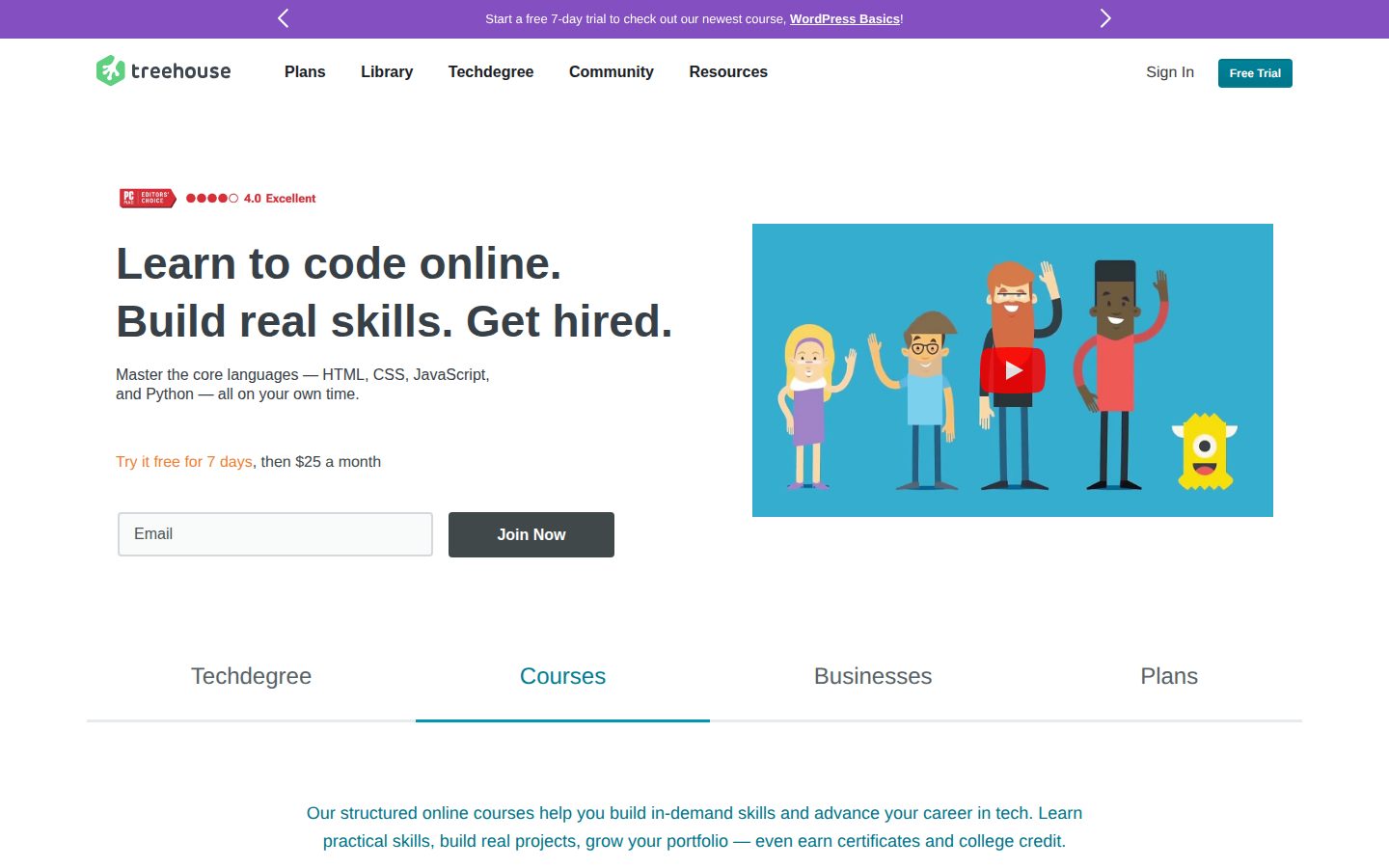
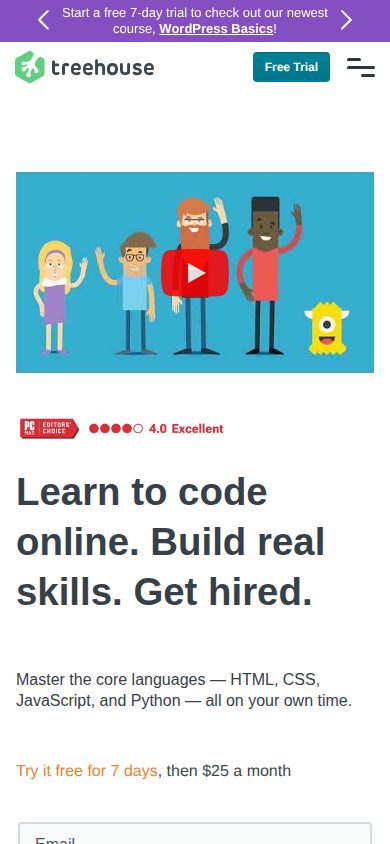
Treehouse desktop previewTreehouse mobile preview

Pricing Plans

Free

Free

Access to select free courses with no subscription required

  • Access to free courses (e.g., Internet Street Smarts, What is AI?, Build a Side Business with AI Tools)
  • Free learning tracks like Learn to Code for Beginners
  • Browser-based learning with interactive quizzes
  • No credit card required
Popular

Basic

$25/monthly

Full access to Treehouse's library of courses for individual learners, with a 7-day free trial

  • Access to hundreds of courses in JavaScript, Python, HTML, CSS, data analysis, AI, and more
  • Structured learning tracks
  • Hands-on projects to build a portfolio
  • Digital certificates upon completion
  • Self-paced learning
  • 7-day free trial included

AI Panel Reviews

The Decision Maker

The Decision Maker

Strategic bet, vendor viability, timing, adoption approval
7.2/10

Solid $25/month bet for workforce upskilling, not a strategic differentiator.

Treehouse is a mature, well-structured coding education platform with real breadth — 300+ courses, Techdegree bootcamps, and a college credit angle no direct competitor matches. It's a workforce development tool, not a competitive weapon.

The college credit partnership via UPI is the thing that separates Treehouse from Codecademy and freeCodeCamp. Digital transcripts through Credly for JavaScript, Python, and Cybersecurity courses — that's a real retention hook for employees on a development path, not just another completion badge.

Two things I watch. One: no public funding data and no changelog visible on the site — hard to assess runway or how aggressively they're shipping. Two: the Techdegree catalog is thin — five subjects — and the pricing page only surfaces a $25/month individual plan, with business tier details buried elsewhere.

At $25/seat, the board won't flinch. Library access, the Compass pre-assessment tool, and Slack-based Techdegree support make this a reasonable pilot for a team upskilling push. Don't mistake it for an L&D strategy.

Competitive Positioning6.5

Codecademy and LinkedIn Learning occupy the same space; the college credit angle is a differentiator but not a moat.

Reputation Risk7.5

ACE-credited college courses and Credly transcripts are credible third-party validators the board will recognize.

Speed to Value7.8

The Compass pre-assessment drops learners at the right starting point immediately — cuts onboarding friction that kills most L&D rollouts.

Strategic Fit6.8

Useful for workforce upskilling, but 300+ courses skewing beginner-to-intermediate won't move the needle on advanced engineering capability.

Vendor Viability6.5

No public funding data or changelog; platform has been around long enough to suggest stability, but no clear growth signals.

Pros

  • College credit eligibility via UPI — no direct competitor matches this
  • $25/month flat makes budget approval a non-event
  • Compass pre-assessment tool removes wasted time on content employees already know
  • Techdegree bootcamps include human-graded projects and career coaching, not just video

Cons

  • No mobile app — entirely web-based limits flexibility for field or hybrid teams
  • Techdegree catalog covers only five subjects — thin for diverse engineering orgs
  • No public changelog; hard to assess shipping cadence or product momentum
  • Business plan pricing and features aren't clearly surfaced — creates friction in procurement

Right for

Teams running a structured upskilling program for early-career or career-changing employees who need guided paths, not just a course library.

Avoid if

Your engineers are mid-to-senior level and need advanced, specialized training beyond full-stack fundamentals.

The Domain Strategist

The Domain Strategist

Craft and strategy in the product's domain — adapts identity per category, same lens
7.8/10

Treehouse's structured Techdegree model is the right architecture for career-changers at $25/month.

Treehouse has built a genuinely coherent learning pathway system — from free entry courses through structured Techdegrees with peer review and career support. The college credit partnership via Credly is a real differentiator that Codecademy and freeCodeCamp can't match.

300+ courses organized into sequenced tracks, a Compass pre-assessment that places learners at the right entry point, and Techdegrees with 9+ portfolio projects. That's curriculum architecture, not just a content library. Someone here understands how adult learners actually progress — you don't dump 300 courses on a beginner and call it a program.

The college credit pathway through UPI is the strategic asset most L&D leaders overlook. If you're deploying Treehouse for workforce development or tuition-benefit programs, transferable credit in JavaScript, Python, and Cybersecurity creates institutional weight that Udemy and LinkedIn Learning simply don't offer. That's a genuine retention and completion lever.

The constraint is the ceiling. Treehouse is built for beginners to job-ready, not for continuous professional development of senior practitioners. If your team's learning needs mature past mid-level, you'll outgrow the catalog. The web-only delivery with no mobile app is also a friction point for learners who commute or work hybrid schedules.

Category Positioning8.2

The college credit partnership via Credly is a structural differentiator that separates Treehouse from Codecademy and freeCodeCamp in any employer-sponsored or workforce development context.

Domain Fit8.0

Compass pre-assessment, department-level admin analytics, and deadline-setting on the business plan map directly to how L&D teams manage cohort-based upskilling programs.

Integration Surface6.8

No API, no changelog, and no dedicated app listed — integration into an existing LMS or HRIS stack will require manual workarounds or the business-tier admin layer.

Long-term Implications7.2

If you adopt Treehouse for early-career and career-changer pipelines, it holds for 3 years; if your workforce learning needs grow past mid-level skills, you'll need a second platform.

Strategic Depth7.5

Techdegree bootcamp structure with peer code reviews and human-graded projects shows real instructional design depth, but the catalog ceiling limits advanced practitioners.

Pros

  • College credit pathway through Credly gives institutional credibility no comparable platform at $25/month offers
  • Compass pre-assessment prevents the learner drop-off that plagues self-directed platforms
  • Techdegree peer review and Slack support channel create genuine accountability structures
  • 30+ AI courses including GitHub Copilot and LLMs keeps the catalog current

Cons

  • Catalog ceiling is real — senior practitioners will exhaust relevant content within 12-18 months
  • Web-only delivery with no mobile app creates friction for hybrid and commuting learners
  • No API or LMS integration surface makes enterprise workflow fit difficult
  • Business-tier pricing not published, which creates friction in budget approval cycles

Right for

Organizations running entry-level tech hiring pipelines or career-change cohorts who need structured, credentialed outcomes at low cost.

Avoid if

Your workforce upskilling needs run past mid-level or your L&D stack requires LMS integration and mobile delivery.

The Finance Lead

The Finance Lead

Money, total cost of ownership, contracts, procurement math
7.2/10

$25/month flat. No SSO tax, no seat tiers. Rare for this category.

Treehouse prices honestly at $25/month with a 7-day trial and no hidden add-ons visible on the pricing page. Business tier pricing isn't published — that's the one gap procurement will hit.

Individual math is clean. $25/month × 12 = $300/year per learner. 50 employees × $300 = $15K/year. No published overage rates, no feature gating within the Basic tier based on available evidence. Year 3 stays predictable if headcount holds. Comparable platforms like Codecademy Pro run $19.99/month, so Treehouse carries a modest premium — justified if the Techdegree structure and college credit program matter to your workforce development case.

The college credit partnership via Credly and UPI is the ROI differentiator. Hard to quantify, but it's a concrete credential story that LinkedIn Learning can't match. Techdegree completion certificates are shareable. Measurable outcomes exist. ROI isn't hand-wavy here — portfolio artifacts and certificates are auditable.

Business plan pricing requires a sales conversation. No published per-seat rate. That creates procurement friction and unpredictable budgeting. Auto-renewal terms aren't disclosed publicly. Standard risk — get the contract language before signing.

Billing & Procurement7.0

Individual billing is frictionless; business tier onboarding cost is opaque without a sales engagement.

Contract Flexibility6.5

Auto-renewal terms and cancellation policy aren't disclosed publicly — standard risk, but unconfirmed.

Pricing Transparency7.5

Individual tier at $25/month is fully visible; business plan pricing requires a sales call, per the evidence.

ROI Clarity7.8

Techdegree certificates via Credly and transferable college credits are auditable outputs, stronger than most competitors.

Total Cost of Ownership8.0

No published add-ons or overages for individual plan; 50 seats × $25 × 36 months = $45K flat, highly predictable.

Pros

  • $25/month flat — no tiered feature taxes on the individual plan
  • College credit program via Credly is a rare, measurable credential differentiator
  • 300+ courses, 7-day free trial, no credit card friction on free tier
  • 50-seat TCO lands near $45K over 3 years — budget-stable

Cons

  • Business plan pricing not published — procurement can't self-serve a quote
  • No mobile app; web-only limits flexibility for field or mobile learners
  • Auto-renewal and cancellation terms not disclosed on public pricing page

Right for

SMBs and HR teams running structured tech upskilling under $500/employee/year with auditable outcomes.

Avoid if

Your procurement team needs published enterprise pricing before engaging a vendor.

The Domain Practitioner

The Domain Practitioner

Daily hands-on reality in the product's domain — adapts identity per category, same lens
7.8/10

Solid beginner runway, but power learners will hit the ceiling fast

Treehouse at $25/month gives beginners a genuinely structured path from zero to portfolio-ready, with Techdegree bootcamps that include peer code review and human grading — rare at this price point. The college credit partnership and Compass pre-assessment separate it from Codecademy's more quiz-heavy approach.

The Compass pre-assessment is the first sign someone here thinks about learner placement, not just enrollment numbers. Letting learners test out of content they already know and drop into the right spot in a track — that's how trainers actually want onboarding to work. The Techdegree structure (9+ portfolio projects, peer reviews, Slack support channel) holds up past day three better than self-paced platforms that leave learners stranded after the first module.

The real ceiling is the content depth. Thirty AI courses sounds robust until you're a trainer trying to sequence advanced LLM fine-tuning or production deployment. The library skews hard toward beginners. Intermediate learners plateau around month two, which is roughly where Udemy's breadth wins.

No mobile app and web-only delivery is a friction point for teams running mixed-device environments. The business analytics dashboard — tracking progress by department — is genuinely useful for L&D reporting, but the pricing page doesn't publish team seat costs publicly.

Day-3 Reality7.5

Structured Techdegree tracks and peer code reviews keep learners engaged past onboarding, but self-paced beginners without a Techdegree have limited accountability scaffolding to stay on track.

Documentation Practitioner-Fit7.2

300+ courses with structured sequencing suggests curriculum depth, but no changelog is visible and docs-availability is flagged as N — harder to verify how current the AI course content actually is.

Friction Surface7.8

In-browser coding environment and interactive quizzes remove setup friction entirely; the Compass pre-assessment cuts redundant content slog, which is a real weekly time saver.

Power-User Depth6.5

Thirty AI courses cover ChatGPT and GitHub Copilot at an introductory level; intermediate-to-advanced learners wanting NLP pipelines or model deployment will exhaust the library quickly.

Workflow Integration7.0

Web-only delivery with no mobile app means learners can't microlearn during commutes — a daily friction point for busy career-changers that Codecademy's mobile experience handles better.

Pros

  • Compass pre-assessment places learners at the right entry point — not just at the beginning
  • College credit via UPI/Credly partnership is a genuine differentiator vs. Codecademy and freeCodeCamp
  • Techdegree peer code reviews and staff support add human accountability at $25/month
  • Free library access through public libraries nationwide widens reach for budget-constrained learners

Cons

  • No mobile app limits learning to desktop sessions — a real barrier for career-changers with day jobs
  • Content depth plateaus at intermediate; advanced practitioners won't find enough to stay
  • Business plan pricing isn't public, which complicates L&D budget conversations
  • No changelog makes it hard to assess how frequently AI course content is updated

Right for

Career-changers and beginners who need structured accountability and a portfolio, not just a video library.

Avoid if

Your learners are already intermediate or need mobile-first, offline-capable delivery.

The Power User

The Power User

Daily human experience, onboarding, polish, learning curve, reliability
7.8/10

$25 a month for structured coding paths that actually lead somewhere

Treehouse is a well-organized coding education platform that earns its keep for beginners and career-changers. The college credit angle and Techdegree structure are real differentiators most competitors won't touch.

The Compass pre-assessment tool alone tells you something about who built this. Someone thought about the person who already knows half the material and doesn't want to sit through it. That's a design decision made by someone who respects your time. At $25/month with a 7-day free trial and 300+ courses, the value math isn't hard. Codecademy exists, freeCodeCamp is free, but neither hands you a structured bootcamp path with human-graded projects and a Slack channel for peer support.

The Techdegree programs are the real product. Nine-plus projects, peer code reviews, an actual certificate. That's not just content — that's accountability structure, which most self-paced learners actually need and most platforms quietly skip.

The honest catch: it's entirely web-based, no mobile app. For someone commuting or stealing 20 minutes on a phone, that friction adds up over three months. Read-only access on mobile is one thing. No app at all is a quiet frustration waiting to happen.

Daily Polish7.5

Gamified badges, leaderboards, and in-browser code challenges suggest someone cared about the daily feel, but no changelog makes it hard to know how actively rough edges get fixed.

Learning Curve8.0

Learning tracks sequence courses logically from beginner to job-ready, and Techdegree programs add deadline structure for learners who drift without accountability.

Mobile Parity5.5

No dedicated mobile app listed anywhere on the site — for a platform billing itself as self-paced and flexible, that's a real gap in daily usability.

Onboarding Experience8.2

The Compass pre-assessment skips you past content you already know, which is the right first move for anyone who's touched code before.

Reliability Feel7.0

Entirely browser-based with no desktop app; no changelog or uptime data public, so reliability is an open question, but the structured track format suggests deliberate, stable product thinking.

Pros

  • College credit eligibility via UPI partnership — almost nobody else offers this at $25/month
  • Techdegree bootcamps include human-graded projects and peer code reviews, not just auto-graded quizzes
  • Compass pre-assessment puts you in the right spot without wasting your afternoon
  • Available free through public libraries — genuinely unusual access model

Cons

  • No mobile app; web-only means stolen commute time is basically lost
  • No public changelog, so it's unclear how often the course library gets refreshed
  • Techdegree certificate carries less brand recognition than a bootcamp diploma or degree

Right for

Beginners and career-changers who want more structure than Udemy but can't afford a $10k bootcamp.

Avoid if

You need to learn on your phone or expect a recognized credential to carry serious employer weight.

The Skeptic

The Skeptic

Contrarian. Watch-outs, deal-breakers, broken promises, category patterns
6.8/10

300+ courses, college credit hook, but the category graveyard is real

Treehouse has genuine differentiators — $25/month, Techdegree structure, and an ACE college credit program that Codecademy doesn't touch. But no changelog, no public funding signals, and a web-only platform in 2024 raise legitimate shelf-life questions.

Three tells upfront. One: 'Get hired' is in the H1 — the kind of promise that lands hard on career-changers and ages poorly if job placement data never surfaces. Two: no changelog listed in the docs. Either they're shipping quietly or they're not shipping much. Three: the affiliate program pays 25% recurring — that's aggressive, and it usually means acquisition costs are high.

The college credit angle is the real differentiator. ACE-credited courses in JavaScript, HTML/CSS, and Python via Credly transcripts — freeCodeCamp and Udemy don't offer that. The Compass pre-assessment tool is smart product thinking. The Techdegree structure, with peer reviews and staff support, is closer to a bootcamp than a video library.

Exit portability is fine. Skills transfer. Certificates are portable. No proprietary lock-in. The tradeoff: no mobile app, no API, and zero public funding data means you're betting on a team you can't fully audit.

Competitive Differentiation7.5

ACE college credit at $25/month is a real gap vs. Codecademy and freeCodeCamp; Techdegree structure adds depth Udemy lacks.

Exit Portability8.5

Skills, portfolios, and Credly-issued certificates all leave with the learner — nothing proprietary traps you.

Long-term Viability5.5

No public funding data, no changelog, no mobile app — hard to gauge shipping velocity or runway from visible signals.

Marketing Honesty6.5

'Get hired' headline with no published placement rates is a claim that outpaces the evidence.

Track Record Match6.5

Treehouse is a 10+ year-old platform — survivor bias works in their favor, but no changelog suggests slowing momentum.

Pros

  • College credit via ACE partnership — genuinely rare at this price point
  • $25/month all-in is competitive against Codecademy Pro at $39/month
  • Compass pre-assessment skips content you already know — smart UX
  • Library access through participating public libraries costs nothing

Cons

  • No changelog — can't verify how actively the platform is being updated
  • Web-only, no mobile app — a real gap for 2024 learner habits
  • No published job placement or completion rate data behind the 'Get hired' promise
  • No public funding or team signals — viability is a genuine open question

Right for

Career-changers who want structured bootcamp pacing without bootcamp prices and care about credential portability.

Avoid if

You need mobile-first learning or verifiable job outcome data before committing.

Buyer Questions

Common questions answered by our AI research team

Pricing

Does Treehouse offer a free trial?

Yes, Treehouse offers a free 7-day trial.

Features

Can Treehouse courses count toward college credit?

Yes, courses in Cybersecurity, JavaScript, HTML, CSS, and Python are eligible for college credit.

Features

What subjects are covered in Treehouse Techdegree bootcamps?

Techdegree bootcamps cover HTML, CSS, JavaScript, Python, SQL, data analysis, UX design, and AI tools.

Features

Do Treehouse courses include hands-on coding projects?

Yes, courses include interactive quizzes, code challenges, and hands-on projects learners can add to a portfolio.

Integration

Does Treehouse have an affiliate program?

Yes, Treehouse has an affiliate program offering 25% recurring commission.

Also in AI Education & Training