On-demand GPU cloud with thousands of GPUs and no minimum commitment
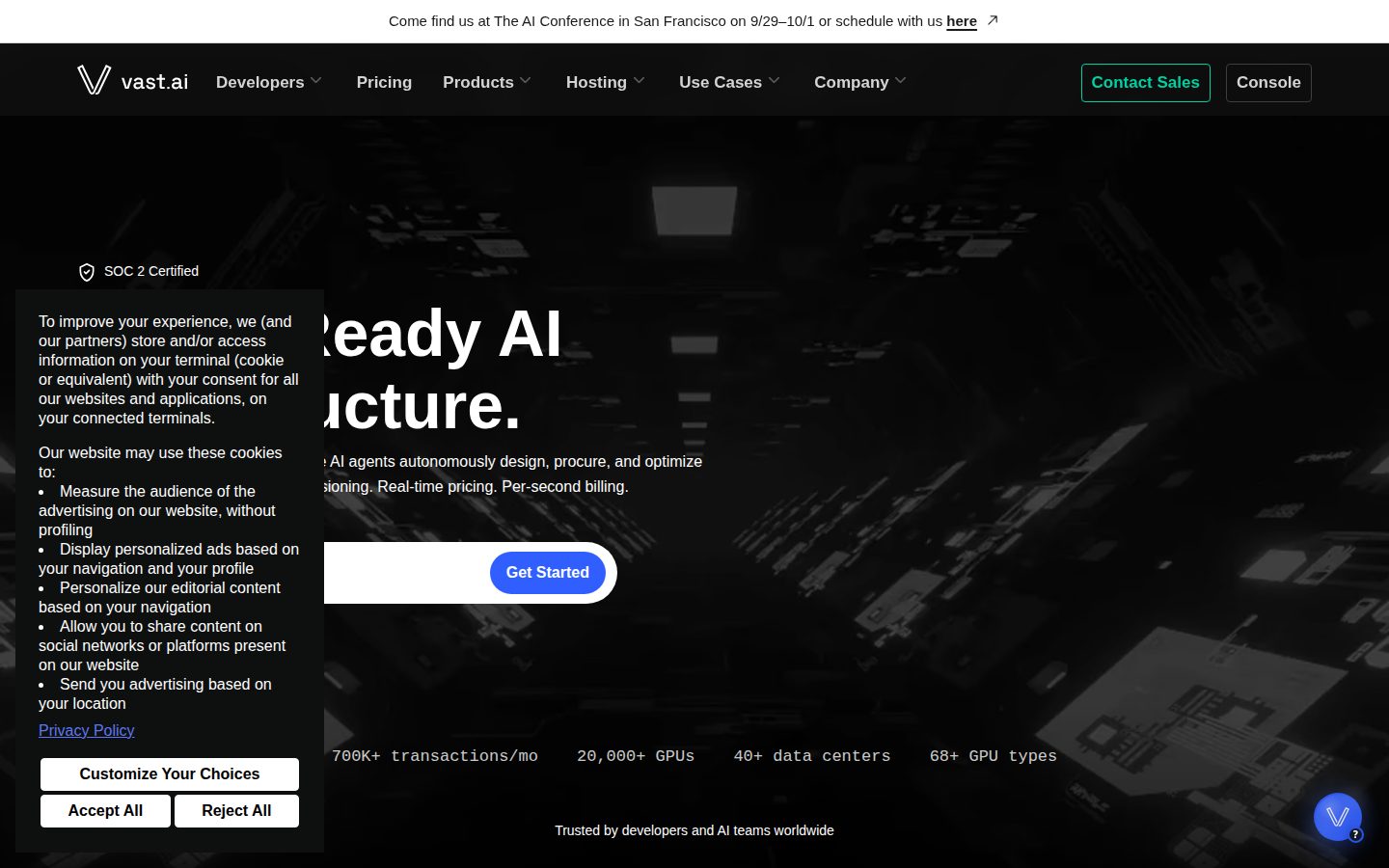
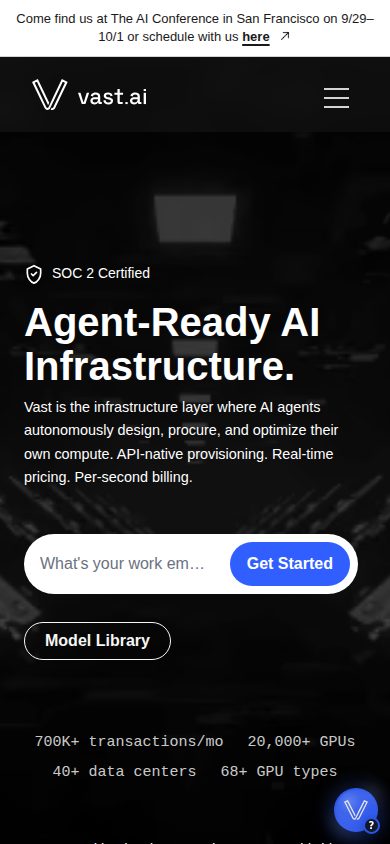
Vast.ai is a GPU cloud platform for renting compute from data centers and independent hosts worldwide.
AI Panel Score
6 AI reviews
Reviewed
Facts checked against vast.ai
AI Editor ApprovedApproved and published by our AI Editor-in-Chief after full panel analysis.Vast.ai works as a marketplace: users search available GPU listings by type (RTX 4090, H100, B200, and others), price, and location, then rent instances on demand with no minimum commitment. Instances can be accessed via SSH, configured with networking and ports, and attached to storage volumes for data movement. Users can manage everything through the web dashboard at cloud.vast.ai, the CLI, the Python SDK, or the REST API, with an OpenAPI spec available as the canonical reference for programmatic access.
Beyond single-instance rentals, Vast.ai offers a serverless product for running workloads such as vLLM and ComfyUI without managing persistent infrastructure, including documented worker states and dedicated serverless pricing. The platform also supports reserved instances for longer-term commitments and a clusters product for multi-GPU setups. For developers building automated workflows, Vast.ai publishes CLI and SDK "skill" files (SKILL.md) intended for use with AI coding agents like Claude Code, Cursor, and Windsurf, along with a machine-readable API catalog and MCP server card for agent-based discovery of its tooling.
Vast.ai serves two sides of the market: renters who need GPU compute for AI/ML workloads, and hosts who supply GPUs from their own data centers or hardware to earn income, with documentation covering host verification and payment. Pricing is usage-based and driven by live marketplace rates rather than fixed tiers, so costs vary by GPU type, host, and demand; a dedicated pricing page and pricing documentation describe the mechanics for both instances and serverless usage.

Supports running ComfyUI image/video generation workflows as a serverless deployment on rented GPU infrastructure.
Provides a library of models that can be deployed on Vast.ai's GPU infrastructure.
Enables deployment of serverless GPU workloads such as vLLM and ComfyUI without managing persistent instances, with usage-based pricing.
Provides documentation and support for deploying vLLM inference workloads on Vast.ai's serverless infrastructure.
Offers a command-line interface for finding, renting, and managing GPU instances and serverless workloads programmatically.
Provides a Python SDK (VastAI class, SyncClient, AsyncClient) for scripting instance management and serverless operations.
Lets users search and rent on-demand GPU instances (e.g., RTX 4090s, H100s, B200s) from a global marketplace of data centers and independent hosts with no minimum commitment.
Allows individuals and data centers to list and rent out their own GPUs as suppliers, with earning, verification, and payment processes.
Web console (cloud.vast.ai) for searching GPUs, launching instances, and managing running workloads.
Allows users to reserve GPU instances in advance for guaranteed availability over a set period rather than renting purely on demand.
Allows users to connect to rented instances via SSH and configure networking and port access for their workloads.
Provides persistent storage and volume management along with data movement tools for transferring data to and from instances.
Supports provisioning virtual machines in addition to container-based GPU instances.
Provides SKILL.md files, an OpenAPI schema, and an MCP server card so AI agents (e.g., Claude Code, Cursor, Windsurf) can discover and safely operate Vast.ai's CLI, SDK, and API.
Exposes a REST API, documented via an OpenAPI spec, for creating instances, managing resources, and integrating Vast.ai into external tools.
Live market-set GPU pricing for production workloads needing guaranteed uptime
Lowest-cost GPU access for fault-tolerant, batch training workloads
Long-term GPU capacity commitments for steady, predictable workloads with volume discounts
20,000 GPUs, $5 to start, no contract — a real alternative to fixed-tier cloud pricing.
“Vast.ai is a GPU marketplace, not a single vendor, which is exactly why it's cheap and exactly why uptime isn't guaranteed on every listing. Solid for teams who can tolerate variance in exchange for price.”
20,000 GPUs, 68+ types, 40+ data centers, 700K transactions a month. That's a liquid market, not a shell of one. $5 to start with no sales call is the right on-ramp for engineers who hate procurement calls.
Two things stand out: the SOC 2 certification, and the interruptible tier at 50%+ off for batch work. That's a mature pricing model for a marketplace — most don't segment preemptible vs guaranteed uptime this cleanly.
The tradeoff: you're renting from independent hosts, not a single accountable data center. Reserved instances cut up to 50% for steady workloads and are self-serve — you prepay an on-demand instance from the console or CLI — but the discount stays on that host, so it doesn't remove the host risk. Fine for experiments and batch training, riskier for workloads that can't tolerate a reclaimed instance.
No minimum commitment plus 68+ GPU types including H100s and B200s is a wider, more flexible catalog than fixed-tier cloud GPU pricing typically offers.
SOC 2 certification helps, but marketplace hosting means variable accountability and interruptible instances can be reclaimed mid-job.
$5 minimum and per-second billing on the On-Demand tier means teams can be running a workload within minutes, not weeks.
Good fit for teams needing flexible compute without long-term cloud contracts, less so if you're standardizing on one hyperscaler.
REST API, Python SDK, OpenAPI spec, and MCP/agent tooling point to active engineering investment, and regular product-update posts confirm a steady release cadence.
Teams running batch training or inference workloads who can tolerate variable hosts in exchange for lower cost and no contract.
Skip it if your workload needs guaranteed single-vendor accountability with zero tolerance for interruption.
A liquid GPU spot market, not a managed cloud — architect accordingly.
“Vast.ai is a marketplace, not a hyperscaler substitute: 20,000+ GPUs across 40+ data centers, priced by live supply and demand. That's the right tool for elastic training and inference, the wrong one if you need a single throat to choke.”
The architecture is a two-sided marketplace: independent hosts and data centers supply GPUs, Vast arbitrates search, pricing, and SSH access. That means 68+ GPU types and 20,000+ GPUs at spot-market rates, per-second billing, $5 minimum entry — real elasticity, no procurement cycle. But heterogeneous hosts mean heterogeneous reliability; the interruptible tier is explicitly preemptible, and on-demand guarantees uptime only within Vast's own SLA, not a hyperscaler's.
Domain fit is strong for teams doing batch training, fine-tuning, or bursty inference who already checkpoint and can tolerate host-level variance. The serverless layer (vLLM, ComfyUI, autoscale-to-zero) and REST API with OpenAPI spec make this scriptable into CI/CD rather than console-driven, which matters for anyone building agent-based provisioning — the SKILL.md and MCP server card for Claude Code/Cursor are a real signal here.
Three-year risk: your workload-placement logic and cost model get tuned to a marketplace, not a fixed catalog, so migrating off means re-architecting scheduling assumptions, not just swapping an SDK. SOC 2 certification helps the compliance conversation but doesn't replace hyperscaler-grade support contracts.
700K+ monthly transactions and 40+ data centers position it as the liquid spot layer next to fixed-tier hyperscaler GPU offerings.
Per-second billing, $5 minimum, and no-commitment rental match how ML teams actually burst compute for training and inference.
CLI, Python SDK, REST API with OpenAPI spec, and SKILL.md/MCP tooling for Claude Code and Cursor make this genuinely agent- and pipeline-scriptable.
Marketplace pricing and heterogeneous hosts mean your scheduling and cost logic gets tuned to Vast's model, raising switching friction later.
Reserved, interruptible, on-demand, and serverless tiers plus a clusters product cover most GPU procurement patterns, not just single-instance rental.
ML teams running batch training or bursty inference who can checkpoint and want spot-market GPU pricing without procurement overhead.
You need a single-vendor SLA and predictable support escalation path for production-critical inference.
$5 minimum, per-second billing, no contract. Math is transparent, not fixed.
“No seat fees, no tiers to negotiate — pricing is live marketplace rate. That's honest, but it means your year-3 number moves with demand, not with a sales rep.”
No SSO tax here — there's no seat model at all. Three modes: On-Demand, Interruptible (50%+ cheaper, preemptible), Reserved (up to 50% off, 1-6 month terms). Start with $5 credit. No sales call required for any of them.
TCO math is different from SaaS. Rent an H100 at market rate, run it 24/7 for a training job, cost scales with hours not headcount. Interruptible workloads cut cost in half but risk reclamation — checkpoint or lose the run. Reserved is a prepay on one instance: you can preview the discounted rate before renting, but cancel early and the discount is clawed back plus a 5% fee.
700K+ transactions monthly, 20,000+ GPUs, 40+ data centers — real marketplace depth, per the vendor's own numbers. SOC 2 certified, which helps procurement. But pricing floats with 68+ GPU types across independent hosts — budget forecasting is harder than a fixed-tier competitor. No published overage rate because there's no overage concept — you just spend more when you rent more.
SOC 2 certification and API-key onboarding lower friction; Reserved is a self-serve prepay from the console or CLI.
No minimum commitment, spin up/down anytime, $5 to start — no lock-in on the on-demand side.
On-Demand and Interruptible rates are visible without sales contact; Reserved rates can be previewed on the search page before you prepay.
Cost-per-compute-hour is measurable, but interruptible pricing requires checkpoint discipline to actually realize savings.
Per-second billing keeps costs proportional to use, but market-rate pricing makes 3-year forecasting harder than fixed tiers.
Teams running variable AI/ML workloads who want per-second billing without a contract.
You need fixed, predictable monthly spend for budget lockdown.
A GPU marketplace that respects SSH and per-second billing, but you own the variance
“Vast.ai gets out of the way for anyone who just wants a box with a GPU and root access. The marketplace model means pricing and reliability vary by host, and that's the cost of the $5 minimum spend.”
Search, rent, SSH in. That's the core loop, and it works the way you'd expect from a marketplace rather than a hyperscaler — you're picking a host, not a black box. 20,000+ GPUs across 40+ data centers and 68+ GPU types (RTX 4090s up to B300s) means real choice, but also real variance: interruptible instances get reclaimed, and reliability depends on whose rig you landed on that day.
The CLI and Python SDK (VastAI, SyncClient, AsyncClient) cover scripted provisioning well, and the OpenAPI spec plus REST API mean you're not stuck clicking a dashboard for automation. SKILL.md files for Claude Code and Cursor are a nice touch if you're wiring agents into provisioning — most GPU clouds haven't bothered.
Vast posts regular product updates listing new features and bug fixes, which matters on infra you depend on daily. Reserved instances and per-second billing on-demand cover both steady and bursty workloads reasonably, but SOC 2 aside, the trust model here is still 'read the host's reviews.'
SSH access and per-second billing feel like real infra work, but marketplace variance means some hosts will be flakier than others by day three.
OpenAPI spec as canonical reference and SKILL.md files for agent tooling read like docs written for people scripting against the API, not marketing copy.
Interruptible instances can be reclaimed mid-job, so checkpoint/resume becomes a required habit, not an option.
Clusters for multi-GPU setups, reserved terms up to 6 months, and serverless vLLM/ComfyUI deployment give real headroom past the single-instance rental.
CLI, Python SDK, and REST API cover the automation surface most ML engineers actually script against.
Engineers who want cheap, scriptable GPU access and don't mind managing their own reliability tradeoffs.
You need a single accountable vendor with guaranteed SLAs across every instance you rent.
A GPU flea market that actually works, if you like shopping around
“Vast.ai gets you renting an H100 or an RTX 4090 in minutes, with no contract standing between you and a terminal. The catch is you're the one comparing hosts, and that's a skill in itself.”
Vast.ai is a marketplace, not a polished cloud console, and it feels like one. You're browsing 20,000+ GPUs across 40+ data centers and independent hosts, picking by price and location, which means quality and latency vary listing to listing. That's the tradeoff of skipping the AWS-style markup: you get per-second billing and interruptible instances at 50%+ off, but you're doing the vetting yourself.
First ten minutes is genuinely low friction — $5 credit, an API key, SSH in, go. That's rare in this category. The CLI, Python SDK, and REST API all exist, and they've even shipped SKILL.md files for Claude Code and Cursor, which tells me someone there is thinking about how agents will actually use this thing, not just humans.
Serverless vLLM and ComfyUI deployment with autoscale-to-zero is the feature that ages well past week one. SOC 2 certification is a nice trust signal for a marketplace model that could otherwise feel sketchy.
CLI, SDK, and dashboard all exist and cover real workflows, but marketplace listings mean UI consistency depends on host, not Vast.ai.
SSH and REST API basics are quick to grasp, but reserved instances, clusters, and marketplace pricing mechanics take longer to master.
Nothing suggests a mobile app; this reads as a web console and CLI product built for a desk, not a pocket.
A stated $5 minimum with no contracts or sales calls is about as low-friction as GPU rental gets.
On-Demand tier promises guaranteed uptime and no interruptions, but Interruptible instances can be reclaimed mid-job by design.
Developers and small teams who want cheap, flexible GPU access without signing a contract.
You need guaranteed enterprise-grade uptime with zero vetting effort on your end.
$5 to start, 20,000 GPUs, and a marketplace model that cuts both ways.
“Vast.ai's pitch is unusually concrete for this category — real GPU counts, real pricing mechanics, no vague superlatives. The tradeoff is the marketplace itself: you're renting from independent hosts, not just hardened data centers.”
No 'best in class' language on the landing page. Just numbers: 20,000+ GPUs, 68+ types, 40+ data centers, 700K+ transactions a month, $5 minimum. That specificity is rare and it's the kind of claim that's easy to check and hard to fake.
The catch is structural, not marketing. Hosts include independent hardware suppliers alongside data centers — the docs cover host verification and payment for a reason. On-demand pricing floats with the market, interruptible instances can get reclaimed. Fine for batch training, riskier if you assumed cloud-GPU stability like a hyperscaler.
Exit is decent — SSH access, standard containers, REST API with an OpenAPI spec, nothing proprietary trapping your workload. SOC 2 certification is a real trust signal for a marketplace model. Regular product-update posts list new features and bug fixes, so the update cadence is on the record. Agent tooling (SKILL.md, MCP server card) is a genuinely different bet than most GPU clouds are making right now.
Marketplace model with independent hosts plus agent-tooling (SKILL.md, MCP card) is a distinct angle vs. fixed-tier hyperscaler GPU rental.
SSH access, standard containers, and a documented REST API/OpenAPI spec keep you from being locked into a proprietary runtime.
SOC 2 certification and a documented pricing/API structure are solid signals; regular product-update posts listing features and bug fixes show steady shipping.
Landing page leads with counts and price mechanics, not adjectives — checkable claims like $5 minimum and 20,000+ GPUs.
Named features (vLLM, ComfyUI serverless, reserved instances) line up with documented pricing tiers, though uptime claims on interruptible tier are self-limiting by design.
Teams running batch or serverless AI workloads who want live market pricing and no long-term contract.
Avoid if you need guaranteed uptime with zero tolerance for host-side variability.
Common questions answered by our AI research team
You can start on Vast.ai with as little as $5 — just add credit and grab your API key to begin renting GPUs, no contracts or sales calls required.
Vast.ai offers over 20,000 GPUs and 68+ GPU types across 40+ data centers, with a marketplace processing 700K+ transactions per month.
Yes. Vast.ai's Serverless offering lets you deploy models as endpoints with automatic benchmarking and optimization across GPU types, autoscaling to zero and charging only for compute time — supporting workloads like vLLM and ComfyUI deployments.
Yes. The REST API is the interface used to provision infrastructure programmatically, callable with commands like curl requests authenticated via a Bearer API key, and it's the same interface AI agents use to procure and optimize compute at scale.
Yes, Vast.ai is SOC 2 Certified.
Who Vast.ai competes with, and how each one differs
AWS offers on-demand GPU instances (EC2) directly rather than a peer-to-peer marketplace, at higher fixed pricing but with enterprise SLAs, compliance certifications, and integrated cloud services that Vast.ai's decentralized supplier network does not provide.
Google Cloud provides GPU/TPU compute through Vertex AI and Compute Engine as a fully managed hyperscaler offering, contrasting with Vast.ai's model of aggregating spare capacity from independent, variable-quality GPU hosts at lower cost.
RunPod is a similarly structured low-profile GPU cloud marketplace targeting AI developers with per-second billing and serverless GPU endpoints, making it a closer functional match than the large hyperscalers.
Company
Vast.aiFounded
2018Pricing
Usage-based


Vast.ai operates an online marketplace based in New York that connects GPU owners with developers and businesses needing cloud compute for AI workloads.