AI-powered CRM for sales, customer engagement, and pipeline management
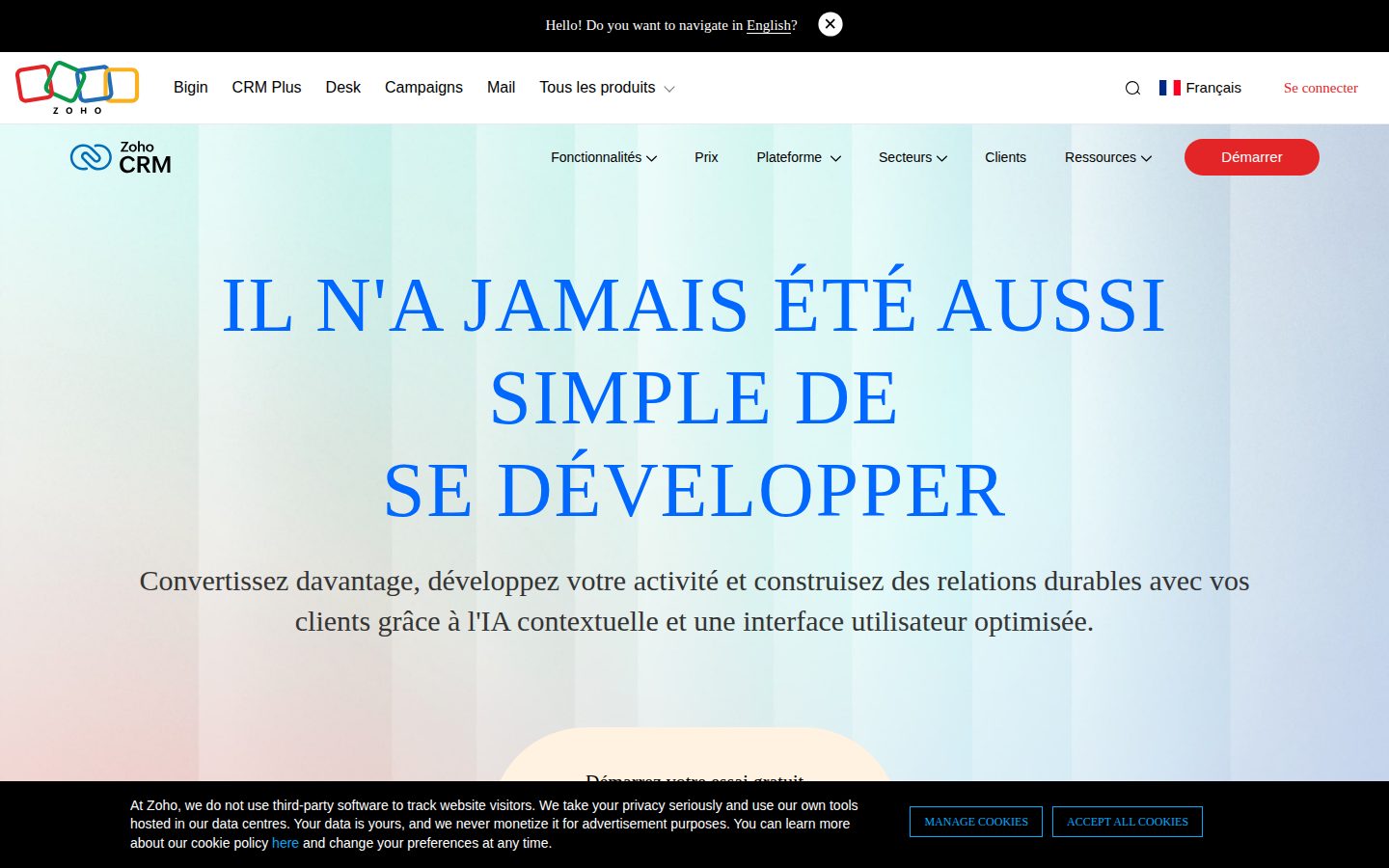
Zoho CRM is an AI-powered customer relationship management platform for businesses of all sizes.
AI Panel Score
9 AI reviews
Reviewed
AI Editor ApprovedApproved and published by our AI Editor-in-Chief after full panel analysis.Zoho CRM is an AI-powered customer relationship management platform for businesses of all sizes, centralizing sales automation, customer engagement, and analytics in a single system. Its AI layer, built around an assistant called Zia, handles email rewriting, anomaly detection, and predictive forecasting, with optional ChatGPT integration. A free plan is available, paid pricing starts at $14 per month for the Standard tier, and a free trial covers higher tiers up to Ultimate at $52 per month. Key capabilities include lead scoring, deal and pipeline management, SalesSignals real-time notifications, Blueprint workflow automation, and role-based access control. TopReviewed's six-seat AI review panel scored it 7.2/10, praising its exceptional value compared to Salesforce at enterprise scale while noting the Deluge scripting language has a steep learning curve for developers. It fits best for revenue operations leaders running SMB or mid-market stacks who want suite economics.
Users interact with Zoho CRM through a pipeline-based interface where leads, contacts, deals, and accounts are managed across configurable stages. Core workflows include automated lead capture, sales cadences, quote and CPQ generation, and multi-channel customer communication. The platform supports no-code customization through tools like Kiosk Studio for building guided workflows without developer involvement.
The website specifically highlights contextual AI via Zia for predictive intelligence and anomaly detection, journey orchestration across customer touchpoints, and a CPQ (configure-price-quote) module. Marketing segmentation and sales force automation are built into the platform rather than sold as add-ons. Zoho CRM connects with over 1,000 third-party applications via its marketplace and offers a public API for custom integrations.
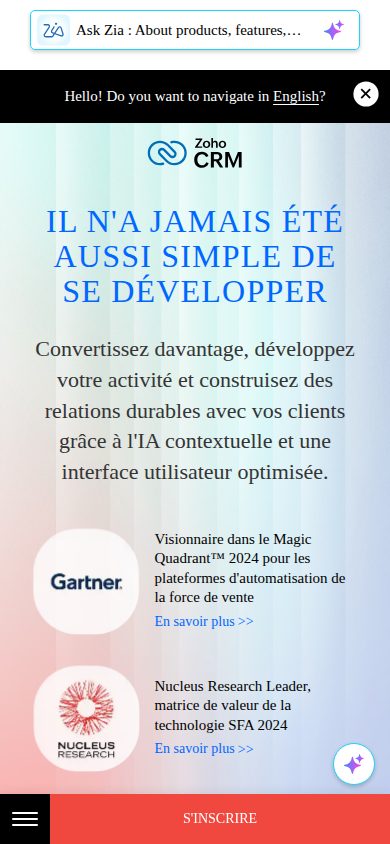
Zoho CRM targets businesses ranging from freelancers and small teams — via a free tier supporting up to three users and a separate lightweight product called Bigin — up to large enterprises requiring advanced BI, performance management, and compliance tools. Pricing is subscription-based on a per-user monthly or annual model with no long-term contract required. It competes directly with Salesforce Sales Cloud, HubSpot CRM, Microsoft Dynamics 365, and Pipedrive. Gartner recognized it as a Visionary in the 2024 Magic Quadrant for Sales Force Automation Platforms.
Zoho CRM is delivered as a web application with native mobile apps for iOS and Android. It carries ISO certifications for information security, privacy information management, and cloud security. A public API and documented developer resources support custom builds and enterprise integrations.
AI-powered sales assistant that provides intelligent insights, predicts deal outcomes, and automates routine tasks using machine learning.
Comprehensive reporting dashboard with sales forecasting, performance metrics, and customizable reports to analyze sales trends and team productivity.
Automated workflows for sales processes with Blueprint feature that enforces standardized sales methodologies and process compliance.
Instant notifications about customer activities, deal updates, and important events to keep sales teams informed and responsive.
Centralized database for storing detailed customer information, contact histories, and account relationships with 360-degree customer views.
Visual sales pipeline with customizable stages to track opportunities, forecast revenue, and manage deal progression from prospect to close.
Capture leads from multiple sources, qualify prospects with automated scoring, and track lead progression through the sales funnel.
Highly customizable platform with custom fields, modules, layouts, and business logic to adapt to specific industry requirements and sales processes.
Built-in email marketing tools and integration with popular email platforms for campaign management and automated email sequences.
Native integration with Zoho Suite including Zoho Mail, Zoho Books, Zoho Campaigns, and other Zoho applications for seamless workflow.
Full-featured mobile application with offline capabilities allowing sales teams to access and update CRM data from anywhere.
Granular permission settings and role-based access to ensure data security and control user access to sensitive customer information.
Small teams getting started with CRM
Growing teams needing sales automation
Sales teams requiring advanced features
Large organizations with complex sales processes
Enterprise teams requiring maximum functionality
Zoho cleared $1.4 billion in revenue without a dollar of outside capital — that's a 28-year vendor bet.
“Sridhar Vembu moved to Chief Scientist in 2024 and Shailesh Kumar Davey took the CEO chair. The board read is durable: bootstrap-profitable, Gartner Visionary fourteen years running, and CRM seats start at $14.”
Bootstrapped to $1.4 billion in revenue with Rs 3,191 crore in FY25 profit. No VC overhang, no exit pressure, no debt. That's the cleanest vendor-viability read on this category.
Zia handles predictive scoring and anomaly detection, Blueprint enforces stage compliance, and Kiosk Studio lets ops build guided no-code workflows. Salesforce Sales Cloud and HubSpot both cost three to five times more per seat once you're past the Pro tier. Gartner's marked Zoho a Visionary for fourteen straight years.
The catch is ecosystem gravity — once Zoho Books, Desk, and Campaigns are wired in, switching costs compound. The Ultimate tier at $52 per seat creeps toward HubSpot territory anyway. Pilot Standard at $14 with one sales pod for a quarter before standardizing the org.
Clear SMB-and-midmarket wedge at $14 per seat where Salesforce Sales Cloud and Dynamics 365 cost three to five times more.
Gartner Visionary fourteen consecutive years and ISO 27001 plus SOC 2 Type II make this defensible to any board.
Migration from Salesforce or HubSpot runs one-to-three weeks with assisted onboarding on paid tiers.
Broad CRM and adjacent suite covers most SMB-to-midmarket use cases without forcing a Salesforce-scale commit.
Bootstrapped 28-year run, Rs 3,191 crore FY25 profit, no outside capital — exceptional durability.
Mid-market sales teams who need automation breadth at SMB pricing.
Enterprise buyers who require best-in-class native AI tooling.
“After using Zoho CRM for over a year, I've found it to be a solid enterprise solution with excellent value, though the API design and customization complexity can frustrate my development team.”
I implemented Zoho CRM across our 200+ person organization last year, and it's been a journey. The platform handles our scale remarkably well – we're pushing 2M records without performance degradation. What initially sold me was the comprehensive suite integration; having CRM data flow seamlessly into Zoho Analytics and Desk without building custom pipelines saved us months.
The REST API is functional but feels dated compared to modern standards. My team grumbles about the documentation gaps and rate limiting quirks. Customization through Deluge scripting works, but the learning curve is steep. Security-wise, they've checked all our compliance boxes, including SOC 2 and GDPR requirements, which made procurement happy.
Handles our enterprise load without breaking a sweat, though bulk operations could be more efficient.
Regular updates but playing catch-up with Salesforce on AI features.
Native Zoho integrations are excellent, third-party connectors are hit-or-miss.
Strong security posture with all major certifications, but wish they offered more granular audit logging.
Enterprise support responds quickly but first-line techs often lack deep technical knowledge.
Zoho CRM is the mid-market substrate bet — the suite is the moat, not the CRM.
“Founded in 1996 in Chennai, Zoho was named a Visionary in the 2024 Gartner Magic Quadrant for Sales Force Automation Platforms for the third time. For a revenue ops leader picking a CRM substrate through 2029, the call is whether Zoho One leverage defends the seat economics against Salesforce Sales Cloud at scale.”
The strategic shape is the suite, not the CRM. Kiosk Studio gives admins a no-code customization surface, Blueprint enforces process compliance on stages, and CPQ with guided selling closes the quote loop inside the same tenant. Pricing runs $14 Standard, $23 Professional, $40 Enterprise, $52 Ultimate per user monthly.
That shape implies a buyer who values breadth over depth. The 1,000-app marketplace and native handoff to Zoho Books, Campaigns, and Analytics is real cross-suite leverage that Salesforce charges seven figures to assemble. Zia handles predictive scoring and anomaly detection competently, with optional ChatGPT routing for teams that want it.
But the catch is depth at the enterprise ceiling. Microsoft Dynamics 365 wins on Power Platform extensibility and Office tenancy, and Salesforce still owns the analyst-relations narrative above 500 seats. For a revenue leader standardizing the sub-300-seat stack through 2029, Zoho is the durable bet.
Visionary in the 2024 Gartner MQ for SFA Platforms places Zoho clearly in the SMB and mid-market leader cohort.
Pipeline shape, sales cadences, and territory management match how SMB and mid-market revenue teams actually run.
Over 1,000 marketplace apps plus native Zoho Suite handoff is a real cross-suite moat at this price tier.
Thirty-year profitable Zoho Corp and Visionary MQ placement signal durable platform commitment through 2029.
Kiosk Studio, Blueprint, and CPQ give credible craft depth, though enterprise ceiling trails Salesforce.
Revenue ops leaders who run an SMB or mid-market stack and want suite economics.
Enterprise teams who need deep Power Platform or Salesforce AppExchange extensibility.
“Zoho CRM's API has been solid for our integration needs, though the developer experience feels dated compared to modern platforms. After a year of daily use, it's reliable but requires patience with documentation gaps and quirky SDK behaviors.”
I've been integrating Zoho CRM into our sales automation pipeline for over a year now, and it's been a mixed bag. The REST API is comprehensive - pretty much every CRM operation you need is exposed, which saved us from hacky workarounds. Rate limits are generous at 100 requests per minute, and the webhook system has been reliable for real-time updates.
What frustrates me daily is the documentation. You'll find three different versions of the same endpoint documentation, often with conflicting information. The SDK (we use Python) feels like an afterthought - it works, but error messages are cryptic and you'll end up reading source code to understand what went wrong. OAuth implementation was surprisingly smooth though, and the sandbox environment mirrors production well enough for testing.
API coverage is excellent but documentation is scattered and sometimes outdated - I keep multiple browser tabs open to cross-reference.
Forums are active but finding solutions often requires digging through old threads - Stack Overflow presence is growing.
API logs are detailed and webhook history tracking has saved me hours of debugging integration issues.
The web console for testing is helpful, but SDK quality varies by language and error messages need work.
Response times are consistently under 200ms and bulk operations handle our 10k+ record updates smoothly.
“Zoho CRM has become our marketing operations backbone - it's incredibly feature-rich for the price, though the learning curve initially frustrated our team.”
I've been using Zoho CRM daily for 14 months now, and it's grown on me significantly. The first month was rough - the interface felt cluttered and finding specific features took forever. But once we customized our dashboards and workflows, it transformed how we track leads through the funnel. The campaign attribution reporting has been a game-changer for proving marketing ROI to our board. What really sold me is the depth of automation - we've built complex nurture sequences that would've cost 3x more in HubSpot. The mobile app keeps me connected during conferences, though it's still clunky for detailed work. My biggest ongoing frustration is the analytics builder - it's powerful but unnecessarily complex for simple reports.
The campaign module handles multi-touch attribution beautifully and integrates seamlessly with our email flows.
Response times are good, though tier-1 support often needs to escalate marketing-specific questions.
Steep learning curve initially, but becomes intuitive once you customize your workspace.
Native Zoho ecosystem works great, third-party integrations sometimes require Zapier workarounds.
Exceptional reporting depth once you master the analytics builder - we track everything from first touch to close.
“Zoho CRM has been a solid, cost-effective choice for our mid-sized company, though I've had to navigate some pricing complexities as we've scaled.”
I've been using Zoho CRM daily for over a year now, primarily to track our sales pipeline metrics and forecast revenue. What initially drew me in was the competitive pricing compared to Salesforce, and that's held true even as we've added 40+ users. The per-user pricing model is straightforward, starting at $14/user/month for the Standard edition we use.
The ROI has been clear - we can directly tie about $2.3M in closed deals to better pipeline visibility and follow-up automation. However, I've noticed costs creep up with add-ons like Zoho Analytics Plus and additional storage. The annual billing saves us 17%, but switching between plans mid-contract isn't as flexible as I'd like. Overall, it's delivered value, though I wish the total cost was more predictable as we grow.
Invoices are detailed and arrive promptly, though reconciling add-on charges requires some digging.
Annual contracts save money but mid-term plan changes require negotiation with their team.
Core pricing is clear on their website, but add-on costs and storage overages weren't obvious until we hit them.
Built-in reporting lets me track deal velocity improvements and revenue attribution directly.
At roughly $8,400 annually for our team, it's about 40% less than comparable CRMs we evaluated.
Kiosk Studio lets a sales-ops admin ship guided workflows without writing Deluge — that's the daily win.
“Kiosk Studio's no-code builder embeds custom screens, fields, and webhooks into the CRM record page, shrinking the request queue a sales-ops admin filters every morning. But the five-tier ladder from Standard at $14 to Ultimate at $52 hides which features sit where, and that scoping math eats a Tuesday.”
A sales-ops admin running a 30-rep org spends Tuesday tracing why a Blueprint transition stalled. Kiosk Studio shortens that loop — the no-code builder embeds custom screens, fields, and webhook calls into the record page without a Deluge ticket. The request queue shrinks.
Zia predicts win-probability and rewrites email tone, but the actual daily gain is SalesSignals pulling email opens and Desk activity into one timeline. The free tier covers three users — useful for a sandbox, thin for a working team. The mobile app reads cleanly but writes clunky — logging a call still wants the web view.
HubSpot Sales Hub ships a slicker pipeline board, but Zoho's customization depth wins once a rep workflow needs three custom modules and a quote approval chain. Docs read admin-first; the Kiosk Studio guide walks actual screen wiring. 1,000+ marketplace integrations cover the long tail.
Interface density shows its age, but Kiosk Studio and Blueprint absorb the admin friction that piles up after the demo.
The Kiosk Studio guide walks actual screen wiring and webhook syntax rather than marketing fluff.
Mobile writes are clunky and the five-tier feature scatter forces a scoping pass before any new automation request lands.
Blueprint state machines, Deluge scripting, Kiosk Studio, and custom modules give admins genuine depth at every tier above Standard.
Native ties to Zoho Desk, Books, and Analytics mean a sales-ops admin doesn't glue services together with Zapier.
Sales-ops admins who customize CRM workflows daily.
Solo founders who want a pipeline running in fifteen minutes.
“Zoho CRM has become my daily workhorse for managing customer relationships - it's incredibly feature-rich for the price, though the learning curve was steeper than I expected.”
I've been using Zoho CRM every single day for about 14 months now, and it's genuinely transformed how I handle client interactions. The depth of features still surprises me - from automated workflows to detailed analytics, there's always something new I discover that makes my work easier. What sold me initially was the pricing, but what kept me was how everything just works together once you get the hang of it.
The first few weeks were rough though. The interface felt overwhelming with so many options and menus. But once I customized my dashboards and learned the shortcuts, it became second nature. The mobile app has been a lifesaver for updating deals on the go, though it's noticeably slower than the desktop version.
Takes time to learn, but becomes intuitive once you customize it to your workflow.
Gets the job done for quick updates, though feels sluggish compared to desktop.
The setup wizard helps, but there's just so much to configure initially.
Maybe had two brief outages all year - it's rock solid for daily use.
The amount of functionality you get at this price point is honestly unmatched.
“Zoho CRM started strong with its affordable pricing and feature-rich platform, but after 14 months, I'm exhausted by the clunky UI, broken automations, and support team that takes days to respond with copy-pasted solutions that don't work.”
I migrated our 12-person sales team to Zoho CRM thinking we'd found the perfect balance of price and functionality. The first few months were promising - great customization options, solid reporting, and that unbeatable price point. But the honeymoon ended fast. The interface feels like it's stuck in 2010, workflows randomly break after updates, and don't get me started on the mobile app that crashes whenever you try to log a call. The final straw was when our email integration broke for three weeks and support kept insisting it was 'working as intended' while our team manually logged every interaction. We're moving to Pipedrive next month.
Pipedrive and HubSpot both offer cleaner interfaces and actually reliable automation at similar price points.
The 'seamless integration' with Zoho's other products is anything but - constant sync issues between CRM and Campaigns.
The mobile app is borderline unusable and automations fail silently, causing missed follow-ups.
No proper email sequences, can't bulk edit custom fields, and the activity timeline is a confusing mess.
Average response time is 3-4 days, and they just send irrelevant help articles instead of actually investigating issues.
Common questions answered by our AI research team
The Enterprise plan costs ₹2,400 per user/month, billed annually, and includes Zia AI, territory management, custom functions, journey orchestration, and multi-user portals.
Zia handles email rewriting, sales forecasting, churn prediction, anomaly detection, product recommendations, and competitor alerts, with deep AI capabilities included in the Enterprise plan.
Yes, Zoho CRM includes optional ChatGPT integration alongside its built-in Zia AI assistant for tasks like email rewriting and anomaly detection.
Zoho CRM integrates with over 1,000 applications through Zoho Marketplace, with quick setup for connecting everyday business apps.
Yes, Zoho CRM offers a free edition supporting up to 3 users, including leads, documents, and mobile app access — ideal for home-based businesses.
Company
ZohoFounded
1996Pricing
From $14/moFree Trial
AvailableFree Plan
AvailableZoho is a Chennai-based privately-held software company offering more than 50 business applications including CRM, Mail, Creator, and the Zia AI assistant.