A collaborative tool for creating images with AI
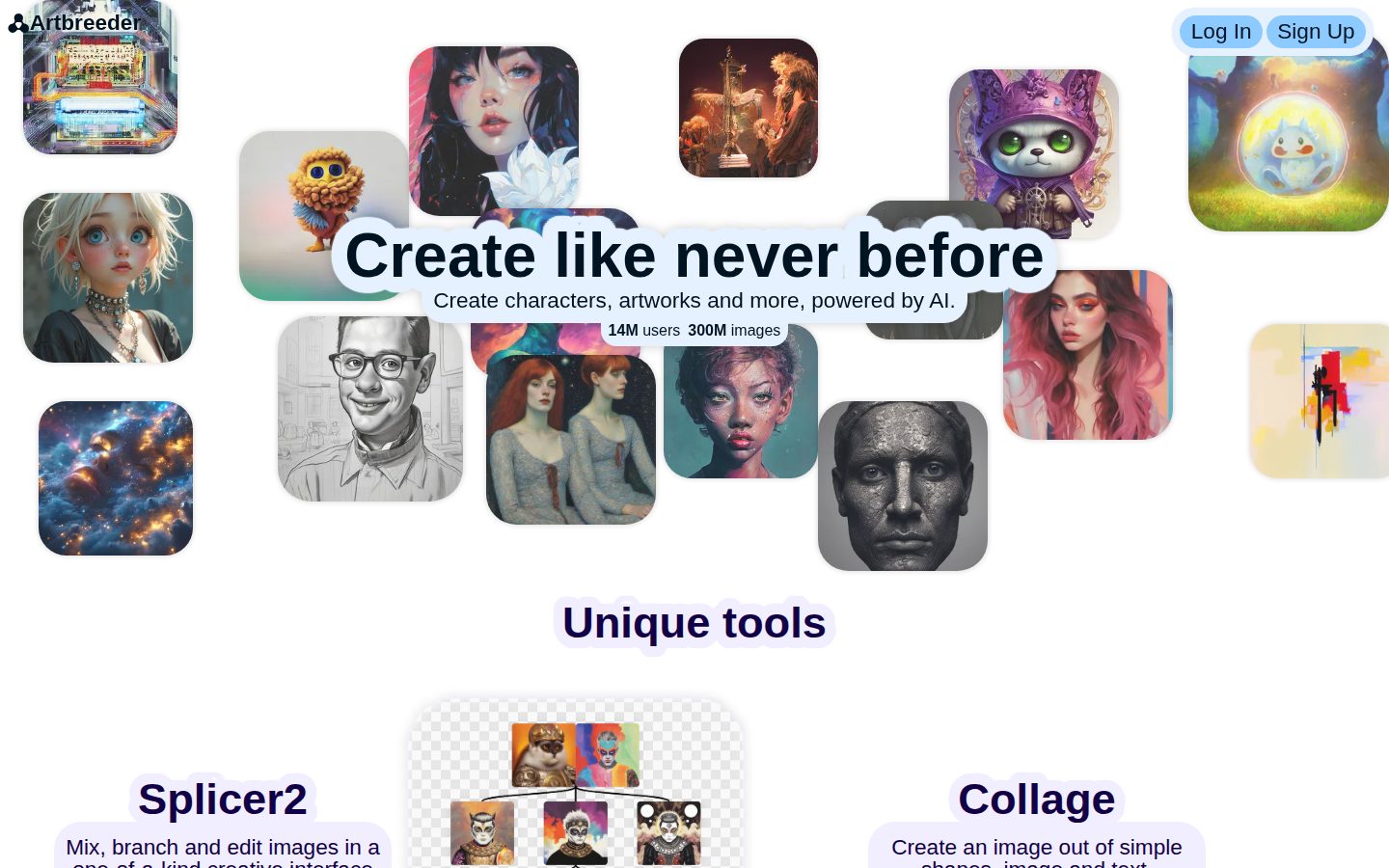
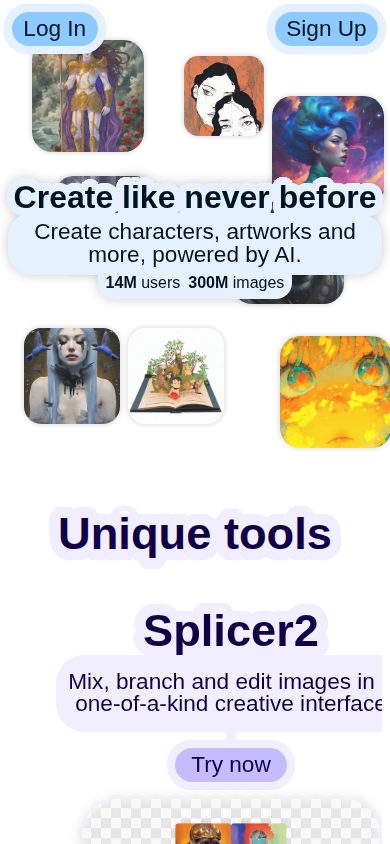
Artbreeder is a web-based platform for creating and blending images using AI models.
AI Panel Score
6 AI reviews
Reviewed
Artbreeder works through a browser interface where users generate images by combining or adjusting existing ones. Rather than typing a prompt from scratch each time, users can start from images created by themselves or other community members, then modify attributes using sliders or blending tools to produce new variations. This iterative, remix-based approach is central to how the tool is used in practice.
The platform highlights its collaborative model as a key differentiator: images uploaded or generated by one user can become the starting point for another user's creation, forming chains of derived artwork. Artbreeder supports multiple image categories and models for different types of content, such as portraits, landscapes, and general images, giving users varied starting points depending on what they want to create.
Artbreeder is aimed at digital artists, hobbyists, and anyone interested in experimenting with AI-generated imagery, including character design and concept art use cases. It competes with other AI image generation tools such as Midjourney, DALL-E, and Stable Diffusion-based interfaces. The product operates on a freemium model, with a free tier available alongside paid subscription plans that provide additional generation credits or capabilities.
As a web-based platform, Artbreeder does not require local installation and is accessed directly through a browser.

Generates and blends AI-created images (portraits, landscapes, anime, albums) by mixing genes/attributes from multiple source images.
Allows fine-grained control over blending attributes (age, gender, style, etc.) between multiple parent images to create new variations.
Combines two or more images together using AI to create a new hybrid image that blends the visual traits of its parents.
Higher subscription tiers provide priority access to GPU processing, reducing wait times for image generation.
Users can publish their creations to a public gallery where other members can 'breed' or remix existing images to create derivative works.
Users can follow other creators and like images, enabling social discovery of popular or trending AI-generated art.
Lets users arrange simple shapes and sketches on a canvas which the AI then transforms into a detailed, coherent image.
Tracks the 'parent' images used to create each new image, letting users trace and remix the creative lineage of any artwork.
Paid tiers allow exporting generated images at higher resolutions than the default preview size.
Offers multiple paid membership levels (e.g., Starter, Advanced, Artist Pro) that unlock additional generation credits, resolution, and privacy features.
Supports multiple genre-specific tools such as portraits, landscapes, paintings, and anime, each with tailored gene sets for that art style.
Subscription plans let users keep their creations private and upload their own images to use as breeding material instead of only public genes.
Entry-level Artbreeder Pro plan for casual creators, billed annually at $7.49/mo (1200 Credits/year)
Mid-tier plan for more frequent creators, billed annually at $15.99/mo (3300 Credits/year)
Top-tier plan for power users needing the most credits, billed annually at $30.99/mo (8400 Credits/year)
A niche remix tool built on old GAN tech, priced fine but strategically thin.
“Artbreeder does one thing well: genetic-style blending of community images. It's not where the market moved.”
StyleGAN and BigGAN. That's the stack, per their own about page. Midjourney and Stable Diffusion interfaces moved past that years ago into prompt-driven diffusion with far higher fidelity.
Pricing is fair. $7.49/month gets you 1200 credits, roughly 12,000 SDXL images. Champion tier at $30.99 drops the per-credit cost to $0.04. No complaints on value.
Two questions: does this move us forward, or just give hobbyists a cheap remix sandbox? It's the latter. Single founder, no docs, no API, though an updates page visible. Fine for a side experiment. Hard to defend as a strategic bet to any board when Midjourney and Stable Diffusion tooling dominate professional workflows.
Overshadowed by Midjourney and Stable Diffusion, which lead in fidelity and enterprise adoption.
Neutral choice — known in hobbyist circles but not associated with professional creative pipelines.
No-install web access and $7.49 entry tier mean fast individual onboarding, per pricing page.
Solves hobbyist remix use cases, not the prompt-driven generation workflows most teams now standardize on.
Small team under Morphogen Inc., no funding data, and cadence shows only in an updates page (no blog I could find).
Hobbyists and character-design tinkerers who want a cheap, community-driven remix sandbox.
Skip if you need enterprise-grade fidelity or a defensible production pipeline.
A genetics-based remix engine with real craft roots but a shrinking ceiling against prompt-native tools.
“Artbreeder's gene-splicing lineage is genuinely distinct, but the toolset hasn't kept pace with where the category's craft ceiling now sits. Good for ideation, weak for finished-asset production pipelines.”
StyleGAN and BigGAN under the hood tell you Artbreeder's DNA predates the diffusion wave. Composer, Mixer, and Splicer are clever — genetics-style lineage tracking is a real interaction idea nobody else has copied well — but next to Midjourney's v6 coherence or SDXL fine-tuning workflows, the output ceiling reads dated.
Domain fit is split. For character design exploration and moodboard breeding, the sliders match how concept artists actually iterate — parent/child lineage mirrors real creative reference chains. But there's no ControlNet-equivalent precision, no inpainting workflow described, nothing for production-grade finishing.
Credits pricing ($7.49 to $30.99/month) is reasonable, and Google Drive sync plus private uploads cover basic studio hygiene. Three years in, though, this is a sandbox tool, not a pipeline tool — no API, no docs, no plugin surface listed. Great for early ideation, a dead end once you need to integrate into a real production stack.
Sits as a nostalgic niche next to Midjourney, DALL-E, and Stable Diffusion interfaces — distinct but not competing on raw output quality.
Lineage-based remixing matches how concept artists riff on references, but lacks precision tools like inpainting or ControlNet-style guidance.
Only integration mentioned is Google Drive sync; no API/plugin ecosystem for studio stacks.
No API or docs listed means adopting this creates a workflow island, not a pipeline component, over a 3-year horizon.
Genetics-style blending (Composer, Mixer, Splicer) is a genuine craft idea, but StyleGAN/BigGAN roots cap fidelity below current diffusion leaders.
Solo artists and hobbyists doing early-stage character or concept exploration through remix and blending.
Avoid if you need production-grade fidelity or API integration into a studio pipeline.
$89.88 a year for 1,200 credits, or 20% more to keep the month-to-month exit.
“Three tiers, all metered in credits, sold annually or month-to-month. The month-to-month option costs about 20% more, and the free plan's 3 credits a month is the only way to test first.”
Artbreeder prices the exit at 20%. Starter is $7.49/month on annual, $8.99 month-to-month — same 1,200 credits either way. Pay yearly and it's $89.88 for the year. The free plan hands out 3 credits a month — enough to see the tool, not to work in it.
Every tier carries the same benefits — no ads, Google Drive sync, unlimited Composer generation. You're buying credits, nothing else. Champion is the volume play: $371.88 a year, 8,400 credits, $0.04 each. Midjourney's flat monthly tiers are easier to forecast, but they don't drop your unit cost as you scale.
The catch is what happens after the credits run out. No overage rate published. No cancellation or refund terms either, though an updates page exists or API docs to hand procurement. Three prices, two billing modes, visible without a sales call — that part's clean.
Self-serve at two billing cadences, with an updates page but no docs or API for procurement to review.
Month-to-month exists at a 20% premium and the free plan gives 3 credits a month, but no cancellation or refund terms are published.
Both billing modes and every unit rate are published — $7.49 annual or $8.99 monthly on Starter, $0.07 down to $0.04 per credit.
Every tier publishes credits, unit rate and an image estimate — Champion's 8,400 credits at $0.04 buy roughly 84,000 SDXL images.
Annual cost runs $89.88 to $371.88 by tier, but no overage rate is published once the credits are gone.
High-volume creators who want the $0.04 Champion credit rate.
Buyers who need a published overage rate before they sign.
Great for gene-splicing portraits, awkward for anyone who needs a prompt box and a deadline
“Artbreeder's Splicer and Mixer make attribute-blending genuinely fun, but the whole workflow is slider-first, not prompt-first. That's a different daily habit than Midjourney or Stable Diffusion trained me on.”
Composer and Splicer are the real hook: mixing genes between parent images to nudge age, style, gender is a different creative loop than typing prompts into Midjourney. First session it's delightful. By day three, when I need a specific character pose fast, sliders start feeling slower than a well-tuned prompt plus negative-prompt stack.
Credits are the daily friction. Starter tier gives 1200/year at $7.49/month — fine for hobby sessions, tight if you're iterating like a concept artist during a sprint. No API, no docs page, but an updates page surfaced anywhere I can find, so discovering Splicer fast mode or Collager's sketch-to-image pipeline happens by clicking around, not reading.
Google Drive sync and private uploads are genuinely useful for keeping breeding material organized. But the lineage-tracking, gene-remix model asks you to think in genetics metaphors instead of layers or prompts — a real relearn, not a plugin into existing habits.
Slider-based blending stays fun but slows down once you need a specific, controllable output fast.
An updates page exists, but no docs page or API I could find — features like Splicer fast mode are discovery-by-clicking.
Credit-metered generation (1200-8400/year across tiers) means rationing usage mid-project.
Champion tier's 8400 credits and fast Splicer mode reward power users, but discoverability of advanced tools is weak.
Genetics/remix metaphor doesn't map onto prompt-driven habits from Midjourney or Stable Diffusion workflows.
Digital artists and hobbyists who enjoy iterative remixing over typing prompts from scratch.
Avoid if you need fast, precise prompt-to-image control on tight production deadlines.
Fun to poke around in, but the credit meter is always running in the back of your mind.
“Artbreeder's slider-and-splice approach is genuinely different from typing prompts into Midjourney. Whether that's a feature or a chore depends on how much you like tinkering.”
The Composer and Splicer tools are the whole pitch here — you're not typing a prompt, you're breeding one image from others, and that genetics metaphor actually holds up in practice. Three months in, that's either delightful or exhausting depending on whether you like fiddling with sliders or just want a picture of a dragon.
The credit system is the thing that'll wear on you. Starter is $7.49/month for 1200 credits a year, and every generation quietly spends down that pool. Compare that to Midjourney's flat monthly buckets — Artbreeder's per-credit math ($0.04 to $0.07 depending on tier) means you're doing arithmetic while you create, which breaks flow.
Community remixing is the real differentiator — breeding off someone else's public image is a genuinely different workflow than Stable Diffusion interfaces offer. But there's no API, only an updates page, no docs page anywhere on the site, which for an eight-year-old tool feels like it's coasted on its original idea more than it's kept sharpening it.
An updates page tracks releases, but no docs I could find, leaving day-to-day details less visible than competitors actively shipping.
Composer, Mixer, Splicer, and Collager give increasing depth, and lineage tracking rewards sticking with it over months.
Platforms listed as web only, no mobile app mentioned anywhere on the site.
Genetics/slider model is a real learning curve compared to typing a prompt in DALL-E, a free 3-credit/month tier softens that.
Tiered GPU priority implies free/low tiers wait longer, a common trust dent in freemium generation tools.
Digital artists and hobbyists who enjoy iterative tinkering and remixing over one-shot prompting.
You want fast, prompt-in-image-out results without tracking a credit balance.
StyleGAN-era survivor still selling genetics sliders while diffusion ate the category.
“Artbreeder's remix-and-breed model is genuinely different from Midjourney or DALL-E. But the tech under the hood reads older, and the site shows no docs, no API, just an updates page.”
Three tells. One: only an updates page, no blog, no docs page — for a product built on Joel Simon's Morphogen since the StyleGAN/BigGAN era, that's thin public signal. Two: 'Splicer fast mode' and 'unlimited generation in Composer' sound like features patched onto an aging core, not a modern pipeline. Three: credits priced at $0.04-$0.07 each, converted to 'SDXL images' — meaning they're now leaning on Stable Diffusion under the hood, not their original GAN genetics engine.
The collaborative lineage idea — breeding images from a public gallery, tracing parentage — is a real differentiator. Midjourney and DALL-E don't do that. Neither does most Stable Diffusion tooling.
Exit portability is fine: images are yours, no lock-in beyond credits. But this is a one-founder-era company competing against venture-funded labs. Three annual tiers, $7.49 to $30.99/month, is fair pricing. Long-term bet is the open question.
Breeding images from a public gallery with traceable parentage is something Midjourney and DALL-E genuinely don't do.
Images are yours, no lock-in beyond unspent credits.
One-founder-era company against venture-funded labs, with an updates page but no blog to signal shipping cadence.
'SDXL images' in the credit math quietly admits the engine is now Stable Diffusion, not the original GAN genetics.
A StyleGAN-era survivor is real longevity, but the category's winners are now diffusion-native.
Creators who want remix-and-breed image genetics that Midjourney and DALL-E don't offer.
You're betting a long-term workflow on a vendor with no visible shipping cadence.
Common questions answered by our AI research team
Artbreeder Pro has three tiers, billable monthly or annually. Annual rates: Starter $7.49/month (1200 credits/year, $0.07/credit, ~12,000 SDXL images), Advanced $15.99/month (3300 credits/year, $0.06/credit, ~33,000 SDXL images), Champion $30.99/month (8400 credits/year, $0.04/credit, ~84,000 SDXL images). Month-to-month costs $8.99, $18.99, and $38.99 respectively. A free plan gives 3 credits/month.
Credits are used to generate images, with each tier offering a set amount per year (e.g., 1200, 3300, or 8400 credits) at rates ranging from $0.04 to $0.07 per credit, equating to thousands of SDXL images.
Yes, Artbreeder Pro includes 'No ads' as one of its benefits, along with privacy controls and other Pro features.
Yes, Google Drive sync is included as a benefit of Artbreeder Pro.
Splicer fast mode is a Pro feature that speeds up the Splicer tool, offered alongside unlimited image generation in Composer and faster rendering.