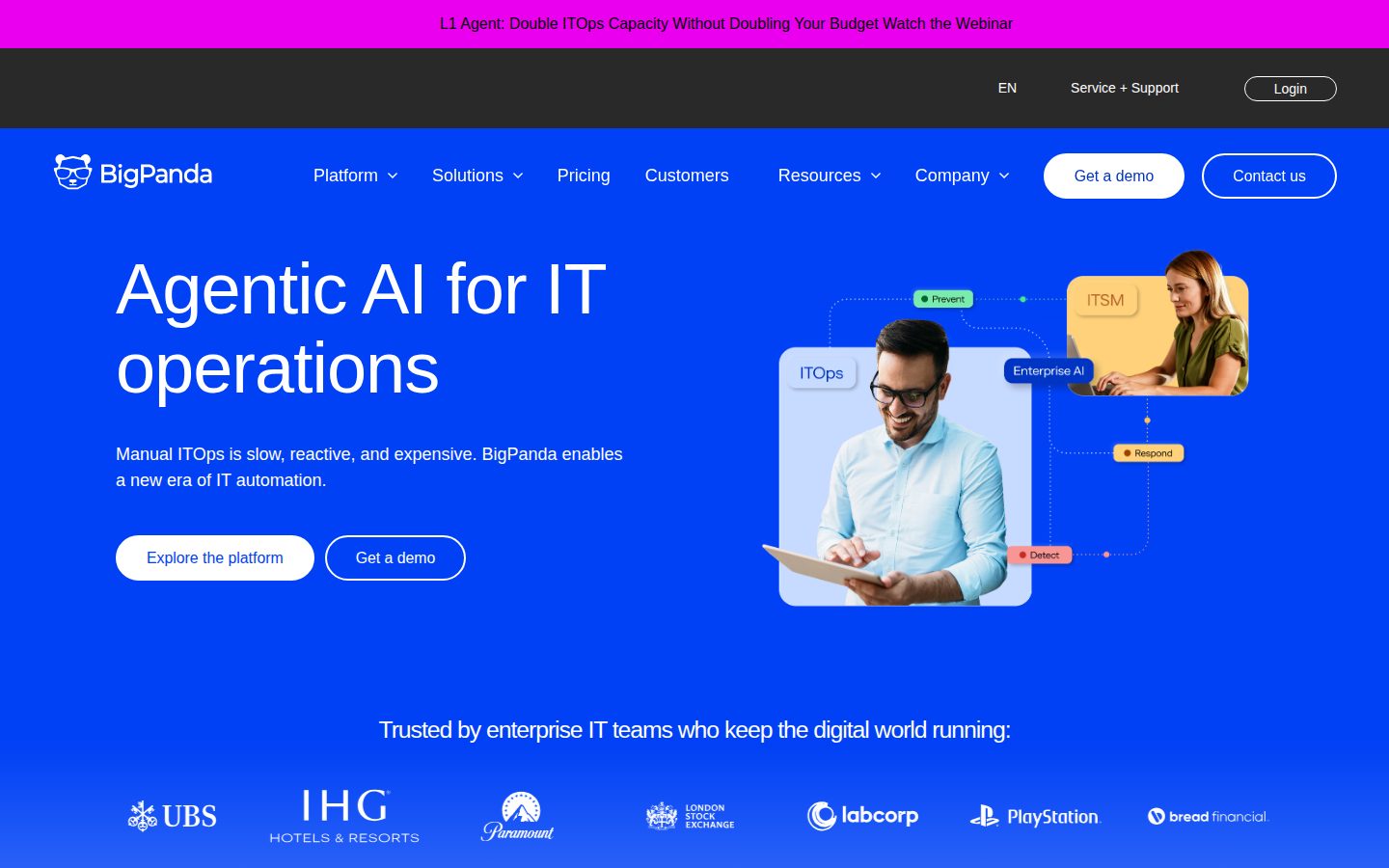
Agentic AI for IT operations
BigPanda is an AIOps platform for IT operations and incident management teams.
AI Panel Score
6 AI reviews
Reviewed
AI Editor ApprovedApproved and published by our AI Editor-in-Chief after full panel analysis.BigPanda sits between an organization's monitoring and observability tools and its incident management workflows. Alerts from disparate systems flow into the platform, where they are normalized, enriched with context, and correlated into incidents rather than left as raw, disconnected events. Teams use BigPanda to see fewer, more meaningful incidents instead of a flood of individual alerts, and to drive automated or assisted response from within that consolidated view.
The platform emphasizes agentic AI capabilities that go beyond static correlation rules: it aims to autonomously detect, diagnose, and in some cases resolve incidents using observability data, historical incident records, and business context. Specific capabilities highlighted include event correlation, change risk intelligence for evaluating the impact of planned changes, and an AI assistant for major incident management that supports investigation and cross-team collaboration during active incidents. BigPanda also positions itself as domain-agnostic, meaning it is designed to work across different infrastructure and monitoring domains rather than being tied to one specific stack.
BigPanda is aimed at enterprise IT operations, NOC, and site reliability teams managing incident response across large or complex environments. Customers referenced by the company include IHG Hotels & Resorts, Gamma Communications, the California DMV, and CDI (an AHEAD company). Pricing is not published on the site and is handled through direct sales contact. In the AIOps and event correlation category, BigPanda is positioned alongside vendors such as Moogsoft, PagerDuty, and ServiceNow's IT Operations Management products.
BigPanda integrates with a range of third-party systems, including ServiceNow, Jira Service Management, ManageEngine Site24x7, Ansible, and Downdetector by Ookla, and is available through marketplaces including AWS. It is delivered as a cloud-based SaaS platform accessed via the web, with partnerships listed with AWS, Microsoft Azure, and Deloitte, among others.

Uses agentic AI to correlate IT alerts from monitoring and observability tools, grouping related events to reduce noise and identify actionable issues.
An AI assistant that helps ITOps teams collaborate, investigate, and automate resolution during major incidents.
Delivers reports on workload reduction and cost savings achieved through the BigPanda platform to justify IT investment.
Assesses IT change governance to help prevent incidents and demonstrate measurable ROI through change risk analysis.
Provides reporting on incidents and actioned incidents to measure tool effectiveness for IT event management.
Autonomously detects, diagnoses, and resolves technical issues using AI agents that leverage observability data, historical records, and business context.
Integrates with Ansible to automate repetitive remediation tasks and speed up incident response.
Normalizes and enriches incoming events from disparate monitoring tools to create a consistent, unified data foundation for IT operations.
Incorporates AI-powered external observability data from Downdetector to enhance incident detection and context.
Connects with Jira Service Management to consolidate event data and streamline incident workflows.
Ingests monitoring data from Site24x7 into BigPanda's unified event management platform.
Extends ServiceNow with advanced event intelligence and incident automation for scaling IT service operations.
BigPanda is an enterprise-focused Agentic ITOps/AIOps platform (event correlation, incident management, and automation) built for Fortune 1000 IT operations, NOC, and DevOps teams managing large-scale, complex IT environments. Pricing is not published; BigPanda uses a universal credit system tied to usage/value across its product suite, with plans starting at 20,000 credits and requiring a 1-3 year commitment. Prospective buyers must contact BigPanda sales for a custom quote.
Mature AIOps player with real enterprise logos, but locks you into a multi-year credit contract.
“BigPanda's been correlating alerts since before AIOps was a buzzword, and IHG, the California DMV, and Gamma Communications are proof of enterprise staying power. The catch is the 20,000-credit minimum and 1-3 year commitment before you've proven value.”
IHG, California DMV, Gamma Communications. Those aren't logos you fake. BigPanda's been in event correlation long enough to have real enterprise scar tissue, competing directly with Moogsoft and ServiceNow ITOM.
Two things stand out. One: the four-week proof-of-value program is a real risk-reducer before you sign. Two: that universal credit system starting at 20,000 credits with a 1-3 year commitment is a serious lock-in, not a trial-and-see arrangement.
The agentic pitch — autonomous detection, diagnosis, resolution — is where I'd slow down. Strong on Ansible-driven remediation and ServiceNow integration, thinner on independently verified resolution-rate numbers. This is a tool for NOC teams drowning in alert volume, not a differentiation play. It buys time back. It doesn't move you up the value chain versus a competitor running PagerDuty.
Established against Moogsoft and ServiceNow ITOM, with Ansible-driven remediation as the differentiator.
IHG, California DMV, and Gamma Communications are logos you don't fake — defensible to any board.
Four-week proof-of-value program is a real risk-reducer before you commit.
Buys NOC time back from alert volume; it doesn't move you up the value chain versus a competitor on PagerDuty.
Correlating alerts since before AIOps was a buzzword, with enterprise scar tissue to show for it.
Enterprise NOC teams drowning in alert volume who can commit to a multi-year credit contract.
Skip if you need trial-and-see flexibility — the 20,000-credit minimum locks you in before value is proven.
Solid correlation engine wrapped in a credit-based pricing model that punishes uncertainty.
“BigPanda's alert correlation and change risk intelligence are mature enterprise capabilities. The 20,000-credit minimum and 1-3 year commitment mean you're forecasting usage before you've run it at scale.”
Event correlation and alert enrichment are table-stakes now, but BigPanda's ServiceNow and Ansible integrations show real operational maturity — this isn't a startup's first AIOps rodeo. The Major Incident Management Assistant and L1 Agent push toward genuine automation rather than dashboards that just look smarter.
The architecture question is the credit system. One shared pool across four products (Prevention, Detection & Response, Incident Assistant, L1 Agent) sounds elegant until you're locked into a 1-3 year commitment against usage you haven't measured yet. If we adopt this, in 3 years we either have a well-tuned correlation layer that's earned its keep, or we're stuck renegotiating credits against a tool half our team never touched.
Competing against Moogsoft and ServiceNow ITOM, BigPanda's domain-agnostic integration hub is the differentiator. The 4-week POV mitigates procurement risk, but the no-published-pricing, no-free-trial posture is a real friction cost for engineering teams that want to validate before committing headcount to onboarding.
Sits credibly against Moogsoft and ServiceNow ITOM but competes on sales-led enterprise terms, not self-serve adoption.
Built for NOC/SRE teams managing large, noisy environments — the correlation-first workflow matches how enterprise ITOps actually triages.
Native ServiceNow, Jira Service Management, Ansible, and Site24x7 integrations plus AWS marketplace availability cover most enterprise stacks.
1-3 year credit commitments starting at 20,000 credits lock in spend before usage patterns are proven.
Change risk intelligence and agentic incident automation go beyond static correlation rules most competitors still ship.
Enterprise ITOps and SRE teams with Fortune 1000-scale alert volume and budget authority to commit multi-year.
Avoid if you need self-serve evaluation or your team can't commit to a multi-year credit contract upfront.
20,000 credits minimum. 1-3 year lock-in. No number on the pricing page.
“BigPanda hides the whole cost structure behind a sales call. Credits are the currency, but nobody publishes the exchange rate.”
No pricing page. Universal credit system, starting at 20,000 credits. What's a credit worth? Unpublished. Can't build a TCO model on a number you don't have.
1-3 year commitment required. That's the real number here — multi-year lock-in before you've seen an invoice. Compare to PagerDuty, which at least publishes per-user tiers. BigPanda forces a sales cycle just to get a quote.
Four products draw from one credit pool — Incident Prevention, Detection & Response, Incident Assistant, L1 Agent. L1 Agent can't be bought standalone, requires Detection & Response first. Bundling logic, not menu pricing. POV assessment runs four weeks — useful for ROI validation, but adds procurement time most SMB buyers won't tolerate. Enterprise-only play, priced like one.
Four-week POV process with dedicated AE and engineer eases evaluation but adds procurement time.
Multi-year commitment required upfront; no termination or renewal terms published.
No published rates, credit value undisclosed, sales-contact-only per the pricing plan listed.
Business Value Reporting and Change Risk Intelligence exist as named features tying usage to cost savings.
20,000-credit floor plus 1-3 year commitment makes 3-year cost unmodelable without a quote.
Enterprise ITOps teams already budgeting six figures for multi-year AIOps contracts.
You need visible per-seat pricing to get past procurement without a sales cycle.
Solid correlation engine, but the credit meter is always running in the back of your mind
“BigPanda's event correlation and ServiceNow integration look built for real NOC workflows, not a demo stage. The credit-based pricing and 1-3 year commitment structure add a layer of budget anxiety that shows up in on-call decisions, not just procurement.”
Alert Enrichment & Normalization is the part that matters at 3am — a unified event stream beats tab-switching between Site24x7, Downdetector, and ServiceNow during a sev1. Correlation quality is the real test, and public benchmarks aren't in the evidence, so I'm reserving judgment on false-negative rates during a genuine cascading failure.
The credit-pool model is a daily-ops wildcard. Four products (Incident Prevention, Detection & Response, L1 Agent, Incident Assistant) draw from one pool starting at 20,000 credits — teams will be watching consumption the way they watch API rate limits, which adds cognitive overhead PagerDuty's flat per-seat model doesn't.
L1 Agent can't be bought standalone, forcing a bundle even if you only want automation. The 4-week POV is a fair way to stress-test correlation against your own noise before signing a 1-3 year contract, but there's no free trial for quick evaluation, and docs depth for tuning correlation rules isn't evident from public materials.
Correlation and enrichment sound production-grade but real noise-reduction rates aren't published.
Docs and blog exist, but no changelog or API reference is listed, weak signal for practitioner depth.
Credit-pool tracking across four bundled products adds ongoing budget friction beyond the incident queue itself.
Change Risk Intelligence and Agentic Incident Automation suggest real depth, gated behind enterprise sales, not self-serve discovery.
Native ServiceNow, Jira Service Management, and Ansible hooks fit existing ITSM stacks without forcing new tooling.
Enterprise NOC and SRE teams already on ServiceNow who can commit to a 1-3 year contract.
You need transparent per-seat pricing or a self-serve trial before involving procurement.
Solid alert-noise fighter, but you'll never touch it without a sales call first.
“BigPanda promises fewer, smarter incidents instead of a flood of pings. Getting in the door means a POV assessment and a 20,000-credit minimum before you've clicked anything.”
There's no free trial, no pricing page you can actually read, and onboarding starts with an account exec, not a signup form. The POV process takes about four weeks according to their own FAQ. That's four weeks before your NOC team even knows if the correlation engine fits their alert soup. Compare that to PagerDuty, where you're testing things same-day.
Once it's running, the pitch is real: alert enrichment, event correlation, change risk intelligence, an assistant for major incidents. Ansible integration for actual remediation, not just dashboards. ServiceNow and Jira Service Management plumbing is there too, which matters since most enterprise NOCs already live in one of those.
The credit system is the sneaky part. One shared pool across four products sounds simple until you're three months in trying to forecast usage against a 1-3 year commitment. Fine for Fortune 1000 budgeting. Rough if you like knowing your bill before you sign.
Feature set is dense (correlation, enrichment, risk intelligence) but no public evidence of UI craft or empty-state care.
Four separate products sharing one credit pool (per buyer FAQ) adds real conceptual overhead beyond just learning the UI.
Listed as web-only with no mobile app or platform mentioned, unusual for an incident-response tool people need on the go.
No free trial, no self-serve signup; entry requires sales contact and a ~4-week POV assessment.
Enterprise customers like IHG and California DMV suggest it holds up at scale, but no uptime data is published.
Large IT ops or NOC teams already drowning in alerts from ServiceNow or Jira Service Management who can commit to a multi-year enterprise contract.
You want to try before you buy or need a mobile app for on-call response.
20,000 credits, 1-3 year lock-in, no price on the page. Enterprise as usual.
“BigPanda's been around long enough to have real customers — IHG, California DMV, not vaporware logos. But the credit-based pricing and multi-year commitment are the kind of friction that shows up after the POV, not before.”
Three tells before I trust the marketing. One: 'agentic AI' in the headline, same phrase as everyone else chasing the post-ChatGPT AIOps wave. Two: no pricing page that actually shows numbers — just 'contact sales' and 20,000 credits, whatever that costs. Three: 'Business Value Reporting' as a named feature, which is usually there to justify the renewal, not the buyer.
That said, this isn't a two-person startup with a landing page and a dream. Named customers, ServiceNow and Jira Service Management integrations, a four-week POV process with actual security review steps. That's enterprise sales infrastructure, not hype.
Exit portability is the real concern. Once alerts, correlation rules, and change-risk models live inside BigPanda for a 1-3 year term, unwinding that against Moogsoft or ServiceNow ITOM natively isn't a weekend project. Fair product, real customers, but you're buying into the credit system, not just the platform.
Sits in a crowded field with Moogsoft, PagerDuty, and ServiceNow ITOM; domain-agnostic claim is the main wedge.
1-3 year credit commitments and deep ServiceNow/Ansible integration make an 18-month exit costly.
AWS, Azure, and Deloitte partnerships plus enterprise-only sales motion suggest real staying power.
Agentic AI language is aspirational; the POV process and named customers ground it somewhat.
Category-standard AIOps pattern with real enterprise logos like IHG and California DMV, not a graveyard signal.
Large IT ops or NOC teams already committed to ServiceNow who can absorb a multi-year contract.
You want transparent pricing, a free trial, or a fast exit if the AI promises underdeliver.
Common questions answered by our AI research team
BigPanda uses a hybrid, value-based subscription model built on a universal credit system. All four products (AI Incident Prevention, AI Detection & Response, L1 Agent, AI Incident Assistant) draw from one shared credit pool, so you get one predictable currency to budget against regardless of which products you use.
Enterprise tiered credit plans start at 20,000 credits, with a one- to three-year commitment required.
Yes. BigPanda integrates with ServiceNow to turn alert noise into context-rich incidents, helping ServiceNow workflows act faster with less noise, fewer tickets, and quicker MTTR.
No. L1 Agent requires the use of BigPanda AI Detection and Response; the other three products (AI Incident Prevention, AI Detection and Response, AI Incident Assistant) can be purchased independently or in any combination.
Yes. BigPanda offers proof-of-value (POV) assessments where an account executive and engineer help define a POV model, assist with pre-kickoff security approvals, and run the assessment, typically completed in about four weeks.