PagerDuty logo

PagerDuty Review

Visit

Digital operations platform for incident response and alert management

PagerDuty is a digital operations platform that manages incidents, alerts, and on-call schedules for IT teams.

AI Panel Score

7.8/10

6 AI reviews

Reviewed

AI Editor Approved

About PagerDuty

PagerDuty is a digital operations platform designed to help organizations manage incidents, alerts, and on-call responsibilities across their IT infrastructure. The platform serves as a central hub that receives alerts from various monitoring tools and services, then routes them to the appropriate team members based on configured escalation policies and schedules.

The software is primarily used by IT operations teams, DevOps engineers, site reliability engineers, and incident response teams at companies ranging from startups to large enterprises. Organizations use PagerDuty to reduce mean time to resolution (MTTR) for incidents, minimize service disruptions, and ensure critical issues are addressed promptly by the right personnel.

Key capabilities include real-time incident management, intelligent alert grouping and noise reduction, on-call scheduling and escalation management, and integration with hundreds of monitoring and collaboration tools. The platform also provides analytics and reporting features to help teams understand incident patterns and improve their response processes.

PagerDuty operates in the IT operations management and incident response market, competing with tools like Opsgenie, VictorOps, and custom alerting solutions. The platform has established itself as a leader in the space by focusing specifically on incident management workflows rather than trying to be a comprehensive monitoring solution.

Features

AI

  • Insights Agent

    A supporting AI agent that performs pattern detection across incident data.

  • SRE Agent

    An AI agent that detects, triages, diagnoses, and fixes incidents autonomously, acting as a virtual responder.

  • Scribe Agent

    A supporting AI agent that handles documentation tasks during and after incidents.

  • Shift Agent

    A supporting AI agent that manages scheduling tasks for on-call operations.

  • Smart Alerting

    Machine learning-based alert filtering that cuts noise by 91% by identifying what actually matters.

Analytics

  • Post-Incident Reviews

    Built-in post-incident review process that captures learnings for continuous improvement after incidents are resolved.

Automation

  • Dynamic Routing

    Automatically routes incidents to the appropriate teams or responders based on defined rules.

  • Incident Workflows

    Automated workflows that orchestrate incident response steps, processing 15.9 million incident workflows per year.

Collaboration

  • Slack and Microsoft Teams Integration

    Allows teams to detect, respond to, and resolve incidents directly within Slack or Microsoft Teams.

  • Unified Response

    A centralized incident response capability that brings cross-team coordination into a single place to eliminate siloed work.

Customization

  • Open APIs & MCP

    Open APIs and Model Context Protocol support that enable building custom workflows fitting specific operational needs.

Integration

  • 750+ Integrations

    Pre-built integrations with over 750 tools including support for bi-directional sync across the entire tech stack.

Preview

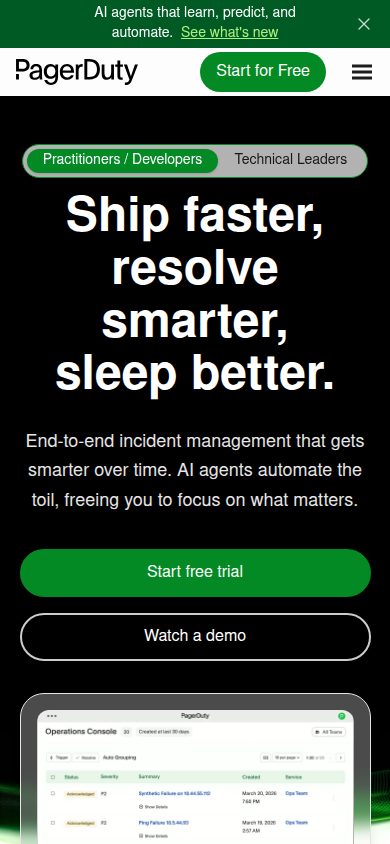
PagerDuty mobile preview

Pricing Plans

Free

Free

On-call and incident response for small teams up to 5 users

  • Up to 5 users
  • 100/month international SMS notifications
  • 1 on-call schedule
  • 1 escalation policy
  • 750+ integrations

Professional

$21/monthly

Out-of-the-box incident response (per user, billed annually)

  • Basic Slack and Microsoft Teams chat experience
  • Multiple on-call schedules and escalation policies
  • External status page (250 subscribers)
  • 2 predefined incident roles, 3 incident types
  • PagerDuty Advance (1,000 credits)
Popular

Business

$41/monthly

Advanced and semi-customizable incident management (per user, billed annually)

  • Custom fields on incidents
  • Up to 3 custom incident types
  • Advanced ITSM integrations
  • Multi-year historical data access
  • PagerDuty Advance (5,000 credits)

Enterprise

Contact sales

End-to-end incident management with full chat and ServiceNow sync

  • Full Premium Slack actions experience
  • Up to 100 custom incident types
  • 10 custom incident roles
  • ServiceNow bi-directional field sync
  • PagerDuty Advance (20,000 credits)

AI Panel Reviews

The Decision Maker

The Decision Maker

Strategic bet, vendor viability, timing, adoption approval
8.2/10

Atlassian's April 2027 Opsgenie shutdown hands PagerDuty a migration window worth pricing into the next budget cycle.

PagerDuty (NYSE: PD) closed FY2026 at $492.5M with $172.7M net income — a profitable 17-year-old public incident-response leader. Atlassian's April 5, 2027 Opsgenie shutdown opens a once-a-decade migration window that should anchor the budget conversation.

Atlassian set the timer. April 5, 2027 — Opsgenie data deletes at midnight PST and a generation of on-call schedules has to live somewhere new. PagerDuty's the obvious landing spot, which is why I'm reading FY2026 results, not the brochure.

Revenue closed FY2026 at $492.5M, up roughly 5%, with net income at $172.7M — that's a profitable public company, not a cohort risk. The Operations Cloud now bundles AIOps, Customer Service Operations, and Rundeck-powered Automation; Professional is $21/user/month and Smart Alerting markets 91% noise reduction.

But growth is single-digit and the stock sits roughly 80% below its 2021 peak — Datadog Incident Management and Incident.io are real, and Rootly and FireHydrant are eating the engineering-led tier. Take the Opsgenie window. Pilot the Operations Cloud on one critical service for 60 days. Don't sign three years until the renewal math holds.

Competitive Positioning7.8

Still the reference vendor, but Datadog Incident Management bundles free and Incident.io is winning new logos.

Reputation Risk8.3

Public category leader is the defensible board choice — nobody gets fired for picking PagerDuty.

Speed to Value7.8

750+ integrations and mature workflows ship value fast, but Opsgenie migrations still budget 6-16 weeks.

Strategic Fit8.0

Operations Cloud spans incident response, AIOps, and Rundeck Automation — fits any team consolidating tooling.

Vendor Viability8.5

NYSE-listed since April 2019, $172.7M FY2026 net income, 17 years in market — a durable 3-year bet.

Pros

  • Profitable public company with $172.7M FY2026 net income — durable 3-year vendor bet.
  • Operations Cloud bundles AIOps, Rundeck Automation, and Customer Service Operations under one contract.
  • Smart Alerting markets 91% noise reduction across 750+ pre-built integrations.
  • Atlassian's April 5, 2027 Opsgenie shutdown is a structural tailwind PagerDuty is best-positioned to capture.

Cons

  • Revenue grew only roughly 5% in FY2026 — single-digit growth for a once-hyped public name.
  • Per-seat pricing runs higher than Opsgenie or Incident.io for mid-market teams.
  • Datadog Incident Management ships bundled with monitoring contracts engineering teams already pay for.

Right for

Operations leaders consolidating incident response after the Opsgenie sunset.

Avoid if

Engineering-led teams who would rather adopt Incident.io or Rootly.

The Domain Strategist

The Domain Strategist

Craft and strategy in the product's domain — adapts identity per category, same lens
8.3/10

Opsgenie's April 2027 shutdown is the migration TAM PagerDuty was engineered to absorb.

Opsgenie's April 5, 2027 end-of-support hands PagerDuty a migration window it has spent 15 years preparing for, against 35,000+ paying customers and two-thirds of the Fortune 100. The 3-year strategic call for a Head of SRE is whether SRE Agent and Rundeck close the AI-native gap that Incident.io's $62M Series B is actively widening.

April 5, 2027 is the date that reshapes this category. Atlassian shuts Opsgenie down, releasing a migration TAM PagerDuty has spent 15 years engineering its product to absorb. For a Head of SRE sizing a 3-year on-call commitment, that calendar is the strategic frame.

PagerDuty serves roughly two-thirds of the Fortune 100 and 35,000+ paying customers, with 750+ integrations and Smart Alerting that filters 91% of noise. The Rundeck acquisition in October 2020 ($100M, 60% cash) added automation to the paging core, and SRE Agent now sits on that runbook surface. Professional starts at $21/seat after a five-user Free tier.

But the tradeoff is mindshare drift. Incident.io closed a $62M Series B at a $400M valuation in April 2025 with AI-native incident agents, and Datadog is bundling on-call into APM contracts the FinOps team won't unbundle. The 3-year question is whether SRE Agent matures faster than Incident.io scales enterprise.

Category Positioning8.0

Still the default incident-management buy at two-thirds of the Fortune 100, but the category is no longer uncontested.

Domain Fit8.4

Built explicitly for SRE and DevOps incident workflows with escalation policies, on-call rotations, and post-incident reviews.

Integration Surface8.5

Bi-directional ServiceNow sync, Open APIs with MCP support, and 750+ pre-built connectors are the strongest pillar.

Long-term Implications7.8

AI-native challengers like Incident.io and APM-bundled on-call put real pressure on the per-seat thesis over three years.

Strategic Depth8.3

750+ integrations, Rundeck-backed automation, and a four-agent AI layer give the platform real depth beyond paging.

Pros

  • 750+ integrations including bi-directional ServiceNow custom-field sync set the procurement moat.
  • Rundeck-backed automation runs runbooks end-to-end rather than stopping at notification.
  • Two-thirds of the Fortune 100 plus FedRAMP coverage clear most enterprise security gates.
  • Smart Alerting filters 91% of incoming signal noise before it reaches the on-call.

Cons

  • Per-seat pricing scales poorly against Datadog bundling on-call into APM contracts.
  • AI-native incumbents like Incident.io are winning developer mindshare with greenfield agents.
  • Enterprise tier is contact-sales only — opacity slows procurement on time-boxed Opsgenie migrations.

Right for

Heads of SRE who run multi-team on-call across hundreds of integrations.

Avoid if

Startups who want an AI-native incident agent built from scratch.

The Finance Lead

The Finance Lead

Money, total cost of ownership, contracts, procurement math
7.4/10

PagerDuty Professional lists $21/user/month annual — premium-priced but procurement-friendly with three visible tiers.

Professional bills $21/user/month annual, Business $41 — both transparent on the page, no NDA required. Enterprise stays a sales call, and Opsgenie's April 2027 shutdown is forcing a migration decision finance teams didn't plan for.

Three tiers visible, one behind sales — procurement can quote two of them without a call. Professional runs $21/user/month on annual, $25 monthly. Business doubles to $41 annual. Incident.io sits near $20/user/month, Rootly closer to $15. PagerDuty has carried the premium for a decade.

50 SREs on Business is $41 × 50 × 12 = $24,600/year. Add ServiceNow bi-directional sync, that's Enterprise — no published number. PagerDuty Advance credits cap at 5,000 on Business, 20,000 on Enterprise, which means the SRE Agent has a meter buyers can't fully model yet.

The catch is the procurement story. Opsgenie hits end-of-support April 5, 2027 — Atlassian's $9.45-$31.90 band disappears, which lets PagerDuty hold the premium. But Incident.io and Squadcast undercut Business by 40-60%. The 750+ integrations and 91% noise reduction earn some of it. Not all of it.

Billing & Procurement7.5

Public company, transparent tiers for Pro and Business, no NDA required to quote the standard team size.

Contract Flexibility7.0

Standard SaaS annual commit with the 16% discount; monthly Professional at $25 is available without lock-in.

Pricing Transparency7.5

Three of four tiers list prices on the page; only Enterprise hides behind sales.

ROI Clarity7.8

91% Smart Alerting noise reduction and 15.9 million workflows/year give SRE teams measurable MTTR signal.

Total Cost of Ownership6.8

Business at $41/user/month sits 40-60% above Incident.io and Squadcast, with Advance credit consumption unmodelable.

Pros

  • Three pricing tiers visible without a sales call — Professional $21 and Business $41 annual.
  • 750+ integrations and 91% noise reduction on Smart Alerting give measurable MTTR signal.
  • Opsgenie's April 5, 2027 shutdown removes the closest priced-down alternative.
  • PagerDuty Advance ships 5,000 credits on Business — bundled AI without a separate SKU.

Cons

  • Business at $41/user/month is 40-60% above Incident.io and Squadcast.
  • Enterprise tier has no published number — ServiceNow bi-directional sync sits behind sales.
  • PagerDuty Advance credit consumption isn't fully modelable on the pricing page.

Right for

Mid-market SRE teams who need a defensible incident-response choice.

Avoid if

Cost-sensitive startups who can absorb a sub-$20 competitor.

The Domain Practitioner

The Domain Practitioner

Daily hands-on reality in the product's domain — adapts identity per category, same lens
8.0/10

Event Intelligence cuts noise by 91%, but Incident.io is winning the Slack-native runbook fight.

PagerDuty's Event Intelligence groups noisy alerts before the page fires and Runbook Automation runs Rundeck jobs straight from the incident timeline. The catch is that Slack-native challengers like Incident.io and Rootly now ship the chat-driven runbook UX SREs prefer, while PagerDuty's web console still owns the on-call source of truth.

Event Intelligence is the feature SREs actually use day-to-day — alert grouping and Auto-pause Incident Notifications quiet the 3am cascade so the on-call pager only fires for one incident, not forty. PagerDuty's own number is up to 91% noise reduction; even half that pays the seat cost back.

Runbook Automation runs Rundeck jobs from the incident timeline, which means restart-service workflows execute without anyone SSHing in. The Service Directory ties each technical service to its team, escalation policy, and runbooks. However, Incident.io and Rootly now own the Slack-native runbook UX, and PagerDuty's chat experience still feels like a mirror of the web console.

Professional at $21/user/month gets you the basics; Business at $41 unlocks the AIOps add-ons most teams actually want. 700+ integrations means whatever monitor fires, PagerDuty receives it — Opsgenie's EOL only widens that moat.

Day-3 Reality8.0

Event Intelligence alert grouping and Auto-pause genuinely quiet the on-call pager once policies are tuned.

Documentation Practitioner-Fit8.0

Docs are comprehensive and written for operators — API references, runbook patterns, and the AIOps quickstart are practitioner-grade.

Friction Surface7.5

Configuration-heavy escalation policies and a dated schedule editor add weekly friction for admins.

Power-User Depth8.3

Event Orchestration, Rundeck-powered automation, open APIs, and MCP let advanced teams script the full incident lifecycle.

Workflow Integration8.2

700+ integrations plus Slack, Teams, and MCP support cover virtually any monitoring or chat stack.

Pros

  • Event Intelligence delivers up to 91% alert noise reduction at scale.
  • 700+ integrations means most monitoring stacks plug in without custom work.
  • Runbook Automation via Rundeck executes remediation from the incident timeline.
  • Service Directory ties every technical service to owners, escalations, and runbooks.

Cons

  • Slack and Teams experience trails Incident.io and Rootly on chat-native UX.
  • Business tier at $41/user/month is steep before AIOps add-ons even appear.
  • Escalation policy and schedule editor UI feels dated compared to newer competitors.

Right for

SRE teams who need durable on-call infrastructure with deep monitoring integrations.

Avoid if

Small Slack-first teams who want a chat-native incident UX.

The Power User

The Power User

Daily human experience, onboarding, polish, learning curve, reliability
7.9/10

PagerDuty's Terraform provider and Events API v2 make incident response feel like real infrastructure, not a SaaS console.

The Terraform provider lets you manage `pagerduty_schedule` and `pagerduty_service` as code, and Events API v2 collapses alert noise with dedup_key. The catch is the configuration surface area — Event Orchestration, AI agents, and Advance credits all need owners.

The PagerDuty Terraform Provider is the tell. `pagerduty_schedule` and `pagerduty_service` in HCL, versioned alongside the apps they page on. Once on-call schedules live in pull requests, the platform stops feeling like a SaaS console and starts feeling like infrastructure.

Events API v2 carries the same energy. POST a JSON payload with a `dedup_key` and forty flapping pages at 2am collapse into one incident. Incident Workflows wire Slack actions and ServiceNow sync into the response. Professional starts at $21 per user — not cheap, but Opsgenie's Atlassian end-of-life in April 2027 is reshaping the alternatives.

The catch is the surface area. Event Orchestration rules, Custom Incident Types, four overlapping AI agents, PagerDuty Advance credits — three months in, someone has to own the config drift or it becomes its own incident. Mobile is genuinely solid for on-call ack, which is the part that matters at 3am.

Daily Polish7.8

Mature incident detail pages and well-sweated UI across a deep product, though the surface is sprawling.

Learning Curve7.2

Three months in, the team owns Event Orchestration rules and Custom Incident Types or accepts the drift.

Mobile Parity8.2

iOS and Android apps treat acknowledge, override, and incident comments as first-class actions, not afterthoughts.

Onboarding Experience7.4

Free tier gets you paging in under an hour, but Event Orchestration choices are heavy for newcomers.

Reliability Feel8.4

Paging infrastructure for thousands of operations teams; the meta-reliability is the whole product.

Pros

  • The Terraform provider lets ops teams manage `pagerduty_service`, schedules, and escalation policies as code in version control.
  • Events API v2 with `dedup_key` collapses noisy alert storms into a single incident instead of pager-blasting the team.
  • Mobile apps on iOS and Android handle acknowledge and override workflows as first-class actions, not afterthoughts.
  • 750+ pre-built integrations cover the long tail of monitoring tools without custom glue code.

Cons

  • Event Orchestration, Custom Incident Types, and PagerDuty Advance credits create real configuration drift over time.
  • The Free tier caps at 5 users and 1 escalation policy, which most growing teams outgrow within a quarter.
  • At $21 per user on Professional and $41 on Business, the per-seat math gets steep for larger response teams.

Right for

Ops teams who manage on-call schedules as code.

Avoid if

Solo developers who need a free alerting webhook.

The Skeptic

The Skeptic

Contrarian. Watch-outs, deal-breakers, broken promises, category patterns
7.2/10

Brand is the verb for on-call, but FY26 grew 5.4% and retention hit 98% — moat without momentum.

PagerDuty is profitable, FedRAMP-authorized, and the default brand in on-call — but FY26 revenue grew just 5.4% to $492.5M and net retention slid to 98%. The Opsgenie April 2027 EOL is real TAM, only every Slack-native rival is chasing it.

Brand recognition outlives revenue growth. PagerDuty is the verb for on-call, but FY26 revenue grew just 5.4% to $492.5M and net retention hit 98% — six straight quarters of decline. Stock near $6, off roughly 89% from the 2021 peak.

The new wedge is the SRE Agent plus Smart Alerting claiming 91% noise reduction. Fine pitch. But Incident.io closed a $62M Series B in April 2025 led by Insight Partners, and Datadog bundles Incident Management into APM contracts. Opsgenie EOL April 5, 2027 is TAM — every rival is chasing it.

Moat is real. FedRAMP-authorized, 750+ integrations, profitable, 15,351 paid customers. The catch: retention is sliding, $21/user Professional is the floor, and the AIOps story here looks reactive. Worth keeping if you're already wired in. Hard to underwrite as a new bet.

Competitive Differentiation6.8

Brand and 750+ integrations still matter, but Incident.io, Rootly, and FireHydrant have caught up on Slack-native UX and Datadog bundles the workflow free.

Exit Portability6.8

Schedules and escalation policies are exportable via the API, but Incident Workflows and ServiceNow bi-directional sync create real lock-in once wired in.

Long-term Viability7.2

ARR $499M and 35,000 customers anchor the business, but FY27 guidance of flat revenue and a 98% retention rate are honest concerns.

Marketing Honesty7.0

The "AI-First Operations Platform" rebrand is aspirational; SRE Agent and the four-agent stack are recent and unproven against the marketing claim.

Track Record Match7.8

Public since 2019, profitable in FY26, 15+ year on-call track record — clear survivor pattern in a category that has buried several alerting tools.

Pros

  • FedRAMP authorization and 750+ pre-built integrations are real enterprise moats few rivals match.
  • Profitable on a GAAP basis in FY26 with $492.5M revenue — no runway risk to underwrite.
  • Smart Alerting's 91% noise-reduction claim is one of the few defensible AI numbers in the category.
  • Free plan up to 5 users and 750+ integrations makes proof-of-concept work cheap.

Cons

  • Net retention at 98% — down from 106% — is six consecutive quarters of erosion.
  • Slack-native rivals like Incident.io ($62M Series B) and Rootly are winning new-team mindshare.
  • AIOps and SRE Agent feel like a response to the agent narrative, not a category-defining move.

Right for

Ops teams already standardized on PagerDuty who need FedRAMP coverage.

Avoid if

Greenfield teams choosing an incident platform in 2026.

Buyer Questions

Common questions answered by our AI research team

Features

What is the difference between the Basic Chat Experience on the Professional plan and the Full Chat Experience on the Enterprise plan for Slack and Microsoft Teams?

The Professional plan includes a 'Basic Chat Experience (Slack, Microsoft Teams)' while the Enterprise plan offers a 'Full Chat Experience with Premium Slack Actions.' The Enterprise plan also adds the ability to 'Trigger any incident action with simple, intuitive slash commands' and 'automatically ingest data from dedicated incident channels into Post-Incident Reviews,' as well as '1-click create an incident specific conference bridge and chat room from the chat incident notification card.' The specific limitations of the Basic Chat Experience versus the Full Chat Experience are not fully detailed in the content.

Pricing

Does the Free plan include access to the 750+ out-of-box integrations, or is that limited to paid tiers?

Yes, the Free plan explicitly lists '750+ out-of-box integrations (Monitoring and chat)' as one of its included features, so it is not limited to paid tiers.

Integration

Which pricing plan is required to get bi-directional custom field sync with ServiceNow?

The Enterprise plan includes 'Bi-directional Custom Field Sync with ServiceNow' as an included feature. It is listed under the Enterprise plan's 'Business Plan, plus' features.

Features

Does the Business plan support multi-year historical data access, and how does that differ from what the Professional plan offers?

Yes, the Business plan includes 'Multi-year historical data access.' The Professional plan does not list multi-year historical data access as an included feature, implying it does not offer this capability, though the content does not explicitly describe what historical data access the Professional plan provides.

Also in AI DevOps