Moogsoft logo

Moogsoft Review

Visit

AIOps platform for automated noise reduction in IT operations

Moogsoft is an AIOps platform for IT operations teams that automates alert noise reduction and anomaly detection.

Moogsoft·Founded 2012·Contact for pricingAI DevOpsAI AnalyticsAI Security

AI Panel Score

6.8/10

6 AI reviews

Reviewed

Facts checked against moogsoft.com

AI Editor Approved

What is Moogsoft?

Thoughtworks Moogsoft is an AIOps platform that applies machine learning to IT event data, reducing alert noise and surfacing actionable incidents for operations teams. It targets mid-to-large enterprise NOC, ITOps, and SRE teams overwhelmed by raw alert volume from complex multi-tool monitoring stacks. A free tier is available, the Team plan costs $833 per month with unlimited users, and Enterprise pricing is quote-based. Key capabilities include AI-powered anomaly detection, situation-based event correlation, automated root cause analysis, and a workflow engine, plus single pane of glass observability, an open API, and 50-plus integrations covering Datadog, Splunk, ServiceNow, and Jira. TopReviewed's six-seat AI review panel scored it 6.9/10, praising NLP-driven correlation that avoids brittle static rule maintenance while noting the absence of a public changelog or roadmap creates uncertainty following the Thoughtworks acquisition. It fits teams needing measurable noise reduction without building rule libraries.

About Moogsoft

In practice, Moogsoft ingests alerts and events from across an IT environment and uses AI-driven correlation to group related signals into a smaller set of actionable situations. Operators work from these consolidated incidents rather than raw alert streams, reducing the manual triage burden and accelerating response times.

The platform's highlighted differentiators include its anomaly detection algorithms, which the product positions as industry-leading, and its automated noise reduction capabilities. These features are designed to filter out irrelevant or redundant alerts before they reach on-call engineers, allowing teams to focus on genuine service degradations.

Moogsoft targets IT operations, SRE, and NOC teams at mid-to-large enterprises managing complex, high-volume alert environments. Moogsoft positions itself against BigPanda and as the upgrade path from IBM Netcool, with a dedicated comparison page for each. Pricing details are not publicly listed; prospective customers are directed to contact the vendor.

Dell Technologies completed its acquisition of Moogsoft in September 2023, and now sells the cloud service as Dell AIOps Incident Management (documented as APEX AIOps Incident Management), while the on-premise software continues as Moogsoft Enterprise. The platform offers documentation and support resources for existing customers, suggesting an established deployment base. Integration breadth with monitoring and observability tooling is a practical consideration for teams evaluating fit.

Features

AI

  • AI-Powered Anomaly Detection

    Uses machine learning algorithms with adaptive thresholds and pattern recognition to continuously monitor IT systems and identify deviations from normal behavior that could signal potential incidents.

  • Natural Language Processing (NLP) for Correlation

    Makes alert relatedness decisions based on NLP rather than static rules or topology, enabling more intelligent and context-aware grouping of incidents.

  • Situation-Based Event Correlation

    Groups related alerts and anomalies from disparate systems into coherent 'Situations' using patented machine learning algorithms that identify relationships between seemingly unrelated events.

Analytics

  • Automated Root Cause Analysis (RCA)

    Employs advanced analytics and historical time-series data to automatically pinpoint the root cause of complex incidents, dramatically reducing manual troubleshooting time.

  • Predictive Trend Analysis

    Analyzes historical trends and patterns to detect anomalies in time-series data and make predictive analyses, so developing problems surface before they become critical.

Automation

  • Workflow Engine

    A configurable workflow engine that lets users process monitoring data with sequences of actions to ingest, enrich, automate, ticket, and collaborate across incident response workflows.

Collaboration

  • Situation Room (ChatOps Collaboration)

    Offers a virtual Network Operations Center (NOC) Situation Room where teams can collaborate throughout the incident management lifecycle regardless of physical location, with integrated ChatOps support.

Core

  • Alert Noise Reduction

    Automatically applies statistical calculations and noise-reduction algorithms to deduplicate and filter incoming alerts, reducing operational alert volumes by up to 99% while keeping critical issues visible.

  • Multi-Domain Data Enrichment

    Enriches ingested alert data with key contextual metadata such as location, department, business criticality, service relationships, runbook references, and escalation processes.

  • Single Pane of Glass Observability

    Aggregates cross-source data from monitoring tools, logs, metrics, and ticketing systems into a unified view so teams do not have to navigate multiple interfaces to synthesize operational information.

Integration

  • Open API & Custom Integrations

    Provides a REST API, webhooks, and a 'Create Your Own Integration' feature enabling custom connectivity with over 50 out-of-the-box tools including ServiceNow, Splunk, AppDynamics, New Relic, and Jira.

Security

  • SSO & Encryption Security Controls

    Integrates security throughout the software development lifecycle with strong encryption for data at rest and in transit, and supports comprehensive authentication methods including Single Sign-On (SSO).

Preview

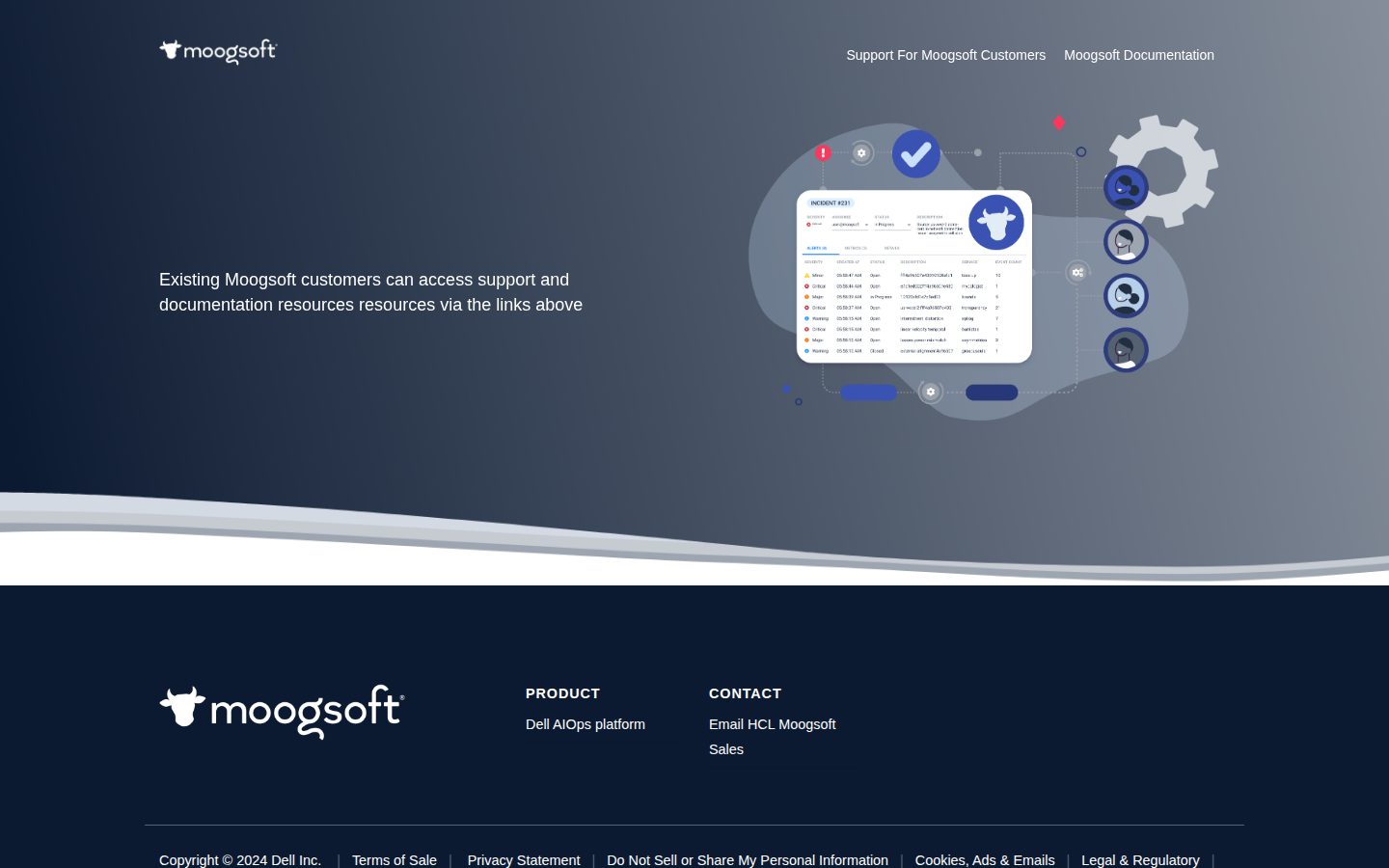
Moogsoft desktop previewMoogsoft mobile preview

Pricing Plans

Enterprise

Contact sales

Covers the cloud service and the on-premise software, which Dell can also host for you, with Standard, Enhanced or Premium support bought at point of sale. Pricing requires contacting sales through moogsoft.com/contact-us or HCL-Moogsoft-Sales@hcltech.com; a free trial is requested through the same form.

  • Standard, Enhanced or Premium support subscriptions
  • Full AIOps platform capabilities
  • Advanced ML-based event correlation
  • On-premise licensing option available
  • Dell-hosted deployment option
  • Custom integrations via REST API and webhooks

AI Panel Reviews

The Decision Maker

The Decision Maker

Strategic bet, vendor viability, timing, adoption approval
6.8/10

Solid AIOps core, but Dell ownership and a frozen site raise real longevity questions.

“Moogsoft's noise reduction and Situation-based correlation are proven capabilities, and the documentation is deep. Dell bought the company in 2023, and that's what I'd want to understand before signing anything.”

The feature set is real. Alert noise reduction claiming up to 99% deduplication, NLP-driven correlation, and a Situation Room for ChatOps collaboration — that's a complete AIOps story. What I couldn't find is a price: no pricing page, no rate card, nothing self-serve, so every number starts with a sales call.

Vendor viability is the real question. Dell acquired Moogsoft in 2023, the company blog hasn't posted since, and the standalone brand now sits inside Dell's AIOps line. Acquired platform, rationalized roadmap, slower execution — I've seen that movie.

The documentation is deep and versioned, which says the install base is real. Pilot it if you're in a noisy NOC environment. Don't standardize until someone on the product team tells you where this is going.

Competitive Positioning7.0

Holds its own against PagerDuty and BigPanda on correlation depth, but neither of those peers carries the same acquisition uncertainty.

Reputation Risk7.0

Moogsoft is a known AIOps name, but explaining to the board in 18 months why the Dell-owned site has gone quiet could get awkward.

Speed to Value6.5

99% noise reduction is a fast, measurable win, but with no self-serve trial and no published price you can't validate it before a sales cycle.

Strategic Fit7.5

Situation-based correlation and automated RCA directly reduce MTTR for NOC and SRE teams managing high-volume alert environments.

Vendor Viability6.0

Dell has backed it since 2023, but the site has gone quiet and the product now sits inside a much larger AIOps line — buying the standalone brand is the open question.

Pros

  • Documented REST and Events APIs, publicly readable — the integration path is scopeable without a sales call
  • NLP-driven correlation and patented Situation grouping are genuinely differentiated vs. rule-based tools
  • Alert noise reduction up to 99% deduplication — the number a flooded NOC feels first
  • Dell's ownership since 2023 removes the funding risk a standalone AIOps vendor would carry

Cons

  • Release notes are versioned in the docs, but no public roadmap — hard to know what ships next
  • The 2023 Dell acquisition creates strategic uncertainty for a platform-level commitment
  • No self-serve trial and no published pricing on any tier — forces a sales conversation too early
  • The marketing site has gone quiet since the acquisition — the blog stops in 2023

Right for

Mid-to-large enterprise NOC or SRE teams drowning in alert volume who need measurable noise reduction fast.

Avoid if

You need a vendor with a clear, independent product roadmap and verifiable shipping momentum.

The Domain Strategist

The Domain Strategist

Craft and strategy in the product's domain — adapts identity per category, same lens
7.2/10

Solid AIOps noise reduction engine, but Dell's 2023 acquisition creates real 3-year uncertainty.

“Moogsoft's Situation-based correlation and NLP-driven alert grouping are genuinely differentiated from rule-based competitors. Dell's acquisition and the absence of any published pricing make this a harder bet than it was two years ago.”

The core architecture is sound. NLP-based correlation instead of static topology rules handles ephemeral infrastructure better than BigPanda's rule-heavy approach. The '99% alert noise reduction' line is marketing, but the Situation model — grouping disparate signals into coherent working incidents — is how mature SRE orgs want to operate.

Dell's 2023 acquisition is where I slow down. The documentation is versioned and current, but the company blog stops at the acquisition post and I couldn't find a pricing page at all. Adopt in year one and by year three you're either on a live roadmap or migrating off a brand folded into Dell's AIOps portfolio.

The 50+ out-of-the-box integrations including ServiceNow, Splunk, and Datadog give this real deployment viability. But contact-only pricing and a sales contact form as the only front door make the evaluation cycle long. The platform is capable; the procurement path is the friction.

Category Positioning6.8

Competes credibly against PagerDuty and ServiceNow Event Management on correlation depth, but the standalone brand has lost visible ecosystem momentum since the acquisition.

Domain Fit8.0

Situation Room ChatOps, multi-domain enrichment with runbook references, and single-pane observability map directly to how NOC and SRE teams structure incident response.

Integration Surface7.5

50+ out-of-the-box connectors including Datadog, Splunk, AppDynamics, and ServiceNow cover most enterprise monitoring stacks; REST API enables custom paths.

Long-term Implications5.5

Release notes run current through the v9 line, but post-acquisition organizational ambiguity still creates meaningful roadmap risk over a 3-year deployment horizon.

Strategic Depth7.8

Patented ML-based Situation correlation and NLP grouping show genuine algorithmic investment beyond basic threshold alerting.

Pros

  • NLP-based correlation avoids brittle static rule maintenance that plagues legacy AIOps deployments
  • Public, versioned documentation covering the REST and Events APIs — no login needed to evaluate
  • Situation model aligns with how mature SRE teams actually triage — consolidated incidents, not raw alert queues
  • 50+ native integrations including Datadog, Splunk, and ServiceNow reduce connector build burden

Cons

  • Release notes run through the v9 line, but no roadmap — hard to assess development velocity post-acquisition
  • Pricing is contact-only and even a trial is requested through sales, extending procurement cycles for high-volume environments
  • API documentation sits on docs.moogsoft.com, but integration depth beyond the listed connectors stays unclear
  • Acquisition context creates real 3-year platform continuity risk that PagerDuty or Splunk ITSI don't carry

Right for

Mid-market ITOps and SRE teams with complex multi-tool monitoring stacks who need correlation depth without building rule libraries.

Avoid if

Your 3-year roadmap requires a vendor with demonstrable active investment and transparent product development cadence.

The Finance Lead

The Finance Lead

Money, total cost of ownership, contracts, procurement math
5.6/10

Zero published prices, zero self-serve entry — the whole rate card lives behind a sales call.

“Moogsoft publishes no price at all — no tier card, no starting rate, nothing in the shop. Three-year TCO stays a guess until a contract is in hand.”

No pricing page. No rate card. No self-serve checkout. The shop page returns nothing at all. For a platform this established, that's a choice.

Category norm for enterprise AIOps is mid-five figures annually. Fifty-person NOC, three years, that's a six-figure commitment. You can't model any of it before the call. Ingest-based platforms usually carry overage rates. I couldn't find those published either. That's where the invoice surprises live.

What's public: 50+ integrations, documented REST and Events APIs, cloud and on-premise deployments. The cloud terms of service too. The commercial terms behind them — renewal window, overage rates — aren't. Dell has owned the company since 2023, so counterparty risk is low. The number you'll pay is unknowable until someone quotes it.

Billing & Procurement4.5

Every tier requires a sales cycle, with no anchor number anywhere on the site to negotiate against.

Contract Flexibility5.0

Cloud terms of service are published, but the commercial terms — renewal window, cancellation, overage rates — aren't.

Pricing Transparency3.0

Nothing is published — no tier card, no starting rate, no overage schedule anywhere on the site.

ROI Clarity6.5

Up to 99% alert noise reduction is a specific, measurable claim tied to the core Alert Noise Reduction feature — if the number holds, it's quantifiable.

Total Cost of Ownership4.0

With no published rate at any tier and no overage schedule, three-year TCO isn't modelable before a quote.

Pros

  • Dell has owned the company since 2023 — counterparty risk on a multi-year contract is low
  • REST and Events API documentation is public — integration cost is scopeable before you buy
  • Cloud terms of service are public — legal can read them before any quote lands
  • Cloud and on-premise deployments are both documented and maintained

Cons

  • Pricing fully opaque on every tier — no public rate, no overage schedule
  • The 2023 Dell acquisition creates roadmap and support continuity uncertainty
  • No self-serve trial — evaluation starts with the sales contact form
  • The company blog stops in 2023 — development velocity is hard to read from outside

Right for

Mid-market ITOps or SRE teams with high alert volume and the procurement bandwidth for a full sales cycle.

Avoid if

You need a fully transparent, self-serve pricing model with predictable year-3 costs before talking to a vendor.

The Domain Practitioner

The Domain Practitioner

Daily hands-on reality in the product's domain — adapts identity per category, same lens
7.6/10

Moogsoft's alert correlation is real — but the integration setup will own your first two weeks

“Solid AIOps core with genuine noise reduction claims (up to 99%) and NLP-based correlation that goes beyond static rules. The API documentation is public and detailed, but there's no published price and no self-serve trial to get hands on it.”

The 'Situations' model is the right abstraction. Grouping correlated alerts into actionable clusters before they hit the on-call queue is exactly what SRE teams need at scale. NLP-driven correlation over static topology rules is a meaningful differentiator versus BigPanda's rule-heavy approach. Correlation definitions are documented step by step.

Day three is where integration debt lands. Fifty-plus out-of-the-box connectors sounds complete until you hit the third custom webhook that needs the 'Create Your Own Integration' path. The Events API is documented with a full schema and generated cURL examples, so that path stays self-serve, not a support ticket.

Dell's 2023 acquisition adds uncertainty. Release notes are versioned in the docs, but the company blog stopped at the acquisition post and I couldn't find a published price anywhere. No self-serve trial either; you request one through the sales contact form and wait. For tooling that sits in your alert path, that's a slow way to see it run.

Day-3 Reality7.2

Situations-based triage is genuinely better than raw alert streams, but tuning correlation definitions is real setup work before the noise drops.

Documentation Practitioner-Fit7.5

Docs are public and versioned across the cloud, on-premise and enterprise lines, though you reach them past a marketing surface written for buyers, not operators.

Friction Surface6.9

API docs live on docs.moogsoft.com, but with no self-serve trial the first hands-on contact still routes through sales.

Power-User Depth7.5

Workflow engine, multi-domain enrichment, automated RCA, and REST API webhooks give advanced operators real configuration surface, though discoverability beyond the UI is unclear.

Workflow Integration7.8

Datadog, ServiceNow, Splunk, Jira integrations cover the core SRE stack; the Situation Room ChatOps model fits incident response workflows without forcing a context switch.

Pros

  • NLP-based correlation beats static-rule competitors — more resilient in dynamic environments
  • 50+ out-of-the-box integrations including Datadog, AppDynamics, New Relic cover most SRE stacks
  • Events API documented with a full schema and generated cURL examples — custom sources stay self-serve
  • Situation Room ChatOps reduces context-switching during active incidents

Cons

  • The company blog stopped posting in 2023 — velocity is hard to read for alert-path tooling
  • Non-standard sources still mean building against the Events API yourself — budget the week
  • No self-serve trial — you can't push realistic event volume through it before a sales call
  • Post-acquisition trajectory under Dell is unclear, adding platform longevity risk

Right for

Mid-to-large SRE or NOC teams drowning in multi-source alert volume who have budget for a dedicated AIOps layer and engineering time to configure integrations.

Avoid if

Your team needs a published price and a self-serve trial before committing to alert-path infrastructure.

The Power User

The Power User

Daily human experience, onboarding, polish, learning curve, reliability
7.6/10

Moogsoft's 99% noise reduction promise is serious — but the Dell acquisition shadow lingers

“Solid AIOps muscle for overwhelmed NOC and SRE teams. But there's no price on the site and no way in without a sales call, which for a tool this established is strange.”

The Situation Room concept — grouping related alerts into consolidated 'Situations' instead of flooding engineers with raw noise — is the right idea. NLP-based correlation instead of static rules is what separates this from older tools like ServiceNow Event Management with its rigid topology maps. Three days in, that's the difference between a queue you triage and one you drown in.

Then you go looking for a price, and there isn't one. No pricing page, no plan comparison, no trial button. PagerDuty lets you open an account and find out. Here you book a call and wait.

Dell bought the company in 2023, and that's what I'd want answered before signing. Roadmap, support continuity, whether deals still close smoothly — none of it is visible, and the blog hasn't posted since. The docs describe a browser-based mobile view for Situations, but a deprecation notice retires that legacy mobile UI with Moogsoft Enterprise v9.2.1, targeted for October 2026. For on-call work, I'd want to know what replaces it before signing.

Daily Polish6.5

The marketing site hasn't moved since 2023 — stale blog, no pricing page, a shop page with nothing in it — which usually reflects inward attention too.

Learning Curve7.0

Docs are thorough and the Situation-based model is conceptually clean, but correlation setup is deliberate work from day one.

Mobile Parity6.0

The docs describe a browser-based mobile view with Situation Rooms and in-app notifications, but that legacy mobile UI is slated for retirement with v9.2.1, targeted for October 2026.

Onboarding Experience5.0

There's no self-serve trial and nothing to open on your own — even a trial starts as a request on the sales contact form.

Reliability Feel7.5

An established enterprise deployment base and documented REST API and webhook integrations suggest the core platform is mature and battle-tested.

Pros

  • Docs are public and versioned — you can read how it actually works before talking to anyone
  • NLP-based correlation beats static-rule competitors on complex multi-system environments
  • 50+ out-of-the-box integrations including Datadog, Splunk, ServiceNow, and Jira
  • On-premise deployment is documented and maintained, which regulated industries actually need

Cons

  • The blog stops at the 2023 acquisition — velocity is hard to read from outside
  • The browser-based mobile view is slated for retirement with v9.2.1, targeted for October 2026 — ask what on-call staff use after that
  • No self-serve trial and nothing to sign up for — even a trial starts with the sales contact form
  • The Dell acquisition adds roadmap uncertainty that sales calls won't fully resolve

Right for

Mid-to-large enterprise ITOps or SRE teams drowning in alert volume who need ML-based triage, not another rules engine.

Avoid if

You want published pricing and a self-serve trial before committing to an on-call platform.

The Skeptic

The Skeptic

Contrarian. Watch-outs, deal-breakers, broken promises, category patterns
6.2/10

Dell acquisition, no pricing page, a blog frozen at 2023 — caution flags stacking up

“Moogsoft has real AIOps bones — NLP correlation, 99% noise reduction claims, 50+ integrations. But Dell bought it in 2023, the blog stopped that year, and there's no pricing page at all — classic absorbed-product signals.”

'Industry leading anomaly detection algorithms' is the pitch. No benchmark behind it. Less standard: I couldn't find a pricing page at all, and the shop page returns nothing.

The product isn't thin. Situation-based correlation with patented ML, NLP-driven alert grouping, 50+ integrations, versioned public docs. The 99% noise reduction claim is the kind of superlative that ages poorly. The mechanism — adaptive thresholds plus NLP correlation — is at least specific.

Dell closed the acquisition in 2023. Category history is full of AIOps deals that became slow sunsets, and the signals lean that way: blog frozen at the acquisition post, no self-serve trial, no price, sales routed through a partner inbox. The docs are the counterweight — current, versioned, REST APIs fully specified. Could go either way. I'd want a 12-month roadmap in writing before signing.

Competitive Differentiation6.5

NLP-based correlation over static rules is a real differentiator vs. BigPanda's topology-first approach, but ServiceNow Event Management has closed that gap for enterprises already on that stack.

Exit Portability5.8

REST and webhook integrations are documented in full, but the Situations data model is proprietary — migration wouldn't be clean.

Long-term Viability6.0

Dell has owned it since 2023, but the blog stopped that year and nothing self-serve remains on the site — the maintenance signals are weak for a platform asking for annual contracts.

Marketing Honesty5.5

'Industry leading anomaly detection algorithms' with no benchmark behind it, and a 99% noise reduction figure with no published methodology — aspirational copy, not grounded claims.

Track Record Match6.0

AIOps correlation platforms have a mixed survival rate post-acquisition; Moogsoft fits the pattern of a niche leader absorbed into a larger portfolio, not the Splunk/PagerDuty survivor pattern.

Pros

  • Situation-based ML correlation with patented algorithms — not just rule-based deduplication
  • Public, versioned documentation across the cloud, on-premise and enterprise release lines
  • Enrichment attaches business criticality, service relationships, and runbook links to alerts before triage
  • On-premise deployment is documented and still maintained — rare in this category

Cons

  • Docs are versioned and current, but the company blog hasn't posted since 2023
  • The Dell acquisition creates roadmap opacity; category norm is absorbed products go quiet within 18 months
  • 99% noise reduction claim is unverified; no benchmark or third-party validation cited
  • No self-serve trial, no pricing — the sales contact form is the only front door

Right for

Mid-size ITOps or NOC teams drowning in alert volume who need NLP-driven correlation and can negotiate a short initial contract.

Avoid if

You need a vendor with a visible roadmap and an independent product direction before committing to a multi-year AIOps contract.

Buyer Questions

Common questions answered by our AI research team

Features

Does Moogsoft reduce alert noise automatically?

Yes. Moogsoft applies machine learning algorithms to IT event data to automatically reduce alert noise, surfacing actionable incidents so operations teams are not overwhelmed by raw alert volume.

Features

How does Moogsoft detect anomalies in IT events?

Moogsoft uses machine learning algorithms applied to IT event data to perform anomaly detection, identifying unusual patterns and correlating related events to surface meaningful incidents.

Integration

Does Moogsoft support custom integrations?

Yes. Custom Integration is listed as a core platform capability alongside noise reduction, enrichment, anomaly detection, correlation, collaboration, and self-service.

Integration

Does Moogsoft work with Datadog?

Yes. Datadog events come in through a custom integration: you create an endpoint under Integrations > Inbound Integrations > Create Your Own Integration and point a Datadog webhook at it.

Alternatives to Moogsoft

Who Moogsoft competes with, and how each one differs

Product Information

  • Company

    Moogsoft
  • Founded

    2012
  • Pricing

    Contact for pricing

Platforms

web

About Moogsoft

Moogsoft is a San Francisco-based AIOps provider that uses machine learning to reduce IT alert noise and correlate events. It was acquired by Dell Technologies in 2023.

Resources

Documentation
API
Blog
Changelog

Also in AI DevOps