Dify logo

Dify Review

Visit

An open-source platform for building agentic AI, workflows, and RAG pipelines

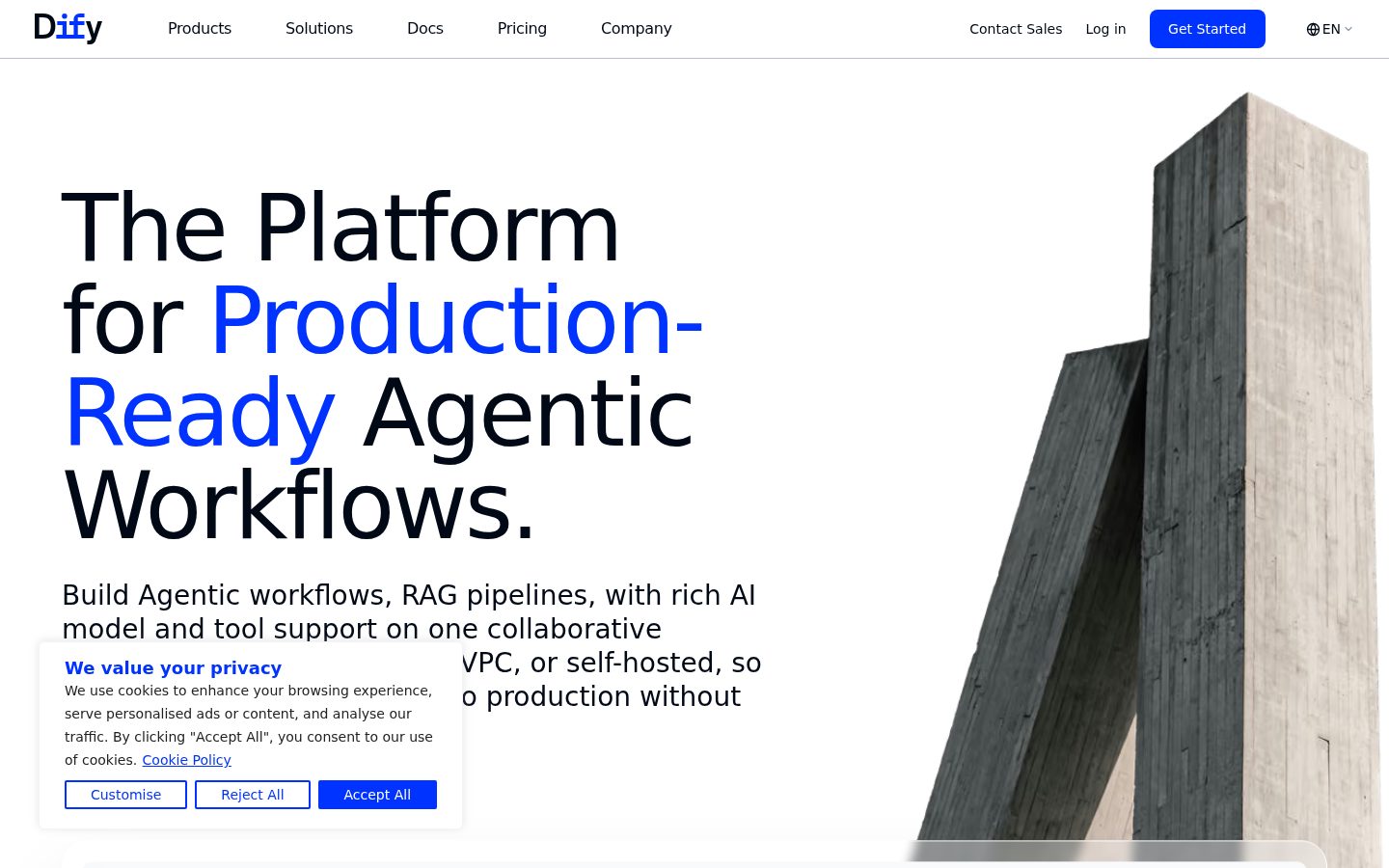
Dify is an open-source platform for building AI agents, agentic workflows, and RAG knowledge pipelines.

AI Panel Score

7.8/10

6 AI reviews

Reviewed

AI Editor Approved

About Dify

Dify centers on a visual builder where users construct agentic workflows and AI agents without writing all the underlying orchestration code by hand. Within this builder, agents can be configured to plan multi-step tasks and call external tools as part of executing a workflow, while a separate runtime handles running these agents once built.

A distinct part of the platform is its Knowledge Pipeline, aimed at retrieval-augmented generation (RAG): it handles ingesting source documents, chunking them, and retrieving relevant pieces at query time so that LLM app responses are grounded in a team's own data rather than relying solely on a model's general training.

Dify is positioned for teams of any size building LLM-powered applications, agents, or knowledge-grounded chat systems. The project is open source, with its code hosted on GitHub (langgenius/dify) at 156K+ stars, and paid Cloud plans are published at $590 and $1,590 per workspace per year.

Features

AI

  • Autonomous AI Agents

    Agents that can plan, call tools, and execute multi-step tasks without step-by-step human direction.

  • Knowledge Pipeline (RAG)

    Ingests and chunks your own data, retrieves relevant content, and grounds LLM answers in that data.

Automation

  • Agentic Workflows

    Enables construction of multi-step, automated workflows that agents follow to complete tasks.

Core

  • AI Agent Builder

    A visual workflow builder combined with an agent runtime for designing and running AI agents.

  • Open Source Platform

    Provides the full Dify codebase publicly on GitHub for self-hosting and customization.

Preview

Dify desktop previewDify mobile preview

Pricing Plans

Sandbox

Free

For trying out Dify's core features.

  • 200 message credits
  • 1 Team Workspace, 1 Team Member
  • 5 Apps
  • 50 Knowledge Documents, 50MB storage
  • 30 Days Log History
  • 5,000 API Rate Limit/month
Popular

Professional

$49.17/monthly

For independent developers and small teams building production AI apps. $590 per workspace/year, billed annually; monthly billing runs about 17% higher.

  • 5,000 message credits/month
  • 1 Team Workspace, 3 Team Members
  • 50 Apps
  • 500 Knowledge Documents, 5GB storage
  • 20,000 Trigger Events/month
  • Unlimited Log History, no API rate limit

Team

$132.50/monthly

For medium-sized teams needing collaboration and higher throughput. $1,590 per workspace/year, billed annually; monthly billing runs about 17% higher.

  • 10,000 message credits/month
  • 1 Team Workspace, 50 Team Members
  • 200 Apps
  • 1,000 Knowledge Documents, 20GB storage
  • Unlimited Trigger Events
  • Priority Workflow Execution, Unlimited Log History

Enterprise

Contact sales

For enterprises requiring advanced security, compliance, governance, and dedicated support. Custom pricing via Contact Sales.

  • Enterprise-grade scalable deployment solutions
  • Commercial license authorization
  • Multiple Workspaces & Enterprise Management
  • SSO
  • Negotiated SLAs by Dify Partners
  • Advanced Security & Controls

Community

Free

For open-source enthusiasts, individual developers, and non-commercial projects.

  • All core features released under the public repository
  • Single Workspace
  • Complies with Dify Open Source License

AI Panel Reviews

The Decision Maker

The Decision Maker

Strategic bet, vendor viability, timing, adoption approval
8.0/10

155K GitHub stars and a real self-host option make this the sane default for agentic workflows.

“Dify pairs a visual agent builder with RAG pipelines and gives you three deployment paths, not one. The Professional tier at $49.17/month is priced for teams who'd otherwise be duct-taping LangChain scripts together.”

Open source with 155K+ GitHub stars isn't a vanity metric here. It means you can self-host Community Edition today, on your own infrastructure, with zero vendor risk if Dify's business ever wobbles.

The Enterprise tier backs that up with SOC 2 Type II, ISO 27001, SSO/SAML and audit logs — the checklist procurement actually asks for. Trigger events, MCP tool support, and a Knowledge Pipeline for RAG round out a genuinely complete agent stack, not just a chatbot wrapper.

Tradeoff: message credits cap fast. Professional gives you 5,000/month for three team members, which a single busy agent can burn through in days. Enterprise pricing is contact-only, so budget certainty disappears right when you need it most. Still, three deployment options beats the usual cloud-or-nothing choice.

Competitive Positioning7.9

MCP-compatible publishing and three distinct deployment modes (Cloud, VPC, self-hosted) go beyond what a single-mode cloud agent platform offers.

Reputation Risk8.0

Open-source self-hosting plus SOC 2 Type II and ISO 27001 on Enterprise removes most lock-in and compliance objections.

Speed to Value7.6

Single-command Docker deploy for Community Edition gets you running fast, but 5,000 message credits on Professional limits real production testing.

Strategic Fit8.2

Agentic workflows plus RAG in one canvas advances agent adoption rather than just cutting cost on existing chat tools.

Vendor Viability8.3

155K+ GitHub stars, a published pricing page with five tiers, and Docker/Helm deploy docs point to active, serious build-out.

Pros

  • Open-source core with 155K+ GitHub stars and Apache-2.0-derivative licensing
  • Three deployment paths: Cloud, VPC/Kubernetes via Helm, or self-hosted Docker
  • SOC 2 Type II and ISO 27001 on Enterprise for procurement-heavy buyers
  • MCP tool support lets agents plug into external systems

Cons

  • Professional tier's 5,000 message credits/month is thin for active production use
  • Enterprise pricing is contact-only, hard to budget against upfront
  • No free trial on paid tiers, just a capped Sandbox

Right for

Teams that want agent and RAG workflows with the option to self-host and avoid vendor lock-in.

Avoid if

Skip it if you need predictable Enterprise pricing without a sales call.

The Domain Strategist

The Domain Strategist

Craft and strategy in the product's domain — adapts identity per category, same lens
7.9/10

Real deployment flexibility and enterprise controls, but the pricing model shifts real operating risk onto message-credit forecasting.

“Dify gives me three deployment paths and a genuine open-source exit ramp, which matters when I'm underwriting a 3-year automation bet. The commercial tiers are cheap to start but the metering model needs real usage modeling before I sign off on it.”

As COO, my first question on any workflow platform is: what happens to my operating model if the vendor disappears or the pricing changes? Dify's answer is credible — Community Edition is Apache-2.0-derivative, self-hostable via Docker, with 155K+ GitHub stars, so worst case I run it myself. That's a real hedge most closed platforms don't give me.

The commercial ladder is where I'd slow down. Professional runs $49.17/month for 5,000 message credits and 3 team members; Team jumps to $132.50/month for 10,000 credits and 50 members. That's not a linear scaling curve — I'd want finance modeling message-credit burn before committing headcount to workflows built on it.

Enterprise adds SSO/SAML, RBAC, audit logs, SOC 2 Type II and ISO 27001 — the governance checklist procurement actually asks for. MCP compatibility keeps it from becoming an integration island. Tradeoff: this is infrastructure I own operationally, not a SaaS I can walk away from cleanly once workflows are embedded.

Category Positioning8.2

SOC 2 Type II and ISO 27001 certification on Enterprise puts it in serious procurement conversations, not just developer-tool territory.

Domain Fit7.8

Three deployment modes — Cloud, VPC/Kubernetes via Helm, and self-hosted Docker — match how ops leaders actually stage rollouts from pilot to production.

Integration Surface7.7

MCP-compatible app publishing and a marketplace for MCP integrations keep this from being a walled workflow silo.

Long-term Implications7.5

Open-source self-hosting is a genuine exit ramp, but message-credit metering ($49.17 to $132.50/month jump) means cost forecasting gets harder as usage scales.

Strategic Depth8.0

Visual builder plus separate agent runtime and a dedicated Knowledge Pipeline for RAG shows real architectural separation, not a single-trick demo.

Pros

  • Open-source Community Edition with 155K+ GitHub stars gives a genuine self-hosting exit path
  • SOC 2 Type II and ISO 27001 certifications on Enterprise satisfy real procurement gates
  • Three deployment modes (Cloud, VPC/Kubernetes, self-hosted Docker) support staged rollout

Cons

  • Message-credit pricing (5,000 to 10,000 credits between tiers) makes cost forecasting harder at scale
  • Enterprise pricing is contact-only, adding sales-cycle friction to a build vs. buy decision
  • Team plan jumps to $132.50/month for only 10,000 credits, a steep step from Professional's 5,000

Right for

Operations leaders who want deployment flexibility and are willing to self-host or negotiate Enterprise terms for governance controls.

Avoid if

Skip it if your finance team needs predictable flat-rate costs rather than message-credit consumption modeling.

The Finance Lead

The Finance Lead

Money, total cost of ownership, contracts, procurement math
7.9/10

Five published tiers, $0 to $132.50, but message credits meter your real cost.

“Sandbox is free, Professional is $49.17/month, Team is $132.50/month. Enterprise is the usual black box.”

$49.17/month buys 5,000 message credits, 3 team members, 50 apps. Team tier jumps to $132.50/month for 10,000 credits and 50 members. That's a 3.7x seat increase for 2.7x price — decent scaling math, if credits match usage.

50-seat team, year 3: Team tier at $132.50 × 12 = $1,590/year, before credit overages. Credits are the wildcard — no published overage rate past plan limits. That's the real cost risk, not the sticker.

Community edition is Apache-2.0-derivative, self-hosted, free. That's the TCO escape hatch: pay in DevOps time instead of subscription. Enterprise adds SSO, SOC 2 Type II, ISO 27001 — priced only via Contact Sales, so no anchor there.

Billing & Procurement7.5

Self-serve monthly billing on lower tiers keeps procurement light; Enterprise requires the sales-cycle route for SSO and audit logs.

Contract Flexibility7.0

Monthly billing on Professional and Team implies low lock-in, but Enterprise terms are negotiated privately with no published SLA baseline.

Pricing Transparency8.0

Four of five tiers list exact prices and limits on the pricing page; Enterprise alone hides behind sales contact.

ROI Clarity7.0

Message credits and Trigger Events give a countable usage unit, but no case-study numbers tie credits to business outcomes.

Total Cost of Ownership7.0

Message-credit metering means costs scale unpredictably with usage; self-hosted Community edition trades subscription cost for infrastructure and ops time.

Pros

  • Four tiers with exact prices, no sales call needed below Enterprise
  • Free Community edition is genuinely self-hostable via Docker
  • Team tier scales to 50 members at a fixed $132.50/month

Cons

  • No published overage rate once message credits run out
  • Enterprise pricing is Contact Sales only, breaks the transparency streak
  • Credit-based metering makes 3-year cost harder to forecast than flat per-seat pricing

Right for

Teams comfortable estimating message-credit usage who want visible pricing below the enterprise tier.

Avoid if

Avoid if you need firm all-in cost certainty before signing, since credit overage pricing isn't published.

The Domain Practitioner

The Domain Practitioner

Daily hands-on reality in the product's domain — adapts identity per category, same lens
7.8/10

Solid canvas for building agent workflows, but the message-credit meter is a daily operational headache

“Dify gives ops teams a real visual builder for agentic workflows and RAG pipelines instead of stitched-together scripts. The credit and rate-limit ceilings on lower tiers mean you're watching a meter, not just building a process.”

The visual builder plus separate agent runtime is the right shape for operations work — you're not hand-wiring orchestration, you're configuring a pipeline that plans, calls tools, and executes multi-step tasks. That maps to how ops actually documents a process: as a sequence with checkpoints, not a monolith script.

Day three is where the tier math bites. Professional at $49.17/month caps you at 5,000 message credits and 500 knowledge documents — fine for a pilot, tight for a live production workflow ingesting real document volume. Team jumps to $132.50 for 10,000 credits and unlimited trigger events, which is the real signal: triggers, not messages, are what an automation-heavy shop burns through. Budgeting against credits instead of flat seats is a new habit, not a small one.

MCP-compatible tool publishing and a marketplace for integrations are the right calls for connecting into an existing stack. SOC 2 Type II and ISO 27001 on Enterprise, plus SSO/RBAC/audit logs, cover procurement asks. Self-hosting via Docker (Community Edition, 155K+ GitHub stars) is the escape hatch if the credit model doesn't fit your volume.

Day-3 Reality7.5

Builder and runtime concept holds up past the demo, but credit ceilings on Professional (5,000/month) force early attention to consumption tracking.

Documentation Practitioner-Fit7.6

Docs, blog, a full REST API reference at api.dify.ai/v1 covering chatflow, workflow, agent and knowledge endpoints, and tagged GitHub releases with detailed notes are all public — solid footing for ops teams debugging a live pipeline.

Friction Surface7.0

Trigger events and message credits are separate metered resources across tiers, adding a new budgeting habit most automation platforms don't require.

Power-User Depth8.0

Self-hosting via Docker, Helm charts for Kubernetes on Enterprise, and open-source access on GitHub give real room to grow past the visual builder.

Workflow Integration7.8

MCP-compatible tool publishing and marketplace integrations fit into existing tool stacks without heavy rework.

Pros

  • Visual agent builder plus separate runtime maps naturally to how ops teams already document multi-step processes
  • MCP-compatible tool publishing and a marketplace for integrations
  • SOC 2 Type II and ISO 27001 certifications plus SSO/RBAC on Enterprise satisfy procurement requirements
  • Open-source Community Edition with single-command Docker deploy as a fallback if hosted tiers don't fit

Cons

  • Professional tier's 5,000 message credits and 500 document cap will strain a live production workflow fast
  • Trigger events and message credits are billed separately, adding a new consumption-tracking habit
  • Enterprise pricing is contact-sales only, so total cost isn't transparent until a negotiation

Right for

Operations teams that want to build and self-host multi-step agentic workflows without writing custom orchestration code.

Avoid if

Avoid if your team needs predictable flat-rate billing instead of tracking message credits and trigger events monthly.

The Power User

The Power User

Daily human experience, onboarding, polish, learning curve, reliability
7.8/10

Powerful canvas, but you'll spend month one learning what the boxes actually do.

“Dify gives you agents, RAG, and workflows on one visual canvas, with a real self-hosted option behind 155K+ GitHub stars. The learning curve is steeper than the demo makes it look, and the free tier is stingy on message credits.”

Dify's pitch is agents, RAG pipelines, and workflows on one canvas, and the feature list backs that up: Knowledge Pipeline for chunking your own docs, an agent runtime for multi-step tool calls, MCP support for plugging into external tools. That's a lot of surface area for a first session.

The Sandbox tier gives you 200 message credits to poke around, which sounds generous until you realize that's maybe an afternoon of real testing before you're staring at a paywall. Professional at $49.17/month gets you 5,000 credits and 3 team members — fine for a small team, tight if you're iterating hard on a RAG pipeline that needs constant re-querying.

What I like: self-hosting via Docker means you're not locked into their cloud, and SOC 2 plus ISO 27001 on the Enterprise tier signals they've thought about procurement, not just demos. What worries me: a tool this flexible usually means week one is spent figuring out which building block does what, not shipping anything.

Daily Polish7.0

Visual builder and knowledge pipeline are named, distinct pieces, which suggests real design thought, but I found no detail on empty states or micro-copy.

Learning Curve7.0

155K+ GitHub stars and MCP marketplace integrations suggest a real ecosystem to grow into, but that same breadth is a lot to climb in hour one.

Mobile Parity5.5

Platform is listed as web only, and a visual workflow builder is the kind of thing that just doesn't translate to a phone screen.

Onboarding Experience6.5

200 message credits on Sandbox lets you poke around fast, but a canvas combining agents, workflows, and RAG is homework before it's welcome.

Reliability Feel7.5

SOC 2 Type II and ISO 27001 on Enterprise, plus unlimited log history on paid tiers, points to a team that takes production seriously.

Pros

  • Self-hosting via single Docker command keeps you out of vendor lock-in
  • MCP support lets agents plug into external tools and marketplace integrations
  • SOC 2 Type II and ISO 27001 certs on Enterprise tier for procurement conversations

Cons

  • 200 message credits on the free Sandbox tier disappears fast
  • Web-only platform with no mobile story I could find
  • Combining agents, RAG, and workflows on one canvas means a real ramp-up period

Right for

Small dev teams who want to self-host an agent and RAG platform without writing orchestration code from scratch.

Avoid if

Avoid if you need a mobile-friendly tool or want to be building production apps within your first hour.

The Skeptic

The Skeptic

Contrarian. Watch-outs, deal-breakers, broken promises, category patterns
7.6/10

155K GitHub stars is real signal. The logo wall of Adobe and Maersk is not.

“Dify's open-source core gives it a genuine exit story most agentic platforms can't match. The pricing tiers and MCP support are concrete; the enterprise logo wall on the homepage is the kind of thing every vendor slaps up regardless of actual contract size.”

Start with what's checkable. Apache-2.0-derivative license, single-command Docker deploy, 155K+ GitHub stars, SOC 2 Type II and ISO 27001 on the enterprise tier. That's a real trail, not just a claim. MCP-compatible tool publishing is a specific, current integration, not vague 'connects to everything' language.

Professional tier at $49.17/month for 5,000 message credits and 3 team members is narrow. Team jumps to $132.50 for 50 members — a big gap, worth checking against your actual seat count before committing.

The open-source core is the real differentiator here versus closed agent-builder competitors — if Dify the company stumbles, you still have the codebase and can self-host indefinitely. That's a cleaner exit than most in this category offer.

Release cadence is easy to check from outside: the GitHub repo ships tagged releases with detailed notes (v1.17.1 in September), and there is a full public REST API reference at docs.dify.ai covering chatflow, workflow, agent and knowledge endpoints. The customer logo wall (Google, Adobe, Maersk) still reads aspirational — three one-line testimonials from RICOH, Volvo and ETS are the only detail behind nineteen logos.

Competitive Differentiation7.2

Visual builder plus agent runtime plus RAG pipeline in one canvas is a real combination, though the agentic-workflow-builder space is getting crowded.

Exit Portability8.3

Apache-2.0-derivative open-source codebase with single-command Docker self-hosting means you're never fully locked to their cloud.

Long-term Viability7.5

Docs, a public REST API reference and tagged GitHub releases with detailed notes (v1.17.1 in September) show a fast, visible release pace, and 156K stars back the community claim.

Marketing Honesty6.8

Homepage leads with nineteen client logos including Adobe, Google and Maersk, with only three one-line testimonials (RICOH, Volvo, ETS) behind them

Track Record Match8.0

155K+ GitHub stars, SOC 2 Type II, ISO 27001, and named MCP tool support are specific and checkable, not just marketing copy.

Pros

  • Open-source Apache-2.0-derivative core with self-hosted Docker deploy as a real fallback
  • 155K+ GitHub stars suggest genuine community traction, not just marketing
  • MCP-compatible tool publishing is a concrete, current integration point
  • Tagged releases with detailed notes ship from the public repo — cadence you can verify

Cons

  • Professional tier caps at 3 team members for $49.17/month — thin for anything beyond a solo builder
  • Big pricing jump to $132.50 for the Team tier's 50 members
  • Nineteen enterprise logos (Adobe, Google, Maersk) backed by just three one-line testimonials
  • Enterprise is the only tier with SSO and the compliance reports, and it is contact-sales only with no published price

Right for

Small teams or developers who want a self-hostable, open-source agent and RAG builder with an escape hatch if the vendor's roadmap disappoints.

Avoid if

Avoid if you need more than 3 team members without jumping straight to the $132.50 Team tier.

Buyer Questions

Common questions answered by our AI research team

Setup

What deployment options does Dify offer?

Dify offers three deployment options: Dify Cloud (managed, zero infrastructure setup), Dify Enterprise (self-hosted or run in your VPC with Helm charts for Kubernetes), and Community Edition (open-source, self-hosted with a single-command Docker deploy).

Security

Does Dify Enterprise support SSO and SAML?

Yes. Dify Enterprise includes SSO/SAML, role-based access control (RBAC), and audit logs, built for procurement, security, and audit requirements.

Features

Is Dify open source?

Yes. Dify's Community Edition is source-available under an Apache-2.0-derivative license, deployable via a single Docker command, and has 155K+ stars on GitHub.

Integration

Can Dify agents connect to external tools via MCP?

Yes. Dify apps can be published as MCP-compatible tools, and teams can install MCP integrations from the Marketplace to bring them into the workspace.

Security

What compliance certifications does Dify Enterprise have?

Dify Enterprise holds SOC 2 Type II and ISO 27001 certifications.

Alternatives to Dify

Who Dify competes with, and how each one differs

Also in AI Workflow Automation