Lexica logo

Lexica Review

Visit

Search and generate AI images powered by Stable Diffusion

Lexica is an AI image search engine and generator built on Stable Diffusion.

AI Panel Score

7.5/10

6 AI reviews

Reviewed

What is Lexica?

Lexica is an AI image search engine and generator built on Stable Diffusion. Users can search a large database of AI-generated images with their associated prompts for inspiration, then generate new images in the browser using Lexica's in-house Aperture model, with no local GPU setup required. Pricing starts at $8 per month; the Starter plan, at $10 billed monthly, bundles a solo commercial license and 1,000 fast generations, and a free tier allows roughly 100 generations per month. Core capabilities include image search, image generation, generation history, and liked-image collections. TopReviewed's six-seat AI review panel scored it 7.5/10, praising the rare commercial license at a $10 price point while noting free and Starter images are public by default, with private generation only on the $60 Max plan. It best fits solo designers who want an inexpensive Stable Diffusion generator with prompt discovery built in.

About Lexica

Lexica is a web-based platform centered around AI-generated imagery using Stable Diffusion. It was initially launched as a searchable database of images created with Stable Diffusion, allowing users to browse millions of generated images alongside the text prompts that produced them. This made it a practical reference tool for anyone looking to understand how specific prompts translate into visual output.

Over time, Lexica expanded its functionality to include its own image generation capabilities through a feature called Lexica Aperture. Users can enter text prompts directly on the platform and receive generated images without needing to set up any local software or external API connections. The generation quality is tuned toward photorealistic and aesthetically refined outputs.

The platform targets a broad audience including digital artists, graphic designers, marketers, and hobbyists who want to create or explore AI-generated visuals. It lowers the technical barrier to using Stable Diffusion by providing a clean, browser-based interface rather than requiring command-line tools or local GPU resources.

Lexica operates on a freemium model, offering a limited number of free image generations per month and paid subscription tiers for higher usage volumes and faster generation speeds. The search functionality for browsing existing images remains accessible without an account.

In the broader AI image generation market, Lexica occupies a niche that combines a community image library with generation tools, distinguishing it from pure generators like Midjourney or DALL-E by emphasizing prompt discoverability and transparency about how images are created.

Features

AI

  • Image Generation

    Enables users to generate new images using Stable Diffusion models directly on the platform.

Core

  • Generation History

    Stores a record of previously generated images so users can revisit and review their past creations.

  • Image Search

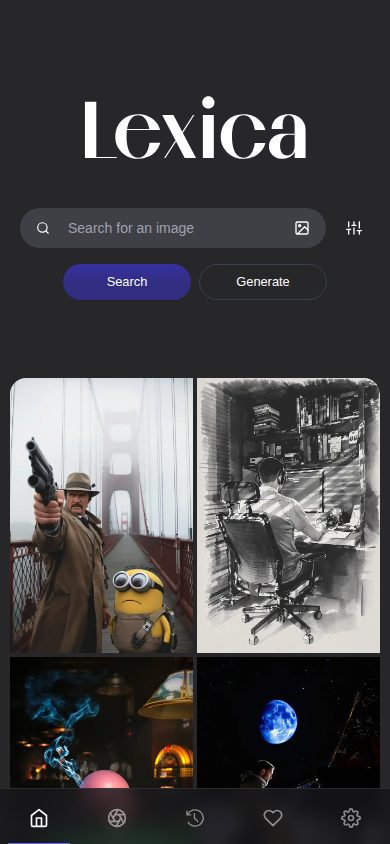
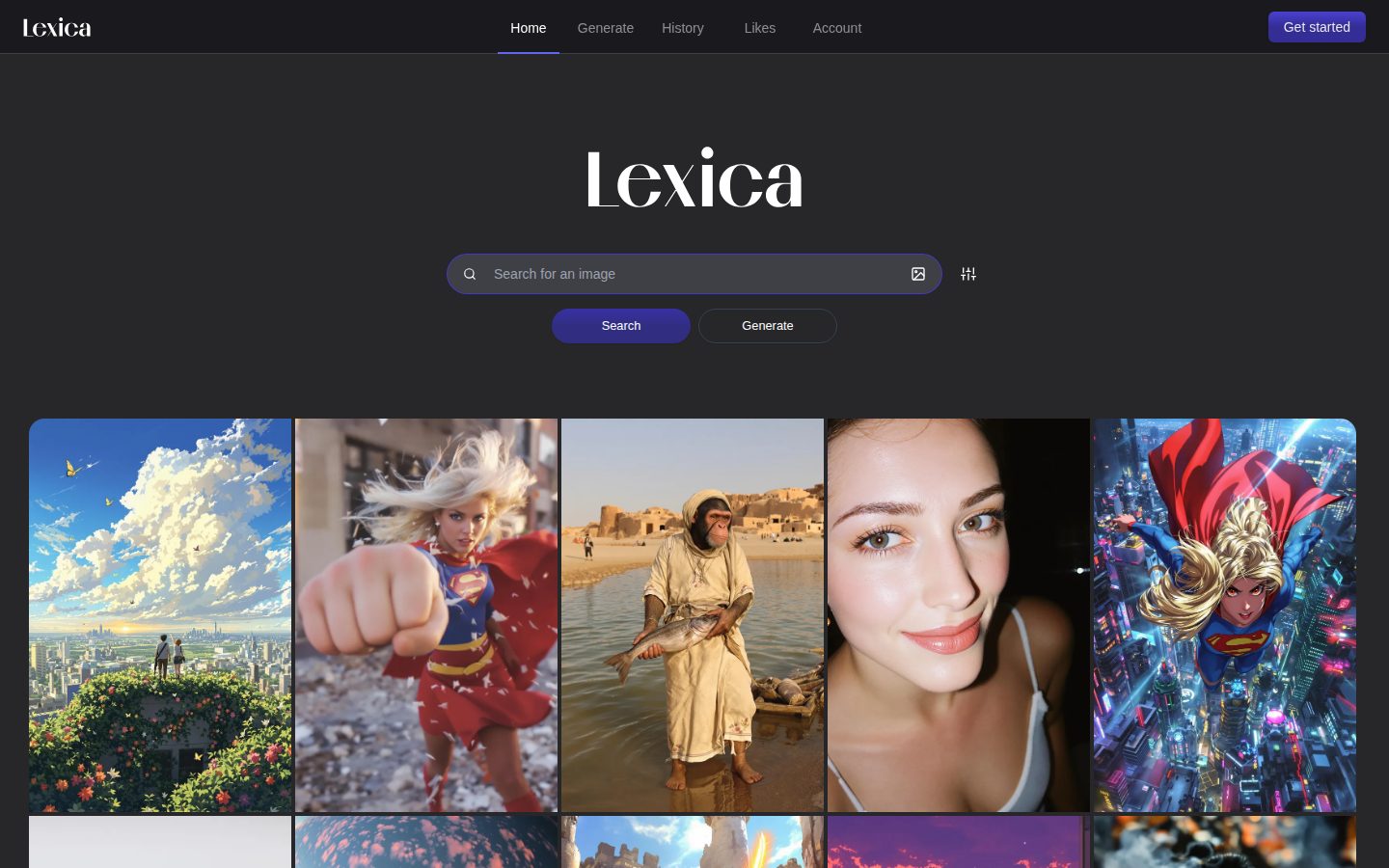
    Allows users to search a large database of AI-generated images by keyword or visual similarity.

  • Liked Images

    Lets users save and organize images they have liked for future reference or inspiration.

  • User Account

    Provides a personal account interface where users can manage their profile, history, and saved content.

Preview

Lexica desktop previewLexica mobile preview

Pricing Plans

Free

Free

Casual users and hobbyists who want to explore AI image generation without a subscription

  • ~100 image generations per month
  • Limited fast generations
  • Images are public
  • Personal/non-commercial use only
  • Access to Lexica search engine

Starter

$10/monthly

Solo users and beginners who want to try AI art generation with a commercial license

  • 1,000 fast generations per month
  • 2 parallel fast generations
  • Commercial license for solo use
  • Images are public
  • Extra fast generations available at $0.05 each
Popular

Pro

$30/monthly

Regular AI art creators and small teams of 2–5 people needing commercial rights

  • 3,000 fast generations per month
  • Unlimited slow generations
  • 3 parallel fast generations
  • Commercial license (solo to 5-person teams)
  • Images are public
  • Extra fast generations available at $0.05 each

Max

$60/monthly

Power users, agencies, and companies with 5+ employees needing private images and maximum output

  • 7,000 fast generations per month
  • Unlimited slow generations
  • 3 parallel fast generations
  • Commercial license for companies with 5+ employees
  • Private images by default
  • Extra fast generations available at $0.05 each

AI Panel Reviews

The Decision Maker

The Decision Maker

Strategic bet, vendor viability, timing, adoption approval
7.5/10

A 2022 seed-funded prompt-search tool that pivoted into image generation against incumbents with deeper pockets.

Lexica owns the searchable Stable Diffusion prompt library and added Aperture v5 generation on top. The vendor question is whether $5M of runway holds against Midjourney and OpenAI on model quality.

Sharif Shameem launched Lexica in 2022 as a searchable index of Stable Diffusion prompts, then added generation later. The $5M seed from Daniel Gross funds a small team for three years out — not enough cash to outspend Midjourney on model training.

Aperture v5 is tuned for photorealism and lands cleanly in the browser without any local GPU setup. The Starter plan at $10/month buys a commercial license and 1,000 fast generations — cheap enough that procurement signs without escalation. The search index over millions of public prompts is the real wedge nobody else has bothered to build.

However, the model isn't competing with Midjourney v6 or DALL-E 3 on raw quality anymore, and the moat is community discovery, not generation. Reputation risk is real if the board asks why we didn't pick the obvious incumbent. Pilot it with your design team for one quarter, then decide.

Competitive Positioning7.0

The prompt-search wedge is unique but generation quality is mid-pack versus Midjourney v6.

Reputation Risk7.0

Niche pick — the board may ask why not the obvious incumbent on the contract.

Speed to Value8.2

Browser-based at $10/month with zero setup makes payback measurable inside a sprint.

Strategic Fit7.5

Solid creative-team tool with browser-first generation, not strategic infrastructure.

Vendor Viability6.8

A $5M seed and small team three years in is thin against Midjourney and OpenAI cash flows.

Pros

  • Lexica Aperture v5 runs entirely in-browser with no local GPU setup required.
  • Starter plan at $10/month bundles a commercial license and 1,000 fast generations.
  • Searchable prompt index over millions of public images is a unique discovery layer.
  • Founder-led with a $5M Daniel Gross seed and a focused product surface.

Cons

  • Model quality trails Midjourney v6 and DALL-E 3 on raw output for client work.
  • Free and Starter images are public by default — only Max at $60/month makes them private.
  • Small team on $5M seed looks thin against well-capitalized incumbents three years out.

Right for

Designers who want browser-based image generation with prompt discovery built in.

Avoid if

Teams who need state-of-the-art photorealism for client-facing creative work.

The Domain Strategist

The Domain Strategist

Craft and strategy in the product's domain — adapts identity per category, same lens
7.3/10

Lexica's moat is the prompt-search library, not Aperture; the generator is competent, not category-leading.

Lexica's prompt-search library remains the cleanest reference catalog in the AI image category, launched within a day of Stable Diffusion in August 2022. The Aperture generator is competent and honestly priced from $10 to $60, but lacks the production features senior creative teams need.

A creative director picking an AI image stack for 2026 should weigh Lexica's prompt-search library as the real moat, not the generator. The platform launched in August 2022 within a day of Stable Diffusion's open release, and the searchable database of millions of generations alongside the prompts that produced them is still the cleanest reference catalog in the category.

Lexica Aperture, now on v3, runs in-browser with no GPU setup. The ladder is honest — $10 Starter for 1,000 fast generations, $30 Pro for 3,000, $60 Max for 7,000 with private images by default. Commercial license starts at Starter, which lines up with how solo designers actually buy.

But the craft ceiling is the problem. Aperture's photorealism is competent, not category-leading against Midjourney v6's aesthetic depth or Ideogram's typography work, and there is no Character Consistency or inpainting canvas. For a senior creative team, Lexica is a reference library with a generator attached, not a production substrate.

Category Positioning7.4

Occupies a defensible niche between reference library and generator, but is not the default pick against Midjourney or Ideogram.

Domain Fit7.6

Browser-based generation plus a prompt catalog fits how designers explore, but not how they ship production work.

Integration Surface6.5

No public API, no docs, no blog per the site — Lexica lives inside its browser app, not the rest of a creative stack.

Long-term Implications6.9

Stable Diffusion substrate is open, yet no public docs, changelog, or roadmap signal makes a 3-year bet harder to underwrite.

Strategic Depth7.3

The prompt-search library is a real craft moat; Aperture itself is mid-tier against Midjourney v6.

Pros

  • The prompt-search library is the cleanest reference catalog in the AI image category, with millions of generations indexed alongside their prompts.
  • Lexica Aperture runs entirely in-browser, removing the GPU and CLI setup barrier for non-technical designers.
  • Honest pricing ladder — $10 Starter, $30 Pro, $60 Max — with commercial license starting at the Starter tier.
  • Free tier with roughly 100 generations a month lowers experimentation cost for evaluation.

Cons

  • No Character Consistency, Style References, or inpainting canvas for production creative work.
  • No public API, docs, or changelog per the site, which limits integration into an existing creative stack.
  • Photorealism trails Midjourney v6 and typography trails Ideogram, so Lexica rarely wins as the primary generator.

Right for

Designers who want a prompt-discovery reference plus light generation.

Avoid if

Creative teams who need character consistency or production-grade aesthetic depth.

The Finance Lead

The Finance Lead

Money, total cost of ownership, contracts, procurement math
7.6/10

Private images cost $60/month — three of four Lexica tiers publish your generations to the public feed.

Lexica's freemium ladder runs free, $10, $30, and $60, with commercial license expanding by team size. The kicker is privacy: only the $60 Max tier ships private images by default.

Privacy is the upcharge. The free, $10 Starter, and $30 Pro tiers publish every generation to the public feed. Private images ship only on Max at $60/month. It's a license boundary, not a feature gate.

Commercial rights are the procurement headache. Solo license on Starter. Up to five seats on Pro. Then 5+ employees forced onto Max. Lexica Aperture gives Pro 3,000 fast generations monthly. A 12-person agency pays $720/year for output Pro could cover. But the contract pushes them to Max.

Top-up runs $0.05 per fast generation across paid tiers. Honest. Predictable. No surprise invoice. Midjourney's $10 Basic caps at roughly 200 jobs and forces a plan upgrade on overage. Lexica raised $5M seed in 2022, led by Daniel Gross and Nat Friedman. Confirm renewal terms before signing annual.

Billing & Procurement7.5

Web self-serve checkout works for SMB, but no enterprise contract path is visible.

Contract Flexibility7.0

Monthly billing is the default, but no auto-renewal or cancellation terms are posted publicly.

Pricing Transparency8.0

Four tiers published without a sales call, plus a fixed $0.05 top-up rate.

ROI Clarity7.5

Fast generations map cleanly to spend, with top-up packs measured per image.

Total Cost of Ownership7.5

Per-tier cost is predictable, but the Max upcharge for private images inflates team spend.

Pros

  • Four-tier ladder published with no sales call required.
  • Top-up rate fixed at $0.05 per fast generation, making overage forecastable.
  • Commercial license included on every paid tier starting at $10/month.
  • Lexica Aperture generations metered per request, not per seat.

Cons

  • Private images locked behind the $60 Max tier.
  • Commercial license caps by team size force 6+ employee agencies onto Max.
  • No published auto-renewal or cancellation terms on the pricing page.

Right for

Solo designers who need a $10/month commercial AI image license.

Avoid if

Agencies with 6+ employees who require private generations by default.

The Domain Practitioner

The Domain Practitioner

Daily hands-on reality in the product's domain — adapts identity per category, same lens
7.6/10

Lexica's prompt-search index is a designer's daily win, but private images require the $60 Max tier.

The browsable index of Stable Diffusion prompts makes Lexica a genuine prompt-discovery tool, not just another generator. The catch is that History is flat and private images only ship at the top tier.

Prompt discovery is the part most image generators skip. Lexica's Search indexes millions of Stable Diffusion outputs alongside the prompts that made them — a designer hunting a moody-product-shot starting point can copy and tweak rather than guess. Lexica Aperture handles generation itself, text-to-image in-browser, no local GPU.

The friction is tier math. Free ships ~100 generations per month with images public by default, fine for hobby work, non-starter for client briefs. Private images live only on the $60/month Max tier — Midjourney bundles stealth mode into its Standard plan at $30.

Browsing is the daily win, however the search index doesn't filter by recency or model version, so you scroll past stale Stable Diffusion 1.5 outputs hunting an Aperture reference. Generation History is flat — no folders, no tagging. For prompt-library work past a few hundred saves, you build organization outside the tool.

Day-3 Reality7.5

Search and Aperture stay useful past the demo, but flat History limits library work.

Documentation Practitioner-Fit7.5

No external docs site per scraped data, but the interface itself is self-explanatory for the role.

Friction Surface7.0

Public-by-default images and no folder structure compound friction across a working week.

Power-User Depth7.3

Aperture plus parallel fast generations support real iteration, capped at 7,000 generations on the Max tier.

Workflow Integration7.2

Browser-only with no Figma or Photoshop plugin keeps it copy-paste for designer pipelines.

Pros

  • Lexica Search exposes millions of prompts paired with their source images, a rare prompt-learning resource.
  • Lexica Aperture runs in the browser with no Stable Diffusion install or GPU required.
  • Parallel fast generations on Pro and Max keep iteration loops short during client work.

Cons

  • Images are public by default on every tier below the $60/month Max plan.
  • Generation History has no folders or tags, so organization breaks down past a few hundred outputs.
  • Search results can't be filtered by model version, so older Stable Diffusion outputs crowd modern Aperture references.

Right for

Designers who want prompt inspiration alongside browser-based generation.

Avoid if

Studios who need private outputs without paying for the top tier.

The Power User

The Power User

Daily human experience, onboarding, polish, learning curve, reliability
7.9/10

Lexica's real trick isn't generating images — it's showing the prompt behind every one in the library

Every image in the search index comes with the exact prompt that made it, which is the closest thing to a free prompt course online. The catch is the in-house Aperture model has been left behind by Midjourney and Flux on raw quality.

Most AI image tools hide the recipe. Lexica does the opposite — every image in the Search index ships with the prompt and seed that made it. For someone learning what "cinematic lighting, 35mm" actually does, that's worth more than another generator. It's the whole reason this site got traction in 2022, the week Stable Diffusion shipped.

Aperture is Lexica's own model, tuned for photorealism and clean portraits. It still gets you there for stock-style work. Starter is $10 a month for 1,000 fast generations and a solo commercial license — honest pricing. Free gives roughly 100 a month, public images only.

But Aperture hasn't kept up. Midjourney v6 and Flux render hands, text, and complex scenes that Lexica still fumbles, and the style range stops at photographic. Mobile is browser-only. The prompt library is the reason to be here. The generator is along for the ride.

Daily Polish7.8

Browser UI is clean and the Search experience is fast, but empty states and micro-copy stay minimal.

Learning Curve8.5

The prompt-and-seed reveal on every result is itself the learning loop — discoverable from minute one and useful at month three.

Mobile Parity6.8

No native app; the web app technically works on phones but the prompt editor and grid feel cramped on mobile.

Onboarding Experience8.2

Search works without an account and Generate is one click after signup — almost zero friction to first image.

Reliability Feel7.6

Four-year-old platform on Next.js and Cloudflare with no notable outages, though free-tier generation queues can drag.

Pros

  • Every searchable image exposes its prompt and seed — best free prompt library on the open web.
  • Browser-only generation with no local Stable Diffusion setup needed.
  • Starter at $10/month with 1,000 fast generations is honestly priced for solo creators.
  • Aperture handles photorealistic portraits and stock-style shots cleanly.

Cons

  • Aperture image quality has fallen behind Midjourney v6 and Flux on hands, text, and complex composition.
  • Style range stops at photographic — limited illustration, anime, or stylized output.
  • No mobile app and free-tier images are public, which kills client work on the cheap plan.

Right for

Designers and prompt-learners who want a searchable library of working Stable Diffusion prompts.

Avoid if

Creators who need top-tier image quality or a real mobile app.

The Skeptic

The Skeptic

Contrarian. Watch-outs, deal-breakers, broken promises, category patterns
7.3/10

Smart 2022 wedge — be the prompt library, then the generator — but Midjourney's web app shrunk the moat.

Lexica's prompt-library-plus-generator combo and $5M from Daniel Gross and Nat Friedman make this a real shop, not a weekend project. The catch is that Midjourney's web app and Civitai already eat the discovery wedge that made Lexica useful.

AI image gen has a long graveyard. NightCafe pivoted, StarryAI faded. Lexica's bet was sharper — be the searchable prompt library first, the generator second.

The receipts hold up. $5M seed in October 2022 led by Daniel Gross and Nat Friedman via AI Grant. Sharif Shameem is a credentialed founder. Lexica Aperture, their photorealistic model, shipped December 2022. Free tier gives ~100 generations, Starter runs $10/month for 1,000 fast generations and a solo commercial license. Honest pricing page.

The catch is the moat. The prompt-library wedge thinned once Midjourney's web app added discovery. Aperture is one in-house model against Midjourney v6 and DALL-E 3. Exit is genuinely clean — PNGs and prompts travel anywhere.

Competitive Differentiation6.5

The prompt-library wedge has eroded as Midjourney and Civitai added their own discovery surfaces.

Exit Portability8.5

PNG outputs and copyable text prompts mean migration to Midjourney or local Stable Diffusion is trivial.

Long-term Viability7.0

Credentialed founder and named investors offset the small-team risk, but no public funding update since the 2022 seed.

Marketing Honesty7.5

Pricing page is concrete with named limits and the homepage tagline matches what the product does.

Track Record Match7.0

Solo-founder image gen vendors have a mixed survival record, but the AI Grant backing and 2022 vintage are positive signals.

Pros

  • Free tier of ~100 generations per month lets you evaluate without a card.
  • Starter at $10/month includes a solo commercial license, which is rare at that price point.
  • Backed by Daniel Gross and Nat Friedman via AI Grant — credentialed money, not pre-seed vapor.
  • Outputs are PNGs and plain-text prompts, so migration away is effectively free.

Cons

  • No published funding round since the 2022 seed and no changelog or blog signal on the site.
  • Aperture is one in-house model competing against Midjourney v6 and DALL-E 3 on raw quality.
  • Free and Starter tier images are public by default, which kills client-confidential workflows below the $60 Max plan.

Right for

Solo designers who want a cheap Stable Diffusion generator with a commercial license.

Avoid if

Teams who need top-tier photorealism for client work at scale.

Buyer Questions

Common questions answered by our AI research team

Features

Can Lexica generate images with Stable Diffusion?

Yes, Lexica generates images using Stable Diffusion models. It serves as a practical image generation interface accessible via the Generate section of the platform.

Features

Does Lexica let you search existing AI-generated images?

Yes, Lexica includes a Search feature that lets you browse a large database of AI-generated images for discovery and prompt inspiration.

Features

Can I view my image generation history on Lexica?

Yes, Lexica provides a History section where you can view your previously generated images.

Features

Does Lexica show the prompts used for AI images?

Yes, Lexica displays the prompts associated with AI-generated images, making it useful for prompt inspiration and learning.

Product Information

  • Company

    Lexica
  • Founded

    2022
  • Pricing

    From $8/mo
  • Free Plan

    Available

Platforms

web

About Lexica

Lexica is an AI image generation platform and search engine built on Stable Diffusion, offering a text-to-image model called Aperture and a searchable library of AI-generated images.

Also in AI Image Generation