Nintex logo

Nintex Review

Visit

Workflow automation, process intelligence, and AI agents in one governed platform

Nintex is a process management and workflow automation platform for enterprise operations teams.

AI Panel Score

7.8/10

6 AI reviews

Reviewed

What is Nintex?

Nintex is a process management and workflow automation platform that combines workflow orchestration, digital forms, document generation, e-signature, robotic process automation, and governed AI agents in one system. It is aimed at operations, IT, HR, and finance teams in mid-size and large organizations automating processes such as employee onboarding, contract management, and loan processing across systems like Microsoft 365, SharePoint, and Salesforce. Pricing is subscription-based and starts at $15,000 per year for the Essentials tier of Nintex Automation CE, with Pro and Expert tiers quoted by sales; a free trial is available. The platform also includes process mapping through Nintex Process Manager, document data extraction and summarization, prebuilt connectors for SQL databases and web services, and an on-premises edition, Nintex Automation K2, for organizations that cannot run in the cloud. Nintex best fits enterprises standardizing automation under IT governance; alternatives include Microsoft Power Automate, UiPath, Appian, and Kissflow.

About Nintex

Teams use Nintex to map how work actually flows, then automate it. A typical build starts in Nintex Process Manager, where existing processes are discovered and documented, and moves into the workflow designer, where forms, approvals, and system actions are assembled into automated processes that connect people, systems, and data. Finished workflows run in Nintex Automation CE, the cloud platform, where process owners can monitor executions, track process health in real time, and adjust steps without writing code.

The platform bundles capabilities that usually require separate tools. DocGen generates documents such as contracts and quotes from workflow data, native eSign collects signatures in the same flow, and Nintex RPA adds software bots for repetitive tasks in systems without APIs. Document intelligence automates the extraction, translation, summarization, and sentiment analysis of inbound content. The newest layer is agentic AI: governed agents that reason, route, and adapt in real time while staying inside audit trails and permissions, which Nintex positions as Agentic Business Orchestration.

Nintex targets mid-size and large organizations — manufacturing, financial services, government, and healthcare are its highlighted industries — with buyers in IT, finance, HR, and operations. Common use cases include employee onboarding, contract management, quote to cash, loan processing, and permitting. Pricing is an annual subscription: Nintex Automation CE starts at $15,000 per year on the Essentials tier, with Pro and Expert tiers quoted by sales, and a free trial is offered. It competes with Microsoft Power Automate, UiPath, Appian, Pega, and Kissflow.

Deployment is cloud-first via Nintex Automation CE, with Nintex Automation K2 (version 5.9.1) available for fully on-premises workflow and application development, including on-premises AI capabilities. Ecosystem editions ship for Salesforce (Nintex Apps and DocGen for Salesforce) and Microsoft. Prebuilt connectors cover Microsoft 365, SharePoint, Dynamics 365, Salesforce, SQL databases, and web services; single sign-on works over SAML 2.0 with Azure AD and Okta; and Nintex publishes SOC 2 Type 2 and SOC 3 reports with GDPR compliance.

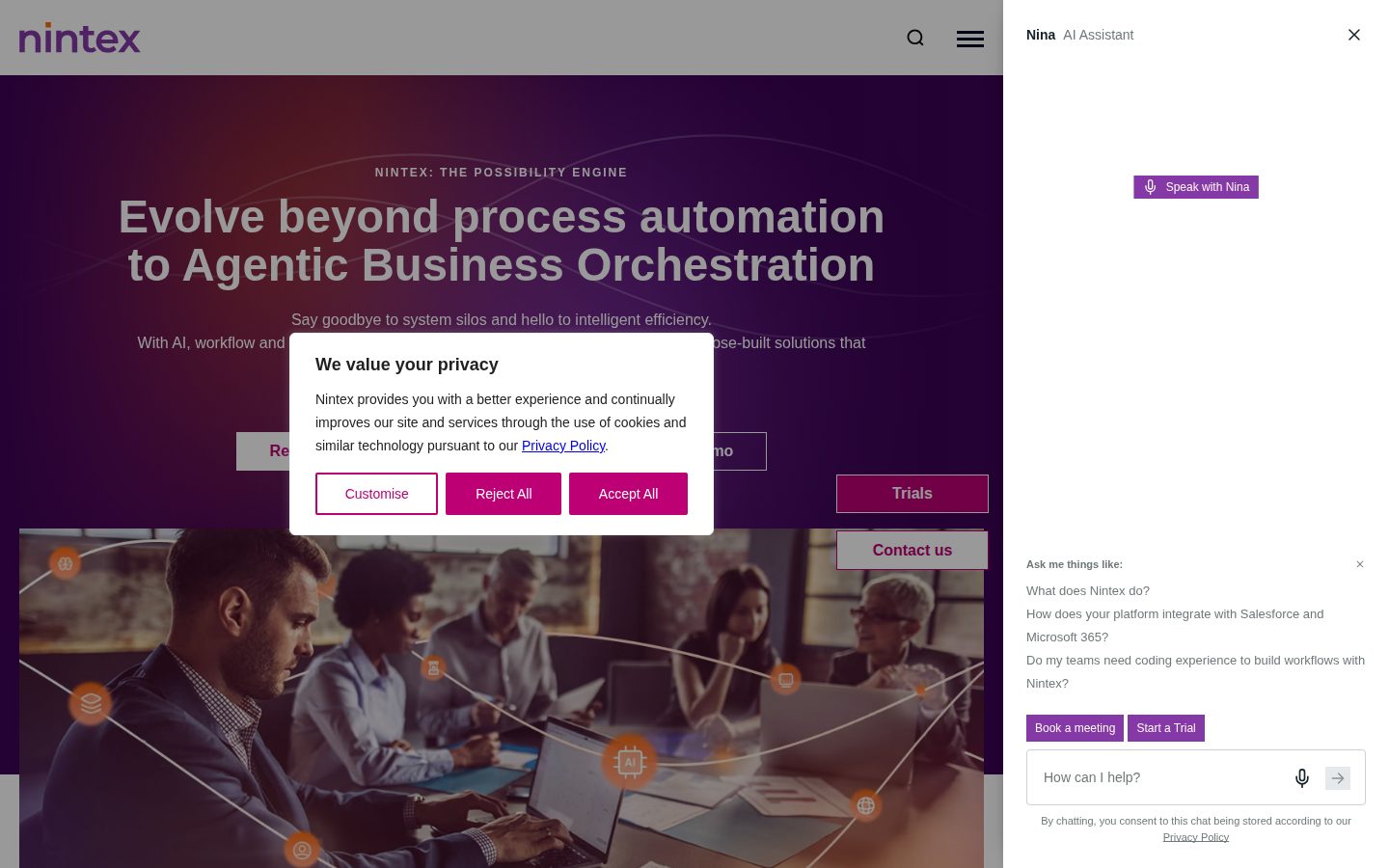
Features

AI

  • Agentic AI agents

    Governed AI agents reason, route, and adapt work in real time within orchestrated business processes.

  • Document intelligence

    Automates the extraction, translation, summarization, and sentiment analysis of inbound documents and content.

Automation

  • Document generation (DocGen)

    Generates documents such as contracts and quotes automatically from workflow data.

  • Robotic process automation (Nintex RPA)

    Extends workflows with software bots that automate repetitive tasks across cloud and on-premises systems.

Core

  • Digital forms

    Builds digital forms that capture structured data and trigger automated workflows.

  • Low-code application development

    Builds and deploys custom business applications on a low-code platform without traditional development cycles.

  • Native e-signature (Nintex eSign)

    Collects electronic signatures inside the same workflow that generates the documents.

  • On-premises deployment (Nintex Automation K2)

    Runs workflow automation and app development fully on-premises via Nintex Automation K2 with built-in AI capabilities.

  • Process management (Nintex Process Manager)

    Discovers, maps, and documents existing business processes with real-time tracking to reduce compliance risk.

  • Workflow automation designer

    Design, deploy, and manage workflows that connect people, systems, and data across cloud and on-premises applications.

Integration

  • Prebuilt enterprise connectors

    Connects to Microsoft 365, SharePoint, Dynamics 365, Salesforce, SQL databases, and web services out of the box.

Security

  • SSO via SAML 2.0

    Supports single sign-on through Azure AD, Okta, and other SAML 2.0 identity providers, with SOC 2 Type 2 and SOC 3 reports.

Preview

Nintex desktop previewNintex mobile preview

Pricing Plans

Essentials

$15,000/yearly

Entry tier of Nintex Automation CE; the published "as low as $15,000 per year" starting price. Tier-specific inclusions are not published.

Pro

Contact sales

Mid tier of Nintex Automation CE; Nintex does not publish this tier's price — contact sales for a quote.

Expert

Contact sales

Top tier of Nintex Automation CE; Nintex does not publish this tier's price — contact sales for a quote.

AI Panel Reviews

The Decision Maker

The Decision Maker

Strategic bet, vendor viability, timing, adoption approval
8.3/10

Twenty-year workflow veteran repositions around governed AI agents — durable bet, but demand pricing clarity upfront.

Nintex wraps forms, document generation, e-signature, RPA, and governed AI agents into one platform it now calls Agentic Business Orchestration, starting at $15,000 a year. TPG's 2021 majority buyout at a reported $2 billion-plus says the vendor will outlast your contract.

Nintex's homepage no longer sells workflow automation. It sells Agentic Business Orchestration — governed AI agents rerouting work inside audit trails and permissions. Renames like that usually mean drift; this one sits on twenty years of shipped product.

The fundamentals hold. TPG bought majority control from Thoma Bravo in 2021 at a reported $2 billion-plus, and the platform bundles DocGen, e-signature, and RPA that competitors sell separately. Automation CE starts at $15,000 a year on the Essentials tier.

Appian tells a similar governed-automation story with a public balance sheet you can actually read. The yellow flag with Nintex is pricing opacity — Pro and Expert tiers are quote-only, which makes renewal math a guess until procurement calls. Pilot one process — onboarding or quote-to-cash — for 90 days and get the three-year price curve in writing first.

Competitive Positioning7.8

Matches Appian on breadth and governance, though Appian's public financials are easier to diligence.

Reputation Risk8.5

SOC 2 Type 2 and SOC 3 reports plus two decades in enterprise accounts make this an easy board defense.

Speed to Value7.6

Low-code designer and prebuilt Microsoft 365 and Salesforce connectors help, but quote-only upper tiers slow procurement.

Strategic Fit8.2

Governed agentic orchestration advances automation strategy instead of just trimming cost on existing workflows.

Vendor Viability8.8

Founded 2006, majority-owned by TPG since a reported $2 billion-plus 2021 deal, with 10,000-plus customers.

Pros

  • Founded 2006 with 10,000-plus customers reported at the 2021 TPG buyout — vendor viability is settled.
  • Bundles DocGen, native eSign, and RPA that rivals sell as separate products.
  • Agentic AI agents run inside audit trails and permissions rather than alongside them.
  • SOC 2 Type 2 and SOC 3 reports with SAML 2.0 SSO clear security review fast.
  • Nintex Automation K2 keeps fully on-premises deployment on the table for regulated industries.

Cons

  • Pro and Expert tiers are quote-only, making renewal economics hard to model before procurement engages.
  • The $15,000 entry price shuts out smaller teams that lighter workflow tools serve for far less.
  • No free plan — only a trial — so hands-on evaluation is shallow before a sales cycle starts.

Right for

Enterprise operations teams who want governed end-to-end process automation from a single vendor.

Avoid if

Small teams who need lightweight workflow automation under $15,000 a year.

The Domain Strategist

The Domain Strategist

Craft and strategy in the product's domain — adapts identity per category, same lens
8.1/10

Nintex Automation K2 keeps workflow and AI behind the firewall, a bet cloud-first rivals stopped making.

Nintex pairs cloud automation in Nintex Automation CE with a maintained on-premises edition, Nintex Automation K2 5.9.1, local AI included. The two-engine estate is the tradeoff a three-year owner has to plan around.

The on-premises edition isn't a legacy concession here. Nintex Automation K2, now at 5.9.1, ships its own local AI — the K2 Intelligence Engine runs behind the firewall with no cloud dependency. That's a posture most of the category abandoned, and regulated buyers know it.

The rest reads like a governed estate: SOC 2 Type 2 reports, SAML SSO via Azure AD or Okta, forms through RPA in one audit trail. Cloud work runs on Nintex Automation CE from a published $15,000 a year — a real number in a category that defaults to 'call sales.'

Against Pega you trade case-management ceiling for speed to running processes — the right trade for most ops-led teams. The catch is that it's really two engines: K2 arrived with the 2020 acquisition, keeps its own release train, and 5.9.1 is a short-term-support build ending March 2027. A hybrid estate means budgeting two skill sets.

Category Positioning8.0

A durable survivor serving roughly half the Fortune 500 at the 2020 K2 close, per the acquisition announcement.

Domain Fit8.3

SOC 2 Type 2 reports, SAML SSO, and audit-trailed workflows match how regulated ops teams govern.

Integration Surface8.2

Prebuilt connectors for Microsoft 365, SharePoint, Dynamics 365, Salesforce, and SQL cover the enterprise core.

Long-term Implications7.6

Two engines from the 2020 K2 acquisition mean parallel release trains, and 5.9.1 support ends March 2027.

Strategic Depth8.0

Full-stack automation plus a locally hosted K2 Intelligence Engine shows craft beyond checkbox AI.

Pros

  • Nintex Automation K2 5.9.1 delivers fully on-premises automation with a local AI engine and no cloud dependency.
  • Published $15,000-per-year Essentials entry price is rare transparency in enterprise process automation.
  • SOC 2 Type 2 reports, SAML 2.0 SSO, and audit-trailed workflows fit regulated procurement.
  • One platform spans forms, document generation, e-signature, RPA, and agentic AI.

Cons

  • Cloud and on-premises run on separate engines with separate release trains, doubling platform skills for hybrid estates.
  • K2 5.9.1 is a short-term-support release with support ending March 2027.
  • Pro and Expert tiers are quote-only, so real costs surface in the sales cycle.

Right for

Regulated enterprises who need governed workflow automation across cloud and on-premises systems.

Avoid if

Small teams who cannot justify a $15,000-per-year entry price.

The Finance Lead

The Finance Lead

Money, total cost of ownership, contracts, procurement math
7.5/10

Nintex publishes a $15,000 floor and nothing above it, so year-3 TCO needs a sales call

Nintex Automation CE starts at $15,000 a year on Essentials, with Pro and Expert priced only through sales. The bundle is broad, but the quote-only tiers make multi-year cost modeling guesswork.

Nintex publishes a floor, not a price list. Nintex Automation CE Essentials starts at $15,000 a year. Pro and Expert are quote-only. No per-user rate, no tier inclusions, no free plan — a trial is the only free look.

Microsoft Power Automate Premium runs $15 per user monthly. Fifty users × $15 × 12 = $9,000 a year — 40% under the Nintex floor. But Nintex bundles what Microsoft sells piecemeal: DocGen, eSign, RPA bots. Add category-norm implementation at 30% of license; year one lands near $20K.

The catch is year 3. Seat growth doesn't move an Essentials bill; an Essentials-to-Pro jump does, and you can't price that jump without a sales cycle. SOC 2 Type 2 reports are published, so security review won't stall. Get tier inclusions and the auto-renewal window in writing first.

Billing & Procurement7.5

Published SOC 2 Type 2 and SOC 3 reports shorten security review.

Contract Flexibility6.5

Annual subscription with no public auto-renewal or termination terms.

Pricing Transparency6.0

Only the $15,000 Essentials floor is published; Pro and Expert need a sales quote.

ROI Clarity7.5

Real-time process health tracking makes workflow value measurable.

Total Cost of Ownership7.5

Bundled DocGen, eSign, and RPA replace separate vendor line items.

Pros

  • One subscription covers forms, DocGen, eSign, and RPA — fewer vendor line items to negotiate.
  • A published $15,000 floor gives a budgeting anchor most enterprise automation vendors withhold.
  • SOC 2 Type 2 and SOC 3 reports plus SAML SSO cut procurement friction.
  • Nintex Automation K2 keeps regulated, on-premises deployments on the same vendor.

Cons

  • Pro and Expert tiers are quote-only, so multi-year costs can't be modeled before a sales cycle.
  • No free plan and a $15,000 entry price shut out small teams.
  • Tier inclusions aren't published, so Essentials-versus-Pro comparisons are impossible up front.

Right for

Operations teams at mid-size and large companies who want automation consolidated on one platform

Avoid if

Small teams who can't justify a $15,000 annual entry price

The Domain Practitioner

The Domain Practitioner

Daily hands-on reality in the product's domain — adapts identity per category, same lens
7.9/10

DocGen and Nintex eSign keep contracts and signatures in one flow, at a $15,000 entry ticket.

Nintex pairs DocGen document generation with native Nintex eSign so contracts go from form data to signature without leaving the workflow. The tradeoff is a $15,000-per-year Essentials floor that makes it a platform buy, not a point tool.

Most workflow platforms tap out at the contract step: generate the document, then hand it to DocuSign and babysit a webhook for the signed copy. Nintex keeps the chain in one designer. DocGen merges workflow data into contracts and quotes; Nintex eSign collects the signature in the same flow, same audit trail.

The eSign step isn't a shim — it's the AssureSign engine Nintex bought in 2021, folded in natively. Workflow data merges straight into document templates, no re-keying customer names, no polling a signature API for status. SharePoint, Salesforce, and Dynamics 365 connectors put the signed PDF where legal already looks.

The catch is the entry ticket: Automation CE starts at $15,000 a year on Essentials, with Pro and Expert quote-only — you're pricing a platform even if documents are all you need. Teams that just want signatures buy DocuSign for less; teams automating quote-to-cash stop stitching three tools together.

Day-3 Reality7.8

Forms, DocGen, and eSign live in one designer, so the daily contract chain never hops tools.

Documentation Practitioner-Fit7.4

Help docs exist and cover licensing detail, but the site leans marketing-heavy with no public API reference surfaced.

Friction Surface7.6

Native eSign removes the signature-tool round-trip, though quote-only Pro and Expert tiers add procurement friction.

Power-User Depth8.0

Document intelligence, RPA bots, and governed AI agents give builders headroom well past forms and approvals.

Workflow Integration8.3

Prebuilt Microsoft 365, SharePoint, Dynamics 365, and Salesforce connectors plus dedicated Salesforce editions fit existing stacks.

Pros

  • DocGen and Nintex eSign generate and sign documents inside one governed workflow.
  • Connectors for Microsoft 365, SharePoint, Dynamics 365, Salesforce, and SQL ship out of the box.
  • Nintex Automation K2 gives regulated teams a fully on-premises deployment path.
  • SOC 2 Type 2 reports and SAML 2.0 SSO with Azure AD and Okta ease security review.

Cons

  • Essentials starts at $15,000 per year with no free plan.
  • Pro and Expert pricing is quote-only, so budgeting requires a sales cycle.
  • The site publishes docs but no public API reference, a gap for integration-heavy builds.

Right for

Operations teams who automate document-heavy processes end to end.

Avoid if

Small teams who only need standalone e-signature.

The Power User

The Power User

Daily human experience, onboarding, polish, learning curve, reliability
7.8/10

Nintex RPA gives your no-API legacy systems a robot, but the real pricing hides behind sales

Nintex bundles workflow design, forms, DocGen, eSign, and Nintex RPA into one governed automation platform for cloud and on-prem systems. Automation CE starts at $15,000 a year on Essentials, with Pro and Expert quoted by sales.

Somewhere in your building there's a system with no API that one person keeps alive with muscle memory. Nintex RPA is aimed at that desk — bots clicking through legacy screens while the workflow designer wires forms, approvals, and system actions across cloud and on-prem.

The RPA muscle came from the Kryon acquisition in February 2022, and the whole thing runs inside governed flows next to DocGen and eSign. Entry is $15,000 a year for Automation CE Essentials. Enterprise money. UiPath builds deeper bots; Nintex sells you the bot and the process around it in one place.

The designer wins you over fast, but the price sheet doesn't. Pro and Expert are sales quotes, and third-party contract reviews say bot licensing rides on top of the base. You'll know the wiring is worth it long before you know what it costs.

Daily Polish7.7

One designer covers forms, approvals, and bots, and Automation CE surfaces process health in real time without code.

Learning Curve7.6

Low-code assembly starts friendly, and the breadth across RPA, DocGen, and forms gives month three room to grow into.

Mobile Parity7.0

The evidence lists web as the only platform, so phone-side approvals look like a browser job.

Onboarding Experience7.2

A free trial exists, but a $15,000 entry price and sales-quoted tiers make week one feel like procurement, not play.

Reliability Feel8.2

SOC 2 Type 2 and SOC 3 reports plus audit trails on every governed flow point to a platform built for scrutiny.

Pros

  • Nintex RPA bots reach no-API legacy systems inside the same governed workflows as forms and approvals.
  • Bundles document generation, native e-signature, and digital forms that usually require separate vendors.
  • Cloud-first via Automation CE with a real on-premises path through Nintex Automation K2 5.9.1.
  • SAML 2.0 SSO with Azure AD and Okta plus SOC 2 Type 2 reports cover enterprise security checklists.

Cons

  • Pro and Expert tier prices are hidden behind sales quotes.
  • The $15,000-per-year entry shuts out small teams.
  • Platform evidence lists web only, so mobile parity is unproven.
  • Third-party contract reviews report bot and premium connector licensing stacking on top of the base subscription.

Right for

Mid-size operations teams who need one governed platform for workflows across cloud and legacy systems.

Avoid if

Small teams who cannot justify a $15,000-per-year entry price for workflow automation.

The Skeptic

The Skeptic

Contrarian. Watch-outs, deal-breakers, broken promises, category patterns
7.3/10

Twenty years of survival, $15,000 to start, and every price above that is a sales call.

Nintex is a durable, acquisition-assembled automation platform with genuine process-mapping depth in Nintex Process Manager. The catch is opacity — $15,000 buys Essentials, and every tier above that is a sales quote under private-equity ownership.

One published price. $15,000 a year for the Essentials tier — then Pro and Expert go quote-only. Based on their pricing page, you can't model year-two costs without a sales call. Opaque tiers plus private-equity owners usually mean the renewal quote drifts up.

The bones are real. Nintex Process Manager — the 2018 Promapp acquisition — handles process discovery and mapping better than most workflow vendors bother to. Forms, documents, signatures, bots, one governed platform. But that breadth was bought, not built, and assembled platforms carry seams.

Ownership is my watch item. Founded 2006; TPG took majority control in 2021 at a reported $2 billion-plus valuation. PE-to-PE handoffs either fund roadmaps or strip costs — could go either way. ServiceNow will absorb this workload if direction wobbles. Process maps export clean; two decades of proprietary workflows won't.

Competitive Differentiation7.0

Process mapping plus execution in one governed platform is a real gap, though ServiceNow presses from above.

Exit Portability6.2

Process maps export cleanly, but years of proprietary workflows, forms, and bots are rebuild work.

Long-term Viability7.8

A reported $2 billion-plus TPG deal in 2021 and ongoing releases signal a plausible 3-year bet.

Marketing Honesty7.0

The homepage 'leader' claim is standard enterprise puffery, but the feature list matches what actually ships.

Track Record Match8.0

Founded 2006 and still releasing — this is the survivor pattern, not the graveyard one.

Pros

  • Nintex Process Manager delivers real process discovery and mapping, not just workflow execution.
  • Twenty years of survival since 2006, with SOC 2 Type 2 reports and SAML SSO.
  • One contract covers forms, document generation, e-signature, and RPA bots.
  • On-premises deployment stays available for regulated industries.

Cons

  • Pro and Expert tiers are quote-only, so total cost is invisible until sales calls back.
  • Platform breadth was assembled through acquisitions, which risks uneven seams between modules.
  • Private-equity ownership adds renewal-pricing and roadmap-priority risk.

Right for

Enterprise operations teams who need governed end-to-end process automation.

Avoid if

Budget-conscious teams who cannot commit to a $15,000 annual entry price.

Buyer Questions

Common questions answered by our AI research team

Pricing

How much does Nintex cost?

Nintex Automation CE starts at $15,000 per year for the Essentials tier, with Pro and Expert tiers priced through sales. A free trial is available, and the on-premises Nintex Automation K2 edition is also quote-based.

Features

Does Nintex include RPA?

Yes. Nintex RPA is part of the platform and extends automation across cloud and on-premises systems, so bots handle repetitive tasks inside the same governed workflows used for forms, documents, and approvals.

Integration

Does Nintex integrate with Microsoft 365 and Salesforce?

Yes. Nintex connects to Microsoft 365, SharePoint, Dynamics 365, Salesforce, SQL databases, and web services, and ships dedicated ecosystem editions, including Nintex Apps and DocGen for Salesforce.

Setup

Can Nintex run on-premises?

Yes. Nintex Automation K2 (version 5.9.1) is the on-premises edition, covering workflow automation and low-code application development with built-in on-premises AI capabilities, while Nintex Automation CE covers the cloud.

Security

Is Nintex SOC 2 compliant?

Yes. Nintex provides SOC 2 Type 2 and SOC 3 reports and supports GDPR compliance. Single sign-on is available through SAML 2.0 providers, including Azure AD and Okta, and workflows carry governance and audit trails.

Also in AI Workflow Automation