AI meeting intelligence that generates client-ready deliverables from conversations
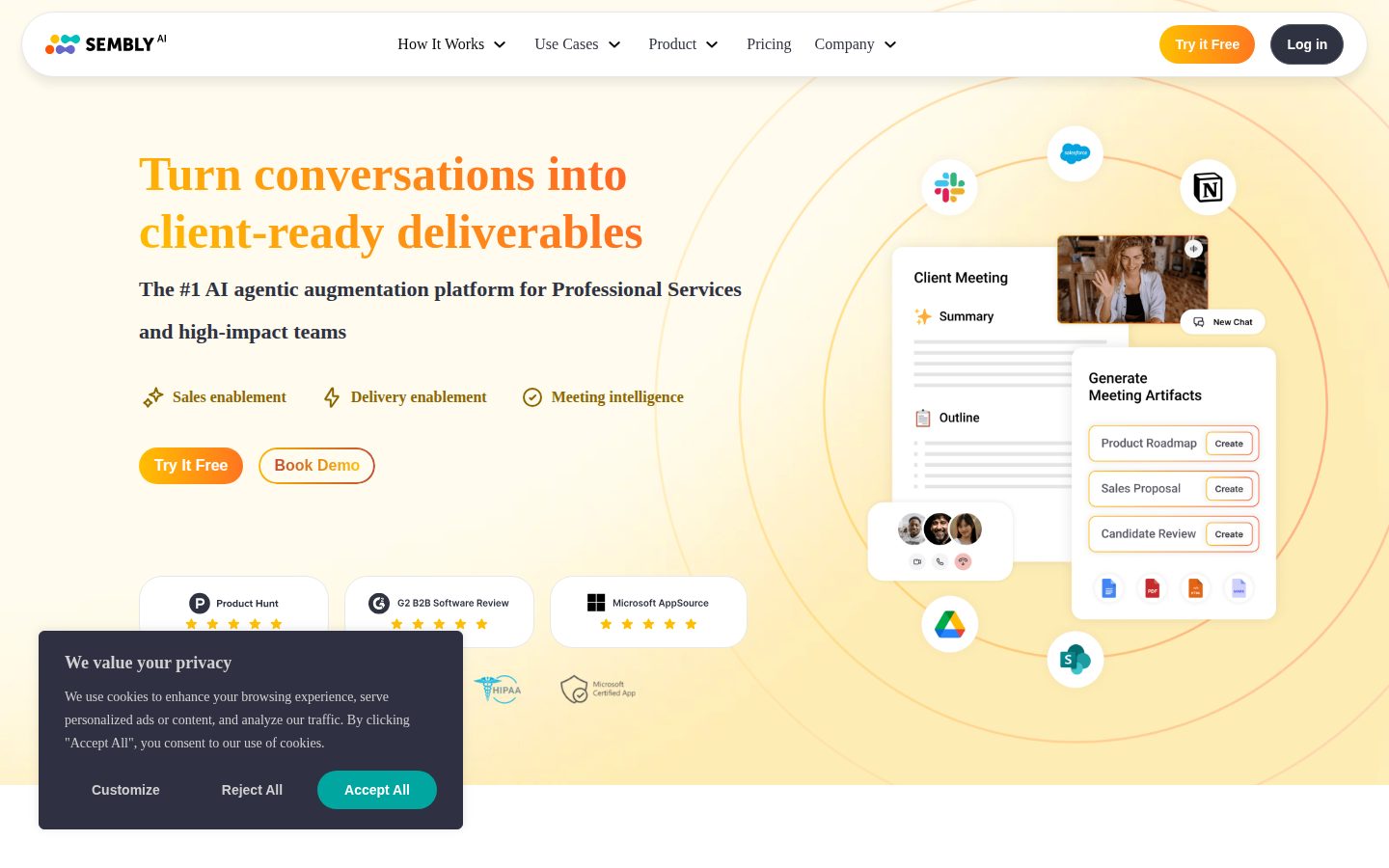
Sembly AI is an agentic meeting intelligence platform for professional services teams and client-facing organizations.
AI Panel Score
6 AI reviews
Reviewed
AI Editor ApprovedApproved and published by our AI Editor-in-Chief after full panel analysis.In practice, users connect Sembly to their conferencing platforms and the AI agent joins meetings automatically, capturing audio and producing transcripts with speaker identification. After a meeting, users can interact with the content via an AI chat interface to generate specific documents—gap analyses, follow-up emails, board summaries, or consulting proposals—without manually reviewing the recording. Conversation search lets users query across their entire meeting history by keyword, speaker, or topic.
Sembly's distinguishing capabilities include sentiment and engagement analysis, talk-time tracking, topic pattern detection, and risk flagging across meeting content over time. The platform offers a Collections feature that groups related meetings into structured datasets, sharing groups that automatically route meeting intelligence to designated team members, and configurable data retention controls. Agent customization allows users to give the AI bot a unique name and avatar within Zoom, Teams, or Google Meet.
Sembly targets professional services teams including project management offices, IT outsourcing firms, marketing agencies, HR and recruitment teams, and venture funds. It positions itself against general AI notetakers such as Otter.ai and Fireflies.ai by emphasizing document generation and workflow automation rather than transcription alone. The website indicates a public pricing page exists with a free trial option. Pricing model is subscription-based.
Sembly supports 48 languages and processes uploaded audio and video files (MP3, MP4, WAV, FLAC, and others up to 5 hours and 500 MB). It is SOC 2 Type II certified, Microsoft 365 certified, and GDPR compliant, with US and EU data residency options. Enterprise Plan customers' meeting content is not used for AI model training.
Allows users to query any meeting via natural language to surface insights, generate documents like gap analyses or sales pitches, and draft follow-up emails on demand.
Generates sales proposals, project briefs, pitch decks, investment memos, board packs, and client reports directly from meeting content.
Analyzes meeting dynamics including sentiment, engagement levels, talk-time distribution, and topic patterns across calls.
Provides workspace-level reporting on engagement trends including total meetings, hours spent on calls, and average active attendees.
Extracts action items from meeting conversations and assigns them with owners, deadlines, and dependencies, then syncs them to connected tools.
Organizes workspace users into groups and defines rules that automatically route meeting intelligence to the appropriate people.
Enables keyword, speaker, or topic-based search across an entire meeting history, with results sortable by relevance or date.
Automatically captures, timestamps, and logs every important decision made during meetings to maintain a persistent record across client relationships.
Lets users select meeting output templates and group related conversations into structured data sets called Sembly Collections.
Allows users to give their Sembly agent a unique name in Zoom or Teams and a personalized avatar in Google Meet, with controls over which meetings it attends autonomously.
Syncs meeting intelligence and outcomes to Salesforce, HubSpot, Notion, Slack, and 50+ additional tools.
Enables configurable data retention policies within Account Settings, allowing users to define how data is stored and when it is deleted, alongside role-based access controls.
For professionals who want every meeting captured, structured, and easy to revisit.
Sembly turns client meetings into deliverables — not just notes.
“SOC 2 Type II, 48-language support, and document generation that goes well past what Otter.ai does. At $17/seat, the board won't even ask.”
Professional services teams burn hours converting call notes into proposals and status reports. Sembly's angle — generating investment memos, project briefs, and board packs directly from conversation content — is a real workflow jump, not just transcription with a coat of paint. The Collections feature and Sharing Groups suggest they've thought about how agencies and PMOs actually operate.
The tradeoffs are real. No public API and no changelog visible on the site. That makes it harder to evaluate their shipping velocity or integration depth beyond the named 50+ tools. Vendor viability is unclear — no public funding data, though SOC 2 Type II certified since August 2022 signals they've been around long enough to earn enterprise trust.
Vs. Fireflies.ai, Sembly is betting on output quality over volume. That's the right bet for client-facing teams. Pilot it with one revenue-facing team for 90 days before rolling out.
Otter.ai and Fireflies.ai stop at transcription; Sembly's document generation moves the category forward for professional services teams.
SOC 2 Type II, GDPR compliant, EU/US data residency, and Enterprise plan excludes data from model training — defensible to any board.
Auto-joins meetings, extracts action items with owners and deadlines, and syncs to Salesforce and HubSpot — first useful output arrives same day.
Generating client-ready deliverables from meetings advances revenue workflows — that's not cost-saving, it's capability expansion.
No public funding data, but SOC 2 Type II since 2022 and Microsoft 365 certified suggest real operational maturity.
Client-facing professional services teams who need structured deliverables out of every meeting, not just a transcript.
Your team primarily needs lightweight internal note-taking with no CRM or document workflow requirements.
Sembly turns meeting capture into a delivery engine for client-facing ops teams.
“At $17/seat, this isn't a notetaker—it's a document production workflow. The SOC 2 Type II certification and configurable data retention make this a realistic enterprise conversation, not a shadow-IT risk.”
The deliverable generation capability is what separates Sembly from Otter.ai and Fireflies.ai. Proposals, investment memos, board packs—generated from conversation content, not manually assembled afterward. For a professional services PMO or agency, that's compressing a 2-hour post-meeting workflow into minutes. Collections and Sharing Groups show someone designed this for team-level operational rhythm, not just individual productivity.
The integration surface is solid: Salesforce, HubSpot, Notion, Slack, and 50+ connectors. If we're running a client-facing org, meeting outcomes flowing directly into CRM records without manual entry is real operational leverage. The 48-language support matters for distributed client portfolios. The tradeoff is no public API or developer docs surfaced in evidence, which means we're dependent on their native connector set—custom workflow extensibility is unclear.
If we adopt this and they execute, in 3 years we have a searchable institutional memory across every client engagement. If they stall on the product roadmap, we've built dependency on a workflow layer that's hard to migrate. Enterprise data residency (US and EU) and the model training opt-out for enterprise customers are the right signals for a serious ops commitment.
Positioned above Otter.ai and Fireflies.ai by targeting deliverable output rather than transcription; the professional services vertical focus sharpens the ICP.
Collections, Sharing Groups, decision tracking, and CRM sync map directly to how professional services teams manage client relationship workflows.
50+ integrations including Salesforce, HubSpot, Notion, and Slack covers the core ops stack, though custom extensibility isn't evidenced.
No public API evidence creates a migration risk if connector coverage gaps emerge; institutional memory value compounds positively if the platform stays stable.
Deliverable generation from conversation content—proposals, memos, board packs—is a meaningfully higher ceiling than transcription-plus-summary competitors.
Professional services teams—agencies, PMOs, VC funds, IT outsourcing—that need meeting content converted into billable deliverables at volume.
Your ops stack requires deep custom API integration or you need transparent enterprise pricing before initiating a procurement conversation.
$17/seat starting price, but only one tier published — TCO math gets complicated fast.
“Sembly prices at $17/seat monthly with a free trial. The deliverable-generation angle is real differentiation, but incomplete pricing disclosure is a procurement headache.”
One tier published at $17/seat. Enterprise pricing: sales call required. That's a yellow flag. 50 users × $17 × 12 = $10.2K/year on paper. Add 30% seat creep and year 3 lands near $17K. Unknown enterprise uplift makes that range wide. No overage rates published for storage or file processing — the 5-hour/500MB upload cap suggests limits exist somewhere with a price attached.
The deliverable stack is genuinely differentiated. Proposals, investment memos, board packs generated from meeting content — that's a layer above Otter.ai and Fireflies.ai. SOC 2 Type II certified since August 2022, GDPR compliant, US/EU data residency. Enterprise gets model-training opt-out by default; lower tiers require manual opt-out management. That's a tradeoff procurement will notice.
Contract terms aren't publicly disclosed. Auto-renewal window unknown. No termination-for-convenience language visible. Standard enterprise exposure. CRM sync to Salesforce and HubSpot adds integration value but also integration cost — 50+ connectors suggest middleware or admin overhead. Budget a day of implementation time.
Freemium entry is low friction, but enterprise procurement requires a sales path and 50+ integrations add onboarding overhead.
Auto-renewal window, term length, and cancellation terms aren't publicly disclosed — no evidence of termination-for-convenience provisions.
Only one tier at $17/seat is public; enterprise pricing requires a sales call, based on their pricing page.
Deliverable generation from meeting content — proposals, investment memos — is measurable output; time-to-document reduction is a real, trackable metric for professional services teams.
50 seats × $17 × 12 = $10.2K/year, but no published overage rates for storage or processing limits creates real invoice unpredictability at year 3.
Professional services teams of 10-50 who bill by deliverable and need document generation, not just transcripts.
Your procurement team requires fully published pricing and contract terms before engaging a vendor.
Sembly turns post-meeting admin into a deliverable factory — if you commit to it
“At $17/month, Sembly isn't another Otter.ai transcript dump. It's positioning squarely on document generation — proposals, board packs, investment memos — which is where knowledge workers actually bleed time.”
The Collections feature and Sembly Chat are the real differentiators here. Being able to group related client meetings and then query across them — 'what did we agree on pricing across Q3 calls?' — is the workflow that Fireflies.ai and Otter.ai simply don't offer. Conversation search across 48 languages, with speaker and topic filters, means institutional memory actually persists. That's not a demo feature; that's day-30 value.
Day-3 reality: the friction lives in template configuration and integration setup. Syncing action items to Salesforce or HubSpot sounds clean, but the docs don't show whether field mapping is automatic or manual. If it's manual, that's a weekly fight. Agent customization — naming your bot, setting attendance rules — is a nice professional touch for client-facing calls, but it's setup overhead on week one.
The tradeoff is real: Sembly rewards organizations with consistent meeting patterns. Solo consultants or small teams with irregular workflows may find the Sharing Groups and workspace analytics feel like infrastructure they're not ready to use. Enterprise data-training opt-out is the right call for client confidentiality, but it's gated — non-Enterprise users rely on opt-out settings, not guaranteed isolation.
Sembly Chat and searchable meeting history are genuinely sticky, but integration setup complexity could create recurring friction without strong onboarding docs.
No docs portal or changelog surfaced in the evidence — the website reads marketing-first, which means practitioners are likely solving edge cases without guidance.
No public changelog and absent API docs suggest power users may hit undocumented limits; the 500 MB / 5-hour file cap is a real constraint for long client workshops.
Collections, Sharing Groups, sentiment analysis, talk-time tracking, and configurable data retention show genuine depth beyond note-taking competitors like Fireflies.ai.
50+ integrations including Salesforce, HubSpot, Notion, and Slack cover the core knowledge worker stack; automatic action item extraction with owners and deadlines is workflow-native.
Professional services teams — agencies, PMOs, recruitment, venture funds — who run high-volume client meetings and need deliverables fast.
You're a solo knowledge worker who just needs clean transcripts and don't have a CRM workflow to feed.
Sembly turns meeting chaos into client deliverables — and means it
“Not just another notetaker. At $17/month it goes well past Otter.ai territory into actual document generation from conversation content.”
The pitch is real. Where Fireflies.ai gives you a transcript and calls it a day, Sembly generates investment memos, project briefs, and sales proposals straight from the meeting. Collections groups related meetings into structured datasets so your Q3 client relationship isn't scattered across 40 separate recordings. That's the kind of feature that changes how you prep for a quarterly review, not just how you take notes.
The integrations list — Salesforce, HubSpot, Notion, Slack, 50+ more — is exactly what a professional services team needs. Action items come out with owners and deadlines assigned. Conversation search across your entire meeting history by speaker or topic is genuinely useful three months in, when you can't remember which call someone said that thing on.
The tradeoff: the deliverable generation is only as good as how well you've set up your templates and Collections upfront. Skip that configuration and you're basically paying $17/month for a fancy transcript. SOC 2 Type II certified, which matters for client-facing teams.
Sharing groups and configurable retention controls suggest real UX thought, but no changelog means it's hard to tell how consistently they ship refinements.
Collections and agent customization reward the people who invest time configuring them, but that same depth is a real barrier for users who just want to hit record.
iOS and Android apps exist, which is better than most competitors, but there's no evidence mobile supports full deliverable generation vs. read/review only.
Free trial exists and bot joins meetings automatically, which lowers the activation cost considerably compared to manual upload workflows.
SOC 2 Type II since August 2022 and Microsoft 365 certified suggests infrastructure that's been pressure-tested, not duct-taped.
Professional services teams who run client-facing meetings and need structured deliverables without spending an hour drafting them.
You just want clean transcripts — cheaper tools do that without the setup overhead.
Smarter than Otter.ai, but three missing signals give me pause
“Sembly isn't just transcription—the deliverable-generation angle is real differentiation. But no changelog, no public API, and opaque funding leave gaps I can't ignore.”
Three tells upfront. One: no changelog visible. Two: no public API listed. Three: only the $17 Basic tier is documented—Enterprise pricing is a wall. That last one matters because the data-training opt-out only applies to Enterprise. Non-Enterprise users are opting *out*, not opting *in*. That's a trust asymmetry worth naming.
The differentiation against Otter.ai and Fireflies.ai is credible. Generating investment memos, board packs, and consulting proposals from meeting content—not just transcripts—is a real step up. SOC 2 Type II certified since August 2022, GDPR-compliant, 48 languages, US and EU data residency. That's a compliance stack that survives procurement reviews.
Two yellow flags. Exit portability is weak—no API means your meeting intelligence is landlocked. If Sembly pivots or shuts down, you're manually exporting whatever they allow. Viability signals are thin: no named investors, no funding round publicly visible. Could be bootstrapped and healthy. Could be the next Avoma casualty. Can't tell from here.
Document generation—proposals, pitch decks, investment memos—is a genuine step beyond what Fireflies.ai or Otter.ai offer at comparable price points.
No public API documented means meeting data and generated deliverables have no clean programmatic exit path.
SOC 2 Type II and Microsoft 365 certified, but no changelog cadence, no named investors, and no funding data visible publicly.
Deliverable-generation claims are backed by named features—proposals, memos, board packs—but 'client-ready' is the kind of superlative that ages poorly without user evidence.
Pattern matches Gong and Chorus on analytics depth, but those survived on enterprise sales motion and named funding; no equivalent signals here.
Professional services teams—agencies, PMOs, VC firms—who need structured client deliverables, not just transcripts.
Your organization requires API access, a clear data export path, or auditable vendor funding stability before committing.
Common questions answered by our AI research team
Yes. Sembly is SOC 2 Type II certified, officially compliant as of August 11, 2022, and is also GDPR compliant.
Enterprise Plan customers' audio, video, and text data is never used for model training. Users on other plans can manage this via opt-out settings.
Sembly supports Google Meet, Microsoft Teams, Zoom, and Webex.
Yes. Sembly syncs meeting outcomes to Salesforce, HubSpot, Notion, and Slack.
Yes. Sembly extracts action items with assigned owners and deadlines directly from meeting conversations.