Seventh Sense logo

Seventh Sense Review

Visit

Send emails at the exact moment each subscriber is most likely to engage

Seventh Sense is an AI-powered email send-time optimization tool for HubSpot and Marketo users.

AI Panel Score

7.7/10

6 AI reviews

Reviewed

What is Seventh Sense?

Seventh Sense is an AI-powered email send-time optimization tool for HubSpot and Marketo users. It analyzes individual subscriber behavior to determine the optimal day and time to deliver marketing email to each contact, using machine learning to keep refining predictions as engagement data accumulates. Marketing teams can improve open and click rates without changing existing workflows because the tool sits inside HubSpot's native campaign interface. Pricing starts at $64 per month, and a free trial is available. Key capabilities include personalized send-time optimization, contact engagement management, email performance analytics, and audience and domain health management. TopReviewed's six-seat AI review panel scored it 7.7/10, praising the five-minute HubSpot setup with first predictions inside 24 hours while noting connectors remain limited to HubSpot and Marketo, with no Mailchimp, Klaviyo, or Braze support. It best fits B2B lifecycle marketers who already run HubSpot or Marketo at scale.

About Seventh Sense

Seventh Sense is an email deliverability and engagement optimization platform that focuses specifically on send-time personalization. Rather than blasting an entire list at the same time, the software learns when each individual contact is most likely to open and interact with email, then schedules delivery accordingly. This approach aims to reduce inbox competition and improve overall campaign performance metrics.

The platform is built to work within existing marketing automation ecosystems, with native integrations for HubSpot and Marketo. Marketers continue to create and manage their campaigns inside those platforms, while Seventh Sense handles the scheduling logic in the background. This makes adoption relatively straightforward for teams already invested in either of those tools.

Key capabilities include individual-level send-time optimization, email throttling and frequency management, engagement scoring, and reporting dashboards that surface insights about list health and contact activity patterns. The frequency management features also help marketers avoid over-sending to contacts who show signs of fatigue.

Seventh Sense is primarily aimed at B2B marketing teams and demand generation professionals who rely heavily on email as a channel. It is particularly relevant for organizations with large contact databases where send-time variability across segments can have a measurable impact on pipeline and revenue.

In the broader email marketing technology market, Seventh Sense occupies a niche position as a point solution layered on top of major marketing automation platforms rather than a standalone email service provider. Its value proposition is focused narrowly on improving email engagement through timing intelligence rather than offering end-to-end campaign management.

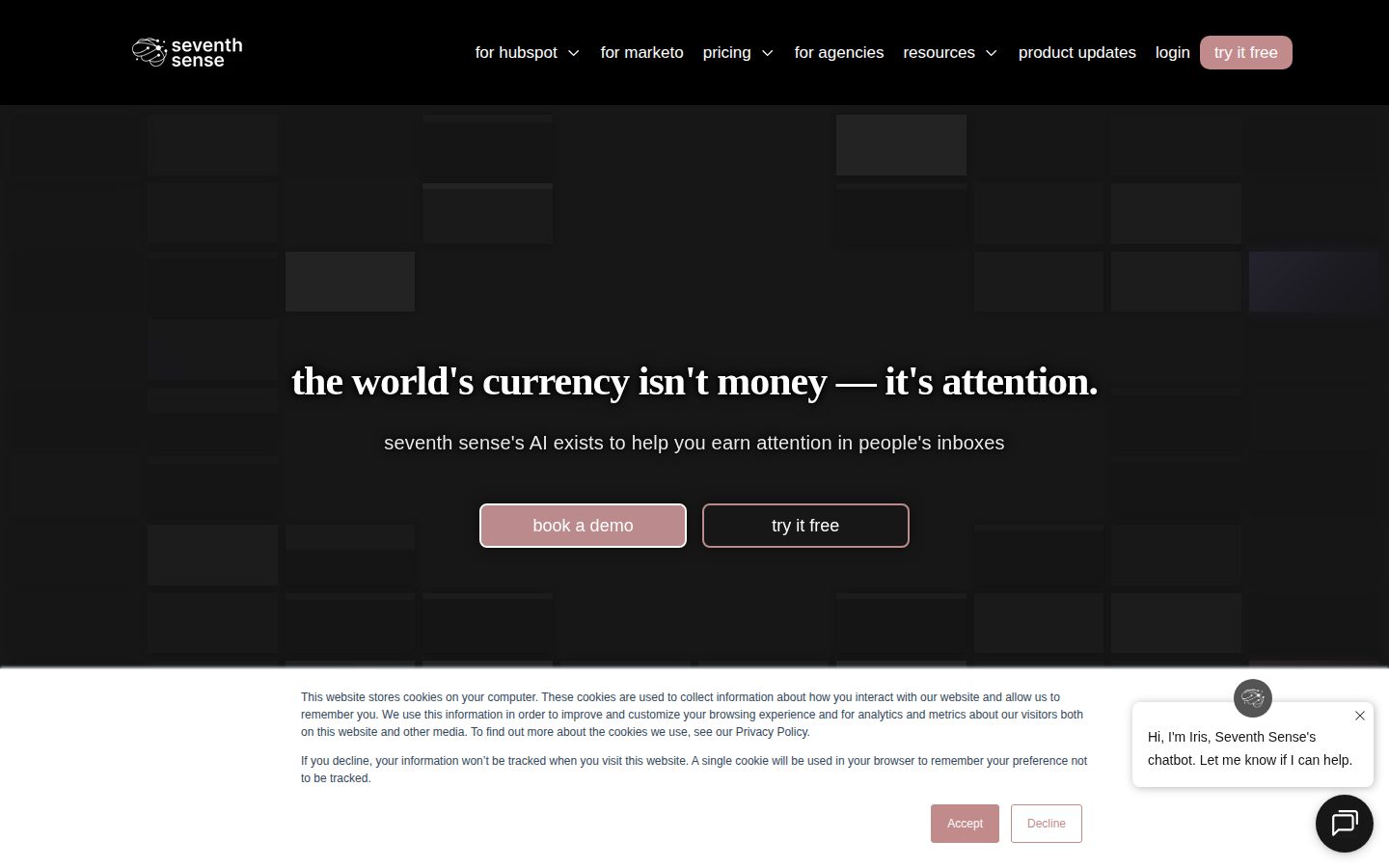
Features

AI

  • Machine Learning Engagement Predictions

    Uses AI trained since 2013 to continuously refine send-time predictions based on individual subscriber engagement data.

  • Personalized Send Time Optimization

    AI pinpoints and initiates email delivery at the time each individual recipient is most likely to engage, using their existing marketing automation system.

Analytics

  • Email Performance Analytics

    Provides built-for-you analytics that uncover hidden insights about email program performance that other platforms including CRMs do not surface.

  • ROI Email Calculator

    An interactive calculator that computes financial return from email marketing investments, total program costs, cost per contact, and revenue estimates compared against industry averages.

Automation

  • Contact Engagement Management

    Automatically manages less-engaged contacts by allowing users to set an engagement probability threshold and letting the AI handle suppression or re-engagement.

Core

  • Audience and Domain Health Management

    Monitors and manages audience engagement and domain health to support sustainable email deliverability and inbox placement.

  • Inbox Timing Optimization

    Ensures emails arrive at the top of the inbox when recipients are ready to engage, rather than at a uniform send time for all contacts.

Integration

  • HubSpot Integration

    Designed specifically for HubSpot, enabling send time optimization and engagement management within existing HubSpot workflows.

  • Marketo Integration

    Designed specifically for Marketo, enabling send time optimization and engagement management within existing Marketo workflows.

Preview

Seventh Sense desktop preview

Pricing Plans

Free Trial

Contact sales

Try Seventh Sense free before committing to a paid plan

  • AI-powered send time optimization
  • Contact engagement management
  • Email performance analytics
  • HubSpot and Marketo integration

AI Panel Reviews

The Decision Maker

The Decision Maker

Strategic bet, vendor viability, timing, adoption approval
7.7/10

Thirteen years on $356K of seed capital is the most defensible line on this vendor's page.

Seventh Sense is the 2013-founded send-time optimizer Mike Donnelly built specifically for HubSpot and Marketo email marketers. It has stayed bootstrapped and niche-focused rather than chasing a Series A, which is the signal a buyer should read first.

Who is this for? B2B demand-gen teams running HubSpot Pro or Marketo with lists big enough that send-time variance actually moves pipeline. Mike Donnelly has been shipping that exact product since 2013 on $356K of seed capital, and it still has paying customers.

Personalized Send Time Optimization is the engine, and the HubSpot plan starts at $80/month for 5,000 marketing contacts on annual billing. Mailchimp's Send Time Optimization ships free with the platform — Seventh Sense is what you buy when timing needs to be per-contact, not aggregate-best-hour.

But the ceiling is the ceiling. This is a point solution layered on someone else's automation stack, and if HubSpot ever ships native per-contact send-time the moat collapses to 13 years of training data. Pilot for 90 days if your contact list crosses 25,000; skip it under 5,000.

Competitive Positioning7.3

Point solution layered on platforms that could ship native send-time anytime.

Reputation Risk7.5

Established HubSpot and Marketo partner — defensible choice, no peer eyebrows raised.

Speed to Value8.2

Native integration means it slots into existing workflows without process change.

Strategic Fit7.4

Improves an existing channel rather than enabling a new motion — useful, not transformational.

Vendor Viability7.8

Thirteen years shipping on $356K of seed capital signals a profitable, founder-led niche business.

Pros

  • Thirteen-year bootstrapped survival on $356K signals real product-market fit, not pitch-deck vapor.
  • Native HubSpot and Marketo integration with dedicated API calls that don''t conflict with other connectors.
  • Personalized Send Time Optimization operates per-contact, not at the aggregate list level.
  • Free trial removes the pilot-budget conversation entirely.

Cons

  • Point solution exposed if HubSpot or Marketo ships native per-contact send-time as a platform feature.
  • Pricing starts at 5,000 marketing contacts — small lists don''t qualify for the entry tier.
  • Annual billing only, with no monthly escape hatch if the lift underperforms.

Right for

B2B demand-gen teams who run HubSpot or Marketo at scale.

Avoid if

Solo marketers who send to lists under 5,000 contacts.

The Domain Strategist

The Domain Strategist

Craft and strategy in the product's domain — adapts identity per category, same lens
7.6/10

Send-time optimization as a feature category is Seventh Sense's twelve-year moat — and the ceiling Marketo and HubSpot decide.

Mike Donnelly and Erik LaBianca bootstrapped Seventh Sense to $356K total funding since 2014, now scheduling over 400 million emails monthly across HubSpot and Marketo customers. The catch is platform tenancy — HubSpot's Smart Send Time and Salesforce Einstein Send Time Optimization compete from inside the suite, and a deeper native optimizer turns the moat into a thin layer.

Send-time optimization is a feature category, not a product category — the question senior marketing ops has to answer before adopting any point vendor here. Seventh Sense bootstrapped to $356K since 2014 and now schedules over 400 million emails monthly across HubSpot and Marketo. Mike Donnelly and Erik LaBianca built a durable business on customer revenue, not VC runway.

Personalized Send Time Optimization is the named primitive — individual-contact ML scheduling, not segment batch windows. Audience and Domain Health Management is the modern payoff: engagement scoring, frequency throttling, suppression of dead contacts that quietly tank deliverability. HubSpot Business runs $64/month annual on 5,000 contacts; Marketo Business runs $360/month annual on 50,000 leads.

However, the strategic ceiling is platform tenancy. HubSpot's own Smart Send Time and Salesforce Einstein Send Time Optimization compete from inside the suite — if HubSpot deepens its native optimizer, Seventh Sense becomes a thin layer over a free feature.

Category Positioning7.0

Point solution defending a feature surface against suite-native competitors like Smart Send Time and Einstein STO.

Domain Fit8.0

Native HubSpot and Marketo integration matches how MOps teams actually run campaigns — no workflow disruption.

Integration Surface8.2

Sits invisibly inside HubSpot and Marketo workflows, with engagement scoring and frequency throttling on top.

Long-term Implications6.8

Platform tenancy under HubSpot and Marketo creates strategic exposure if either deepens native send-time features.

Strategic Depth7.4

Narrow scope but deep on individual-contact ML scheduling since 2013, with twelve years of training data.

Pros

  • Native HubSpot and Marketo integration that does not disrupt existing campaign workflows.
  • Frequency throttling and engagement scoring address post-Apple MPP deliverability work, not just open-time guessing.
  • Bootstrapped twelve-year operating history on $356K total funding signals durable customer-revenue economics.
  • Honest point-solution pricing at $64/month annual for HubSpot Business on 5,000 contacts.

Cons

  • Strategic dependency on HubSpot and Marketo as host platforms creates platform tenancy risk over three years.
  • Suite-native send-time features from HubSpot and Salesforce Einstein compete on the same surface for free.
  • Open-rate signal degradation since Apple MPP in 2021 weakens the very optimization input the platform was built on.

Right for

Marketing operations leaders who run high-volume HubSpot or Marketo programs.

Avoid if

Solo creators who send under 5,000 emails monthly.

The Finance Lead

The Finance Lead

Money, total cost of ownership, contracts, procurement math
7.6/10

Annual-only billing, $960/year HubSpot floor, $5,400/year Marketo floor — same product, 5.6x sticker delta.

HubSpot tier opens at $960/year for 5,000 contacts; Marketo opens at $5,400/year for 50,000 leads. Annual billing is mandatory on both — no monthly option, no termination for convenience clause documented.

Annual-only billing is the contract shape here. HubSpot tier runs $960/year billed annually, starting at 5,000 contacts — $0.192 per contact per year. Marketo opens at $5,400/year for 50,000 leads. Same product, 5.6x sticker delta. No monthly option on either.

50-person marketing team on HubSpot Pro, 25,000 contacts: roughly $4,800/year prepaid. Add the 30% contact growth demand gen teams underestimate and year 3 lands near $7K. Engagement Probability Threshold is the suppression primitive that earns the line item.

Compare to HubSpot's native send time optimization at the Pro tier — free, baked in. But Seventh Sense schedules over 400 million emails monthly across customers since 2013. Founded by Mike Donnelly in Reston, Virginia. ~$356K total raised. Bootstrapped P&L, not VC runway.

Billing & Procurement7.8

Recurly handles credit card billing on standard tiers and ACH or invoice is available for enterprise — standard B2B SaaS procurement.

Contract Flexibility6.8

Annual billing is mandatory on both HubSpot and Marketo tiers with no monthly option, though cancellation before renewal is permitted.

Pricing Transparency8.3

HubSpot tier publishes $960/year with $0.192 per-contact rate; Marketo tier publishes $5,400/year — only Enterprise is contact-sales.

ROI Clarity7.0

Cited engagement lifts span 7% to over 100% with no segmentation of what drives the range.

Total Cost of Ownership7.6

Per-contact pricing is predictable and there is no SSO tax, but no published overage rate beyond the contracted tier.

Pros

  • HubSpot pricing is fully published with a per-contact rate of $0.192 per year, rare clarity for this category.
  • No SSO tax, no per-seat fees — pricing scales flat by contact volume in 5,000-contact increments.
  • ACH and invoice billing available for enterprise procurement; Recurly handles credit cards on standard tiers.
  • Bootstrapped since 2013 with roughly $356K total raised — no VC pressure forcing a fire-sale exit.

Cons

  • Annual billing is mandatory on both tiers — there is no monthly option even on the entry HubSpot plan.
  • Marketo tier carries a 5.6x premium over the HubSpot tier for the same underlying product.
  • No published overage rate beyond the contracted contact tier — invoice surprise risk if list grows mid-term.
  • Free trial exists but trial limits are not documented publicly.

Right for

Marketing teams on HubSpot Pro who can prepay a full year.

Avoid if

Small teams who need monthly billing or short commitments.

The Domain Practitioner

The Domain Practitioner

Daily hands-on reality in the product's domain — adapts identity per category, same lens
7.8/10

Send Time AI rewrites HubSpot's delivery queue, but the $80 floor locks you to two CRMs.

Seventh Sense schedules over 400 million emails monthly by predicting each contact's open window and slotting your existing HubSpot or Marketo send into that slot. There's no Mailchimp, no Klaviyo, no Braze — the practitioner value depends entirely on which automation platform your team already pays for.

Send Time AI mounts onto HubSpot's native send queue, so the daily campaign tab in HubSpot still owns the workflow — Seventh Sense rewrites delivery downstream. For a B2B lifecycle marketer that means no second tool, unlike Klaviyo's Smart Send Time which forces a context switch.

Frequency Optimization reads contact-level fatigue and suppresses sends below your engagement threshold — the part legacy ESPs leave to the marketer's spreadsheet. The platform schedules 400 million emails monthly. HubSpot setup runs about five minutes; Marketo closer to twenty.

But pricing starts at $80/month on HubSpot and jumps to $450 on Marketo, annual-billed and scaled by contact count — that math punishes a 200K Marketo list fast. Founded 2015 by Mike Donnelly, the catch is platform lock-in: no Mailchimp, Braze, or Iterable connectors after a decade.

Day-3 Reality7.8

Once Send Time AI is configured it runs inside the existing HubSpot send queue, so there is no second tool to babysit.

Documentation Practitioner-Fit7.5

Active blog plus pricing and setup pages, but trial limits and exact AI suppression behavior are not documented in public materials.

Friction Surface7.6

Five-minute HubSpot setup keeps onboarding clean, though annual billing and contact-scaled pricing add procurement friction.

Power-User Depth7.2

Frequency Optimization and engagement thresholds are powerful but narrow — it is a point solution, not a deep platform to grow into.

Workflow Integration8.4

Lives natively inside HubSpot and Marketo UIs — campaigns stay in the CRM and Seventh Sense rewrites the schedule downstream.

Pros

  • Sits inside HubSpot's native campaign UI — no second tool to learn or alt-tab into during the daily send loop.
  • Frequency Optimization suppresses fatigued contacts automatically instead of leaving the fatigue spreadsheet to the marketer.
  • HubSpot setup runs about five minutes from install to first optimized send, with first predictions inside 24 hours.
  • Ten-plus years scheduling 400 million emails monthly means the model has real training data, not a 2024 cold start.

Cons

  • Connectors are limited to HubSpot and Marketo — no Mailchimp, Klaviyo, Braze, or Iterable after a decade in market.
  • Marketo pricing starts at $450/month with annual billing and scales by contact count, which punishes large lists.
  • Value depends on send-time variability across the list — a 9-to-5 B2B audience sees smaller lifts than consumer lists do.

Right for

B2B lifecycle marketers who already run HubSpot or Marketo at scale.

Avoid if

Marketers running their email program on any platform other than HubSpot or Marketo.

The Power User

The Power User

Daily human experience, onboarding, polish, learning curve, reliability
7.9/10

Seventh Sense is a send-time scheduler that lives inside HubSpot and Marketo and nowhere else

HubSpot plans start at $80 a month for 5,000 contacts and Marketo jumps to $450, all billed annually. Pioneered the send-time personalization niche back in 2013, but its world stops at two marketing automation platforms.

Most marketing add-ons want their own login, their own dashboard, their own opinion. Seventh Sense doesn't. It sits inside HubSpot or Marketo and quietly reshuffles when your emails actually go out — which is the whole point of a send-time tool.

HubSpot pricing starts at $80 a month for 5,000 contacts, billed annually. They've been at this since 2013 and schedule over 400 million emails monthly, per their homepage. Personalized Send Time Optimization is the marketed feature, but the Engagement Threshold dial — set a probability cutoff, let the system suppress the dead weight — is the one that saves your sender reputation month three.

But this is a HubSpot and Marketo-only world. No Klaviyo, no Customer.io, no Mailchimp — which ships its own send-time AI for free. And the Marketo tier jumps to $450 a month, real money for what is essentially a smarter scheduler.

Daily Polish7.5

The dial-and-threshold UX is quiet and unobtrusive, but public evidence on empty states and micro-copy is thin.

Learning Curve7.8

Core threshold-and-send-window controls are simple, but deliverability analytics reward marketers who stay with it for a quarter.

Mobile Parity7.5

Mobile parity is not a meaningful axis for a background scheduler that lives inside HubSpot and Marketo.

Onboarding Experience8.0

HubSpot setup runs about five minutes per third-party reviews, with optimized sends starting inside 24 hours.

Reliability Feel8.2

Schedules over 400 million emails monthly and has run since 2013 — that volume rarely happens on a flaky pipeline.

Pros

  • Native HubSpot and Marketo integration means no rebuilt workflows or shadow campaigns.
  • Engagement Threshold control protects domain reputation without manual list pruning.
  • Has scheduled over 400 million emails monthly since 2013 — the track record is real.
  • The $80 a month HubSpot entry tier is approachable for SMB marketing teams.

Cons

  • Locked to HubSpot and Marketo — no Mailchimp, Klaviyo, or Customer.io support.
  • Marketo tier at $450 a month is a steep jump from the HubSpot entry price.
  • No free plan, only a trial, and pricing details are buried per-platform.

Right for

Marketing teams who run high-volume email on HubSpot or Marketo.

Avoid if

Solo operators who send under ten thousand emails a month.

The Skeptic

The Skeptic

Contrarian. Watch-outs, deal-breakers, broken promises, category patterns
7.3/10

Eleven years of equity silence and 400 million monthly emails — Seventh Sense is a bootstrapped survivor.

Seventh Sense raised $356K in 2015 and has scheduled emails through HubSpot and Marketo ever since. The send-time pitch is narrow but proven, but platform-native Smart Send Times keep shrinking the moat.

The funding history is the headline. $356K raised total — last round was January 2015. Eleven years of equity silence. Most enterprise SaaS vendors I watch with that profile either die quiet or sell quiet. Seventh Sense did neither.

The product is narrow on purpose. Personalized Send Time Optimization plugs into HubSpot or Marketo, lets ML reorder send times per contact, lifts open rates. The ROI Email Calculator exists because the value prop is measurable. HubSpot starts at $64/mo annual.

But the dependency is total. HubSpot's own Smart Send Times feature keeps shipping, and Marketo has Predictive Audiences in Engage. If either absorbs the timing layer fully, the standalone case erodes. Schema shows 400 million emails scheduled monthly — that's the proof of moat today.

Competitive Differentiation6.8

Send-time optimization is increasingly table stakes inside HubSpot Smart Send Times and Marketo Engage.

Exit Portability6.0

You can stop scheduling through it any time, but HubSpot and Marketo own the contact data — no real lock-in, no real takeaway either.

Long-term Viability7.0

Bootstrapped survival proves profitability, but $356K total raised and zero fresh capital since 2015 limits the war chest.

Marketing Honesty7.8

Scope claims are narrow and measurable; the ROI Email Calculator invites verification rather than dodging it.

Track Record Match8.0

Thirteen years operating in a category where most vendors die inside five is the strongest single signal.

Pros

  • Thirteen-year survival in a marketing-tech category with a brutal graveyard.
  • Narrow, measurable value prop with a public ROI calculator.
  • Native HubSpot and Marketo integration with no workflow rewrite.
  • Bootstrapped capital structure means no investor pressure to pivot or exit.

Cons

  • Total dependency on HubSpot or Marketo as the host platform.
  • Platform-native send-time features keep narrowing the moat year over year.
  • No fresh equity since January 2015 limits the engineering war chest.

Right for

B2B marketers who run HubSpot or Marketo at scale.

Avoid if

Teams who want vendor independence from their marketing automation platform.

Buyer Questions

Common questions answered by our AI research team

Integration

Does Seventh Sense work with both HubSpot and Marketo, or do I need a separate plan for each platform?

Seventh Sense works with both HubSpot and Marketo. The content describes it as 'the only AI powered email performance management system designed specifically for hubspot and marketo,' but does not specify whether each platform requires a separate plan.

Features

How does the contact engagement management feature automatically handle less-engaged subscribers — what actions does the AI actually take?

The content states you can 'set an engagement probability threshold — and let our AI handle the rest,' but does not specify the exact actions the AI takes beyond automatically managing less-engaged contacts for 'audience and domain health.'

Features

What kind of open rate or click rate improvements can I realistically expect, and what does the '7% to over 100% increases in email engagement' range depend on?

The content cites '7% to over 100% increases in email engagement' and one customer example where open and click rates doubled while sending 44% fewer emails year-over-year. However, the content does not explain what factors determine where a result falls within that range.

Pricing

Is there a free trial available, and what limitations does it have compared to the paid version?

The content shows a 'try it free' call-to-action, indicating a free trial exists. However, no details about trial limitations or how it compares to a paid version are provided.

Product Information

  • Founded

    2013
  • Pricing

    From $64/mo
  • Free Trial

    Available

Platforms

web

About Seventh Sense

Seventh Sense is a Charlottesville, Virginia-based email send-time optimization platform built for HubSpot and Marketo email marketing teams.

Resources

Blog
Changelog

Also in AI Marketing Tools